Feeds:
Posts
Comments

Archive for the ‘Uncategorized’ Category

“I could teach World War II [including the Holocaust]  in 15 minutes if I was just going to teach to the test,” Mr. Rozell said. “One multiple choice question, and zip — they’re off to college.” Newspaper interview, 11-11-2001

D-Day, Sixty-Five Years On. a post from last year.

a must read on this day and the days to follow:

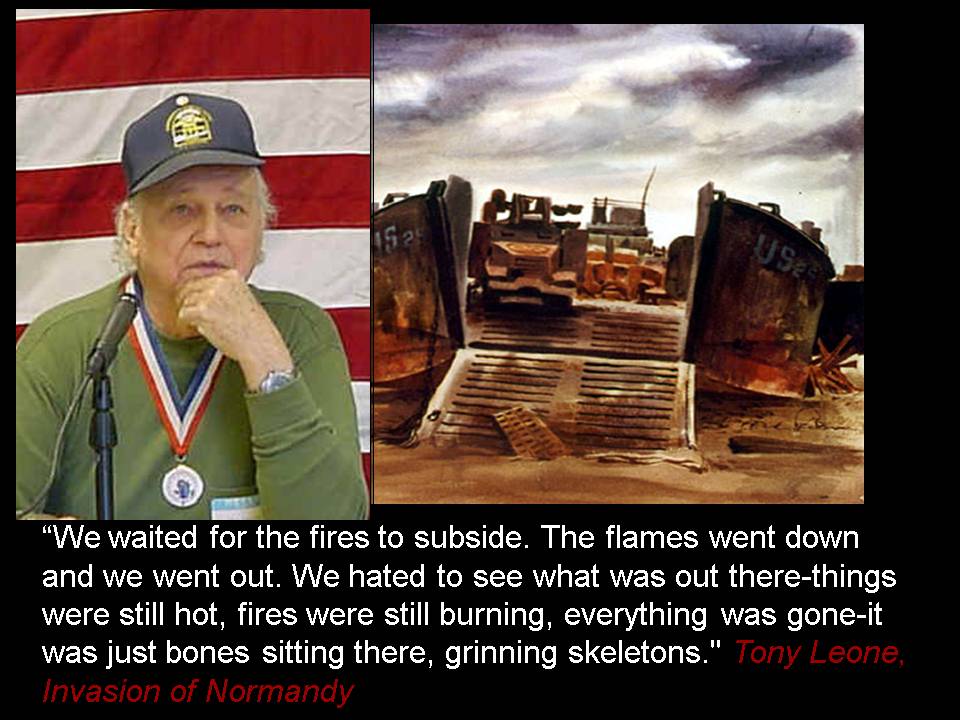
ANTHONY LEONE- INVASION OF NORMANDY


This interview was conducted in 2001 before a student audience with a veteran of the Normandy invasions. It originally appeared on my other website, www.hfcsd.org/ww2.


He sits behind a student desk, wearing a medal presented to him by the French government that he also wears to Mass every Sunday. “I wear it to pay homage to the guys. I made it and they didn’t. It still bothers me.”

He rests on his walking cane and leans forward as he speaks. He is animated-he motions with his hands to emphasize his points. A prolific author and letter writer to the local daily newspaper, Anthony’s mission is to educate the public about what his generation of Americans went through.He doesn’t hold back in his interview. This is how he deals with it, every day…
…I hate snakes, I could feel the snake slithering between my legs. They were firing live ammo over our heads and I said “hey (whistles) you know,” but I endured and they didn’t bother me, the snakes, and I didn’t raise my head, so I’m here to tell you about what happened after that.


I got assigned to USS LST 27.  I said to myself what the heck is a LST. We boarded in Norfolk VA.  I carried my sea bag, along with the rest of the graduates of boot camp, up this long gangway. This was the biggest vessel I had ever seen in my life. If you had it up here on Lake George, it was 327 feet long, imagine that, and 50 foot wide. That’s a big ship.

Matthew Rozell – What does LST stand for?

Anthony Leone – Landing Ship, Tanks.

MR – Landing Ship, Tanks. So what was that  supposed to be for in the  Normandy landings?

AL – What we did is carry small boats. We sent the small boats in first loaded with troops and vital supplies……

MR – Then you turned around and went back?

AL – No. When we were able to, we came in with the LSTs and opened the bow doors and dropped the ramps. But at the time, not even the small boats could get in among the obstacles, there were mines all over the place. They were killing our soldiers, like sheep to the slaughter…

We left Norfolk in March of 1944, and landed in Africa. We had gone through bad air raids by the Germans in the Mediterranean and U-boat attacks and we survived. One ship was hit and set afire, a ship carrying lumber, and incidentally the crews couldn’t get the fire out, it was in the stern of our convoy.  I almost lost my life there, I didn’t tell you this previously, I was the loader on a 20mm AA gun…

MR – What is an AA gun?

AL – Anti-Aircraft Gun, it was a 20mm… it’s obsolete now, but then it was a pretty good gun, it was pretty accurate, made in Sweden. I was about to get another magazine and load, when a bomb landed on the port side, near miss, and it swung our LST over to the starboard. I was going into the dark Mediterranean with a magazine in my hand and I said  “There goes Leone, you’re done.” The aimer grabbed me by the back of my  life-jacket and pulled me back. That was close, that was my first “baptism by fire” right there. I was 18 years old, screaming, hysterical, shaking a fist and if a real German had popped up in front of me on the deck, I would have fainted dead away. I was scared-heroes are heroes, but most are scared.

MR – So that was the airplane attack.

AL – Yes, that was the Luftwaffe, JU-88’s and Dornier torpedo bombers. We succeeded in almost completely obliterating the British anti-aircraft cruiser on our port side. I think some of the guys did it deliberately, some guys didn’t like the British too much.  They knocked the radar off, that’s a story I don’t wish to go into.

We sailed from Africa and reached Africa, with out further incident. We sailed for England. We landed in Swancea, Wales. We got liberty. And we un-loaded an LCT. An LCT is a long wide flat box sort of landing craft where the ramp drops down and the conning tower is in the back and we had one top side. We carried it piggyback. What we did was fill the starboard bilge tanks with water and then chop the cables holding the LCT on, on these greased wooden skits. Severing the cables and the thing would slam into the water with a big splash. We got rid of that thing, there were some heavy seas and we were top heavy. We had no keels to speak of.

MR –  Now is that what would land the men, later on?

AL – Yes, the same ones, matter of fact, that went in there…….. from there we went to Southampton and then Falmouth.  From there we became part of the ‘B’ back up force for the D-Day landings, at the end of May.  We took on units from the 175th Infantry, which belonged to the 29th Division.  Everything was frozen, we couldn’t move…..

MR – Now this is about what date?

AL – This was about the end of May, about a week before D-Day.

MR – So you’re getting ready for the Great invasion.

AL – Yes, we were sealed off, the area was sealed off, we couldn’t go on liberty, we couldn’t visit the British girls, which was quite a sacrifice in those days, they were all over the Yanks.  We were like the invention of sliced bread, they couldn’t get enough of the Yanks.  The Yanks had a lot of money I guess, and they showed the British service men up pretty bad.  Their behavior was abominable….

MR – Whose behavior?

AL – The American troops over there.  The British treated them real good, the Americans were spoiled had a lot of money, and….it’s the same  old story.

They sealed us off, and on the 4th and 5th we were ready to go. We headed toward Piccadilly Circus, that was the name of the circle in the middle of the channel that we were supposed rendezvous at, from there the flotillas would go towards the English beachhead and we would go towards the American beachhead, Omaha and Utah beach.

MR – So you all went out to the sea on the 5th

AL – Yes-it was real stormy.

They called it off and Eisenhower was really blown away by it. They waited, and I guess a British meteorologist saw a break, a window in the weather. Eisenhower had decided to go for it, he had his fingers crossed, he had a letter ready apologizing for the loss of lives and withdraw from the continent in case it failed.  So, we went, the first units moved up from British ports of Southampton, London, Plymouth and Portland. We were the second, the backup force from Falmouth.

By the time we got to the beachhead the next day, it was a mess. This was on June 7th. All you saw was a layer of white smoke on the beach. The Americans had gotten off the beach by late June 6th.

The [US Army] Rangers had gotten in behind the Germans, but we were there, it was still hot, there were still mines all over the place, hedgehogs and stakes driven in the ground with mines sitting on them.  At high tide when you came in you couldn’t see them.  Our LCVPs had to negotiate between them, this was impossible at high tide, you had to wait until the tide was way out, then the soldiers had to walk almost half a mile over bare land, no foliage or anything.

Of course the Germans mowed them down like a wheat field.

,As I said before there were German privates just sitting there with machine guns, just killing Americans and crying as they were doing it “Please go back I don’t want to kill no more” (Repeats this line in German). At one point General Bradley was going to pull them off, take all the people at Omaha Beach and bring them over to Utah. Utah was a pretty successful landing-there, casualties were almost negligible. We came in with the LSTs. We had already launched our LCVPs and brought in supplies and troops.

MR – What’s a ‘LCVP’?

AL – Landing Craft Vehicle Personnel, that is, a Higgins Boat. It was invented by Higgins, a boat builder from the United States. Then it was time for us to come in and unload the tanks.

As we came in, it was pretty hard to negotiate because the mined obstacles were still all over the place and there were pieces of human bodies floating all over.  The American soldiers had the life belts on that you activate and they blow up, they had a CO2 cartridge. What it did was, they had a heavy pack on, and it would up end them and drown them, they couldn’t get loose. We saw a lot of soldiers floating that way. Their life belts worked alright, but it killed them. Their bodies floated to and fro all day long.

We came in and we were moving in. Now up in our conning tower our officers had barricaded themselves behind a pile of mattresses up in the bridge, not that they were “chicken”, they were just being smart about the whole thing, they didn’t want to get hit with shrapnel. We proceeded in.

On Utah Beach on June 19, a big storm stirred up a lot of mines. Now our lookout yelled “Wreckage in the water, dead ahead!” We stopped. Apparently there was an LCT had been hit earlier and it was laying there. Had we gone another 25-30 feet we would have been impaled, practically stuck on the thing-we couldn’t move. We kind of backed up and motioned for the LST in line behind us  to go around. When they did, they went around us, and as they made that move they blew right in half; a mine.

A huge structure like an LST, 327 feet long, welded steel, 50 foot wide, blowing in two. Now the crew aboard it had a motley assortment of pets. They had pigeons, and chickens. What the hell would you have a chicken onboard for?… Chickens and dogs and cats. This was strictly forbidden, but they let them get away with it. We were the “Suicide Navy “, they called us. A very apropos title.

We proceeded to go in after we saw that. We were not too enthusiastic about going in and hitting the beach we said, “If this is happening here, what is going to happen there?..” Even though it was a day later, June 8th,  we started to move in on to Omaha Beach. We were all armed to the teeth.  We had our clothing well impregnated with chemicals to withstand a gas attack, and when your body got out of it, that stuff would drive you crazy. We had that on and we were all ready to go over, life jackets and helmets, I was manning a 20mm and we went, all of a sudden the PA crackled. I heard the damnedest noise, that scared me more than the enemy, really, when it first came on, (singing) “Mares eat oats and does eat oats, and little lambs eat ivy, a kid’ll eat ivy too, wouldn’t you” (stops singing). It was the voice of our skipper, he was dead drunk. (audience laughs)  He was a very solemn looking individual, dark, we couldn’t see him and we called him “The Shadow” at night. When he walked on the bridge all you would see was the glow of his cigarette. He let it burn to his lips and then spit it out, he was fearless. Here is this guy who is fearless and he is singing “Mares eat oats”, I would have chosen a different tune really, but everyone burst out laughing , it was a morale builder in a sense. It told us the captain was human after all and he was just as much afraid as we were.

So we went in and hit the beach, started up the ventilator fans as we had big tubes coming out of the tank deck to suck the exhaust fumes out (and incidentally both their vehicles were burning oil, don’t know why, poor maintenance). They got them going and the trucks were towing (this was the 175th Heavy Tank Company, it was part of the 29th Division) and they started to move out when the brake seized on the 57mm anti-tank cannon carriage they were towing  in the back of the lead truck.  Marion Burroughs, a friend of mine, who was driving it says now,, “God that saved my life, that brake locking up like that, it never happened before in all my years of working with it”… That’s the way things happen you know. He motioned the other truck to go back  around him- it was an army wrecker, used for picking up tanks or wrecked vehicles. It went around and both of the vehicles went out, two I think it was,  and hit a mine just coming  off the ramp.  I still think they went off the tape. They had it taped off where it was safe you know, there were mined and un-mined areas. It blew up and there were bodies all over the place and the trucks were filled with Chesterfield cigarettes and Old Gold, I remember vividly, and Lucky Strike had gone gold, they had taken the green out of the cigarette wrapper to save the cadmium that was green, I think. Cigarettes went all over the place, dummy bazooka shells, the thing was loaded with ammo and gasoline and it went up, a flaming cauldron-  it was like a blast furnace. These poor guys were screaming and they were pinned to the frame and you could see the rubber of the tires all turning to liquid and dripping. Their screams! It seemed like they screamed long after life left their bodies. I still hear them sometimes. If you ever hear a person screaming in agony when they were being burnt…

We went out to see what we could do. I reached down and got a piece of shrapnel through the top of my helmet, cut it open and broke some skin. I didn’t realize it until the thing fell of my head landed on the deck. I went down  to see what I could do to help. You couldn’t get near the thing the fire and the flames were so hot. A couple of individuals did go out and they rescued somebody, and I went out to get another helmet.  I need the another helmet in the worst way. They were all over the place like coconuts. I see one of them, and I went out to get it and zing zing zing!!!!!! The sand, burst of sand right in front of it, some Germans probably anticipated my move and said “well this guy’s not going to get his helmet”.

One of our officers, a deck officer, a little fellow named Surf, went out and dragged somebody back to the ship.  They always made fun of him because of his size, he was puny, he was like another Don Knotts, they all used to pick on him, make him stand on a table because he was Jewish, things like that, that was World War II.  A colored steward would have to stand on the back of the bus, even though he survived a lot of battles, he had to stand on the back of the bus in Norfolk.  This is what World War II was like.

He went out in the surf -he was crazy  and so forth, he got back and I think he got the Silver Star for it. He was ten foot tall in our eyes after that.

There was one medic, he’s a friend of mine now, he was a medic at the time and he belonged to the Foxy 29 medical team. They were a medical team assigned to all the landing ships, like the LSTs, and they were composed of one or two naval doctors and a team of corpsmen.   We had a surgical operating station in the back of the tank section, it was a complete operating room and we operated on the wounded there.  At times we’d go back to eat and we’d set our trays down in the dinning room. They’d operate on the tables there, and our trays would slide in the blood and stick to them.  Talk about appetizing, well you don’t feel much like eating after that.

To get back to the burning trucks, finally someone closed the damn bow door.  So, we lifted the ramp, it takes ages for that thing to come up on chains, we closed the bow. We waited for the fires to subside and the flames went down, and we went out. We hated to see what was still out there. Things were still hot, fires were still burning, everything was gone -it was just bones sitting there grinning skeletons.

We started out low, the fellows of the 175th took off with the trucks and the anti-tank guns. They didn’t cast one eye towards the human barbecue, I call it, that’s what it was. They looked the other way, unbeknownst to them they were heading into a bad battle with the Germans at St. Lo. The [German] 352nd Infantry Division wasn’t supposed to be there, but it was and it hit them.

On June 7th,  we started carrying wounded back, became sort of a hospital ship, because we made many many trips back and forth across the channel. Our tank deck had stretchers, metal things that clipped in and you hung bars and stretchers on. We had a lot of wounded. Among the wounded, we had enemy and our own troops together. We didn’t differentiate when it came to surgery, they were treated the same believe it or not, this is the way the American mentality worked. The Germans probably weren’t that way at the time, but we treated everybody the same. One German boy, couldn’t have been more than 13 or 14, had his arm blown off up to here (points to above the elbow). I was out feeding the prisoners and I came to him and I had a can of creamed chicken, where you heat up the can, I proceeded to take a spoon full and put it in his mouth.  He took it in his mouth and spit it all over me. He was a Nazi, Hitler Youth, only 12 or 13, I think.  About that time I was about to take the .45 out and kill him, I felt like doing it, really.  The fellow next to him, a German prisoner, was my age and my God he looked twice as old and his hair was gray.  He had apparently been through an awful lot.  He was a member of the 352nd Infantry Division out there.  They had been through bombing from the air, they couldn’t come out in daylight -our planes would hit them with rockets, knock out their tanks, and their tanks would have to move by night, couldn’t move during the day.  The German Tiger tanks were notorious for bearings failure, they were awful heavy, even though one lone Tiger tank could knock out ten of our Shermans.  Our Shermans were junk really.

The older fellow, 18 years old, same age as me, looked old enough to be my father at the time. He said “You must forgive him, he lost his parents in Berlin, the American air attacks killed his parents, and his entire regiment was wiped out, he is alone.  Your mortar got him” [makes a crazy lunatic gesture and whistles] that’s the universal sign. Sometimes I worry about him, wonder what happened, he was an enemy.  At the time we hated the Germans, we had the Nazis aboard that slaughtered our GI’s at Malmedy, during at the Battle of the Bulge.  They were under double guard because the crew was all trying to get at them, and kill them .  In fact one of the crew had relatives in the army who were prisoners of the Germans. Real bad feelings.

MR – They don’t know that story, these kids. How many Americans were killed? They surrendered and the Nazi SS killed them. You transported these people back ?

AL – We transported them back to England for trial, boy you want to see them, they were different, they were not typical German prisoners.  They were arrogant.  They were selected for height, blue eyes, blonde hair, and they looked down on us. Yes, the SS, they were bad news. They had the death head symbol, the symbol of a skeleton on their caps.  All night long we had double watch on them.  There were guards, MPs, and guards with machine guns.  The crew was trying to get to them, all night long. I couldn’t sleep, I’ll tell you right now.  I mean a stray bullet, who wants to sleep with something like that going on.

We carried a lot of wounded back and forth.  One of the first casualties we had aboard, was off of the Coast Guard’s LST 16, he was the coxswain of a LCVP, bringing in the soldiers.  They hit a mine, blew both his legs off.  They brought him on our LST and put him on the operating table, he died probably an hour later, he didn’t have a chance.  They brought in a Navy officer, his LCVP got blown sky high.  He didn’t have a scratch on him. That’s what we got all day long. We got British paratroopers, English flyers, American flyers, casualties.  Before we hit the beach they were coming on board.  They were bringing them out to us on Rhinos.  Rhinos were like a pontoon with an outboard motor on it.  They put them on that and they brought them out on LCVPs too.

A lot of the time we couldn’t sleep at all.  All we could hear were the groans of the wounded, the screams of the dying and pain, and the gurgling of the dead.  You noticed that most of all. They have that vacant look in their eyes like they left this world and gone.  I guess the only thing about that is you don’t have the pain anymore.  I was 18 years old, I shouldn’t be there.  It was hell of a waste… quality time, no way.  But I wouldn’t have it any other way because as I pointed out before, Mr. Rozell has a copy of Stud Turkel’s book The Good War and it was a “good” war.  We had our fleet sunk at Pearl Harbor.  What would you do if somebody was coming in your house, grabbing your family?  You have to fight.  It was a good war, we were fighting for a cause.  I fought against my own relatives in Italy.  We had Italian prisoners on board that worked in our galley.  They helped the cook, they saw the ovens on board and went crazy.  They were the enemy and they ran loose.  The Italians were running around, the Germans didn’t like that.  Italians were big lovers not fighters- I know from experience.

We had the dead on the fantail, and I think of the most horrible thing that happened to me, next to the trucks blowing up.  I was on the bow watch, usually the bow watch had good eyes, specially trained for aircraft identification.  I got a call on the intercom from over the phones, that said the guys wanted to see me on the fantail.  “The guy from your home town wants to talk to you…”

Well before we went in and hit the beach, I talked to a second Louie from my home town. He said, “If something ever happens to me, go see my parents.”  I said, “You’re going to be all right, don’t worry about it.”  I got that call and went back and he said, “He’s back on the fantail.”  So, I went back on the fantail, it’s the stern.  It was just starting to get dark and Joe Morganson said, “There’s your dead friend from Utica right there.”  He propped the dead lieutenant up I had talked to and reassured days before. This was the mentality of the time, the sickness.  These guys were sick to do something like that.  They propped him up, pulled the blanket back.  His face was bloodied where the sniper hit him in the head.  It’s the same second lieutenant, his mother and father owned a clothing store in Utica, Kessler, his name was.  About that time I went nuts. I went after those guys, they were running and laughing, it was a joke to them.  This was the kind of mentality contend with.  When you live with people like that it’s not a good time, and you sleep with people like that, and they come back drunk, bragging about their victory with the girls.  I think their brains were where the sun don’t shine.  A lot of violence, one guy went crazy.  We were anchored up in Rouen after D-Day, to bring troops up there.  A guy had been drinking an apple cider made locally in Normandy,  it was very potent drink.  It’d really knock you out if you weren’t used to it.  He had his gut full of it.  I laid there and watched him. I didn’t trust that son of a gun.  All of a sudden his eyes turned red, he was crazy.  He came at me with his knife.  He was slashing at me, jumping on me.  Why me? I don’t know.  He get this left foot right open, right through the shoe. I’ve got a big scar there.  It took about 20 of us to get him down.  You know he got out of the punishment? He tried to kill me, but they probably needed men desperately. I would have shot him, you know, really, because he tried to kill me, pure and simple.  That is what you had to live with everyday. The wounded, the dying, the death, it became a way of life.  That’s bad, that’s bad.  When I got discharged from the service I got a 100 percent disability, I was a basket case.  I had to get some shock treatment, once or twice.  It wiped out my memory.  I have written several books based on my diaries. If I didn’t have my diaries I would never recall the things that had happened.  I have in my possession the declassified deck logs of the ship.  Minute by minute the things that happened.  Some of these officers didn’t have the time to mark everything down, believe me.

The other fellows sent me their diaries. Of course they got a complementary copy of my latest book, because they gave me a part of their lives.  I spent ten years in the VA hospital in out-patient treatment, I’m still going there in Albany.  I would do it all over again, because it was a cause.  A cause celebre, you might say. It’s nothing like what’s going on today.

War itself should be abolished, it should be outlawed.  There can’t conceivably be any winners, no one would want to nuke his world.  It was bad enough to see men die all the time, it’s not a pleasant sight.  I hate to see, right now today, a dog die.  If a dog got hit by a car, I’d die, I’d feel badly.  But to see a human being die and then get used to it and endure yourself and say, this is a way of life, I have to live with it.  That crew became my family for two years, the only home I had…

Read Full Post »

Liberator Carrol Walsh…

Walsh recalls his good friend George C. Gross, with whom he came across the Train Near Magdeburg on Friday, April 13th, 1945. Walsh then recounts the day, and the years afterward,  

 “…the fading memories of the survivors of that event tell you the story of the confluence of  time and place that cast them together forever. It was the morning of Friday April 13 1945,  in a  place called Farseblen…”

Read Full Post »

REMEMBER.

Mary and Clarence.Scene #1: The morning of December 16, 1944. A lonely outpost on the Belgian frontier.

In subzero temperatures, the last German counteroffensive of World War II had begun. Nineteen thousand American lives would be lost in the Battle of the Bulge. “Hell came in like a freight train. I heard an explosion and went back to where my friend was. His legs were blown off-he bled to death in my arms.” The average age of the American “replacement” soldier? 19.

Scene #2: Memorial Day, sixty-plus years later. In a small town in the United States, it is a day off from work or school and it is the unofficial start to the busy summer season. We sit in our lawn chairs, we chat with neighbors and sip our drinks when the gentlemen with the flag march past.children decorate graves.

The holiday known originally as “Decoration Day” originated at the end of the Civil War when a general order was issued designating May 30, 1868, “for the purpose of strewing with flowers or otherwise decorating the graves of comrades who died in defense of their country during the late rebellion.” When Congress passed a law formally recognizing the last Monday in May as the day of national celebration, we effectively got our three-day weekend and our de facto beginning of summer.

Of the sixteen million American men and women who served in WWII, a half million died on the field of conflict. In 2009, over 1000 veterans of World War II quietly slip away every day. The national memory of the war that did more than any other event in the last century to shape the history of the American nation is dying with them. Incredibly, it comes as a shock to many Americans today that the “Battle of the Bulge” didn’t originate as a weight-loss term.

In the high school where I teach, I have been inviting veterans to my classroom to share their experiences with our students. As their numbers dwindled, I smartened up, bought a camera, and began to record their stories. We’ve spoken at length with a pilot forced to bail out at 28,000 feet of his flaming B-17 bomber, only to watch crew members die in the subsequent explosion and then be taken prisoner himself. We have had conversations with POWs who survived forced marches in brutal weather, and with Jewish infantrymen who were among the first to liberate the death camp at Dachau. We have met men who were handcuffed to Nazi war criminals at Nuremberg and who were assigned to suicide watch guard shifts there after fighting their way across Germany. We listen to what it was like to sail eerily into Pearl Harbor 36 hours after the Japanese attack and see no lights except the USS Arizona still blazing with the bodies of hundreds of Americans entombed in it. We are with the torpedo bomber pilot as he takes off from the flight deck of the carrier USS Yorktown during the epic battle of Midway, and is forced to land on the deck of another carrier as the Yorktown burns and later slides to the bottom of the sea. A blind Marine describes what it was like to lose his eyesight nearly sixty years after being struck by mortar fragments, not once, but twice in the same day at Okinawa (and he told us that ” the hardest part was telling my mother”). We ride with the tank commander fighting across Nazi Germany for mind-numbing eighteen hour days, a self-described “fugitive from the law of averages”, as his tank crests a hill to a sudden encounter with a train transport of emaciated and suffering Jewish concentration camp victims. A former 17 year old from our town tells us what it was like to share a shell crater for a sleepless night with a headless fellow Marine in the  black volcanic sand of Iwo Jima. My students and I are just “one person away” from the shock of Pearl Harbor, the chaos at Omaha Beach and the Huertgen Forest, the horrors of Guadalcanal, Tarawa, and Peleliu Island.

Sixty-plus years ago these men and women saved the world.  I think about this: by the time my teaching career ends in 10 or 15 years, almost all of these veterans will be gone.  many of them I have already lost.

It’s not enough that I have an interest in their stories. I have long looked out into a sea of faces, some students mildly interested in what I have to say, but many others displaying a quiet and disturbing apathy about the past. What is infinitely reassuring and comforting to me, however, is that they all seem to have a genuine interest in a “real” connection with the past, with a person who becomes the ultimate source, because he or she was there.

These men and women have helped to spark students’ interest in finding out more about our nation’s past and the role of the individual in shaping it. We have worked to weave the stories of our community’s sacrifices into the fabric of our national history. And that, to me, is what teaching history should be all about. After all, if we allow ourselves to forget about the teenager who bled to death in his buddy’s arms, if we overlook the sacrifices it took to make this nation strong and proud, we may as well forget everything else. Where will we be when there is nothing important about our past to remember? The answer is found in simple study of any other great civilization in history that allowed the collective memory of the past that once bound them together to be trivialized and blurred, to be eroded away and forgotten-

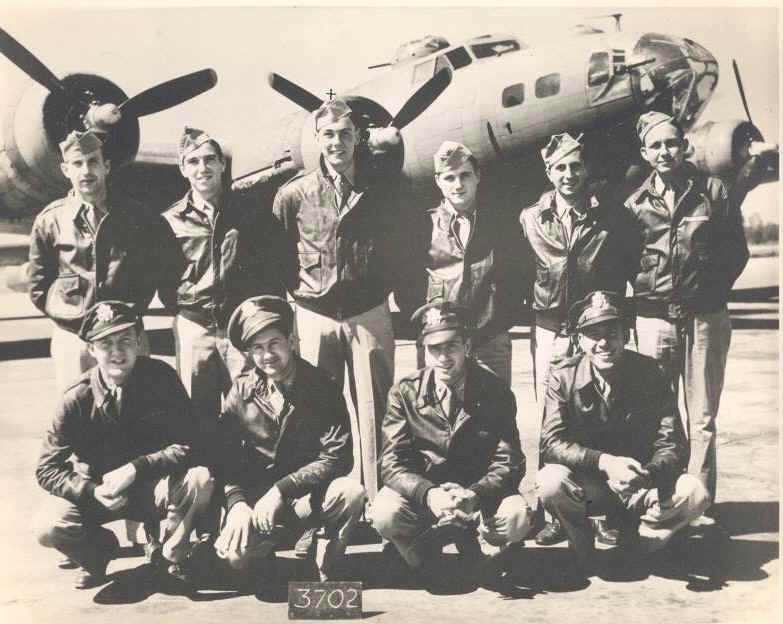
They’re not here anymore.                                                                                  This Memorial Day,clarence. cross over his head. entire crew killed. 7-29-1944.

Remember.

Clarence was my father’s older cousin. He was twenty years old. If you click on the group photograph, he is the tall one in the center with the cross that someone drew over his head. In the first photo, my daughter Mary is at his grave in St. Mary’s Cemetery in Fort Edward, NY, this past weekend. We were decorating graves with my high school students.

Dad remembered Clarence coming home on leave and teasing him in a playful manner- Dad was just a kid. But so was Clarence. He was a gunner in a B-17 crew. He didn’t come back. None of the crew in the photograph did.

They were all killed on July 29, 1944.

POSTSCRIPT: Or so I thought for years. Read about how I found his tailgunner here. 

Read Full Post »

Doing my job, too…

click to enlarge.

Read Full Post »

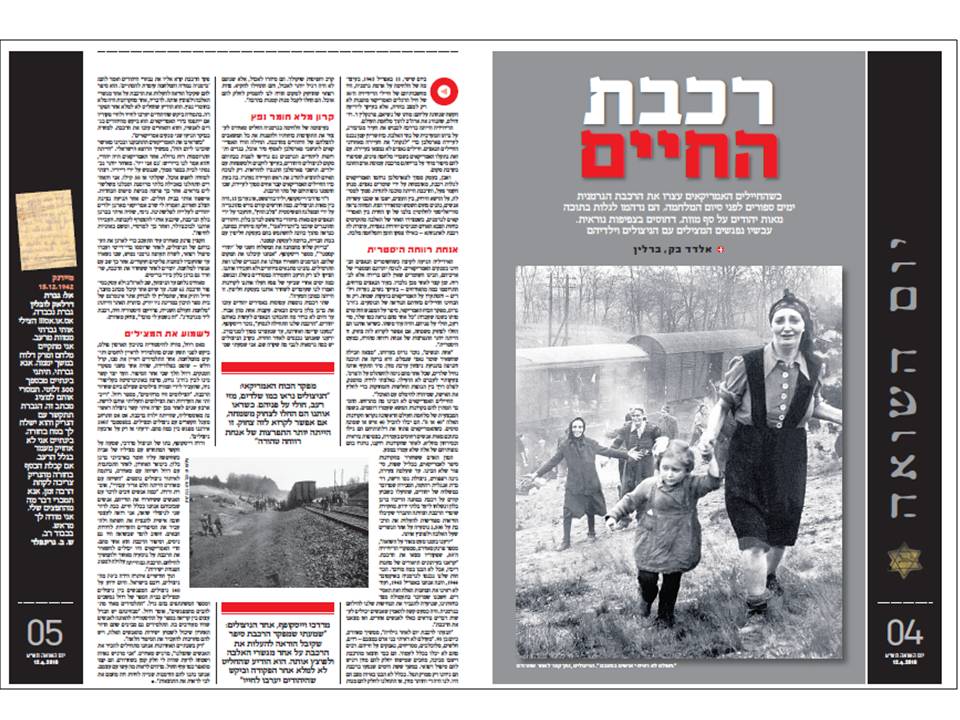
A Train Of Life / Eldad Beck, Berlin

This story ran in the major Israeli daily “Yediot Aharonot”on Holocaust Remembrance Day, April 12th, to a quarter million households.  Thanks to the author for his interest and to Varda W. for contacting him.

Translated from Hebrew by Professor Amiela Globerson, Rehovot, Israel


This story ran in the major Israeli daily “Yediot Aharonot”on Holocaust Remembrance Day, April 12th, to a quarter million households.

On Friday, April 13 1945, at the midst of war on the grounds of Germany, the thoughts of the 30th Division of American soldiers were concerned not only with the situation in the frontier, but rather a the message on the death of their president Franklin Roosevelt who had led the USA in the world war.

The division was on its way to conquer the city Magdeburg, on the western side of the river Elba. A limited artillery troop entered the village of Farsleben, in order to “clean it up” from the last Nazi soldiers. No Nazi soldiers were found there. However, the American soldiers came across prisoners of war from Finland who told them a strange story, namely that they had escaped from a train loaded with people, nearby.

Indeed, in a valley near Farsleben, the Americans were astonished to notice a train guarded by Nazi guards. The locomotive was still active, the train being ready to move. Nearby the railway, on the green loan among the trees, there were several people sitting or lying down – enjoying the sunshine and the fresh air. The view was absolutely surrealistic: in the midst of frontier between the Americans and the Germans, where on one side of the Elba River the Red Army Forces were approaching driving Nazi troops, a train was taking a rest – as if time and war have stopped moving.


The hysterical sigh of relief


The idyll terminated when the Nazi guards noticed the American tanks. In view of the size of their enemy, these guards realized that they had no chance and that should rather escape. They were captured after a short while. While the Nazis were still escaping, there were a few civilians, mainly women, girls and children, who approached the Americans with joyful screaming. Only then did the Americans realize the horrible appearance of the train passengers. George C. Gross, the commander of the American Force, reported last year – just before his death, on that meeting: “Each one of them looked like a skeleton, reflecting the signs of starvation and morbidity on their face. Moreover, when they saw us they burst into laughter of joy, if one can indeed name it ‘laugh’.

It was a burst of pure sigh of relief, almost hysterical”.

“One of the women”, Gross remembered witnessing, “found a package that a Nazi had left while escaping. She checked the package and waved  in victory movement with the food kit. She was immediately surrounded by a shoal of skeletons, each one of them trying to dominate the ‘prize’. My shouting at them did not help. I had to leave the tank, to pave my way among the weak, erased bodies, in order to save that woman, who quickly escaped with food”.

The American soldiers did not understand what was going on. The explanation was waiting for them within the wagons that were staying there silently. In the language of the First World War these wagons (“boxcars”) were designated “40 or 8”, namely, they could accommodate 40 people or 8 horses. When the Americans opened the doors they found inside hundreds of people loaded, standing, stinking horribly. After having evacuated the train, there were the remaining bodies of those who did not manage to survive following that journey.

The many people who were released from the train told the Americans, in a mix of languages, a story that was impossible to understand. Eventually, a young woman, Gina Rappaport, a fluently English speaking survivor from the Warsaw Ghetto, told them that this was an exportation of Jews, loaded on the train a week earlier at the concentration camp of Bergen Belsen, on the way to an unknown destination. Investigating the guards of the train and the personnel, it appeared that they had received clear-cut orders to lead the train with its 2,500 passengers – to one of the bridges on the Elbe River, and to explode it there.

“At that time we knew very little about the holocaust”, says Frank W. Towers, one of the commanders of the 30th division, whose soldiers found the train. “We have read in the newspapers descriptions of concentration camps, but we did not realize what it was all about. Our forces entered Germany on October 1944,and here we were on April 1945, and so far had not seen those camps and the prisoners. We thought that it was all just propaganda, to enhance our determination to fight Germany. It was hard to believe that people can carry out such horrible things to other people. We then found the train”.

Towers nowadays 93 year old, continues, “I arrived at the train on the following day after it was found,  I have never seen people in such conditions – skinny, weak, filthy, stinking, fighting for their life. Many of them could not even stand up. They have already been taken out of the train, sitting around it, anticipating food and medical treatment. During the six days on the train all they have received was tasteless soup. We could not understand the situation in which they were. We had plenty of food, so we provided them our war-servings of food and chocolates. They ate immediately, but their bodies were not used to food anymore, and they started vomiting. The medical personnel called in emergence instructed us to stop serving the food, and the recommended treatment was to provide the food in by far smaller amounts”.

A wagon loaded with explosives


At the midst of the war against Germany, Towers decided to stop the progression of his fighting forces and to direct all the resources towards rescuing the Jews who were in the train. Firstly, the Americans asked the inhabitants of Farsleben to collect food, clothes and medications for the Jews. The Germans were also requested to accommodate survivor Jews in their homes, particularly elderly and families with children. The Farsleben inhabitants objected to these instructions, and complied only upon the threat that unless they obey – the Mayor of the village will be killed. At the same time, the American soldiers prepared a collective grave near the small town, to burry all the dead victims of the train.

Dr. Mordechai Weisskopf, then – a 15 year old boy born in Budapest, was among the survivors. A few months earlier he was deported from Hungary by the “Arrow Cross” fascist party, and then transferred by Nazis to Bergen Belsen, along with hundreds of Budapest Jews. The Hungarian Jews were placed in “zunderlager”, a special site at the camp, probably as based on the intention to use them in an exchange arrangement with the Allies, similarly to the arrangement that went on with Kastner.

“It was all about at the time when the second transport of ‘Kastner’s Jews’” was moved out”, saysWeisskopf. “We were transferred to their place. The Germans allowed us to keep our clothes and personal back-packs. We had the privilege of special conditions, and exempted from the slavery. We suffered from hunger and the torture of standing up in orders in the snow and rain. A few days after the end of Passover we were transferred to a train, claiming that we would be released upon an exchange arrangement. Obviously, this was misleading”.

Two additional trains loaded with Jew prisoners left Bergen Belsen on the following days. One of them disappeared, leaving no traces. Until now, it is not clear what the Nazis intended to do with those Jews. “Our train started moving”, recalls Weisskopf. “We were moving back and forth, until we stopped near Magdeburg. We knew that we were entering the area of the frontier. The survivors had several different versions on what was happening there. I heard that the commander of the train called the representatives of the Jews and told them ‘Germany is lost and the war is about its end’. He told them that he got an order to move the train onto one of the Elba bridges and there to explode it. As he said, one of the wagons was full of explosives. He said that he had decided not to carry out that order, pending on an agreement that the Jews will guarantee his life as well as his soldiers, in case they are captured by the Americans. He asked the Jews to provide him with their civil clothes for himself and his soldiers, and they all left the train. The Americans arrived there on the following morning day, in two tanks”.

“When we saw the Americans we all hugged and cried in joy, happy to have survived and be acquitted that day”, continues the Israeli doctor. “There was the great excitement. One of the Americans was a Jew, and said in Jewish: ‘I am also a Jew”. Later on I entered a house in a nearby village that had been evacuated of its inhabitants. We went straight into the pantry, looking for food. My body weight at that time was 30 Kg. I, as well as the others, started eating with no control, and then suffered from severe diarrheas. Afterwards there was a burst of typhus epidemics. I was hospitalized. One day, a Red Cross representative came in, telling me that an American Rabbi was organizing a group of Jewish children to migrate to Palestine. My brother in-law, being with me in Bergen Belsen and in the train, convinced me to join that group. We were transferred to Buchenwald, from there to Marseille, and then to boats on the way to Haifa”.

The officer Frank W. Towers remained there to organize the transfer of the survivors,

after they were first sprayed with DDT and received medical treatment, and were then transferred to an abandoned German Airport, where they stayed until they were moved to refugee camps. Subsequently, he returned with his people to resume their role in the war. Two days after having rescued the survivors from the train, the British soldiers released also the Bergen Belsen camp.

Towers fought until the victory, returned to the USA and has never engage in the story of the train ever since, for the whole period of 62 years. Then, one day he received a letter from a friend, another veteran soldier, who suggested viewing an internet site of a high school in New York. The name was: ”The second world war, a living history project, a train near Magdeburg”. “It sounds familiar”, Towers responded laughing.

Listening to the rescuers


Matt Rozell, a history teacher at the Hudson Falls High school, asked his students nine years ago, to interview war soldier veterans. One of the students interviewed his grandfather, Carrol Walsh-a judge in Florida, who happened to be one of the two commanders of the American tank. Rozell was move on with that story. The witness referred the teacher to George C. Gross in California, a university lecturer at that time, who delivered to the teacher photographs that he had made on the day when the train was released. “The photographs were amazing”, Rozell says. “I organized the witnessing data along with the photographs and placed them all on the internet site. Four years later, I had the first call from one of the train survivors, in Australia, who was a child on the train. Slowly, the circle of connections with survivors and rescuers has expanded. A meeting of these people was organized on September 2007.  At that time I knew about only four of them”.

VardaWeisskopf, the daughter of Mordechai Weisskopf, learned about the renewing contact with the rescuers of her father while she was searching material about him in the archives of Bergen Belsen. Recently, in January, following correspondence with Rozell and talks with Towers, she took it to locate additional survivors. “Talking with Towers was a mighty shock to me”, says Varda. “How many people are privileged to talk with people who have released their parents, people who thanks to them we live? As a second generation daughter to holocaust survivor, I have the feeling of a personal mission to record the information on the holocaust, and to see to it that it will be passed on to the coming generations. From my point of view, there were also miracles in the holocaust, and the event of the train was one of these. Actually, the Americans could have left behind the train with its passengers, and continue their role of fighting in the war. Moreover, the train could have been target to direct shelling”.

Within two months Varda managed to locate about 70 survivors, most of them in Israel. So far, a total of 140 survivors have been located. The meetings of survivors and rescuers at the High School continue, and the number of participants is increasing. “The students are very enthusiastic about these meetings”, says Rozell “From their point of view there is a tremendous difference between reading a history book and listening directly to people who were involved in the events. The students realize that they are the last generation having the chance of interviewing directly  these people, so they take it as an obligation to see to it that the information will be brought to the coming generations.”.

“Only for the last two years we have started knowing the people whom we have saved”, emphasizes Towers. “I feel proud and happy knowing that I have had a small part in saving them. They have come up from the ashes, like a Phoenix. It is amazing to see what they did with themselves. We have afforded them a second chance to live, and it warms my heart  to see the results”.

Read Full Post »

JACKSONVILLE, Fla./HUDSON FALLS, N.Y. — As World War II came to a close in 1945, a small American tank battalion discovered a train full of Jewish prisoners abandoned in the German countryside. Sixty-five years later, the survivors and liberators were reunited.


At the World War II museum at Camp Blanding, the walls are lined with historical artifacts and articles. “That is my actual uniform,” said Frank Towers.

At 92, Towers volunteers at the museum every week. He shares the stories behind each piece of history, including his own. Towers, a lieutenant at the time, was assigned to the 30th Infantry Division of the United States Army during World War II.

As the war came to a close, the 30th swept through the German countryside, liberating the towns and people held captive by the Nazis.

On April 13, 1945, a tank battalion from the 30th came across the freight train, stopped at the bottom of a hill outside the town of Magdeburg.

“We had never seen any of this torture they were talking about until we came up on this train. Then, of course, we became believers,” said Towers.

Twenty-five hundred Jewish prisoners from the Bergen-Belsen concentration camp were inside the boxcars.

Sick, starved and likely headed to their deaths, twice the number of prisoners were packed into cars, forced to stand on the train for the past six days.

“They were skin and bones. They’d been tortured,” Towers recalls.

During the Holocaust, more than 100,000 Jews died in the Bergen-Belsen Camp alone; a small percentage of the six million who ultimately lost their lives at the hands of the Nazis.

With Allied forces closing in, the Nazis began evacuating Bergen- Belsen to hide evidence of the atrocities committed there. “It was hard to believe anyone would do this to another group of human beings,” Towers said.

As a liaison officer, Towers knew the roads well, and was tasked with transporting the victims. “Out of the battle zone, to safety, food, clothing and shelter,” he said.

The liberators loaded the survivors into trucks and delivered them safely to American military grounds. For Towers, this was just part of the job.

After the war, Frank was assigned to occupation duty in another part of Europe. His wife, Mary, joined him. Later, the couple moved back to the states and eventually settled in Alachua County, outside Gainesville.

Towers didn’t dwell on his war time experiences over the years, he said, though he always felt connected to the people his division helped rescue from the train.

“As one of the [survivors] remarked to me, ‘We were born again. Our life started all over again, for us,'” Towers recalled.

Almost a lifetime later, liberators like Towers are finding out just how much their actions meant.

In late September, a crowd gathered on a high school stage in a small, upstate New York town. A handful of veterans, now close to 90, stood side-by-side with the people they helped save -liberators and survivors united once again.

“It’s a very emotional meeting for all of us.”

This gathering was years in the making. When Hudson Falls High School history teacher Matt Rozell asked his students to interview veterans for a project, the story of the train near Magdeburg was uncovered.

“Each account is absolutely memorable. There’s a common thread through every single one,” Rozell said.

He posted the story on the internet, and survivors – the children and young Jewish people rescued from the train – began contacting him from all over the world, he said.

Carolle Walsh, who lives in Tampa now, was one of the first tank commanders from the 743rd to discover the train.

After a few days’ reunion, he considered the people he helped save to be dear friends.

“It’s sort of become like old friends. Initially coming to the train, how would I ever expect to see anyone who was on the train [again]? At that age and time I would have never considered the fact. So it’s like seeing old friends now,” Walsh said.

They’re grandparents now, Rozell said. “I definitely think there’s a feeling of wanting to know what happened to them.”

Sara Atzmon and her family were part of the Jews of Belgium, rounded up by the Nazis and forced to live in ghettos, then concentration camps.

“I lost 60 persons from my family. Sixty, not 16. My father, my brothers, my grandmother. It’s crazy,” said Atzmon.

She was only 11 when she arrived at Bergen-Belsen. Atzmon remembers being cold all the time. She was given only one child’s shoe; on the other foot she wore a red women’s high-heel.

“We were afraid. Children were not people you explained something to,” she recalled.

For decades, she never knew how to find the words to say thank you to her liberators, her “angels” as she calls them.

“It was an impossible dream,” Steven Barry, who is from Hungary. He was 20 when the Americans freed him from the train.

A member of the Hungarian Army Labor Battalion, he and a comrade were captured as they went underground to escape the Nazis.

His desire to understand his own history led him to Hudson Falls, and Frank Towers. “We kind of hugged, kissed and cried. Because basically, I saw him 65 years ago,” Towers said of the meeting.

Barry agreed.

“Can you imagine an army that landed on D-Day and fought its way through unbelievable conditions, getting shot at and then rescuing 2,500 flea-bitten Jews? I mean if you tell this to somebody, they’ll think you’re lying. It just doesn’t happen. But it did,” he smiled, grasping Towers’ hand in his.

Barry emigrated to the U.S. after World War II, and joined the U.S. Army; he served in the Korean War.

He lives in Boca Raton, Fla., now, and communicates regularly with Towers. The two share a bond not only with each other, but with every Jewish survivor and American liberator on that German hillside in 1945.

“We’ll always be special friends. There’s a bond there that will never be broken. No question about that. It’s something that doesn’t happen every day,” Towers said.

“It’s once in a lifetime, our meeting. It really is,” Barry agreed.

Atzmon and her surviving family members moved to then-Palestine after the war. She joined the Israeli army and got married.

At age 55, she began painting her experiences as a little girl in a Nazi concentration camp.

Today, her work – paintings on giant canvases – hang in galleries all over the world, including a permanent exhibition in Germany.

She travels often, speaking to school-aged children about the Holocaust. “I am very grateful. [The liberators] saved our life. They give life for my family and all people,” she said.

Over the years, Hudson Falls High School students and faculty have recorded more than 100 interviews with veterans and survivors.

The purpose of the project is to preserve the stories and pass them on to future generations, so the Holocaust and the people affected by it are never forgotten.

When Towers returned to Northeast Florida from New York, he received a message from Tampa resident Alex Kopfur. He had seen a television clip of the Hudson Falls reunion and contacted Towers to see if they could meet.

A week later, Kopfur arrived at the Camp Blanding museum with questions. “How many cars were on the train?” he asked Towers, handing him pictures of his mother and father.

“I really don’t know,” Towers replied, showing Alex a registry of camp prisoners.

Kopfur doesn’t remember much about the train; he was only a small Polish child when he and his parents were rescued.

He is thankful to have had the opportunity to meet just one of his liberators.

“I’ve had many arguments with people about why the United States should be overseas. I always say I remember being rescued by American troops overseas, so I can not argue against that,” Kopfur said.

He is one of several who have contacted Towers in the past few months.

“Anything that brings people together like this enriches my life. I feel good about it. To meet Alex, Sara, Fred, and the others… Carolle Walsh, Mr. Barry,” Towers recalled.

On the 65th anniversary of the end of the Holocaust, the liberators and survivors continue to make connections.

“The words are too small to say them. What can I tell them? That they give us life? The future? This is the future,” Atzmon said.

In March, several traveled to Nashville for another reunion hosted by the 30th Infantry Division.

Earlier this month, Matt Rozell joined a group of survivors in Washington, D.C., for the National Holocaust Days of Remembrance Ceremony.

While his friends were at the Capitol, Frank Towers returned to Normandy, France, once again to speak to a group of citizens about the rescue of the people.

Read Full Post »

{As part of the conclusion to my USHMM Teacher Fellowship project, I  am posting the unfolding nature of the discovery of the camps as Allied troops closed in from the East and the West, sixty-five years to the day that the discovery/event occurred.}

April 15, 1945: Soviet forces are 35 miles east of Berlin and 60 miles east of Dresden, Germany. British troops close on Bremen and Hamburg, Germany.

April 15, 1945: At Ravensbrück and Sachsenhausen, Germany, 57,000 inmates–17,000 of them women–are marched westward by the SS. Once under way, many will be shot and/or die of exhaustion, and others, including 21-year-old Mila Racine, will be killed during Allied bomb attacks aimed at nearby targets.

April 15-17, 1945: A small contingent of British troops at the Bergen-Belsen, Germany, camp is unable to prevent Hungarian SS guards from murdering 72 Jewish and 11 non-Jewish prisoners.

April 16, 1945: The Red Army launches its final assault on Berlin.

April 18, 1945: Nazis initiate a death march of prisoners from Schwarzheide, Germany, to Theresienstadt, Czechoslovakia.

April 19, 1945: Leipzig, Germany, is captured by American forces.

Weber, Louis. The Holocaust Chronicle. Publications International Ltd., 2007. http://www.holocaustchronicle.org

Read Full Post »

World War II Soldiers Who Liberated Nazi Death Camps Meet at Holocaust Museum

Jerome Socolovsky | Washington16 April 2010

Matthew Rozell and survivor Steve Barry honored before 121 liberators in Washington, DC just before Rotunda ceremony on April 16th.

More than 100 former U.S. soldiers who liberated Nazi death camps during World War II were honored this week in Washington, D.C. The veterans recalled the horrors they witnessed 65 years ago when they encountered the victims of the Holocaust.

The flags of their wartime divisions lined the U.S. Capitol rotunda for the ceremony to honor the old soldiers. And Army General David Petraeus paid them a tribute. “Just as the horrors of the death camps will never be forgotten, neither will your courage, selflessness, or compassion,” he said.

These men, known as “The Liberators”, were among the first witnesses of one of the greatest horrors of the 20th century, the concentration camps where six million Jews were systematically slaughtered.

Much of what they did is commemorated at the U.S. Holocaust Memorial Museum in Washington. They toured the museum before the ceremony.

One of the liberators, George Sherman, 84, was a young Jewish soldier at the time of the war, fighting in the U.S. Army’s 11th Armored Division. In early May 1945, his squadron [???] left Linz in Austria on its way east to join forces with the Russians.

But as Sherman’s reconnaissance unit left the city, they caught wind of something terrible. “Within a kilometer or two of leaving we started to smell an odor which we couldn’t identify which was really strong.” So he and his buddies followed the stench and found stockades with barbed wire and prisoners wandering all over the place.

“Inside the gates there were just piles of bodies stacked up and mainly people coming out of what turned out to be their barracks, in the worst physical conditions, skeletons, a lot of the things they were wearing were just rags,” Sherman said.

The soldiers of his division were welcomed as heroes at the Mauthausen concentration camp.

Sherman’s wife Marcia accompanied him on the museum tour. She says it brought back memories he’s never talked about before.

“The ovens were still hot, because the Germans, they’re methodical,” Sherman said. “Right up to the last minute. You’d think they would try to get away and whatnot. No, right up to the last minute they were trying to kill as many as they could kill.”

What angers Sherman now is when people try to deny the Holocaust.

“How they can in the face of all the evidence, that has been carefully documented and authenticated, how they can deny this? It’s unbelievable,” he said.

The Holocaust museum documents the genocide and the testimony of the aging survivors.

One of them is Steve Barry, now 85 years old. He was on a train crammed with prisoners and still remembers the day he saw his American liberators.

“I don’t think the word has been invented yet, of how I felt,” Barry said.

He said he owes those liberators his life. But one he met disagreed.

“And he said, ‘You know, you don’t owe me or us anything. This whole world owes you everything, because what they took away from you, no one can give back to you anymore.'”

But the liberators did get something here in Washington. Gen. Petreaus honored each with a medal.

When Petraeus saw Sherman and his wartime buddies, he walked up to them and said, “Did you get a coin? Ok, you’re good to go!”

The aging vets posed for a photo with general at the Holocaust museum, where the flags of their old divisions hang permanently above the entrance hall. The men stood proud, once more, for what they fought for 65 years ago.

Read Full Post »

This morning, a live broadcast from the Rotunda where we honor the sacrifice of soldiers who, 65 years ago, liberated Jews and other victims from Nazi terror. What they did mattered then, and what we do matters now. Peter Fredlake, USHMM.

http://www.ushmm.org/remembrance/dor/webcast/

The United States Congress established the Days of Remembrance as the nation’s annual commemoration of the Holocaust and created the United States Holocaust Memorial Museum as a permanent living memorial to the victims. This year, Holocaust Remembrance Day is Sunday, April 11, 2010. In commemoration of the 65th anniversary of the liberation of Nazi concentration camps, the Museum has designated Stories of Freedom: What You Do Matters as the theme for the 2010 observance.

Inmates waving a homemade American flag greet 7th Army troops upon their arrival at the Allach concentration camp, a subcamp of Dachau, April 30, 1945.

Inmates waving a homemade American flag greet 7th Army troops upon their arrival at the Allach concentration camp, a subcamp of Dachau, April 30, 1945. USHMM, National Archives and Records Administration, College Park, MD

As Allied soldiers were closing in on Germany in the spring of 1945, they encountered dozens of concentration camps and were suddenly confronted with the reality of Nazi atrocities. The few surviving victims fully experienced the depths of human evil and depravity. For the soldiers, however, even the brutality of war did not prepare them for what they encountered.

Upon seeing Buchenwald, a member of the 333rd Engineers Regiment stated, “My feeling was that this was the most shattering experience of my life.” A U.S. Army chaplain trying to make sense of the carnage wrote to his wife, “This was a hell on earth if there ever was one.” After photographing Buchenwald, Margaret Bourke-White wrote to her editor at Life magazine, “The sights I have just seen are so unbelievable that I don’t think I will believe them myself until I’ve seen the photographs.” One American journalist wrote, “Buchenwald is beyond all comprehension. You just can’t understand it, even when you’ve seen it.”

And that was the problem. Survivors and other eyewitnesses understood and believed. But would the world? General Dwight D. Eisenhower grasped this problem and, after visiting a subcamp of Buchenwald, he addressed his staff: “I want every American unit not actually in the front lines to see this place. We are told the American soldier does not know what he is fighting for. Now, at least he will know what he is fighting against.”

Eisenhower not only understood that this was a war that at its very essence was a struggle for the freedom of peoples and the ideals on which civilization is based but also that the horror was so extreme that it might not be believed. Realizing that a failure to believe would be a danger for the future of mankind, he ordered other soldiers to visit the camps, and encouraged journalists and members of Congress and the British Parliament to bear witness as well. He wanted others to be, just as he was, “in a position to give first-hand evidence of these things if ever, in the future, there develops a tendency to charge these allegations merely to ‘propaganda.’” And ultimately he was right.

Sixty-four years later, standing at Buchenwald with Elie Wiesel by his side, President Barack Obama acknowledged the value of bearing witness: “We are here today because this work is not finished. To this day, there are those who insist that the Holocaust never happened—a denial of fact and truth that is baseless and ignorant and hateful. This place is the ultimate rebuke to such thoughts, a reminder of our duty to confront those who would tell lies about our history.”

President Obama referred to the Holocaust as “our history,” understanding that Holocaust memory belongs to all of humanity. Because unlike the battle-hardened soldiers who liberated the camps and brought freedom to Europe, we now know that the unthinkable is thinkable. We know all too well the human capacity for evil and the catastrophic consequences of indifference in the face of evil. And we now realize that to preserve human freedom, what we do matters. Every day each of us has the potential to shape the world in which we live. By keeping these stories of freedom alive and building on Elie Wiesel’s original hope, each of us must work to promote human dignity and confront hate whenever and wherever it occurs. As the American soldiers who unwittingly became liberators 65 years ago understood, our future depends on it. -USHMM

Read Full Post »

It is April 13th, the 65th anniversary of the liberation. In the past two days I have heard from a half-dozen “new” survivors. My wife Laura and I are headed to Washington DC to take part in the National Days of Remembrance ceremonies. You can click here for the link to our film (“Honoring Liberation” at page bottom) and more information on the ceremony.

UPDATE: 4-14: At the U.S. Holocaust Memorial Museum yesterday, my wife and I had the honor of being addressed, along with 120 liberators, survivors and donors, by Assistant Secretary of State Michael Posner on the human right issues facing our nation and the world today.

The United States Congress established our Days of Remembrance (April 11-18) as our nation’s annual commemoration of the Holocaust. Hudson Falls High School is the ONLY high school in the nation represented at it.

Tonight we will have dinner with the Attorney General of the United States, Eric Holder. On Thursday morning, Hudson Falls High School will be honored at a special breakfast honoring liberators. Following that, special ticket holders(me, etc) will be allowed into the US Capitol Rotunda for the climatic event of the Days of Remembrance. The keynote speaker will be General David Petraeus. I will be there representing our school.

If you go to this website, you can see details about how to tune in.

http://www.ushmm.org/remembrance/dor/
And read below the moving narrative of Dr. George C. Gross, his remembrance of the liberation day, written 9 years ago, before he was aware of any of the survivors. He got to know quite a few before he passed on Feb. 1, 2009. Greetings to all the survivors on the day of your rebirth, and to the soldiers who, in “just doing our jobs”, saved the world.

A Train Near Magdeburg

{As part of the conclusion to my USHMM Teacher Fellowship project, I  am posting the unfolding nature of the discovery of the camps as Allied troops closed in from the East and the West, sixty-five years to the day that the discovery/event occurred.}

Foreword:

Excerpt from Wayne Robinson, Move out Verify: the Combat Story of the 743rd Tank Battalion (Germany, no publisher, 1945), 162-63:

There was another sidelight to the death of fascism in Europe.  Only a few of the battalion saw it.  Those who did will never forget it.

A few miles northwest of Magdeburg there was a railroad siding in wooded ravine not far from the Elbe River. Major Clarence Benjamin in a jeep was leading a small task force of two light tanks from Dog Company on a routine job of patrolling. The unit came upon some 200 shabby looking civilians by the side of the road.  There was something immediately apparent about each one of these people, men and women, which arrested the attention. Each one of them was skeleton thin with starvation, a sickness in their faces and the way in which they stood-and there was something else.  At the sight of Americans they began laughing in joy-if it could be called laughing.  It was an outpouring of pure, near-hysterical relief.

The tankers soon found out why.  The reason was found at the railroad siding.

There they came upon a long string of grimy, ancient boxcars standing silent on the tracks.  In the banks by the tracks, as if to get some pitiful comfort from the thin April sun, a multitude of people of all shades of misery spread themselves in a sorry, despairing tableaux  [sic]. As the American uniforms were sighted, a great stir went through this strange camp. Many rushed toward the Major’s jeep and the two light tanks.

Bit by bit, as the Major found some who spoke English, the story came out.

This had been-and was-a horror train.  In these freight cars had been shipped 2500 people, jam-packed in like sardines, and they were people that had two things in common, one with the other:  They were prisoners of the German State and they were Jews.

These 2500 wretched people, starved, beaten, ill, some dying, were political prisoners who had until a few days before been held at concentration camp near Hanover.  When the Allied armies smashed through beyond the Rhine and began slicing into central Germany, the tragic2500 had been loaded into old railroad cars-as many as 68 in one filthy boxcar-and brought in a torturous journey to this railroad siding by the Elbe.  They were to be taken still deeper into Germany beyond the Elbe when German trainmen got into an argument about the route and the cars had been shunted onto the siding.  Here the tide of the Ninth Army’s rush had found them.

They found it hard to believe they were in friendly hands once more: they were fearful that the Germans would return.  They had been guarded by a large force of SS troopers, most of whom had disappeared in the night. Major Benjamin, knowing there were many German Army stragglers still in the area, left one of the light tanks there with its accompanying doughboys as a protective guard.  The Major then returned to Division headquarters to report the plight of these people.

For 24 hours, the crew of the tank remained on watch as their charges streamed about the vehicle, crying and laughing their thanks of rescue, and those who could told stories of slavery, oppression, torture, imprisonment, and death.  To hear their stories, to see before them the results of inhuman treatment lifted still another corner of the cover which, on being removed, exposed the full cruel spirit of Nazism which permitted such things to be. And this was but one of the many such stories being brought to light as Allied soldiers ripped into the secrets of Adolph Hitler’s Third Reich.

The train needed some badly needed food that night.  More, the promise of plentiful food the next day was given to them.  The commanding officer of the 823rd Tank Destroyer Battalion was seeing to it that such food would be available.  He had ordered German farmers of the surrounding towns to stay up all night, if necessary, to get food to these people.  Other Americans concerned themselves with locating living quarters to get the concentration camp victims away from the evil-smelling freight cars before more of them died and were covered by a blanket or just left lying in their last sleep beside the railroad tracks.

Sgt. George Gross (relayed to Matthew Rozell, March, 2002):

On Friday, April 13, 1945, I was commanding a light tank in a column of the 743rd Tank Battalion and the 30th Infantry Division, moving south near the Elbe River toward Magdeburg, Germany. After three weeks of non-stop advancing with the 30th from the Rhine to the Elbe as we alternated spearhead and mop-up duties with the 2nd Armored Division, we were worn out and in a somber mood because, although we knew the fighting was at last almost over, a pall had been cast upon our victories by the news of the death of President Franklin D. Roosevelt.  I had no inkling of the further grim news that morning would bring. Suddenly, I was pulled out of the column, along with my buddy Sergeant Carrol Walsh in his light tank, to accompany Major Clarence L. Benjamin of the 743rd in a scouting foray to the east of our route.  Major Benjamin had come upon some emaciated Finnish soldiers who had escaped from a train full of starving prisoners a short distance away. The major led our two tanks, each carrying several infantrymen from the 30th Infantry Division on its deck, down a narrow road until we came to a valley with a small train station at its head and a motley assemblage of passenger compartment cars and boxcars pulled onto a siding.  There was a mass of people sitting or lying listlessly about, unaware as yet of our presence. There must have been guards, but they evidently ran away before or as we arrived, for I remember no firefight.  Our taking of the train, therefore, was no great heroic action but a small police operation.  The heroism that day was all with the prisoners on the train.

Major Benjamin took a powerful picture just as a few of the people became aware that they had been rescued.  It shows people in the background still lying about, trying to soak up a bit of energy from the sun, while in the foreground a woman has her arms flung wide and a great look of surprise and joy on her face as she rushes toward us.  In a moment, that woman found a pack left by a fleeing German soldier, rummaged through it, and held up triumphantly a tin of rations.  She was immediately attacked by a swarm of skeletal figures, each intent upon capturing that prize. My yelling did no good, so that I finally had to leap from my tank and wade through weak and emaciated bodies to pull the attackers off the woman, who ran quickly away with her prize.  I felt like a bully, pushing around such weak and starving fellow humans, but it was necessary to save the woman from great harm.  The incident drove home to me the terrible plight of the newly freed inhabitants of the train.

I pulled my tank up beside the small station house at the head of the train and kept it there as a sign that the train was under American protection now.  Carroll Walsh’s tank was soon sent back to the battalion, and I do not remember how long the infantrymen stayed with us, though it was a comfort to have them for a while. My recollection is that my tank was alone for the afternoon and night of the 13th.  A number of things happened fairly quickly.  We were told that the commander of the 823rd Tank Destroyer battalion had ordered all the burgermeisters of nearby towns to prepare food and get it to the train promptly, and were assured that Military Government would take care of the refugees the following day. So we were left to hunker down and protect the starving people, commiserating with if not relieving their dire condition.

I believe that the ranking officer of the Finnish prisoners introduced himself to me and offered to set up a perimeter guard. I think I approved and asked him to organize a guard, set out pickets, and handle the maintenance and relief of the outposts. However it happened, the guard was set up swiftly and efficiently. It was moving and inspiring to see how smartly those emaciated soldiers returned to their military duties, almost joyful at the thought of taking orders and protecting others again.  They were armed only with sticks and a few weapons discarded by the fleeing German guards, but they made a formidable force, and they obviously knew their duties, so that I could relax and talk to the people. A young woman named Gina Rappaport came up and offered to be my interpreter. She spoke English very well and was evidently conversant with several other languages besides her native Polish.  We stood in front of the tank as along line of men, women, and little children formed itself spontaneously, with great dignity and no confusion, to greet us.  It is a time I cannot forget, for it was terribly moving to see the courtesy with which they treated each other, and the importance they seemed to place on reasserting their individuality in some seemingly official way.  Each would stand at a position of rigid attention, held with some difficulty, and introduce himself or herself by what grew to be a sort of formula:  the full name, followed by “a Polish Jew from Hungary”-or a similar phrase which gave both the origin and the home from which the person had been seized.  Then each would shake hands in a solemn and dignified assertion of individual worth. Battle-hardened veterans learn to contain their emotions, but it was difficult then, and I cry now to think about it. What stamina and regenerative spirit those brave people showed!

Also tremendously moving were their smiles.  I have one picture of several girls, specter-thin, hollow-cheeked, with enormous eyes that had seen much evil and terror, and yet with smiles to break one’s heart.  Little children came around with shy smiles, and mothers with proud smiles happily pushed them forward to get their pictures taken.  I walked up and down the train seeing some lying in pain or lack of energy, and some sitting and making hopeful plans for a future that suddenly seemed possible again. Others followed everywhere I went, not intruding but just wanting to be close to a representative of the forces that had freed them.  How sad it was that we had no food to give immediately, and no medical help, for during my short stay with the train sixteen or more bodies were carried up the hillside to await burial, brave hearts having lost the fight against starvation before we could help them.

The boxcars were generally in very bad condition from having been the living quarters of far too many people, and the passenger compartments showed the same signs of overcrowding and unsanitary conditions.  But the people were not dirty.  Their clothes were old and often ragged, but they were generally clean, and the people themselves had obviously taken great pains to look their best as they presented themselves to us.  I was told that many had taken advantage of the cold stream that flowed through the lower part of the valley to wash themselves and their clothing.  Once again I was impressed by the indomitable spirits of these courageous people.

I spent part of the afternoon listening to the story of Gina Rappaport, who had served so well as interpreter.  She was in the Warsaw ghetto for several years as the Nazis gradually emptied the ghetto to fill the death camps, until her turn finally came.  She was taken to Bergen-Belsen, where the horrible conditions she described matched those official accounts I later heard.  She and some 2500 others, Jews from all over Europe, Finnish prisoners of war, and others who had earned the enmity of Nazidom, were forced onto the train and taken on a back-and-forth journey across Germany, as their torturers tried to get them to a camp where they could be eliminated before Russians on one side or Americans on the other caught up with them. Since the prisoners had little food, many died on the purposeless journey, and they had felt no cause for hope when they were shunted into this little unimportant valley siding.  Gina told her story well, but I have never been able to write it.  I received a letter from her months later, when I was home in San Diego.   I answered it but did not hear from her again.  Her brief letter came from Paris, and she had great hopes for the future.  I trust her dreams were realized.

We were relieved the next morning, started up the tank, waved good-bye to our new friends, and followed a guiding jeep down the road to rejoin our battalion.  I looked back and saw a lonely Gina Rappaport standing in front of a line of people waving us good fortune.  On an impulse I cannot explain, I stopped the tank, ran back, hugged Gina, and kissed her on the forehead in a gesture I intended as one asking forgiveness for man’s terrible cruelty and wishing her and all the people a healthy and happy future. I pray they have had it.

George C. Gross

Spring Valley, California

June 3, 2001

click here for the ANNOTATED PHOTOGRAPHS

LISTEN to Carrol Walsh and George Gross share their recollections of the liberation of “A Train Near Magdeburg” (9:32)

Read Full Post »

« Newer Posts - Older Posts »