Feeds:
Posts
Comments

Archive for the ‘Uncategorized’ Category

2 DVD Set.

In 2001, as part of a class project collecting the testimony of World War II veterans, Mr. Matthew Rozell, a teacher at Hudson Falls High School in a small town in upstate New York, interviewed a tank commander, the grandfather of one of his students, who mentioned one day in combat in April, 1945 in which he and another tank commander were ordered to go and investigate a train full of civilians that they stumbled across during the final battles of the war in Nazi Germany.  His curiosity heightened, Mr. Rozell began to dig deeper into what had really unfolded on that day. This long forgotten event was about to spring to life; the result of this teacher’s work has made a profound impact on thousands of lives all over the world.

Rescuing the evidence of the Holocaust and of World War IIand honoring the history all of the veterans and survivors  is Rozell’s mission. “There are so many lessons here – lessons of self-sacrifice and duty. This war brought out the worst in people and it brought out the best of people,” says Rozell. “When you look at this mini snapshot of time, you see it all. In the end, good triumphs over evil.”

In April 2010, as a U.S. Holocaust Memorial Museum Teacher Fellow, Mr. Rozell was  invited to witness the nation’s Days of Remembrance ceremonies held in the U.S. Capitol Rotunda, honoring the liberators of the camps. He was also named as the 2009 Daughters of the American Revolution Outstanding Teacher of American History for New York State, and on the national level, chosen as the 2010 Organization of American Historians Tachau Teacher of the Year in Washington, DC. To date, he has organized five reunions and was also  honored on September 25th, 2009 as the ABC World News Person of the Week for his efforts to keep history alive (“Teacher takes students on a journey of humanity”). He has taught history at his alma mater for over two decades.

The 2 DVD set celebrates the American soldiers and the Holocaust survivors whose lives were saved by this chance encounter. Soldiers from all over the nation and survivors from all over the world have come together to offer testimony and meet each other, in many instances, for the first time since liberation day on April 13th, 1945.

The program is no longer available.


  • “Today I saw a sight that is impossible to describe…I’ll never forget today….”-letter home from Charles Kincaid, 30th Infantry Division, US 9th Army
  • “Carrol and I were again side by side as we came up to the train with Major Benjamin, chased the remaining German guards away, and declared the train and its captives free members of society under the protection of the United States Army, as represented by two light tanks….” George C. Gross, 743rd Tank Battalion, US 9th Army
  • “How could we [the world] have stood by and let that happen to them?  We owe them.”   Carrol Walsh, 743rd Tank Battalion, US 9th Army
  • “I often wonder what this world would be like if those six million had never perished.”  Frank Towers, 30th Infantry Division, US 9th Army
  • “I got out of this train and I saw the greenery and the wild flowers. It was wonderful because suddenly I was seeing things in color. Everything that I’d remembered about the camp was black and white…” Elisabeth Seaman,  Survivor
  • “Against all odds I am standing here before you.”  Steven Barry, Survivor
  • “Hatred is something we must fight against…silence helps the oppressors. I tell my story so that it won’t become your future…”   Leslie Meisels,  Survivor
  • “We cannot be lax at all.  We must keep the faith.  We must tell others.”  Buster Simmons, 30th Infantry Division, US 9th Army
  •  “I’m listed as a liberator, but I’m a survivor of WWII… We must ever be thankful.  We must never take freedom for granted.”   William Gast, 743rd Tank Battalion, US 9th Army
  •  “After they gave us back our lives, we need to live each day.”  Paul Arato, Survivor
  • “You have the power to heal the world.”  Lev Raphael, son of Holocaust survivors
  • ” The smell of cordite… that is one of the things you remember…” Francis Currey, MOH, 30th Infantry Division, US 9th Army
  • ” The day my father was liberated from the POW camp, he left hating behind and began living.” Robert Miller, son of 30th Infantry Division soldier
  • “The Germans didn’t get a chance to kill us, because  you, the American angels, came on time.” Ariela Rojek,  Survivor
  • “We were kids-kids are the future-people were starving to death-but {the adults} made sure that the kids ate…” Micha Tomkiewicz, Survivor 
  • “During the war, the majority… did not care. Even if a neighbor was taken away, it did not mean a damn thing…” Fred Spiegel,  Survivor
  • “Love gives us wings to soar above it all.”  Sara Atzmon, Survivor

Program Notes: “Americans came to Liberate, Not Conquer”

Americans Soldiers/Holocaust Survivors Reunion

Disc One: The American Soldier Liberators (124 minutes)

Introduction by  Mr. Rene Roberge, Hudson Falls High School

Film, Honoring Liberation, USHMM (April 2010)/ABC World News Persons of the Week (9-25-09)

Reading: A Letter to the Chaplain: A Liberator’s 1945 Eyewitness Account of the Farsleben Train

Tribute to Liberator/Photographer George C. Gross, 743rd Tank Battalion

Speakers:

Tim Gross, son of liberator George C. Gross

Carrol Walsh, 743rd Tank Battalion

Frank Towers, 30th Infantry Division

Francis Currey, Recipient, Medal of Honor, 30th Infantry Division

Buster Simmons, 30th Infantry Division

William Gast, 743rd Tank Battalion

Robert Miller, author, Finding My Father’s War (son of 30th ID member)

Disc Two: The Holocaust Survivors (144 minutes)

Albany New York Television News Coverage

Speakers: Survivors-

Sara Atzmon (Hungary; Israel)

Fred Spiegel (Germany; Howell, NJ)

Ariela Rojek (Poland; Toronto, Canada)

Leslie Meisels (Hungary; Toronto, Canada)

Paul Arato (Hungary; Toronto, Canada)

Elisabeth Seaman (Netherlands; Palo Alto, California)

Micha Tomkiewicz (Poland; Brooklyn, New York)

Lev Raphael: (son of train survivor) Author, My Germany- “Revisiting Germany”

Speaker: Survivor Steven Barry (Hungary; Boca Raton, Fla.)

Film, A Special Reunion

Student Performance, Miss Kylie James, Hudson Falls Class of 2010 “This Is For Remembrance”

Speaker: Teacher Organizer Matthew Rozell

Supplemental Material: Guidelines for Teaching the Holocaust, USHMM Museum Teacher Fellowship Outreach Project, Matthew Rozell and Sara Kollbaum, 2008

Read Full Post »

Just returned from a three day conference.

As Holocaust educators, we talk about the choices that individuals face and the patterns that one may follow in making one’s choice. The trend seems to be to focus on the role of the “perpetrator” and “bystander”  in the greatest crime in the history of the world, to examine the nuances of their behavior, to perhaps gain insight into why the Holocaust occurred. Yes. Very, very,  important.

But how about including in our discussion the actions and behaviors of the soldiers who ended the Holocaust? They faced a choice, too. They had seen their friends vaporized in front of their eyes, they were weary, and tired of being shot at, and utterly exhausted. They were twenty fours hours away from another major showdown at a “last stand” city. Many of the soldiers would not survive, though the end of the war was in sight.

But they stopped, even as the enemy was digging in behind the battlelines.

Horrified and in shock, they sprang into action. One 4 year old survivor remembers that it was the “first time in my life that I can recall an adult with a smile”. If someone were to argue that the world owes these soldiers a debt, I don’t think too many people would find that problematic.

If you have not viewed the news clips (about 3 minutes each), I welcome you to do so.  In doing so, however,  you are forewarned that there is  someone who vehemently disagrees with that argument. He even shakes his finger.

And what does that say about the soldiers in this story? We need to dissect the behavior of the collaborators and those who are complicit in the crime. But what is it about the decisions made  and actions taken by these soldiers that is important to study? Of course this is worthy of our consideration, and as I struggle with my own role  in  the future of Holocaust education, I don’t think it should be overlooked or worse, “sidebarred” in the larger narrative of choices, patterns of behavior, and decision making.

Remember, the permanent exhibition at the USHMM even opens with visitors listening to the narrative of one of these soldiers on the elevator ride up to the 4th floor.  Why? It is more than that soldier just becoming  the “set-up guy” for the shock that greets one when the elevator doors open. We need to really explore that further.

Frank Towers, a World War II veteran who helped liberate 2,500 Jews on a train bound for a Nazi concentration camp, meets Bruria Falik of Woodstock, who was on the train, at Arbor Ridge at Brookmeade in Rhinebeck. (Photos by Karl Rabe/Poughkeepsie Journal)

Thank you for allowing me the opportunity to have you consider this, with the video  interviews, as well. And to the folks who might have thought otherwise, it’s not about me, finding and bringing folks  together- those soldiers are primary actors in this drama, and are survivors in their own right as well. {And note that throughout this discussion I have refrained from using the term “liberator”. My guys are not even officially recognized as “liberators”.}

What made them tick? Would one of us have picked up and carried a sick, lice-ridden, foul smelling “semblance” of a human being, exhausted and at the breaking point ourselves ?  Look below in the next post to get a Holocaust survivor’s take on it.

Read Full Post »

{As part of the conclusion to my USHMM Teacher Fellowship project, I  am posting the unfolding nature of the discovery of the camps as Allied troops closed in from the East and the West, sixty-five years to the day that the discovery/event occurred. This post also gets an inordinate amount of hits; please be sure to visit the “About” link for context.}This was originally posted on 4-15-10.}

April 15, 1945: British troops reach the Bergen-Belsen, Germany, concentration camp and find 60,000 survivors and 27,000 unburied corpses. Following liberation, starvation and typhus will claim about 13,000 more…

(Weber, Louis. The Holocaust Chronicle. Publications International Ltd., 2007. http://www.holocaustchronicle.org)

See  Bob Spitz’ testimony of his liberation, and typhus.  In this video, filmed by my son Ned in March 2008, he is addressing his liberators for the first time since 1945.

When I was in ninth grade, my education was disrupted brutally by having been transferred into a railroad yard, packed into cattle cars of the German government and ended up in Bergen Belsen with my father. We were in Bergen Belsen from late March to February, in which my father and I were separated. We were hiding the fact that we were father and son. He was taken away from me and he was shipped to a camp in Austria, the camp was called Mauthausenwhere he was killed. So I was in Bergen Belsen, all by myself, age 14-½ -15, and my physical situation was very, very bad. You heard from other former inmates that they had doctors and birth certificates. We had no no doctors or birth certificates. More often than not we had water problems. We didn’t have running water because the water system was probably in a very bad condition. We didn’t have water available 24 hours a day. I don’t think I have to discuss food with you, you’ve heard enough stories about the lack of food … So on that particular fateful April day, we’d received our orders to go to the railroad yard to be packed in because we we are now going to Theresienstadt. Theresienstadt is so many kilometers from Prague, Czechoslovakia; it was a military camp during the existence of the Austrian-Hungary Empire. Which disintegrated in 1918. Now it became a camp for Jewish inmates under the National Socialist system, you know our train made a drastic mistake in getting to Theresienstadt. It didn’t get into Theresienstadt; it didn’t make it because of you gentlemen of the 30th Division. It was certainly a big day, as I was sitting inside of that car, cattle car, where I would estimate that there were few inmates in the cattle car that had fewer then 1,000,000 lice each. Naturally starved to death, skin and bones, very, very  bad condition. Until we heard, I heard, that somebody was fiddling with the lock of my sliding door, from the outside. Obviously that sliding door, the lock was open and first thing I know is that the sliding door is sliding toward an open position. A young man who wore, for you veterans, an ‘OD’ uniform, which means olive drab in English, and he had a white  armband with a red cross in it. Behind him there were 2 or 3 younger men without the Red Cross armbands, they were talking a language that I understood. I assume that I was the only one in my car that understood/spoke English. I had English in school with other languages. I was the only one with these guys that was able to strike up a conversation. They were, I think, more delighted than I was. I didn’t realize just how many advantages I just gained because I have successfully established a line of communication with these guys from another part of the world. They were delighted that they could start finding out information that was never available to them. At this time I think I want to stop for a minute to try to convey to you the impressions that I gained at that time from these three guys.

It’s hard for me to describe it accurately because, a) I was sick, terribly sick, b) my perception did not function at all, I had a high fever so I’m trying to remember to the best of my ability: The degree of shock, their shock, surprise, questioning on their faces-Where did these people come from? How did this happen? But within a few minutes this combination of emotions got transferred into the demonstration of concern, care, interest, a demonstration of wish, and good intentions, that was conspicuously demonstrated to each and every one of us. Before I realized just what was happening, the strong arms of that young man with the white armband grabbed me- I don’t know why, he probably didn’t know how many lice I had on my skull-

He pulled me out of that car and then the other soldiers started pulling guys out of it.

I forgot to tell you. When the first soldier opened that sliding door, some bodies-our bodies-fell on him from the railroad car. They were dead. Naturally that came as a surprise. To us, you know, it was a matter of an every day event. He pulled me out and I don’t know how, I didn’t know what was going on. I was out of it, first thing I knew, I am riding on a truck. Again I went out of it, the next thing I knew I was standing in front of a gun which was run by a gasoline-fed engine. They were spraying me with white powder, lots of it. Later on I found out that was procedure of DDT, de-lousing. Believe me they had to waste an awful lot of powder on me.

After this, they pulled me and took me into a room. Now I knew it by then that the city, the village of Hilersleben  all of a sudden gained 2500, 2600, 2700 new comers. From that train and many of them needed hospitalization. I assumed the majority needed hospitalization. I was put in a semi-private room, two people to the room. Well later I found out that the 2nd and 3rd floor consisted of wards with 70 bunks,  70 beds. Here I have a semi-private room because they could talk to me and I could talk to them. After God knows how many medical examinations and everything else the drastic change of tension in my diet was really very, very easy. Going from no diet to a diet is a drastic turnabout, but it’s an easy process. Again my food had to be supervised very carefully because many people, liberated people, got extremely sick and many died because of their food intake not being planned or controlled. A good Army major went from living quarters with a cocked 45 pistol in his hand, expressing his desire that the German peasant, the German farmer, the German citizen starts cooking for these guys. Many of these guys weren’t ready for that food. It played havoc.

So as time went on, I got better and better and I got rid of my typhus and my fever dropped. They called this “normalcy”. I have a problem with this word, normalcy, what is normal? What’s normal to you doesn’t have to be normal to me. I think it’s only a setting on a washing machine. My recovery was very nice and satisfactory except I assumed a new duty which I wasn’t aware of. Often, as the day went on, one medic after another said, ”Hey, Bob. Will you please come with me to the 3rd floor? We have a problem  with Tommy/ Billy/ etc. There’s a problem, he can’t talk to us, and we can’t talk to him.” I found myself acting as a translator. Little did I know that was going to be the beginning  of something big.

{transcribed by Ashleigh Fitzgerald, HFHS ’10.}

Read Full Post »

It makes me happy…

US Army tank commander and liberator Carrol Walsh is reunited with the Holocaust survivors he helped to freedom 64 years earlier; Ariela Rojek, Paul Arato, Elisabeth Seaman, Fred Spiegel. Sept 23, 2009.

To my survivor friend who recently got online and now checks her computer everyday, to see the website, because it “makes me happy”.  It makes me happy to know how much this means to you and the others, even though I’m not updating it every day!  I love to hear from you, sometimes it comes when I need to hear it.

Best wishes for a happy and healthy new year! To all our soldiers too!

Read Full Post »

Holocaust survivor meets Army rescuer after 65 years

Michael Woyton • Poughkeepsie Journal • August 12, 2010

Mrs. Falik heard of Frank in the Yediot Ahronot article, a major daily in Israel, that appeared in April 2010 on my project.Thanks to Varda W. in Israel for her major efforts at uncovering more survivors and getting the word out.

Frank Towers, a World War II veteran who helped liberate 2,500 Jews on a train bound for a Nazi concentration camp, meets Bruria Falik of Woodstock, who was on the train, at Arbor Ridge at Brookmeade in Rhinebeck. (Photos by Karl Rabe/Poughkeepsie Journal)

RHINEBECK — Frank Towers doesn’t remember the 12-year-old Bruria Falik he may or may not have seen 65 years ago in a crowd of children.

But they met Wednesday for the first time with hugs and tears.

Towers, 93, of was one of a contingent of soldiers who liberated a train filled with 2,500 Jews headed for Bergen-Belsen, the Nazi concentration camp.

He was speaking about his war experiences to a group of people at Arbor Ridge at Brookmeade, a senior living community in the Town of Rhinebeck. Falik, a Woodstock resident, was there to finally meet one of the men who saved her life.

Towers, who now lives in Brooker, Fla., was part of the 30th Infantry Division, an Army National Guard unit from South Carolina, North Carolina, Georgia and Tennessee, making its way through Germany toward the Elbe River.

“We were bombarded by propaganda about the torture and capture of the Jews (by the Germans),” he said, speaking with vigor. “We didn’t believe it. We thought they were trying to make us fight against the Germans all the harder.”

In early April 1945, the division liberated Brunswick and was headed to Magdeburg, Towers said.

“We had heard there were German troops in Fallersleben waiting to ambush us,” he said, and reconnaissance was sent April 13, 1945, to scout the area. No enemy troops were discovered.

“They found something else they weren’t prepared for,” Towers said: an idling train crammed full with about 2,500 Jews.

“The crew’s last order was to take the train onto a (bombed out) bridge and run it into the river,” he said.

“But they had a little bit of brains,” Towers said. “They figured they’d get killed too.”

The cars were so crowded, he said, each meant to hold about 40 people but jammed with as many as 100, it was impossible for everyone to get to the sole bucket in the corner, which was the bathroom.

“There was a horrendous stench,” Towers said. “It was so bad our own American boys had to turn around and vomit.”

Having rations and being willing to share, the soldiers gave what food they had to the starving people.

During their trip, once a day, they were given a thin, cold potato soup that was mostly water.

The food the soldiers shared was too rich for the starved people, Towers said, and they stopped giving them anything and waited for medical protocol. The people were taken to nearby Hillersleben, where they were turned over to the American military for further processing.

They were infested with lice and were dusted with DDT, their clothing confiscated and burned.

After getting showers, the people were given clothing donated by the people of Farsleben.

Towers said it wasn’t until they found the train that he realized what he originally thought was propaganda was, in fact, the truth.

“My own version, my own experience, of one small facet of the Holocaust was repeated 6 million times,” he said.

Before their meeting Wednesday, going through Falik’s mind was, how do you say thank you to someone who saved your life?

Falik said she does not remember Towers.

“But I felt I knew him all my life,” she said.

Calling that April day “glorious,” Falik said her memory tends to focus on the positive things.

“This is a country that dedicates itself to saving people all over the world,” she said.

“And I have a wonderful son as a result of being saved,” Falik said.

Towers said that sometimes the events from 65 years ago invade his dreams.

“And a lot in a bad way,” he said. “What I saw and what people like her (Falik) conveyed the way they had to live, in my dreams, I’m laying on a lice- and tick-infested bunk on a train, and I can feel them crawling on me.”

Towers demonstrated waking with a start.

But then he remembers what he and the other soldiers did that day.

“I had a small part to play in saving her life,” Towers said.

“She has come up in society,” he said, “and I’m partly responsible. It’s quite emotional that we have come full circle.”

Patricia and Donald Weber of the Village of Rhinebeck came to the lecture because the subject is poignant.

“It’s something we should not forget,” Patricia Weber said. “Man’s inhumanity to man is awful. We need to learn what we can do to prevent it.”

http://www.poughkeepsiejournal.com/article/20100812/NEWS01/8120340/Holoc

Read Full Post »

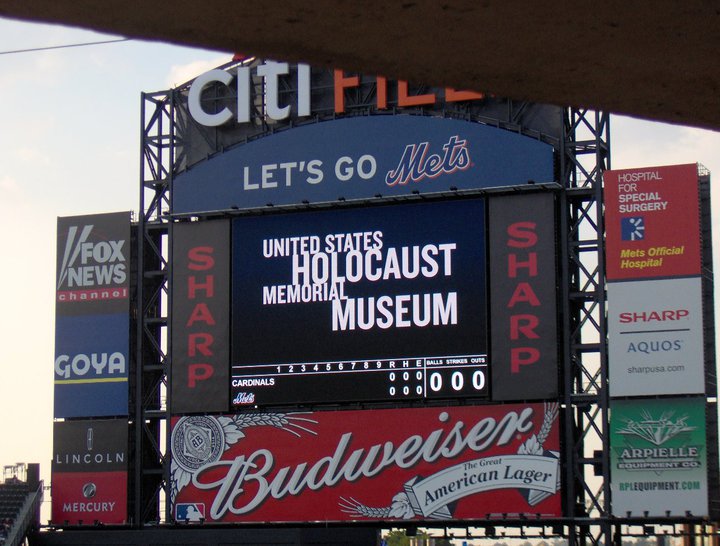
I was the featured speaker at this event hosted by the NYC Next Generation Board held on July 28th, 2010 at CitiField  in NYC. I spoke about this project and on behalf of the United States Holocaust Memorial Museum’s Teacher Fellowship Program.

Good evening and thank you for your welcome. I would like to thank the Next Generation Board and staff for having me here this evening.

As you have just heard, I am particularly devoted to the mission of the United States Holocaust Memorial Museum’s Teacher Fellowship program. In April I was honored to be in Washington, DC with these fine veterans at the Days of Remembrance ceremonies with over 100 other liberators. Tonight I would like to present you with some snapshots of the people I have encountered in my work, and how the ripple effect has led to these worldwide connections. I also think it is important to place my work in the context of the Museum’s mission and to place it in a perspective that illustrates why we are all gathered here this evening.

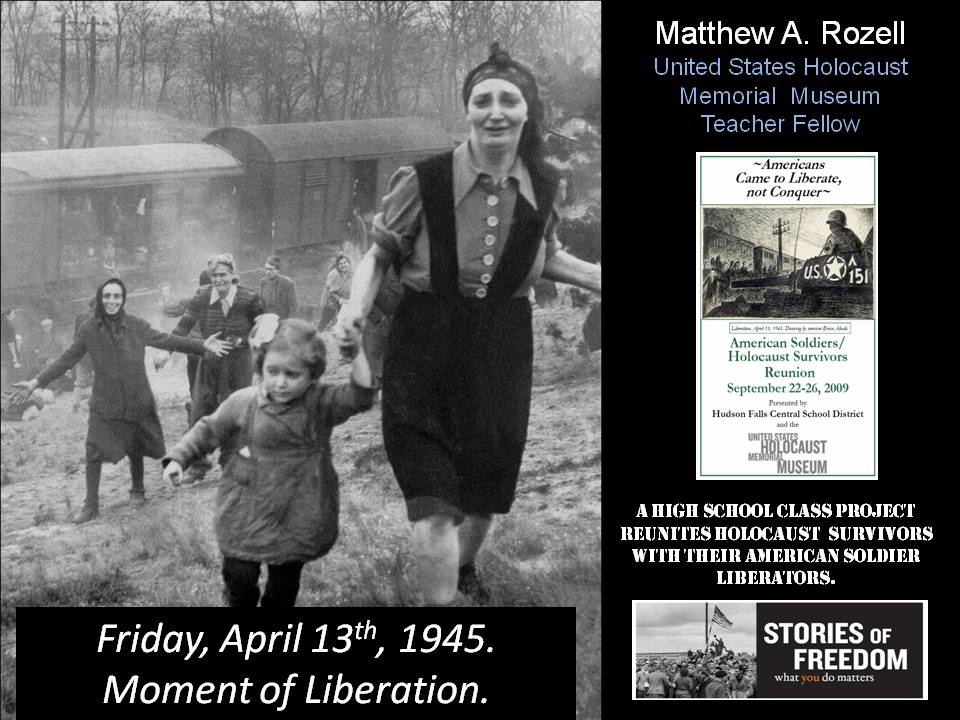
As Ms. Sawyer explained, this endeavor began as a simple oral history project and it has now taken on a life of its own. The photograph on the screen was taken by Major Clarence Benjamin and is one of the most dramatic liberation photographs ever to come to light. What is unique about this and the other ten liberator photographs is that we have now identified several persons who are still living. They in turn contact other survivors and their families. Some just stumble across my website. On Holocaust Remembrance Day in Israel, April 12th, a major Israeli daily that reaches a quarter million households ran a lead story; here in NY the newspaper Hamodia ran an article that reached 50,000 in January. This has multiplied the ripple effect; to date, we have uncovered 165 survivors who were aboard that train near Magdeburg Germany.

Right now, rescuing the evidence is my main mission. There are so many lessons here – lessons of self-sacrifice and duty, of courage and kindness, but also of horror, cruelty and sorrow.  This war brought out the worst in people and it brought out the best of people. And when you look at this mini snapshot of time, you see it all. In the end, good triumphs over evil.

Here are some sample vignettes from my work with the testimony of survivors I know, and this is just scratching the surface. Here they recall the moment of liberation at the hands of the Americans.

Jacob, a four year old boy, has very vivid memories of recalling that this was the first time in his young life that he ever saw an adult smile. He also recalls an angry American major cocking his .45 and putting it to the head of a burgermiester who was reluctant to order the neighboring townspeople to provide shelter and food for the starving victims, a story which has been corroborated by many survivors.

Ina, a seventeen year old Dutch Jew, remembered the straight white teeth of her liberators and thinking in her famished and confused state that they all must have had the same dentist.

Bob, a fifteen year old, recalled hearing somebody fiddling with the lock on the railcar door and sliding it open. They were soldiers with Red Cross armbands who were shocked as the bodies tumbled out on top of them. QUOTE “The degree of shock, their shock, surprise, questioning on their faces-Where did these people come from? How did this happen? But within a few minutes this combination of emotions got transferred into the demonstration of concern, care, interest, a demonstration of wish, and good intentions, which was conspicuously demonstrated to each and every one of us. Before I realized just what was happening, the strong arms of that young man with the white armband grabbed me- I don’t know why, he probably didn’t know how many lice I had on my skull-He pulled me out of that car and then the other soldiers started pulling guys out of it. ”

21 year old Steve, who celebrated his 20th birthday freezing in a locked boxcar in early Dec. 1944  on the way to Bergen Belsen, recalled sitting on the embankment the evening before the liberation and  watching the Allied carpet bombing of Magdeburg and hoping that the bombs would fall on him. QUOTE  ” The next morning, we had this tiny little fire going and we were sitting next to it and I was sitting there with this great big abandoned SS overcoat on, to keep warm.  One GI walked down the embankment, came over to the fire, sat next to me, took out his pen knife, and he cut off the SS insignia from my coat, and slowly dropped it into the fire…”

Micha, a six year old boy from Poland, remembers visits to the house where he and his mom were quartered by a huge black American soldier who constantly smiled, bringing him chocolate, which he had never tasted before.

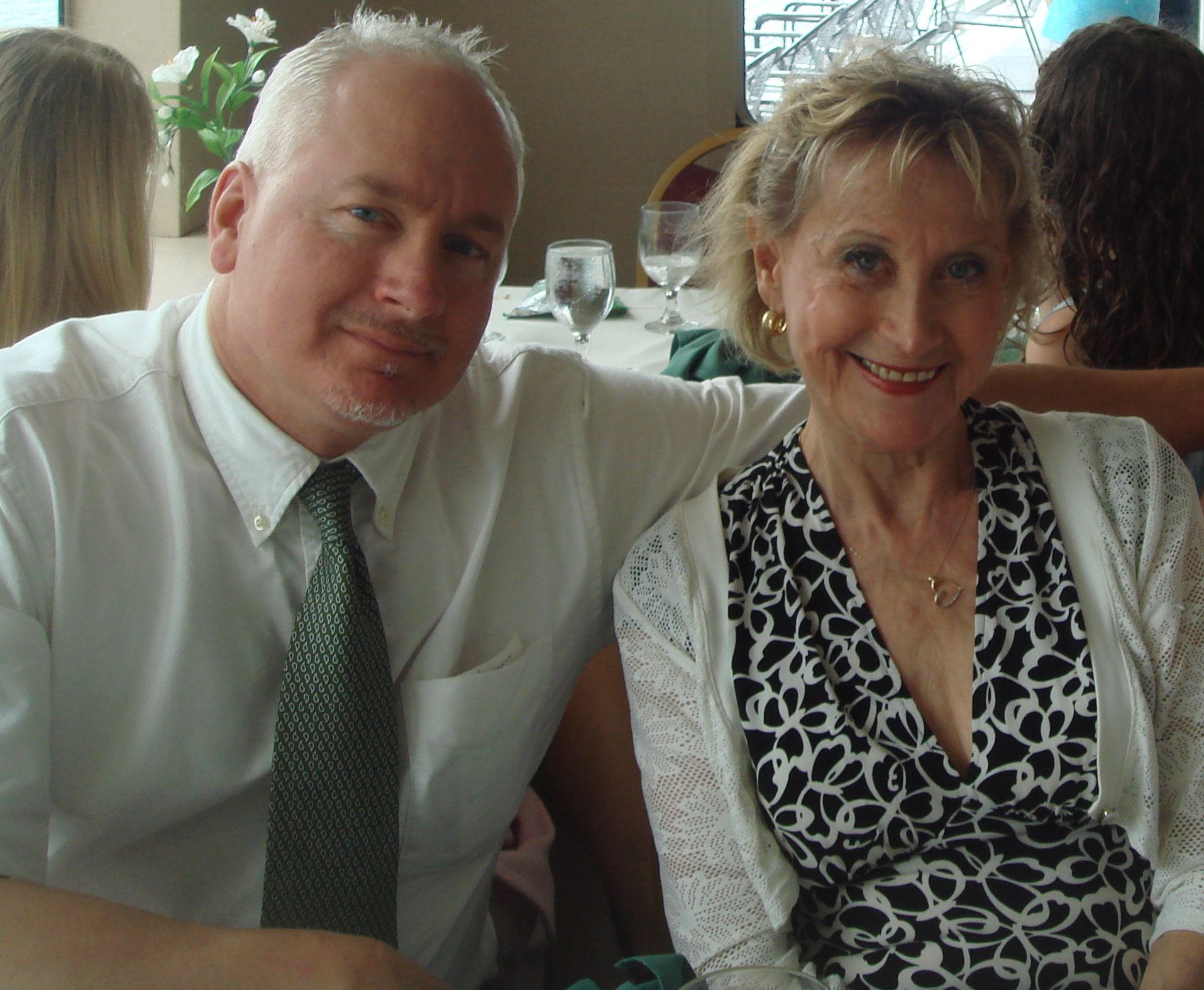
Matthew Rozell at CitiField event, July 28, 2010. USHMM photo.

Several of these child survivors have told me that they recall the camp in shades of gray and black and white, but they remember the liberation in vivid Technicolor. Elisabeth from Holland: “I got out of the train and I saw the greenery and the wild flowers. It was wonderful because suddenly I was seeing things in color. Everything that I’d remembered about the camp was black and white…”

Most recently, this was confirmed once more by this woman, a little girl who had been an orphan in Bergen Belsen. Back in Israel where she lives, she got a phone call from the daughter of another survivor who had tracked her down. Lily got a call as she was cooking dinner at home for her extended family in Tel Aviv last March, and was completely shocked as she knew very little of the details of her early life. She did immediately decide to travel to the United States to meet me, and came up here about a month ago. Lily’s father had been shot in the Warsaw ghetto and her mother died in Belsen shortly after their arrival. She was “purchased” with bread rations from a man who she had been entrusted to but who was actually neglecting her, and then she was cared for by a series of women whose faces and names she cannot recall. Eventually she was taken to Israel and raise on a kibbutz, and when she met me; she confided that she did not even know her birth date. She did remember the liberation, that all these young soldiers were chewing gum and gave her her first chocolates. I then arranged for her to have an interview at the Museum, and she called me up, very excitedly after the fact to say that she was received very well, and that her interviewer even had done research in the archives before she had gotten there and was able to tell her the day she was born…June 15th. As she and many others have told me, her family is proof that Hitler did not win.

I’d like to think that this project has done a great deal to undo Hitler’s legacy. The ripple effect of that we spoke of is reaching many thousands of lives- liberators, survivors, their children and grandchildren, and generations to come.  In perspective, though, we have to understand that for every soul saved on the train, another 2500 perished during the Holocaust.

Just as importantly, the project has touch thousands of students. You see, one of the points that I stress is that now these students become the new witnesses, just as you are also here to hopefully help us to carry the ripple forward to the future generations. I point out to the kids that they have a responsibility now to use what they have witnessed, and I show them the Holocaust denial website that is out there specifically devoted to the refuting of my story. It’s still out there, and ignoring it is not going to go make it go away.

I have talked to plenty of my peers who did not really learn about the Holocaust in own their days in the classroom, and who really have difficulty grasping how to teach it effectively. There is a lot more to teaching about the Holocaust than collecting bottle caps or counting pull tabs in a crate. Realistically, only a handful can bring their students to the Museum in Washington, but what we have to realize is that this Museum is much more than a brick and mortar building. As was previously mentioned, the Museum Teacher Fellowship program has developed into cutting edge national outreach to nurture Holocaust education in this nation, but a lot more needs to be done. Last year the Education Division reached 5000 teachers across the nation, and the good news is that the ripple effect means that if each committed teacher reaches 100 students over the course of ten years or so, we have now carried the message to fifty thousand kids.  In perspective, however, we have to keep in mind that there are at least 14 million secondary school students in the United States. But just imagine the potential of a program where even more highly qualified and committed MTF teachers could be trained to reach 100 or more fellow teachers over the years!

People often ask me how my work as an MTF impacts students. For a long time I really struggled with this question-I myself have never taken students on a field trip to the Museum-until last month when a reporter for my college alumni magazine showed up in town to find out.

“He puts history right in front of your eyes,” one of my students said. “Never could I have gotten the experience of meeting such inspiring people who learned to love after the ultimate form of prejudice was thrust upon them. A message of acceptance not only reached the little town of Hudson Falls, but the entire world.”

“It’s life altering,” said another. “And because we’ve heard these stories, it’s our job to make sure it won’t happen again.”

My friends, these high school kids now know that what they do matters, and whatever we can do to support these programs will pay dividends later. Now I can say truly that my getting up and going to work each day makes a difference. And now like them, when it comes down to what really matters, I just can’t be a bystander.

Thank you for your attention and I hope that you enjoy the game.

28 July, 2010 the United States Holocaust Memorial Museum’s New York Next Generation Citi Field event to commemorate the 65th anniversary of the liberation of the Nazi concentration camps.

Read Full Post »

“Never have I met such devoted human kindness. Their humanity led us back to our rightful life as human beings on earth…

Now, after so many years, let me at least say, “thank you very much” to those devoted and kind US soldiers.

This valuable narrative surfaced a few months ago when it was sent to me by Shoshana Ben-Tora of Israel, written by her mother. Two of her brothers who were on the train are still alive, and remember this event with tears in their eyes… She sent it to me on Israel’s Independence Day. I share it on our Independence Day. Following that , you can see the letter that Chuck Kincaid wrote, as read out during our Soldier-Survivor Reunion last fall, of the sights that effected him for the rest of his life.

April 7-13, 1945

After suffering from constant starvation for six long months at the death factory of Bergen-Belsen the SS left us now in total hunger and total thirst. By now, we had been steadily crouching inside the crowded cattle trucks for five days. We were too exhausted, dizzy and weak to grasp how grave our situation was. What do the Nazis have in mind?

Turning Point – 12 April, 1945

We now reached the most crucial hour of our life during World War II under German Nazi rule. From each and every truck, a Jewish leader was asked to appear before a high-ranking SS officer, who issued a disastrous order that we immediately carried out. All men between the ages of sixteen and sixty were to line up in columns of five in front of the cattle trucks, with the angels of death fluttering around. We had to fight them off, and – luckily for us – we won! Our deteriorating health prevented us from comprehending the great life-and-death peril we were in at the time. We did not sense how we hovered between life and death, but our subconscious felt and knew it.

A paralyzing darkness seized me. Time stood still until all the men returned to the cattle cars. Then, our leader told us what really took place. As our transport of two thousand souls somehow got caught up between two combatants – the US army fighting against Hitler’s cowards – our SS captors decided to annihilate us all. They were going to gun down the men with machine guns in front of the cattle cars, and then blow up the rest of us – babies, small children, women and the elderly – in the cattle cars. That was the decree that the Nazi beast devised when its hour of doom came. Our leaders persuaded the SS officers to withdraw the decree by bribing them with gold jewelry that the Spanish Jewish group had. The SS officers fled, leaving us to be liberated shortly by the US army. Thus, by the generous decree of the Almighty, we were rid of the cruel tormenting clutches of the German Nazis, on the precious date of April 12, 1945, around mid afternoon.

This is how our “door of freedom” opened wide before us. Our leaders told us how to behave, letting us know that we could leave the cattle cars, but must stay close by. We were also told that we were in close range of an ongoing heavy battle. Those who wished to sleep the night outside the cattle car could do so on top of the grassy hill just in front of us. We were presently situated twenty kilometers from the city of Magdeburg, between two small towns. To our right was Farsleben and to our left was Csilics. At long last, the enfeebled crowd began crawling out of its prison, although many were too faint to enjoy the very first steps of freedom. It looked like there was hope that the US army would liberate us for good from the barbaric domination of Nazi Germany by the morrow.

A Real Bath!

We soon spotted a small pond and together with my sister Jolan I took my first steps in its direction in order to take a “real bath in real water”. As we walked there, a band of SS German officers were running away. One of them aimed at us with his small gun and fired some bullets with an accompanying last farewell to us – “swine Jew”! Luckily for my sister and I, we were far enough not to get hurt.

In front of the cattle car, we could see German civilians from the two nearby towns running in opposite directions on the main road, trying to escape from the approaching US forces. With dulled sense, we glimpsed towards them. Several SS guards stayed with us. Some of them asked for – and received – civilian clothes from our people.

Many of us spent the night on the grassy hill beneath the open, starry blue sky. A nearby gun battle illuminated the area through the night. Sounds of cannons kept us awake and we prayed fervently now more than ever for our liberators’ swift victory.

The next morning we dug up recently planted potatoes we found between two stones, made a fire and cooked them. They tasted delicious. In the early afternoon, I again started walking towards the small pond, but then my little sister Jolan excitedly hollered to me: “hey you, come back fast, the US army has arrived”!

US Angel Soldiers

As much as my faint condition would allow me, I hurried to the scene of the miracle to welcome them, this being the big moment we so yearned for. Two angel-like American soldiers stood there beside their “magic” jeep. My sister and I looked on enchantedly as they took captive the several SS cowards who stayed in their shameful and disgraceful uniforms. The SS henchmen held up their hands while one of the Americans stood opposite them with a pointed weapon. Then, the second US officer searched their pockets.

These two dear, brave soldiers of valor hurried straight from the battlefield to liberate us from the satanic German Nazis. I just kept looking at their faces, which still reflected emotions of battle. Their eyes and face mirrored wrath as their glance fell on us, the feeble crowd. They came to liberate us and the many cadavers laid out in front of the cattle cars on the bare earth.

The American officers told us that an airplane spotted our transport leaving Bergen-Belsen, and that they escorted and watched us since then. In the event that our Nazi transport guards would attack us, they were ready to come to our defense. It was Friday, April the thirteenth, at about three p.m., when the gracious US army emancipated us – our group of two thousand living dead. They brought us back from the edge of the grave, from the satanic, barbaric, murderous clutches of the German Nazis.

Standing there and looking up at our liberators, I waited to sense some kind of emotion on this miraculous occasion – but no. Reality did not penetrate my consciousness. My senses were incapable of experiencing any signs of emotion – no tears of joy appeared, nor even the slightest smile. My senses were left stiff, in the aftermath of extended suffering. We are liberated, but only outwardly. Our mind still remained under great pressure, as heavy, dark clouds obscured our world of comprehension. It will take a good many years to be free completely. When that time comes, if ever, we will be able to feel wholly liberated and shake off the shackles of bondage and imperceptible suffering.

Feeding Us Back to Life

Taking their German  SS captives along with them, the two American officers left us for now. The majority of our group was so feeble that they stayed inside the crowded cattle trucks. Some ventured to the nearby small towns for provisions. The following day, early in the afternoon, the US army arrived with a big army truck. They brought us a delicious hot meal, potato goulash with veal meat. Never before in my life, or after, did I eat as tasty a meal as this. I just looked on as those US soldiers of valor took care of our group of two thousand, going from cattle car to cattle car so patiently. After suffering so long from inhuman treatment, I felt a great distinction to be treated with human kindness by those American soldiers. It was like being born again.

With their kind devotion toward us they sowed back into our souls the sparks and seeds of human hopes and feelings. By Sunday morning, my sister Jolan and I plucked up some courage and crawled out of the cattle cars to look around at the nearby town of Farsleben. We were pleasantly surprised to discover that US officers were already strolling the locality, patrolling the place. Some of our fellow Jews were also around and about. The local population either locked themselves in their homes or escaped. None of them ventured to welcome the new liberators.

Suddenly we came by a friend of ours, Kati, with a smiling face. She invited us to taste from a big can of scrambled eggs that she just received from the American soldiers. Gladly, we did. With our bare hands, we grabbed a handful from it, thanking her for the kindheartedness.

Our Liberators

Now about our generous, kind, angelic liberators who freed us from Nazi hands. As I look back over the long years that passed, and recall the group of 2,000 of which I was a part – how we must have looked when we were freed from Bergen-Belsen! I must say that the soldiers who freed us were like angels from heaven. They took care of us with great devotion. They worked hard with their fine kindness that saved our lives. They placed us in the nicest looking houses in the area to make us comfortable. They prepared the special meals we needed because of our weak and sick condition. In short, the US army pulled us back to life from the edge of the grave. They did all they could to build up our spirit and health so damaged by the Nazis. Never have I met such devoted human kindness. Their humanity led us back to our rightful life as human beings on earth.

The US army freed us on the thirteenth of April 1945. When they left us we were all sorry that they hadn’t given us a chance to thank them for all their kindness. Now, after so many years, let me at least say, “thank you very much” to those devoted and kind US soldiers. Within 24 hours they put up a hospital for our sick! They put us up in comfortable quarters and went from room to room looking for the sick and infirm. If they found someone in bed or looking too pale-faced, they immediately carried them to the hospital. There they conducted their efficient check-ups. Many of us were sick with spotted-typhus, a very infectious disease. Two of the American doctors who treated us contracted it and sadly enough died from it.

April 17th. (1945)

Dear Chaplain;-

Haven’t written you in many months now, its funny how a few moments are so hard to find in which to write a letter way past due; it’s much easier to keep putting it off the way I’ve done. I’ll try to make up for it in this letter.

Today I saw a sight that’s impossible to describe, however I’ll try. Between 2400 and 3000 German refugees were overran by my division during our last operation; most of them were, or had been, inmates of concentration camps, their crimes the usual ones, – Jewish parentage, political differences with der Fuhrer, lack of sympathy for the SS, or just plain bad luck. Not one of these hundreds could walk one mile and survive; they had been packed on a train whose normal capacity was perhaps four or five hundred, and had been left there days without food.

Our division military government unit took charge of them, and immediately saw what a huge job it was going to be, so they sent out a call for help. Several of our officers went out to help them organize the camp they were setting up for them. The situation was extremely ticklish we soon learned; no one could smoke as it started a riot when the refugees saw the cigarette, and we couldn’t give the kiddies anything or they would have been trampled to death in the rush that would result when anything resembling food was displayed. The only nourishment they were capable of eating was soup; now the army doesn’t issue any of the Heinz’s 57 varieties, so we watered down C-ration[s] and it served quite well.  It was necessary to use force to make the people stay in line in order to serve them. They had no will power left, only the characteristics of beasts.

A few weeks of decent food will change them into a semblance of normal human beings; with God willing the plague of disease that was already underway, will be diverted; but I’m wondering what the affect of their ordeal they have been through, will be on their minds; most will carry scars for the rest of their days for the beatings that they were given. No other single thing had convinced me as this experience has that Germany isn’t fit to survive as a nation. I’ll never forget today.

I was going to write mother tonight but thought better of it. I’ll be in a better frame of mind tomorrow. I’m only a few dozen miles from Berlin right now, and its hard to realize the end is in sight. I’m always glad to receive your scandal sheet. You perhaps missed your calling, as your editorial abilities are quite plain.

As ever,

Charles. (transcribed by Kaylee Merlow, HFHS ’11.)

Read Full Post »

So this orphaned little girl who was liberated on the train came to visit me in the USA, all the way from Israel.  My wife and I met her and Lynda, her friend from NYC, after they drove up from New York this week. When she came down to the lobby of the hotel, she just glowed. We had dinner at a beautiful place on the lake, and the next day a cruise on a ship on the lake, and then at my friend Johnny’s restaurant in Saratoga Springs, after they got a special tour of the Dance Museum in Saratoga from Sarah, Johnny’s daughter. Later in her tour, she traveled to the United States Holocaust Memorial Museum in Washington, where the staff were not only prepared for her  testimony appointment, her interviewer Ina also told her the date of her birth-June 15th- which she has never even known before! She was cooking dinner for her family in Israel in March, when the phone rang and she learned of this website and of this new chapter in her history, thanks to Varda W.

Hello, Matthew,
My name is Lily Cohen and I was a little girl who was on that train coming from Bergen-Belsen.  My name was Lili Kazimierski-Shein and I was an orphan, probably about 5 or 6 years old.  at that time.  I don’t know my birth day, or year.
I am so moved to find this research, as most of my early life appeared to be “erased” somehow by the Holocaust, and only now am I able to take small steps into what was my past to piece together fragments of memories.  I remember the train.  I remember the hill, I remember a German soldier running away, and I remember a woman who was trying to take care of me dying at my side.
How did I hear of you?  Varda  called me last evening, having found my name in a book by Hilda Huppert called “Hand In Hand With Tommy.”  Since it only mentioned my first name and the kibbutz where I was raised, she called the kibbutz!  Amazing how things can come together when there are people dedicated to finding out “the rest of the story.” Thank you for your dedication.

My life has turned into a really wonderful victory over Hitler’s attempt to obliterate the Jewish race.  Tonight I made dinner for 10 people in my home in Tel Aviv – 6 of whom came from me… You are really doing a holy work and I do hope to meet you some day.

TESTIMONY FOR LILY BY NIUTA Haya GUTKOVSKI 28 MARCH 1997

Matt Rozell, Lily Cohen, Lake George, NY June 24, 2010.

The first time I met her, Lily was approximately at the age of 2 or 3 in Bergen-Belsen.  I was told that she was there with her mother who died in the camp from Tuberculosis.  Lily was there with a “father on paper”.  His name was Schon, received at the time a Certificate for himself, his wife and daughter, for Palestine. His wife and daughter were killed, and he remained on his own with the papers.  Instead he listed Lily and her mother on his papers.  They arrived to Bergen-Belsen as a family.  As I heard, the Kazimierski family was very, very rich, and Lily’s mother, Madame Kazimierski paid him for the Certificate.  When her mother died, Lily remained with him in the men’s barrack, which was separated from the women’s barrack, but there was a connection between the two barracks and the two camps.  It was a special camp which was called ‘The Palestinians,’ because all the people had some kind of connection to Palestine.  I had a husband in Palestine.  We heard from the men in the barrack that Schon was abusing the girl, hit her, and ate her food (we only got only 200 grams of bread per day).  She was dirty, neglected and very, very miserable.  We had decided, Serve Celevachik who was the head of the Men’s camp of 350 people, and me, who was head of the women’s barrack of 70 people and children that we had to take the girl out of the men’s barrack.  At the end we decided that he would take all the things that her mother gave him, which was probably some jewelry and gave him food, our rations, and we wanted him to give the girl to us, for our care.  We got her in a horrible condition, dirty, neglected, full of lice, in very, very bad mental condition, with unstoppable crying and fears.  She did all her things in the bed.  In our barracks, Bronka Eiseman started to take care of her in a very devoted way.  She used to get up in the middle of the night for her, she managed to release some of the fears, she shaved her head, she took care of her, and practically ‘put her on her feet’ in a very limited way. And then another disaster happened to Lily.  The second one.  Bronka was sent to Vittel, which was a camp in France, and Lily stayed again without any shelter.  We tried to do the best we could.  We took turns to take care of her.  I loved her very much and made a contact with her which actually lasted until this very day. Then, in 1945, the Germans decided to transfer us to Theresienstadt.  That is what they told us.  We walked on foot more than 10 kilometers.  Lily, at that time, was probably 4 ½ years old.  We were 2,500 people, Germans, Dutch, Polish, etc.  Then they put us on the train. We were thinking this is the end of our troubles.  We were on the train, stopping and starting for probably one week.  On the way the train was bombed.  And Lily, who at that time was under the care of one of the women, again, stayed alone, because the woman was killed.  On the 13th of April, 1945, finally the train stopped, the Germans ran away and the Americans came.  They took us to a German city that belonged to SS families by the name of Hilleslaben.   There, for the first time, we got food as we needed.  I was there only a few weeks and then I ran away. When I arrived to Israel, to Palestine I heard that Lily came on a children’s transport and ended up at Ma’ale Hachamisha near Jerusalem.  When I heard about it I started to visit her regularly, and that is how we stayed in touch all these years.

Read Full Post »

And I am very happy to have been a small part in their liberation in April of 1945 and now we have come full circle and we have met again.  We have embraced, we have hugged, we have kissed, we have cried.  And we are very proud to be a part of their lives today.

~Frank Towers, liberator, describes his feeling to the people he saved 65 years earlier, and to student witnesses at Hudson Falls High School.

Read Full Post »

I posted this a year ago. I am re-posting today.

To all of my friends at the Museum, and to Officer Johns family–it’s still too raw and too real. Please know that I am thinking of you.

Matt

I think it is a given that the tragic lossIn Valor, there is Hope. of security guard Stephen Johns on Wednesday will serve to strengthen our commitments, as United States Holocaust Memorial Museum Teacher Fellows, to persevere all the more in our missions.

Here is a post from Pollster.com’s Mark Blumenthal, which sums up how I feel about the Museum staff as well.

June 10, 2009

This is Personal

By Mark Blumenthal

Regular readers will probably remember my that my father-in-law Frank Burstin, who passed away about a week before last fall’s elections, was a survivor of the Auschwitz death camp. For that reason, as you may imagine, the news this afternoon about a shooting at Washington’s Holocaust Museum hits pretty close to home for me and for my family.

But you don’t know the half of it.

I have a special memory of Pop (as we knew him) from last summer. It was a few weeks before he received his cancer diagnosis, during what turned out to be his last visit to the Holocaust Museum. Because he lost his parents and all of his siblings to the Nazis, and because no grave site exists for any of his family, Pop made it a habit to visit the Museum at least once a year. It fulfilled for him the custom that many Jews practice of visiting the cemetery of loved ones once a year. I only got to accompany him on one of these visits, that one last year, along with my wife’s nephew Jake.

I described him last year as “kind and optimistic soul,” and he certainly was. But when he entered that museum, something changed. He was not unkind, but in that place, as I soon learned, he suffered no fools (nor anyone else).

We wandered into the museum, through the same doors and into the same foyer where shots rang out this afternoon. My wife had given us visitor passes that she receives as a member of the Museum. The lines were long, and it was not obvious which line we needed to stand in.

Pop was having none of it. He walked away from me and wandered up to the museum staffer standing at the head of the long line leading to the elevators that takes all visitors to the museum exhibits. I thought for a moment that Pop was going to ask directions. I was wrong.

He thrust out his arm in the direction of the staffer, displaying the number the Nazis tattooed on his arm at Auschwitz just a few inches from her face. Without making eye-contact and barely breaking stride, Pop kept walking. Understandably, the staffer barely blinked. She didn’t make a move to stop him.

Pop kept walking right into the elevator that had just filled with the visitors that had been waiting in that long line. And even though the elevator was already quite crowded, he walked right in. Jake and I had to run past the guard to catch up. “Pop, Pop,” I said, feeling a little embarrassed, hoping to talk him into at least waiting for the next elevator.

The staffer inside the elevator must have heard me, because he smiled, held the door and said with smile, “We have room for Pop. You guys too. C’mon in.”

And up we went. I have been to the Holocaust Museum many times, but none as memorable as that visit.

About a month ago, in a conscious effort to carry on her father’s tradition and to commemorate his birthday, my wife Helen paid her own solo visit to the Museum. She arrived at the end of a busy work day, in a rush, just a few minutes before closing time. Unfortunately, given the late hour, they had run out of the candles usually provided in the Hall of Remembrance for visitors to light and leave in the niches of the outer walls.

Already feeling emotional — her dad had passed away just six months before — she broke down sobbing.

A staffer nearby immediately came to her assistance, asking if she needed help. She explained, and the gentleman asked her to wait. He soon returned with a candle, explaining with a conspiratorial wink that he kept his own special supply for such emergencies.

The guards and staff at the Holocaust Museum have a special duty. The do more than just protect and operate one of Washington’s many heavily trafficked museums. On a daily basis, they help open the doors to the elderly survivors of the atrocities of World War II. As my stories attest, they do it with a remarkable degree of kindness and professionalism.

As far as I know, the Holocaust Museum personnel that we encountered were not armed guards, though it is possible they were. But when I heard about the shooting this afternoon, and more specifically that at least one of the victims is a security guard now apparently in critical condition, it struck very close to home.

This is personal.

As far as I am concerned, the staff members of the Holocaust Museum are part of our family and the Museum itself is hallowed ground. We pray for the recovery of the wounded guard. “Never take your guard force and security people for granted,” William Parsons, the museum’s chief of staff said on television a few minutes ago. Our family never will.

A very sad update: MSNBC just reported that the guard, Officer Steven Tyrone Johns, has passed away. We are all mourners tonight.

http://www.pollster.com/blogs/this_is_personal.php

Read Full Post »

« Newer Posts - Older Posts »