Feeds:
Posts
Comments

Archive for the ‘Uncategorized’ Category

West Ham send message to racist fans with Holocaust ceremony

Auschwitz survivor will lead pre-match ritual following anti-Semitic chants at Tottenham

Darren Richman /The Independent

Friday, 18 January 2013

West Ham will commemorate Holocaust Memorial Day today at Upton Park with a reminder to sections of their support that anti-Semitic chanting is unacceptable. The club have invited the Football Association chairman, David Bernstein, the Mayor of Newham and Holocaust survivor Zigi Shipper to attend the match against Queen’s Park Rangers and mark the occasion by lighting candles before kick-off. Lord Sacks, the Chief Rabbi, has written a piece in the programme emphasising the fact that sport can be a force for good in helping erase all forms of prejudice.

West Ham’s decision to honour the victims of the Holocaust in this manner is particularly admirable given the events that marred their trip to Tottenham in November. A vocal minority of fans engaged in abusive chanting and made hissing sounds to emulate the gas chambers. Shipper feels that education is the key.

“A lot of these people don’t know any Jewish people,” he said. “They don’t really know what a Jew is. They don’t realise the full scale of what happened. Six million Jews were murdered along with Gypsies, homosexuals and the physically and mentally handicapped. All just because of who they were.

“I have gone to many matches but never heard anything like that which was heard at White Hart Lane. I know for certain that I would have left the ground immediately if I’d been there. When I got off the boat and arrived in this country as a boy, I never imagined anything like that would happen.”

Shipper, 83, was sent to Auschwitz concentration camp in his teens and witnessed countless horrors. “I saw women and babies shot dead,” he said. “Every day I ask myself how human beings could possibly behave that way and then sit down with their wife and children. How could they eat dinner? How could they listen to music?”

Shipper settled in London shortly after the war and started his own stationery company, which is still active today. Most of his time now, however, is spent educating young people.

He said: “I travel round the country visiting schools and universities and share my story. It is important that people understand what millions of us went through. I don’t want the Holocaust to be forgotten because there is always the danger of history repeating itself.”

Of recent racist incidents in football, including Milan’s decision to walk off during a game, he said: “Is walking off letting the racists win? It’s hard to say but I would probably have done the same.”

Shipper has already been involved in spreading his word to football: he addressed the England squad before they departed for Euro 2012.

“I have met Prime Ministers and the Queen but being asked to speak to the players was the greatest honour of my life,” Shipper said. “All I kept thinking was that it’s not bad for a little Polish immigrant who came to this country with nothing more than the clothes he was wearing.”

http://www.independent.co.uk/sport/football/premier-league/west-ham-send-message-to-racist-fans-with-holocaust-ceremony-8458299.html#

Read Full Post »

Matthew Rozell, 30th Infantry Veterans of WWII, Holocaust survivors at Mighty Eighth Air Force Museum, March 2, 2012.

Matthew Rozell, 30th Infantry Veterans of WWII, Holocaust survivors at Mighty Eighth Air Force Museum, March 2, 2012.

Frank Towers’ invitation to soldiers, survivors, interested parties and their families to come to Louisville in the spring. The soldiers have convened annually since the end of World War II; since 2008, thanks to the project, the 30th Infantry Division has hosted Holocaust survivors and their families as well for very emotional, uplifting, and fun times. Email for details.

*********************************************************************************************************

Don’t forget the dates!!       April 11 – 12 – 13, 2013

Don’t forget to make your Hotel Reservation

and Registration!!

Hotel Crowne Plaza,  Louisville, KY

*********************************************************************************************************

Dear Fellow 30 Division Members and Friends:

I hope you all enjoyed your holiday and that the New Year holds only good things for you and your family.

Now that the holidays are over it is time to focus on making your reservations for the Reunion.  Included are the Pre-Registration Form and the Reservation Form and the information to make your hotel reservations. Please do it NOW.

We have a great program planned and will include a trip to the Louisville Slugger Factory and Museum, a professional photographer that will take a picture of you and/or your family (so bring your medals and ribbons to show off).  We will also have one of Louisville’s noteworthy news casters, Ken Schulz, MC our banquet on Saturday evening.  Our entertainment will include a local bagpiper as well as others.

Why come to Louisville?

Louisville, is a city of urban neighborhoods that have been revitalized, and some of our best known shopping areas are the Bardstown Road and Frankfort Avenue corridors with their small shops and plentiful locally owned restaurants.  The homes and buildings in the Old Louisville neighborhood is one of the largest historic preservation districts featuring Victorian architecture in the U.S.  The Downtown area has had significant renovations over the last few years with the construction of the YUM! Center which is home court for our Louisville Cardinals men’s and women’s basketball teams.  The Center, along with Waterfront Park and Fourth Street Live, have attracted new housing, shops and restaurants breathing new life into the area.

Louisville has museums to interest everyone..  Home to the Frazier International History Museum; The Muhammad Ali Center; The Louisville Science Center; The Kentucky Museum of Art and Craft and many, many more.

Our hotel, the Crowne Plaza, is locally owned and operated.  It is near the airport and offers free shuttle service from the airport to the hotel.  The Crowne Plaza also offers many amenities including indoor/outdoor pool, fitness center, boutique shop, 24 hours business center, complimentary Wi-Fi, and more.

You can see Louisville is the place to be, so much so that Louisville was named “The Top U.S. Travel Destination for 2013” by Lonely Planet’s, the world’s leading travel publisher.

We are looking forward to having you here and sharing some of our history and hospitality with you, and most of all, to meet many of your former friends and colleagues.

Best Regards,

Bill Vaughan. President

30th Infantry Division Veterans of WWII

*********************************************************************************************************

Taps – 2012

(Last 6 Months)

ADAMS, Cleveland L. 30 MP Plat. 7/30/12 Stockbridge, GA

ADKINSON, Bruce 743 TkBn B 6/17/12 Beverly, MA

DUMEY JR, (DuMay) Leon 120-G 11/23/12 Cape Girardeau, MOM

FARKAS, Louis 119-I 12/ /12 Colton, OR

HOGUE, Donald W. 117 K 6/12/12 Montevallo, AL

HOUCK, Arthur T. 120-K 6/16/12 Hampstead, MD

LAZINGER, Sol 117-B 6/13/12 Philadelphia, PA

MAXEY, James C. 120 CN 6/ 29 /12 Tullahoma, TN

MILLER, Edmund L. 120-H 9/07/12 Pewamo, MI

PITRUZZELLO, Joseph S. 119-L 5/02/08* Alexander City, AL

PRUITT, Frank H. 120-2BnHq 12/10/12 Spartanburg, SC

PULVER, Murray S. 120-B 9/21/12 Peoria, AZ

STANFORD, Arna V. Widow 8/18/10* Williamsburg, VA

STECKLER, William 105 Engr. B 9/09/12 Palm Harbor, FL

SULLIVAN, Thomas “Jack” 118 FA 8/07/12 Savannah, GA

TURNER, Woodrow W. 117-F 8/15/12 Littleton, CO

UBBES, Jean M 743 TkBn-B 7/28/12 Kalamazoo, MI

VOORHIS, Thomas K. 120-K 8/06/12 Manteca, CA

WALSH, Carrol S. 743 TkBn-D 12/17/12 Sarasota, FL

YOUNG SR., James E. 120 6/26/12 Butler, PA

Those with an asterisk (*) were received too late for a prior publication.

Our Most Sincere Condolences to the Families of These Lost Heroes

*********************************************************************************************************

As most of you already know, men of the 743rd Tk. Bn., and  30th Infantry Division, liberated over 2.500 victims of the Holocaust from Bergen-Belsen on 13 April 1945.

We will be honored to have some of these Survivors join with us again at Louisville.  Two of them have never been with us before, so they will give a resume of their life history, so be sure to come to hear these stories that have never been told before.

One of these Survivors will be coming all of the way from Jerusalem, Israel, joining with other members of his family, to meet his Liberators for the first time.  The other Survivor will be coming from San Diego, CA with his daughter, also to meet for the very first time with some of his liberators.

To make it clear, each of you veterans were “Liberators” of this group of victims.  Although you may not have had any personal hands-on experience with them at the time of their liberation, You were doing your job which was supporting the action in the local vicinity of this tremendous discovery and the release of these frail humans to Freedom.

Join with us on this occasion to meet these Survivors that you helped to liberate 68 years ago !!

This will be an Historic event !!  68 years to the date of their Liberation !!!


Read Full Post »

A funny thing happened on the day that schools all over the US were supposed to be attacked again, and the world was scheduled to end.

Nothing.

Never mind the fact that on Friday, Dec. 21, many districts nationwide closed and a lot of schools locally and elsewhere saw significantly high rates of absenteeism. Some parents refused to send their kids to school; other kids, being kids, milked it and began vacation a day early.

As a teacher, I’ve been through this before. In the beginning, it was the horror of Columbine. The following week, one could cut the tension in the schools with a knife. And on the first anniversary, I remember the hype being even worse. The stress levels were off the charts. More than a dozen years later, I’m also now a parent with school age children.

Following the latest horrific school tragedy, a well-meaning teacher in Florida coined the phrase “our 9/11 for schoolteachers”- google it if you like-as he looked ahead to returning to the classroom following the shooting. And true to the pattern established after Columbine, each passing day in the schools saw the tension levels ratcheted up. By Friday many schools even had an armed presence in the hallways. Outside my own classroom a kid accidentally dropped his books –a couple of my students flinched automatically and then shot glances at one another. But I don’t think anyone laughed.

When a student “joked” that he heard we were all going to die Friday, the marker got capped, that day’s lesson went out the window and a new one began. I turned one of their desks around, pulled out the chair, and sat down. We clarified the lockdown procedure; I explained my expectations; they listened. Then the questions came.

Thus we began the “national conversation”. And it was not about gun control.

It was about fear control.

I did not psychoanalyze or attempt to explain the inexplicable. I listened to the concerns, but gently steered the conversation back to the elephant in the school hallways- the unadulterated undercurrent of anxiety and fear pulsing through the building.

I told them that if a couple designated school safety officers with concealed carry permits might make people feel better, maybe a paradigm shift should be part of the discussion. But let’s consider first how we got here.

I told them that in preparing my own lessons, and thinking and writing about them at my blog, I constantly am exploring what it truly means to be an American. The actions of the perpetrator do not define us. After catastrophes, as a people Americans are consistent in exhibiting an outflowing of love, compassion, concern and “the demonstration of wish and good intentions”- a term once used by a friend, a Holocaust survivor, to describe the reaction of the American soldiers who found him in his pitiful state. This national inclination to want to help others who are suffering makes me proud, but there is another reaction that needs to be brought up.

Everyone wants to help. To me, though, there is something a bit discomforting about a nationally known TV doctor attempting to comfort a grieving child in Newtown. Whether or not the star sanctioned it, it was transformed into a photo op. I found it unsettling when another daytime television megastar softly pitched questions to a sobbing child about his dead brother. A promotional soundbite let me know that “coming up, the All New Dr. “X” show will be on the ground in Newtown.”

It was incessant, and we ate it all up. It made us sick, yet we came back for more. We posted links on Facebook. Our kids were bombarded with this, and it would just a matter of time before the “did you hear” rumors circulated. Every school chief information officer in this nation had the door pounded in that week, I will guarantee. Parents demand action and criticize policy. The “how safe are your schools” surveys begin. And it all trickles down.

It seems today that our fears are fueled exponentially by our desire for information and the media’s accommodation of our needs. Fear and death sells, and rules the day. For some reason we seem to be drawn to it.

So we steered the discussion back. As a teacher, I do not accept the notion of “our 9/11 for school teachers”, just as a parent I chose not to be subjected to the incessant media broadcasts of terror and anxiety in the days following the attack. We can’t control others, but we can control how we react. But if, as a nation, we decide we want to send our kids to reverse prisons every day, then we have made our choice.

The day after our conversation, on Friday, December 21st, one of the students who did venture back into school  commented that she felt better, felt safer. Maybe it was the two officers patrolling the halls.

But maybe our classroom conversation had something to do with it as well.

Read Full Post »

Friday the 13th.

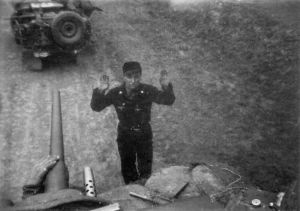
This account comes to me from a survivor’s son who lives in Hungary. He had read of Carrol Walsh’s passing on the internet and contacted me. It is Carrol who is commanding one of these tanks. Sgt. George Gross commanded the other, and took photographs.

I just came across this website . My father was on this train.
He passed away twenty years ago, in April 1992.

Here is an excerpt from his memoirs about his liberation day.
—————————————————-

Translation from my father’s Memoirs pp. 302-304.
————————————————-

The day of April 13 1945 was a Friday and a sunny and windy day. In the morning, the SS opened the doors of the freight cars, after they had argued with each other whether they should kill us with their submachine guns. But the US troops were too close.

——————————————————————-

Perhaps it was an older SS man who prevented our execution. Later that day, a Jewish woman, who had been his lover in the camp, saved him from becoming a prisoner of war or worse. She got him civilian clothes, I do not know how. The same woman became the lover of an American soldier later.
——————————————————————

Several hundred people wrapped in rags streamed through the open doors, if they could be called people at all. We were all mere skeletons.

The train was idling in a deepening, so I climbed uphill, across a road and to a field. I was pulling out potatoes planted on the field, when a motorcycle approached. It was a motorcycle with a side-car. There was an elegant SS or Nazi leader in the front: I could not decide, since he was wearing a mixture of uniform and civilian clothes. It must have been his wife sitting behind him and his child in the side-car. He pulled over and offered me a cigarette. I told him I did not smoke, so he closed his silver-looking cigarette-case and started the engine.
He seemed to hesitate about the direction he should take.

Prisoner taken. Photo by tank commander George C Gross, April, 1945.

Prisoner taken. Photo by tank commander George C Gross, April, 1945.

Then two small American tanks arrived. I was standing in the middle of the road, and noticed that the American soldier leaning out of the turret of one of the tanks aimed his gun at me.
The tank came closer and closer, and the soldier lowered his submachine gun. I must have looked terrible, so he did not take me for an enemy. I was lucky he had not shot me from the distance, since my small coat and boots vaguely resembled a military uniform. Lice were crawling all over my clothes and skin.

The few hundred former inhabitants of the concentration camp surrounded the tanks right away. Suddenly somebody remembered that the SS guarding us were still in the carriages. The SS were caught quickly, and lined up. The “intrepid” SS were trembling so heavily that their pants were flapping.

The first thing a Jewish woman asked from the soldier leaning out from the tank was money, and she received a dollar bill. She must have established her future with this dollar.

My attention was drawn to something else: in the rear of the tank there was a box of canned food. I climbed under the tank, emerged at its end, and pulled out a can. It turned out that I stole a can of oranges. This was my luck. I ate the potatoes charred in the can with the oranges, and probably this combination saved my life. Everyone who ate meat or anything greasy died within hours or within one or two days at the latest.

I felt fever in my body, undressed completely naked in front of staring women, and went into the ice-cold water of the lake next to the railroad. People warned me not to do this, but I went into the water, felt good, felt that I got rid of the lice and the burning heat of the fever. When I put on my rags again, I felt the fever ever stronger.

I asked an American soldier to sign the photo of my fiancee (I still have this photo). To my surprise, he signed the name Churchill. I thought he was joking. But he reassured me that his name was really Churchill.

(Once I read about a father named Churchill, who went to see his son’s grave in Vietnam during that war. The report mentioned that the father had been a soldier in World War II. He must have been my Churchill)

In the evening, there were news that we should flee, because the Germans pushed back the Americans. The Germans would massacre us for sure, the women had pulled out material for parachutes from a carriage in order to make clothes.

I was already so weak that I did not care whether the returning Germans would kill me: I stayed in one of the carriages, and fell asleep.

On Saturday, April 14, German peasant [horse-drawn] carts came for us by some order, so I was carried to Hillersleben. I dragged myself to the first floor of the first building, it looked like an office building, lay down under the sink of the bathroom, and fell asleep.

I am sure the American soldiers had no idea who we were and what we went through.

Read Full Post »

Class Act
Historic Reuniter
By Nancy Cooper
Photography by Erica Miller
Volume 147, Number 1, January/February 2013, Page 7

How does a young man from a small town with no experience in Holocaust education become a well-regarded figure in World War II and Holocaust history nationwide?

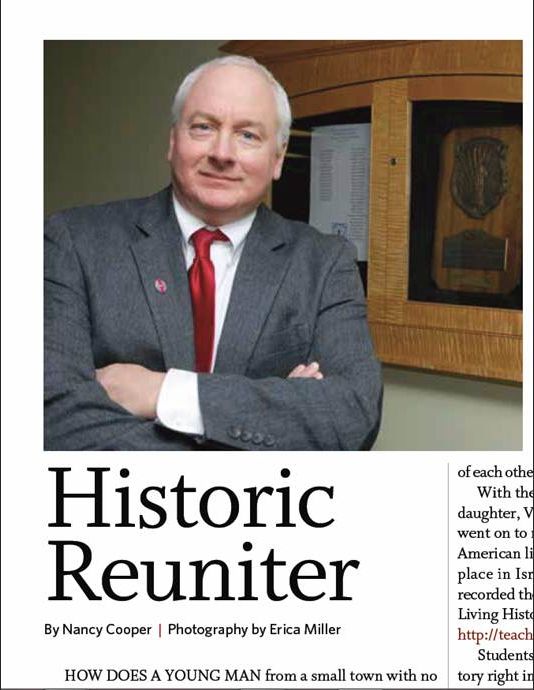
Matthew Rozell 12-12 American Spirit magazine

Not purposely posed. Erica Miller photo. Click the photo to see what I mean…. Only thing missing from 1992 is Dad.

The answer is part of the story of the remarkable career of Matthew Rozell, history teacher at Hudson Falls High School in New York. Following in the footsteps of his father, who was a history teacher in a nearby town, Rozell has taught at his alma mater for the past 25 years.

When Rozell emphasizes to his students the importance of tracking down primary sources, he has a dramatic way of proving his point. Through such primary research, he and his students have been able to identify and reunite Holocaust survivors with the U.S. soldiers who freed them.

Rozell’s instrumental role in such a historic reunion began in 2001 when he sat with Carrol “Red” Walsh, tank commander, U.S. Army 743rd Tank Battalion, to listen to some of his World War II tales. After nearly two hours of conversation, Walsh was reminded by his daughter to “tell [Rozell] about the train.” That prompt was a catalyst to a bigger story.

Walsh related that in April 13, 1945, his tank division saw something unexpected near Magdeburg, Germany: freight train cars alone on a track. When he drove his tank alongside the train, he could see that the cars were filled with Jewish men, women and children—more than 2,000 of them.

Intrigued by the story, Rozell searched for photographs of the liberation, which he posted on his school’s website in 2002. It wasn’t until four years later that Rozell received an e-mail from a grandmother in Australia who had been a 7-year-old girl on that train. She said that as soon as saw the photographs, she fell out of her chair: This was the day of her liberation in 1945.

From then on, “Almost every time I opened my e-mail inbox, there would be another message from a survivor, somebody that I wasn’t aware of before,” Rozell says. “These people weren’t aware of each other for the most part before finding the site.”

With the help of liberator Frank Towers and a survivor’s daughter, Varda Weisskopf of Israel, Rozell and his students went on to reunite nearly 225 Holocaust survivors with their American liberators. Rozell organized 10 reunions: One took place in Israel and three happened at his school. Students recorded the individuals’ interviews as part of a World War II Living History Project (www.hfcsd.org/ww2). Learn more at https://teachinghistorymatters.wordpress.com.{clarification: there have been at least 10 reunions since Rozell began the project; however he did not organize the ones occurring off campus but rather participated in or otherwise helped to facilitate them.}

Students have said of Rozell and the project: “He puts history right in front of your eyes. Never could I have gotten the experience of meeting such inspiring people who learned to love after the ultimate form of prejudice was thrust upon them. A message of acceptance not only reached the little town of Hudson Falls, but the entire world.”

“It’s life-altering,” said another. “And because we’ve heard these stories, it’s our job to make sure it won’t happen again.”

The powerful lesson hasn’t been limited to his students at Hudson Falls. In 2008 Rozell was awarded a Museum Teacher Fellowship at the U.S. Holocaust Memorial Museum for his work in Holocaust education. The Tennessee Holocaust Commission has created workshops based on his work. On September 25, 2009, Rozell and his students were named ABC World News “Persons of the Week.” His project was also the subject of the U.S. Holocaust Memorial Museum documentary “Honoring Liberation,” which debuted at the Holocaust Days of Remembrance in Washington, D.C., in April 2010.

To keep his teaching methods fresh, Rozell says, “I listen to the kids and adjust all the time. Some days you do not know the impact you have, but I can look to the dozens of kids who have gone into history education as a feather in my cap of sorts.”

He advises today’s youth not to take the sacrifices of the past for granted: “Talk to older Americans who served their nation.”

-American Spirit Magazine, Jan.Feb. 2013. National Society Daughters of the American Revolution.

Read Full Post »

Well, let me stop you there.

My brother and I were working on a story that we thought would be fun to turn into a screenplay. Of course, every story needs a plot, tension, storyline, and above all a focus. And the cool thing about this story is that it was all TRUE.

World War II infantry veteran Carrol Walsh, top,meets Holocaust survivors at a reunion in New York State, on Tuesday, Sept. 22, 2009. Walsh’s unit liberated a Nazi train carrying 2,500 Jewish prisoners, some pictured here, from the Bergen-Belsen concentration camp in Germany during the war’s waning days.The reunion came about because of efforts of high school history teacher Matthew Rozell.

World War II infantry veteran Carrol Walsh, top,meets Holocaust survivors at a reunion in New York State, on Tuesday, Sept. 22, 2009. Walsh’s unit liberated a Nazi train carrying 2,500 Jewish prisoners, some pictured here, from the Bergen-Belsen concentration camp in Germany during the war’s waning days.The reunion came about because of efforts of high school history teacher Matthew Rozell.

While there are several protagonists, we settled on a hero, a main character of sorts to follow.  My brother asked me why he was my hero.

My reply: because he so did not wish to be called one.

He was uncomfortable with the limelight-you could tell that with some of the interviews he did. There was always something higher behind how he conducted himself. Like his lifelong friend Dr. George Gross, the appearance of the Holocaust survivors that they liberated on April 13th 1945, I think profoundly enriched his sunset years. Above all I remember his laugh, his chuckling disdain for fools and his engaging talks to young people about what he saw-and what our responsibility as human beings is.

The last time I was with him we spent 5 hours together on a rainy summer afternoon, ten years nearly to the day after our initial meeting and my seemingly innocuous interview with him. This day he was happy as we sat together. He reminded me that he felt sorry for me as a Yankees fan, then said, do you know I saw Babe Ruth play? With his dad, he would travel to New York City by train on Sunday afternoons to watch his beloved Brooklyn Dodgers play,  back in the days when men dressed up for these outings.He popped in a cassette tape that he made-Benny Goodman, I think, closed his eyes and tapped his foot and snapped his fingers to the beat, head bowed,swaying from side to side… “Oh, man”…

My brother said to me- so do you like your main character?

No, I replied.  I loved him.

Carrol passed away yesterday, Dec. 17th, 2012, at 6:05 pm at home with his wife of 68 years by his side. He was 91.

===================

A Train Near Magdeburg

A Teacher’s Journey into the Holocaust, and the Reuniting of the Survivors and Liberators, 70 years on

===================

In the wake of so much heart breaking tragedy and misery in the world, I am pausing and remembering the actions and life of a single man who would bring to thousands of people so much joy, laughter, and of course life itself, with so much personal humility.

He profoundly altered the course of my own life in the short time I was honored to know him.  This CBS News short sums up a lot about the man. And the interview that follows was where I took today’s post title from.

Carrol Walsh: World War II Veteran Who Liberated Nazi Train Dies At Age 91

Just listen to him tell a story.

The Story with Dick Gordon- broadcast May 25, 2009

Steve Barry, Holocaust survivor

Carrol Walsh, US Army, liberator

Interviewed by Dick Gordon

May 2009

Read Full Post »

I had hoped to have a few days to reflect on my own  loss mentioned in the previous post but as an educator, this has to be brought up. Now.

If you are a follower, much of the teaching history matters website is to explore the idea of what it truly means to be an American. What is it that truly defines us as a people? What is it that we truly value? What do we want to pass on to our children?

Following the latest horrific tragedy, we are hearing a lot of buzz about having a “national conversation.” And I don’t see where it’s doing kids much good.

Kids seem to become more anxious with each passing hour, though the tragedy occurred last week.  Now they are in front of you in the classroom. Your job is to explain the world to them. They look to you for answers and solutions, reassurance and comfort.

Try walking in a teacher’s shoes this week.

Here is some hard earned advice gleaned over working through past school related tragedies, which I offer up to the three teachers who follow this blog.

  1.  Don’t try to make sense or explain the inexplicable, or offer “solutions”.
  2. Don’t psychoanalyze or pontificate.
  3. If a kid is with seven teachers a day, consider “teachable moment  impact fatigue” (I think I just coined a new phrase) as well. You still have a lesson planned. Pause, reflect, be human, but carry on. There are more days ahead.
  4. On a personal note, consider unplugging the TV for a few days. Trust me, you won’t miss anything. Log off of Facebook, maybe even turn off the smartphone.

Say no to death and fear.

Breathe. Set the real tone. Just be.

Peace. And leave the decorations up, for the kids’ sake and our own.

Read More: A Conversation.

+++++++++++++++++++++++++++++++++++++++++++++++++++++++

I read this Friday. For me, this lady nailed it out of the gate.

not heard ’round the world-lifted from Quartz.com

The deadliest school massacre in US history was in 1927. Why its aftermath matters now

By Lenore Skenazy — December 15, 2012

In the end there were 38 children dead at the school, two teachers and four other adults.

I’m not talking about the horrific shooting in Connecticut today. I’m talking about the worst school murder in American history. It took place in Michigan, in 1927. A school board official, enraged at a tax increase to fund school construction, quietly planted explosives in Bath Township Elementary. Then, the day he was finally ready, he set off an inferno. When crowds rushed in to rescue the children, he drove up his shrapnel-filled car and detonated it, too, killing more people, including himself. And then, something we’d find very strange happened.

Nothing.

No cameras were placed at the front of schools. No school guards started making visitors show identification. No Zero Tolerance laws were passed, nor were background checks required of PTA volunteers—all precautions that many American schools instituted in the wake of the Columbine shootings, in 1999. Americans in 1928—and for the next several generations —continued to send their kids to school without any of these measures. They didn’t even drive them there. How did they maintain the kind of confidence my own knees and heart don’t feel as I write this?

They had a distance that has disappeared. A distance that helped them keep the rarity and unpredictability of the tragedy in perspective, granting them parental peace.

“In 1928, the odds are that if people in this country read about this tragedy, they read it several days later, in place that was hard to get to,” explains Art Markman, author of “Smart Thinking” (Perigee Books, 2012). “You couldn’t hop on a plane and be there in an hour. Michigan? If you were living in South Carolina, it would be a three-day drive. It’s almost another country. You’d think, ‘Those crazy people in Michigan,’ same as if a school blows up in one of the breakaway Republics.”

Time and space create distance. But today, those have compressed to zero. The Connecticut shooting comes into our homes–even our hands–instantly, no matter where we live. We see the shattered parents in real time. The President can barely maintain composure. This sorrow isn’t far away, it’s local for every single one of us.

And of course it brings up Columbine. Two horrors, separated by years and miles, are now fused into one. It feels like terrible things are happening to our children all the time, everywhere. Nowhere is safe.

As a result, I expect we will now demand precautions on top of precautions. More guards. More security cameras. More supervision. We will fear more for our kids and let go of them even more reluctantly. Every time we wonder if they can be safe beyond our arms, these shootings will swim into focus.

Will this new layer of fear and security make our children any safer? Probably not, but for a reassuring reason: A tragedy like this is so rare, our kids are already safe. Not perfectly safe. No one ever is. But safe.

That’s a truth the folks in 1928 America understood. We just don’t feel that way now.

Not when there’s no distance between us and the parents in Newtown.

http://qz.com/37069/the-deadliest-school-massacre-in-us-history-was-in-1927-why-its-aftermath-matters-now/

Read Full Post »

From David McCullough. I’ve heard him speak, and I am re-reading “Truman” right now. He needs to be heard again. While in no way comparing my efforts to his, we obviously are on the same wavelength, and like him, I have the same mission. I really think that more people need to “get it”.

I’m proud to say that I recently received one of the the same medals as he was awarded in 2003.

Our Failure, Our Duty
We are raising a generation of young Americans who are by-and-large historically illiterate. And it’s not their fault. There have been innumerable studies, and there’s no denying it. I’ve experienced it myself again and again. I had a young woman come up to me after a talk one morning at the University of Missouri to tell me that she was glad she came to hear me speak, and I said I was pleased she had shown up. She said, “Yes, I’m very pleased, because until now I never understood that all of the 13 colonies – the original 13 colonies – were on the east coast.” Now you hear that and you think: What in the world have we done? How could this young lady, this wonderful young American, become a student at a fine university and not know that? I taught a seminar at Dartmouth of seniors majoring in history, honor students, 25 of them. The first morning we sat down and I said, “How many of you know who George Marshall was?” Not one. There was a long silence and finally one young man asked, “Did he have, maybe, something to do with the Marshall Plan?” And I said yes, he certainly did, and that’s a good place to begin talking about George Marshall.

We have to do several things. First of all we have to get across the idea that we have to know who we were if we’re to know who we are and where we’re headed. This is essential. We have to value what our forebears – and not just in the 18th century, but our own parents and grandparents – did for us, or we’re not going to take it very seriously, and it can slip away. If you don’t care about it – if you’ve inherited some great work of art that is worth a fortune and you don’t know that it’s worth a fortune, you don’t even know that it’s a great work of art and you’re not interested in it – you’re going to lose it.

We have to do a far better job of teaching our teachers. We have too many teachers who are graduating with degrees in education. They go to schools of education or they major in education, and they graduate knowing something called education, but they don’t know a subject. They’re assigned to teach botany or English literature or history, and of course they can’t perform as they should. Knowing a subject is important because you want to know what you’re talking about when you’re teaching. But beyond that, you can’t love what you don’t know. And the great teachers – the teachers who influence you, who change your lives – almost always, I’m sure, are the teachers that love what they are teaching. It is that wonderful teacher who says “Come over here and look in this microscope, you’re really going to get a kick out of this.”

There was a wonderful professor of child psychology at the University of Pittsburgh named Margaret McFarland who was so wise that I wish her teachings and her ideas and her themes were much better known. She said that attitudes aren’t taught, they’re caught. If the teacher has an attitude of enthusiasm for the subject, the student catches that whether the student is in second grade or is in graduate school. She said that if you show them what you love, they’ll get it and they’ll want to get it. Also if the teachers know what they are teaching, they are much less dependent on textbooks. And I don’t know when the last time you picked up a textbook in American history might have been. And there are, to be sure, some very good ones still in print. But most of them, it appears to me, have been published in order to kill any interest that anyone might have in history. I think that students would be better served by cutting out all the pages, clipping up all the page numbers, mixing them all up and then asking students to put the pages back together in the right order. The textbooks are dreary, they’re done by committee, they’re often hilariously politically correct and they’re not doing any good. Students should not have to read anything that we, you and I, wouldn’t want to read ourselves. And there are wonderful books, past and present. There is literature in history. Let’s begin with Longfellow, for example. Let’s begin with Lincoln’s Second Inaugural Address, for example. These are literature. They can read that too.

History isn’t just something that ought to be taught or ought to be read or ought to be encouraged because it’s going to make us a better citizen. It will make us a better citizen; or because it will make us a more thoughtful and understanding human being, which it will; or because it will cause us to behave better, which it will. It should be taught for pleasure: The pleasure of history, like art or music or literature, consists of an expansion of the experience of being alive, which is what education is largely about.

And we need not leave the whole job of teaching history to the teachers. If I could have you come away from what I have to say tonight remembering one thing, it would be this: The teaching of history, the emphasis on the importance of history, the enjoyment of history, should begin at home. We who are parents or grandparents should be taking our children to historic sights. We should be talking about those books in biography or history that we have particularly enjoyed, or that character or those characters in history that have meant something to us. We should be talking about what it was like when we were growing up in the olden days. Children, particularly little children, love this. And in my view, the real focus should be at the grade school level. We all know that those little guys can learn languages so fast it takes your breath away. They can learn anything so fast it takes your breath away. And the other very important truth is that they want to learn. They can be taught to dissect a cow’s eye. They can be taught anything. And there’s no secret to teaching history or to making history interesting. Barbara Tuchman said it in two words, “Tell stories.” That’s what history is: a story. And what’s a story? E.M. Forster gave a wonderful definition to it: If I say to you the king died and then the queen died, that’s a sequence of events. If I say the king died and the queen died of grief, that’s a story. That’s human. That calls for empathy on the part of the teller of the story and of the reader or listener to the story. And we ought to be growing, encouraging, developing historians who have heart and empathy to put students in that place of those people before us who were just as human, just as real – and maybe in some ways more real than we are. We’ve got to teach history and nurture history and encourage history because it’s an antidote to the hubris of the present – the idea that everything we have and everything we do and everything we think is the ultimate, the best.

http://www.realclearpolitics.com/Commentary/com-4_18_05_DM.html

Read Full Post »

Another great and timely email…

From: Philip M.  Sent: Sunday, December 02, 2012 6:26 PM

Subject: Your Dad

I just wanted to take a moment to send you an e mail. I was in your Dad’s classes from 1977- 1978 at Glens Falls HS, He was a teacher who inspired learning.

He was my favorite teacher along with Mr Cubbins, I went on to teach French, Spanish, Social Studies, Economics, Government, World History, and many other classes…

Also I was able to earn a pension after many years from the US Army at the Rank of Major. Without good teachers, I never would have accomplished anything.

My Dad was a teacher also and he passed away 10 4 2004. Sincerely, Philip M.

++++++++++++++++++++++++++++++++++++++++++++++++++++++++++++++++++++++++++++

Today, Dec. 4th, would have been my dad Tony Rozell’s 81st birthday. He passed away in 2000. Phil’s email above was a reminder. Good timing, Phil! From  father to son! About the time you had my dad in the classroom I was trying to figure out how to get away from him, and this town!

A couple Dad stories.
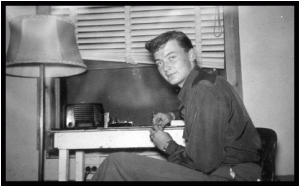
tonewritin2Dad (Tony) entered the Air Force at the outbreak of the Korean Conflict and quickly rose through the ranks. He was a superior clerk and administrator who served in the war zone and saw death and destruction near the 38th parallel. There is one story Dad used to relate that I really like. In the early days of his service, he was singled out for abuse by a mean-spirited corporal who particularly delighted in bullying the 88 lb. runt from Hudson Falls. Years later, after Tony had proven his abilities and achieved the rank of Tech. Staff Sergeant, this same corporal came to his office to receive his orders. He avoided Dad’s eyes as Dad handed them to him, and Tony asked quietly if the corporal remembered him. The former bully’s eyes darted around the room and back to his feet, as he nervously replied, “No, sir!” With that, Dad nodded and bid his former tormenter farewell without the dressing down he so richly deserved. He could have shipped the guy to Timbuktu.

Dad had a large impact on a great many lives outside of the immediate family, and was a great influence on me as a teacher, though I never saw him teach myself. I do recall early in my teaching career going into his school with him to get some materials and encountering three boys kicking a crushed milk carton back and forth in a stairwell. I wondered how my father (the teacher) was going to handle this- would they be sent to the office? Reprimanded? Told to pick up the milk carton and exit the building promptly? I think they were wondering this, too, when Dad just jumped in the middle and began to kick it around with them…

He rarely had discipline problems because he loved the students more than he loved the authority and power he had over them. He was never sour or burned out. He always came home from school humming to himself and generally in an upbeat mood. I can remember him saying on many occasions how much he loved his career “because the kids are always different-no two are ever alike.”

Before he retired in the early 1990s, the Glens Falls Post Star ran a feature article on DaRozells profile Feb. 3, 1992d and I as teachers. I think Dad hit it right on the head when he said, “Teaching is not a matter of how smart you are, it’s a matter of personality…If you know your subject and you’re fair, it doesn’t make any difference what you teach.”

++++++++++++++++++++++++++++++++++++++++++++++++++++++++++
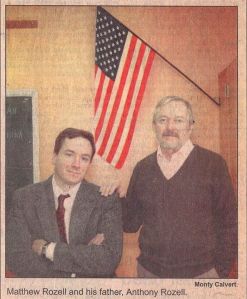
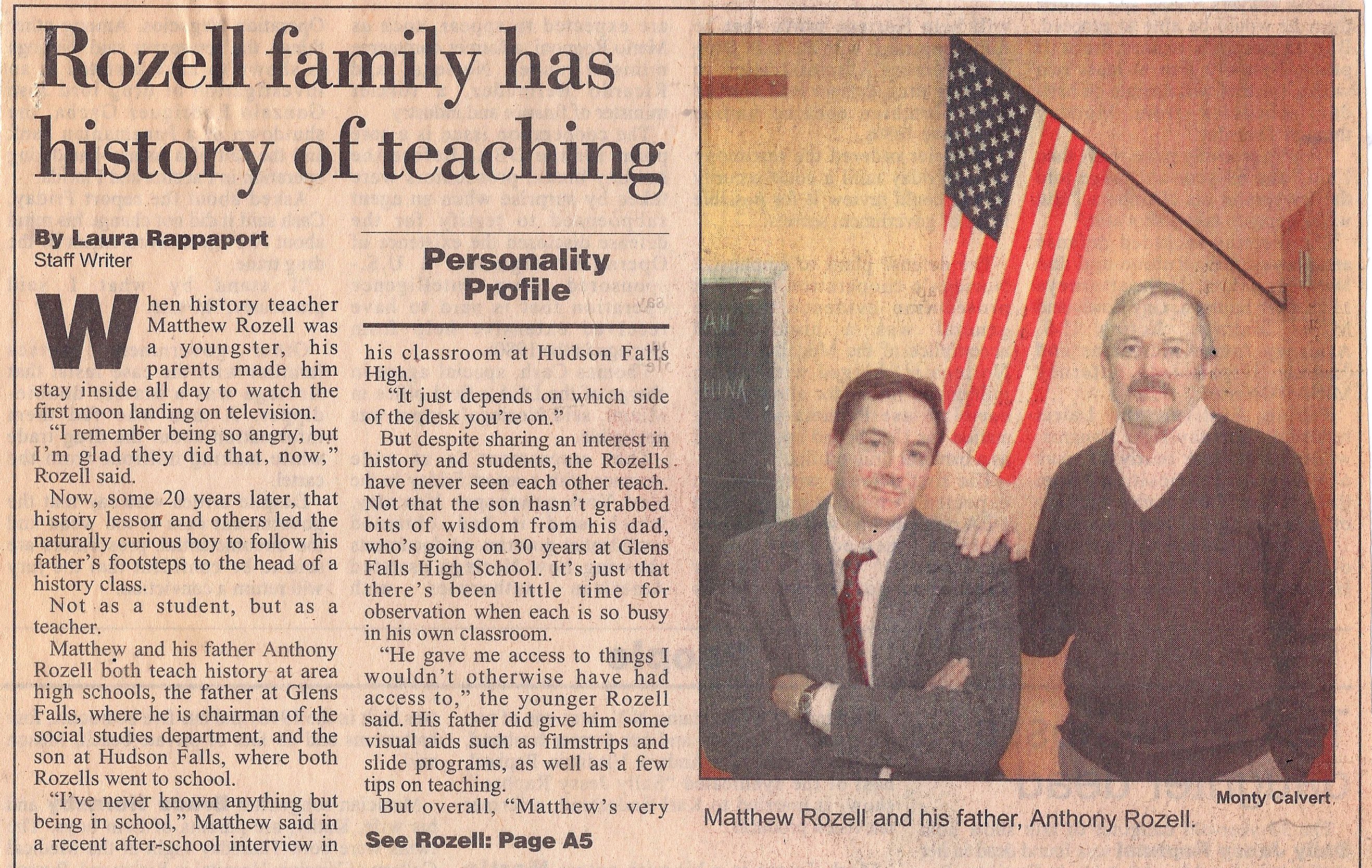
Feb 3, 1992 Glens Falls Post Star story. Captain and the Kid.

Feb 3, 1992 Glens Falls Post Star story. Captain and the Kid.

Rozell Family has “history” of teaching

By Laura Rappaport, Staff Writer

February 3, 1992

When history teacher Matthew Rozell was a youngster, his parents made him stay inside all day to watch the first moon landing on television.

“I remember being so angry, but I’m glad they did that, now,” Rozell said.

Now, some 20 years later, that history lesson and others led the naturally curious boy to follow his father’s footsteps to the head of a history class. Not as a student, but as a teacher.

Matthew and his father Anthony Rozell both teach history at area high schools, the father at Glens Falls, where he is chairman of the social studies department; and the son at Hudson Falls, where both Rozells went to school.

“I’ve never known anything but being in school,” Matthew said in a recent after-school interview in his classroom at Hudson Falls High, “It just depends on which side of the desk you’re on.”

But despite sharing an interest in history and students, the Rozells have never seen each other teach. Not that the son hasn’t grabbed bits of wisdom from his dad, who’s going on 30 years at Glens Falls High School. It’s just that there’s been little time for observation when each is so busy in his own classroom.

“He gave me access to things I wouldn’t otherwise have had access to,” the younger Rozell said. His father did give him some visual aids such as filmstrips and slide programs, as well as a few tips on teaching. But overall, “Matthew’s very independent,” his father said. Maybe so, but the younger Rozell credits his parents with kindling his interest in history by exposing him and his four siblings to it. On trips to Boston and New York City the family would visit the major museums and historical sites. “I was always very interested in what I saw,” said Matthew Rozell, adding that he usually had more questions than his brother and sisters. Also, with a father who teaches summer school, (Anthony taught summers in Hudson Falls for 21 years) it was hard to get away from school subjects – even for a few months. On summer afternoons or evenings, the father might play tapes or show slides of what he was working on in school. “It wasn’t like he would sit and make us watch it,” said Matthew. “I wasn’t enthralled, but at the same time I was exposed to it.” And his parents made sure their kids paid attention to important world events, like the historic moon landing. “He gave me money to go to the newsstand” for the momentous, occasions, Matthew said.

The elder Rozell is also a collector who hangs onto magazine and newspaper articles about the big stories of the day. His classroom bulletin boards at Glens Falls are covered with yellowing newspaper pages.

Contemplating retirement at the end of the next school year, the senior Rozell said he fell into teaching “out of the blue” in 1958 when there was a lack of teachers in the state. He had wanted to be a minister and started his education at St. Joseph’s Catholic Seminary in Yonkers. He already had almost all of the necessary graduate credits in history and was offered a chance to take a few more credits to become certified and guaranteed a teaching job. “I could not help but do that,” he recalled. “Once I got into it, everything fell into place, and 1’ve enjoyed it ever since.”

His son, now 30, followed a tougher path: jobs were scarce when he finished his teaching degree at State University of New York at Geneseo in 1985. He looked for work in the western part of the state, and even had the opportunity to run a restaurant or become a chef. But Matthew Rozell felt he shouldn’t throw away his education. “I spent too much money on my education to just give it up,” he said.

Failing to find a job in western New York, the young Rozell came home to Hudson Falls and stayed with his parents. He finally landed his present job – with a little help from dad,.- midway into the 1987 school year after a year at St. Mary’s Academy. He was the third teacher the class had that year, and it was a tough assignment. “When I first came here I was more interested in survival,” he acknowledged. “It’s like throwing a piece of meat to the wolves.” The more experienced Rozell helped his son through some of the rough spots in the beginning, and Matthew Rozell turns to his father less now, in his fifth year teaching.

Father and son are close, but they don’t spend a lot of time talking about education and lesson plans. The teachers’ wives may actually have been brought closer together by sharing similar work – in the South Glens Falls Central School District, Matthew observed. His wife Laura teaches special education at South Glens Falls, while his mother, Mary, is the school nurse teacher there. The two women have become very close, and usually go to staff meetings together, according to Matthew.

“They like to wear the same outfits on those days and see if anyone will notice,” he said.

Anthony Rozell looked back on his own long career in education and ahead to the future his son will face in the classroom. “A teacher today has access to so much material,” he said. “I didn’t have one iota of a film strip or a tape … I

21 years on. Article for release Feb. 2013. Dad is gone but spirit is raging. Erica Miller photo.

21 years on. Article for release Feb. 2013. Dad is gone but spirit is raging. Erica Miller photo.

just had to drum it into their heads,” Kids are different today, too, the father noted. More come to school with problems at home that can interfere with their studies. The students he gets the most joy from are those who bring with them a good attitude toward learning and toward life. “The ones you have that are happy people, smiling people, polite people, those are the ones you never forget,” he said. And those are usually students whose families take an interest in their learning and well-being. . “They know that they belong,” he said. “Their parents are really caretakers. That’s nice.”

And in the final analysis, said Anthony Rozell, there’s not a lot a father can really teach a son about the profession or art of teaching.

“A teacher finds, eventually, their own niche, their own method,” he said. “Teaching is not a matter of how smart you are, it’s a matter of personality …. If you’re strong and , fair, it doesn’t make any difference what you teach.”

++++++++++++++++++++++++++++++++++++++++++++++++++++++++++++++++++++++++++++++++++++

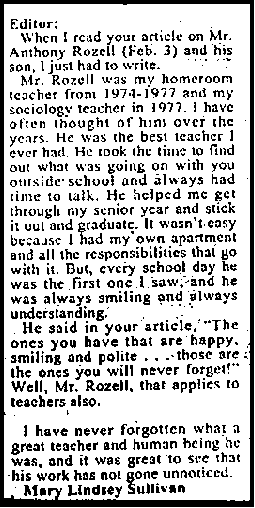
The Old Man was tickled when this letter to the editor appeared in the Post Star shortly thereafter…

I just had to write

++++++++++++++++++++++++++++++++++++++++++++++++++++++++++++++++++++++++++++++++++++

Brother Ned’s observations on the Dad’s 80th…

http://alaskatracks.blogspot.com/2011/12/tony-rozell.html

Read Full Post »

Just when you think that maybe things are “quieting down”,  an email comes in your inbox again.

At Thanksgiving Time.

Can’t wait to speak to Kurt. In the meantime, read below. He has to be around the 230th survivor of the train to make our acquaintance…good work Frank and Varda! Frank, you never cease to amaze me, at 95 yrs young, you are doing laps around me! So now I can share with the students, and fellow survivors and soldiers!

In the words of survivor Dr. Micha Tomkiewitz, “welcome to the family!”

—–Original Message—–
From: Kurt Bronner

Survivors Kurt Bronner and his lovely wife. Thanks to Frank and Varda W. for finding them- “welcome to the family”

Sent: Thursday, November 22, 2012 2:31 PM
To: Rozell Matt
Subject: Thanks

Dear Matt…This last week I have been in touch with Frank Towers and Varda W….They found me on the list on survivors of the deathtrain..I have seen movies and stories…Its like my past has been opened up…On this day of Thanksgiving I would like to wish you a happy peaceful Year and thank you for opening up a chapter of many survivors on that train…I live in Los Angeles and the Burbank school system has had a similar program and I have been talking to students in junior and high schools…Have 100s of letters from the students…Teachers like you are in my Golden book..Thank you for your groundbreaking efforts…with my best to You and your family with my love, Kurt Bronner

Teaching tolerance

April 08, 2000

by Irma Lemus, Burbank Leader

MEDIA DISTRICT NORTH — Fifty-five years have passed, but Kurt Bronner can still vividly recall his mother being beaten by a Nazi soldier as he watched helplessly through a barbed wire fence. It was the last time Bronner, now 74, ever saw his mother.

The Encino resident revisited the horrific nine months he spent at Bergen-Belsen, a concentration camp in northern Germany, Friday during a presentation to Burbank High School students.

The event was part of the Burbank Human Relations Council’s Holocaust remembrance program, held every April and May to coincide with Burbank’s Interfaith Days of Remembrance. About 25 Holocaust survivors and liberators are involved in the program, speaking at area schools about the human toll of hate and bigotry run amok

“If you remember anything from today, remember that hate exists and you, as future leaders, must stop the Holocaust from happening again,” Bronner, a Hungarian native, told the students.

“People think that it can’t happen here, but I remember my father once told me that it couldn’t happen in Hungary and it did,” said Bronner, who was removed from his home along with his family at the age of 17.

Don Duplechein, who served in the U.S. Army’s 567th Ambulance Company during World War II, also spoke to students Friday. He described the scene as he and about 30 other troops arrived at the Nazis’ Dachau death camp at the end of the war.

“You couldn’t believe it. When we arrived we saw people begging for food with lice all over their heads. We knew we had to feed and bathe these people,” Duplechein said.

To a small group of students who gathered after the presentation, Bronner spoke in more detail about his experiences in the concentration camp.

“A lot of people think that children were held at the camps, but the truth is that in a lot of the camps the children were killed and the only ones allowed to live were young people and adults,” he said.

Danny Screws, 17-year-old Burbank junior, said it was difficult to believe that nobody was willing to act to stop what was happening.

“I asked him [Bronner] how the government could let the people be treated that way. He told me that, although they were from Hungary, they were still Jews. I think that was wrong,” Screws said.

Bronner described traveling to the concentration camp by train with hundreds of people piled into a single boxcar, barely able to move or breathe . He talked about the horrible living conditions at the camps where thousands of people died from starvation and disease.

“I remember trying to find my father’s body as he was put on a horse-drawn carriage. I couldn’t find him to say goodbye because of all the bodies piled up,” said Bronner, whose father died at Bergen-Belsen.

Bronner was asked if he hated the Nazis for what they did to his family.

“You know, a student once asked me what I would do if the people that killed my parents walked through the door. I told the student that killing the person wouldn’t bring my parents back and it would make me a killer. You have to forgive, but never forget,” he said.

Read Full Post »

« Newer Posts - Older Posts »