Feeds:
Posts
Comments

Archive for the ‘Uncategorized’ Category

Marc Silver

National Geographic News

Published April 8, 2013

 Note: This is from National Geographic. As the nations commemorates Holocaust Remembrance Week, I’ll be flying to Louisville for the annual 30th Infantry Division Veterans of World war II reunion to take part in the reuniting of 5 survivors with the division that liberated them. The 30th will also be honored with a flag in the annual national ceremony at the Capitol Rotunda. In April 2010 I was honored to be in attendance at the Rotunda ceremony with 121 liberators and dozens of survivors.

I will post more about these events later. In the meantime, if you have not read the news below, it is a staggering development.

The map of the Third Reich is being dramatically redrawn.

Thirteen years ago, when he started digging into the past to document the number and nature of Nazi-era ghettos and camps, scholar Geoffrey Megargee expected to identify perhaps 7,000 sites. He vastly underestimated his task. More than 42,200 sites will be named in the planned seven-volume encyclopedia that he is editing: The United States Holocaust Memorial Museum Encyclopedia of Camps and Ghettos, 1933-1945.

This week is Holocaust remembrance week in the United States, with an official ceremony at the U.S. Capitol Rotunda on April 11 at 11 a.m. For the latest insights into the Nazi era, we spoke with Megargee and Martin Dean, editor of volume two of the encyclopedia: Ghettos in German-Occupied Eastern Europe.

“To document this on a map and see how the Holocaust affected every single community throughout Europe makes quite clear the scope of the Nazi regime’s murder campaign,” says Dean.

Investigating the Sites

To be included in the encyclopedia, a site had to have housed at least 20 people and have been in existence for at least a month. In addition, it had to have been identified on a map—not the easiest thing to do when some towns in question have changed their names several times since  World War II ended.

The scholars drew upon past research and interviews with survivors but also sought records that have “disappeared into archives in a dozen different countries,” says Megargee. Many of the archives were behind the Iron Curtain until the 1990s, off limits to outside scholars. Even now some are restricted.

The sites include the extermination camps where gas chambers were built for “the final solution” of murdering the Jewish people. But that’s only part of the project’s scope.

“We’re not just looking at sites directly involved with the Holocaust,” says Megargee, “but [also] with the entire range of persecutory facilities that the Nazis and their allies ran.”

Forced Laborers Everywhere

Each listing has a careful yet hair-raising description of the site, drawing from records as well as survivor testimony. Many of the encyclopedia entries were forced labor camps.

“Think of what life was like in Germany,” Megargee says. “There were foreign forced laborers in every conceivable kind of business: farms, factories, retail shops, hospitals, railroads. You couldn’t go anywhere in Germany without encountering people being held against their will and forced to work. Their rights were being violated.”

And it would have been no secret to German citizens that these laborers were in their midst. “Even in a large city, you know who lives in your neighborhood—and who doesn’t,” Megargee says. “And you could see barracks where these forced laborers lived.”

Workers thought to be shirking their duties were sent to work education camps. They faced up to eight weeks of very hard labor along with beatings and possibly solitary confinement. If there was evidence of a change in behavior, the worker could go back to the forced labor camp. If not, he or she might be sent to a concentration camp.

The Work Education Camp Watenstedt-Salzgitter, established “in some woods just to the northeast of Hallendorf” in Germany, could hold about 800 female prisoners and 1,000 males at a time. The Encyclopedia entry mentions 492 documented deaths there in 1942 attributed to “weak heart” or “shot while trying to escape.” A survivor of the camp recalls an SS man “who beat the prisoners on their way to breakfast.” (There were Jewish inmates at this camp, but in most forced labor and work education camps in Germany, the internees were typically non-Jewish Europeans.)

Staggering Death Rate

Megargee says some of the categories of sites he found were “particularly surprising or horrible.” The so-called Care Facilities for Foreign Women and Their Children were essentially holding pens for female workers, typically from Eastern Europe, who had become pregnant. At an earlier stage in the Nazi regime, these women would have been sent home to have the child. After 1943, they were sent to the Care Facilities, where “the baby was either aborted or, after birth, would be killed by slow starvation,” says Megargee.

European Jews were first confined to ghettos. When the ghettos were shut down, most Jews were killed; only a few were selected for work and sent to forced labor and concentration camps, where they again were periodically selected to continue working or to be killed. The death rate for European Jews in the camps and ghettos was a “staggering” 90 percent, compared with 10 percent for the foreign workers held in German forced labor camps, Dean notes.

The Encyclopedia of Camps and Ghettos pays tribute to those many millions imprisoned and slaughtered by the Nazis by its memorialization of all the site names. On its pages a reader will find camps that few people have heard of, like the work camp at St. Martin’s Cemetery in Poznan, Poland, where Jews had to excavate Polish graves to look for gold teeth, jewelry, or brass, and even smash up the headstones for the Nazi war effort. And there are the infamous names etched in the world’s memory, like Auschwitz-Birkenau with its gas chambers.

“This is giving recognition to all of the thousands of places where people suffered and died,” says Martin, “that would otherwise fade from people’s consciousness.”

http://news.nationalgeographic.com/news/2013/04/130408-encyclopedia-labor-camps-nazi-holocaust-memorial-museum-holocaust-remembrance-week/

Read Full Post »

I just got home from a Yom Hashoah event, Holocaust Remembrance, that was pretty intense.

Three American candles.You know that when folks come up after you speak and squeeze your hands that you have made a favorable impression. Teachers in the audience come up to say they feel inspired.

But  they know that it is not about me.

I let the liberator and the survivor do the talking (see link below), then spoke about our obligations as the new witnesses to carry on the story.

Of course the event is about those who perished. But we must listen while we can to the survivors and become the new witnesses.

For those of you who came out, I re-post the narrative here-scroll down to the bottom for the NPR story, in 3 parts, from You Tube.   To those of you who may be curious, do it. You don’t even have to watch, just turn it up and listen. Set aside a few moments of time to recall, together, the moment of liberation and the aftermath.

But also remember that if we let the liberator’s final message go by the wayside [part 3], then we have learned nothing. Our kids, our students deserve better. Trust me, if you are an educator, or an educational administrator {my emphasis} puzzled with how to get kids to DO ANYTHING for you, they will respond for you with this, if presented correctly.

And as a final aside, the three candles pictured above, Red, White, and Blue, are for

Major Clarence Benjamin,

Dr. (SGT) George C. Gross, tank commander,

and Judge (SGT) Carrol S. Walsh, tank commander.

I kept alive their stories tonight.

Thanks to survivor Bruria Falik for thinking of this, in addition to the six candles for the millions lost and the candle for the 2nd generation. It was my honor to explain their significance. To those of you who offered your support and feedback, in person or on line, thank you. It is what I kind of need sometimes to know that I am making a difference.

Feel free to leave response!

MR

April 7, 2013

Read Full Post »

Holocaust Remembrance Day Schedule

Jewish Federation of Ulster County
Sunday, April 7, 2013

PROGRAM
Please enter quietly, take a card, light a candle, and then take a seat

Music composed by MARJORIE BERMAN and sung by the WJC YOUTH CHOIR

 Welcome by HARRIET MILLER, President of Ulster County Jewish Federation and
BRURIA FALIK, member of the Board of the Ulster County Jewish Federation

 Lighting of the 6 Memorial candles

Poem: I am a survivor, written BY SANDY FALK, and read by DANNY FALK, children of Bruria Falik

RABBI JONATHAN KLIGER leads the Kaddish

Candle lighting honoring the memory of liberators MAJOR CLARENCE BENJAMIN,
TANK COMMANDER GEORGE C. GROSS, and JUDGE CARROL WALSH

 JULIA INDICHOVA will read a Memorial Poem

RUTH HIRSCH will speak briefly

Survivors will briefly share their experiences

MATTHEW ROZELL will present “Honoring the Hours of Liberation and Defeating the Legacy of Hitler”

MR. ROZELL is responsible for reuniting Holocaust survivors of the Bergen Belsen concentration camp with the actual American solders who liberated them from a train transport in the closing days of World War II. To date, over 240 survivors have been located around the world, and ten reunions have been held since 2007 with the soldiers who freed them.

Mr. Rozell and his students were named ABC World News “Person of the Week” in September, 2009. He is also a Teaching Fellow of the United States Holocaust Memorial Museum, and has spoken on behalf of their educational programs. The museum maintains a national corps of skilled secondary teachers who serve as leaders in Holocaust education.

Matthew Rozell is also a history teacher from Hudson Falls, NY, and the 2012 recipient of the National Society of the Daughters of the American Revolution Founders’ Medal for Education. For the past twenty years he has worked with high school students in preserving the narrative history of the World War II generation. Mr. Rozell was recently selected to travel to Germany, the Czech Republic and Poland for three weeks this summer to study the Holocaust with the Holocaust and Jewish Resistance Teachers’ Program. His work can be seen at teachinghistorymatters.wordpress.com.

Refreshments will be served following the program.

Read Full Post »

USS Thresher Sinking: Impacts of Deadliest Submarine Disaster In U.S. History Remembered 50 Years Later

By David Sharp 04/05/13 02:47 AM ET EDT Associated Press

Note: Another somber anniversary. My friend Ted, a Cold War submariner, is in New Hampshire today to attend a reunion and also the ceremonies, to pay his respects.

KITTERY, Maine — The first sign of trouble for the USS Thresher was a garbled message about a “minor difficulty” after the nuclear-powered submarine descended to about 1,000 feet on what was supposed to be a routine test dive off Cape Cod.

Minutes later, the crew of a rescue ship made out the ominous words “exceeding test depth” and listened as the sub disintegrated under the crushing pressure of the sea. Just like that, the Thresher was gone, along with 129 men.

Fifty years ago, the deadliest submarine disaster in U.S. history delivered a blow to national pride during the Cold War and became the impetus for safety improvements. To this day, some designers and maintenance personnel listen to an audio recording of a submarine disintegrating to underscore the importance of safety.

“We can never, ever let that happen again,” said Vice Adm. Kevin McCoy, an engineer and former submariner who now serves as commander of the Naval Sea Systems Command in Washington, D.C.

This weekend, hundreds who lost loved ones when the Thresher sank will gather at memorial events in Portsmouth, N.H., and Kittery, Maine.

Built at Portsmouth Naval Shipyard in Kittery, and based in Groton, Conn., the first-in-class Thresher was the world’s most advanced fast attack submarine when it was commissioned in 1961.

Featuring a cigar-shaped hull and nuclear propulsion, the 278-foot-long submarine could travel underwater for unlimited distances. It could dive deeper than earlier submarines, enduring pressure at unforgiving depths. It was designed to be quieter, to avoid detection.

On April 10, 1963, the submarine already had undergone initial sea trials and was back in the ocean about 220 miles off Cape Cod, Mass., for deep-dive testing. Some submariners are baffled by the initial message about a minor difficulty because it’s believed a brazed joint on an interior pipe had burst – a problem anything but minor.

The Navy believes sea water sprayed onto an electrical panel, shorting it out and causing an emergency shutdown of the nuclear reactor.

The submarine alerted the USS Skylark, a rescue ship trailing it, that it was attempting to surface by emptying its ballast tanks. But that system failed, and the sub descended below crush depth.

Understanding their dire situation, Navy crew members and civilian technicians would have scrambled to close valves to try to stem the flooding, struggled with a ballast system disabled by ice, and worked to restore propulsion by restarting the reactor, a 20-minute process.

Their deaths would have been instant because of the force of the violent implosion. The sub’s remnants came to a rest on the ocean floor at a depth of 8,500 feet.

There was nothing the divers on the Skylark could do.

“It’s one of those times when there’s silence,” recalled Danny Miller, one of the Skylark divers, now 70 and living in Farmington, Mo. “You don’t know what to say. You don’t know how to feel. You just know something tragic has happened.”

The Thresher wreckage covers a mile of ocean floor, according to University of Rhode Island oceanographer Robert Ballard, who used his 1985 discovery of RMS Titanic as a Cold War cover for the fact that he had surveyed the Thresher on the same mission.

“It was like someone put the submarine in a shredding machine,” Ballard said in a recent interview. “It was breathtaking. There were only a couple of parts that looked like a submarine.”

Word of the disaster spread quickly.

Paul O’Connor, now a union president at Portsmouth Naval Shipyard, remembers seeing the bulletin on TV. He was 6. Barbara Currier, whose husband, Paul, was a civilian worker on the Thresher, was shopping with her daughters when she heard the news on the radio in a store.

What followed was a blur of activity for families. Navy officers in dress whites showed up on doorsteps. Friends and neighbors brought food.

After the submarine was declared sunk, President John F. Kennedy ordered the nation’s flags lowered to half-staff. International leaders sent condolences.

“The men, they were heroes. Most of them were doing what they wanted to do for their country to keep the country safe,” said Currier, 86, who never remarried and still lives in the same house in Exeter, N.H. “They were pushing things to the limit.”

For the families, the silver lining is that subs are now safer. The Navy accelerated safety improvements and created a program called “SUBSAFE,” an extensive series of design modifications, training and other improvements.

People involved in the SUBSAFE program are required to watch a documentary about the Thresher that ends with an actual underwater recording featuring the eerie sounds of metal creaking and bending as a U.S. Navy submarine breaks apart with the loss of all hands.

“Every job we do, we need to have in the back of our minds that we have the lives of the sailors in our hands. It’s that critical and it’s that literal,” said O’Connor, president of the Metal Trades Council.

Hundreds of family and friends of the Thresher’s crew, along with sailors who previously served on the submarine, will gather Saturday for a memorial service in Portsmouth, N.H. A day later, neighboring Kittery will dedicate a flagpole that stretches 129 feet high in remembrance of the number of lives lost.

Because of their tender ages, and the lack of a body or proper grave site, children like Vivian Lindstrom, who lost her father, Samuel Dabruzzi, a Navy electronics technician, were unable to grieve properly.

Thanks to the reunions, they at least know they’re not alone, said Lindstrom, of Glenwood City, Wis.

“We’ve experienced the same things, felt the same things,” she said. “We feel like family. We call ourselves the Thresher family.”

Read Full Post »

eisenhower at ushmmBy BRIDGET MURPHY, Associated Press

BOSTON (AP) — Matthew Nash’s grandfather only mentioned the photographs to him once.

Twenty-five-years later, they are the subject of a new documentary on the Holocaust that Nash spent three years making after finding the pictures his grandfather took while serving as an Army medic in World War II.

Kept hidden from Nash and others in the family, the photos were not something Nash’s grandfather seemed to want to talk about with relatives. But they were something he could never forget.

Nash’s film — “16 Photographs at Ohrdruf” — tells of the first concentration camp that U.S. soldiers liberated in 1945.

The 72-minute film will have its first public screening Thursday evening at Lesley University in Cambridge, Mass., and also will be shown as part of the Boston International Film Festival on April 16 and the G.I. Film Festival in Washington in May.

The summer he was 12, Nash asked about his grandfather’s World War II service as the two were stacking wood in his grandparents’ barn in East Dorset, Vt.

“As I recall he got really quiet,” said Nash, now a 37-year-old photography professor at Lesley University. “I think he just said, ‘Yeah, we saw some really terrible things. When you get a little older, I’ll show you some pictures and you’ll understand.'”

But Donald Grant Johnson, a former Army lieutenant, died in 1991 without sharing the photos with his grandson. Family members only spoke of the pictures in whispers.

When Nash’s grandmother threatened to destroy them when the subject came up at Thanksgiving dinner in 1995, Nash and his sister felt compelled to secretly sift through their late grandfather’s belongings the following Christmas. That’s when they found an envelope marked “Holocaust” tucked away in a wooden trunk. Inside were a few letters and a series of snapshots of a war horror the 23-year-old Johnson encountered as a soldier in April 1945.

Johnson took most of the photos at Ohrdruf in Germany. Nash believes his grandfather may have treated survivors of the camp, which the Germans had formed as a sub-camp of Buchenwald.

On a personalized sheet of notepaper with “Don Johnson” printed at the top, the 65th Infantry Division Army veteran cataloged the photo collection as best he could.

“Lime Pit — effort to destroy bodies,” reads one handwritten caption. “Griddle used in (vain) attempt to incinerate bodies — note skull bottom center,” reads another. “Small stack of bodies,” says yet another.

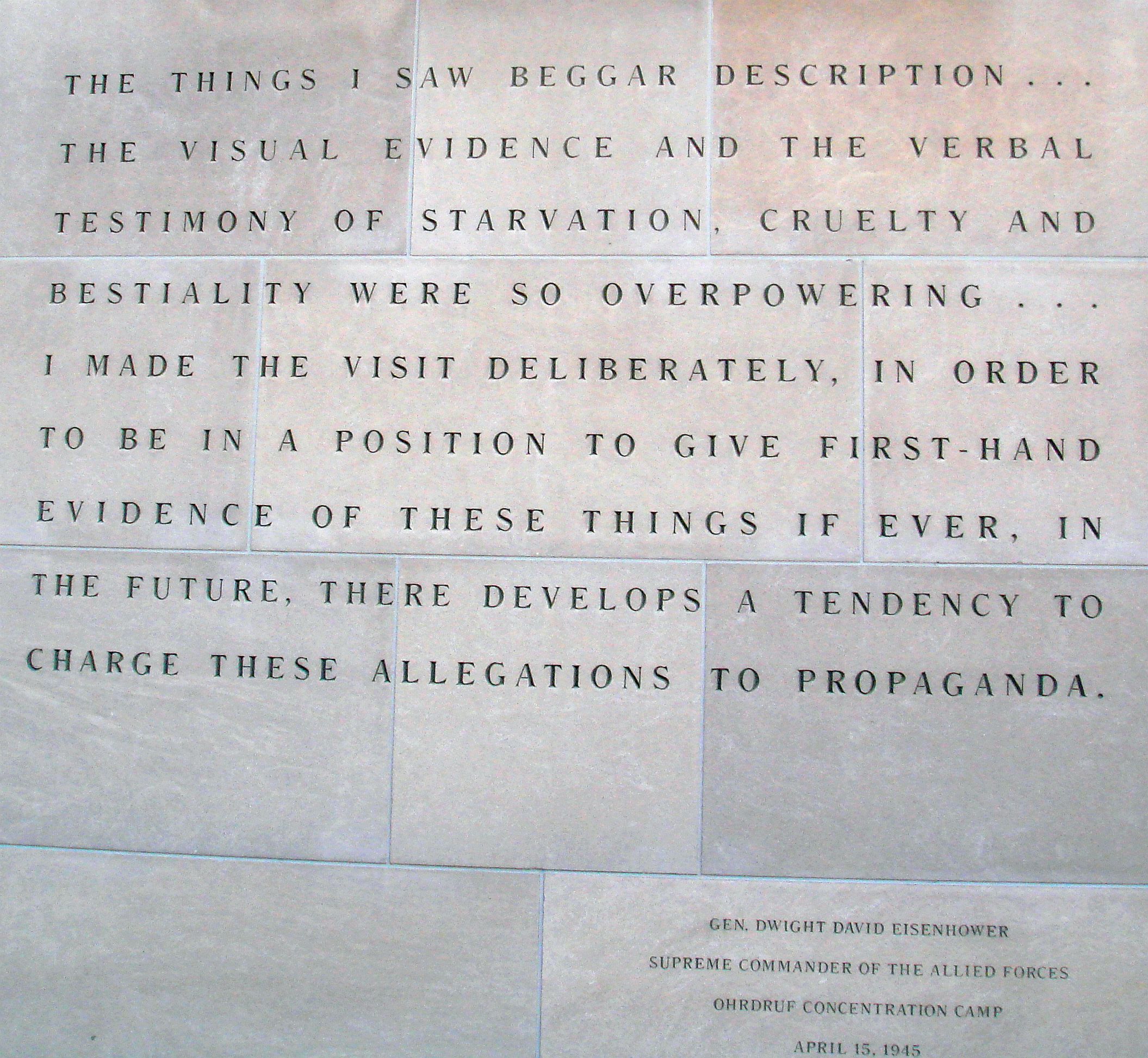
Soldiers are on the outskirts of some of Johnson’s shots, standing together to view piles of emaciated and burned corpses. Gen. Dwight D. Eisenhower wanted many witnesses to the Nazi atrocity so that reports of it couldn’t be dismissed as propaganda.

“He had as many units as possible come and see the camp,” said Geoffrey Megargee, a scholar from the U.S. Holocaust Memorial Museum who appears in Nash’s film.

Johnson likely came to Ohrdruf within a few days of its liberation. He later returned home to become a banker, National Guard soldier, and a volunteer emergency-medical technician.

Some of Johnson’s photos show survivors, including what he described as a survivor being treated by two camp doctors. The skeletal-looking man is lying on a cot, with what appears to be an open wound on his hip, as the men stand beside him. In another, a bare-chested boy of about 14 looks toward the camera, with what appears to be prisoner barracks in the background.

Nash found 19 photos in all and used 16 in his film. His research showed his grandfather may have shot a few of the photos at Mauthausen concentration camp in Austria.

The professor also discovered from letters his grandfather packed away with the pictures that he had wanted his photographs to become part of the U.S. Holocaust Memorial Museum. He said in one letter that he had visited more than one concentration camp, but Ohrdruf was engraved in his memory.

“I keep the pictures close at hand and have made a point of looking at them frequently,” Johnson wrote. “And, during my years of National Guard service, I made a point of showing them to the personnel, hoping we could prevent any such disasters from happening again.”

Johnson died two years before the museum opened, and before he sent the pictures. Nash has since given the photos to the museum for its archives, and said he’s proud to have done that for his grandfather.

Nash made the documentary with about $5,000 and the help of friends in the film business.

Among film interviewees, Nash talked to veterans who served in the same infantry division as his grandfather, including Boston resident Edwin “Bud” Waite. The 87-year-old was an infantry soldier who wasn’t part of liberating concentration camps, but visited Dachau later. He said he sees value in Nash’s film effort.

“I think it’s very important because the younger people nowadays, they don’t really understand concentration camps back in World War II,” Waite said.

Megargee, who will give a lecture before Thursday’s screening, said Nash’s film opens up a personal window into what the Allies were fighting against in World War II.

“When you can personalize the history, especially for younger kids, it helps to get them interested. It’s one thing to talk about tens of thousands of camps. It’s another thing to bring it down to the level of one American soldier,” he said.

Copyright 2013 The Associated Press.

Read Full Post »

Woodstock event remembers Holocaust

WOODSTOCK, N.Y. — A Yom Hashoah event that will remember the Holocaust will take place April 7 at 3 p.m. at the Woodstock Jewish Congregation, 1682 Glasco Turnpike, Woodstock NY, 12498.

Synagogue Main Number (845) 679-2218
Email info@wjcshul.org
Persons of all faiths are welcome.

The Yom Hashoah  observance will include a candlelight memorial service, followed by an address by Matthew Rozell titled “Honoring the Hour of Liberation and Defeating the Legacy of Hitler.” Rozell is the founder of a project that has reunited survivors from the Bergen-Belsen concentration camp with the U.S. soldiers who liberated them from a train transport during the closing days of World War II. To date, with the help of Varda Weisskopf and Frank Towers, more than 240 survivors worldwide have been located, and 10 reunions have taken place since 2007. Rozell is also a teaching fellow at the United States Holocaust Memorial Museum and has spoken on behalf of its educational programs. His work can be seen at teachinghistorymatters.wordpress.com.

The ABC News video can be seen here.

Read Full Post »

So I am going to the Stations of the Cross at our local church. I have never gone before.  It is Friday evening and there are about a dozen worshipers in attendance and my family is going to lead the procession. In fact, we are the procession.

My daughter and son flank me with candles and I have the heavy cross. We stand before each station as my wife is at the lectern reading the text for the parishioners to follow and respond to. At the cue of the organ, we move on.

Somewhere along the way the candles go out, first with Mary and then with Ned. Kind of symbolic given what comes next.

Laura reads the text from the proscribed booklet, beautifully.  I’m trying to follow along but frankly am kind of distracted by the candles going out and my aching feet. Maybe they are supposed to hurt, maybe that’s the point. To reflect on all this suffering, and then death.

But flanked by my children I am jolted back with the utterance from the lectern: something near the tenth station about how somebody in the storyline has to practice Christianity in secret, “…because of the Jews.”

It’s 2013. This is the church that reared me. At the lectern where I eulogized my  father, my wife reads the proscribed text: because of the Jews. After the service I check the booklet- yep, it’s there, she read it like she was supposed to. Imprimatur.

*             *             *             *             *             *             *             *

Though my father would go to the Stations during Lent, this is our first time. To tell you the truth, I’m left a bit devastated. On the ride home, I can’t help but think back to the pogroms that would occur on Good Friday, where houses are torched and people are beat up and killed after church service. Jews. How innocent people who knew that to be on the streets this day was to be a target, instead had to “lay low” on that day. Since childhood I perceived being born on Good Friday as a badge of honor of sorts-so why now I am reflecting on people murdered by angry mobs on that day, throughout history?

*             *             *             *             *             *             *             *

Sometimes I feel the eyebrows arching behind my back for my interest in studying and teaching the Holocaust.

Son at Western Wall, Jerusalem.

Son at Western Wall, Jerusalem.

First, the obvious. People I don’t know have railed against me on the Internet, implying that traumatized liberator soldiers are liars. The Jews are lying again. That the survivors are pictures of health. That I should educate myself.

Then, the more subtle. I’m not Jewish.  People I do know perpetuate stereotypes about Jews and money, Jews and finance- well, if I was Jewish, very likely at some point in time I would have been forbidden from practicing the trade of my choice. If an angry mob was going to burn down my business and drive me out of my home, my village, maybe I’d go into a more “portable” means of sustaining my family, too.

But also sometimes I think I’m regarded with curiosity by some people in the Jewish community. Some people wonder why I am so dedicated to this mission. Some do not understand why a non-Jew takes the interest to do what I have done, but to me it is simple.

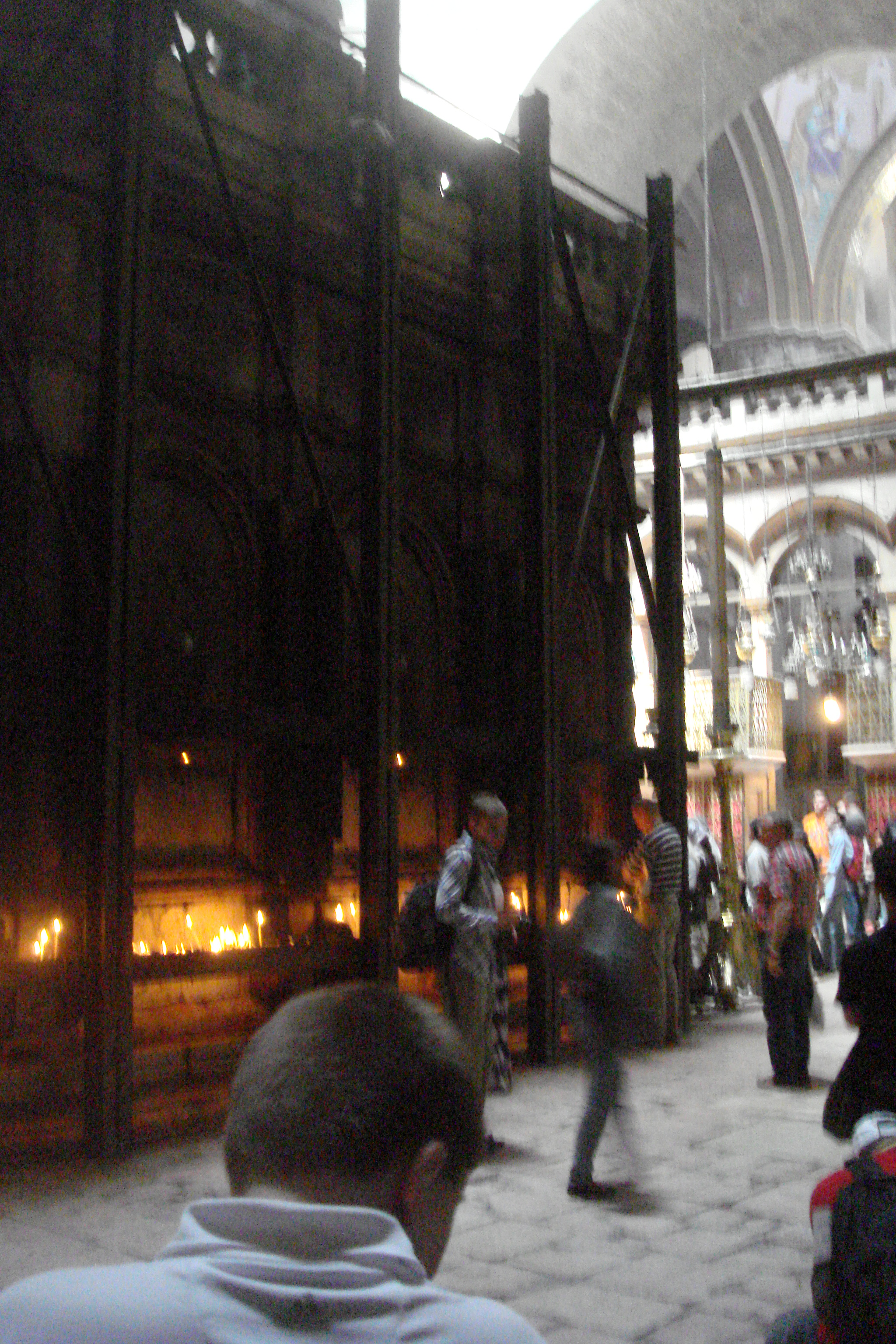
Son at Christ's Tomb, Jerusalem.

Son at Christ’s Tomb, Jerusalem.

I’m a human being.

It was a Jewish catastrophe, but also an unprecedented tragedy for the entire human race. We all have to deal with it and sort it out. Being an educator, it naturally follows that there are significant lessons here.

I also think I am justified in arguing that these lessons are urgent.

Following the Sabbath, the Jewish mother goes to claim her Jewish son, so many years ago. In 2013, my birthday falls on Easter.

I’ll  think about this- meditating on the photos here that I took myself-that maybe it’s time to set aside what keeps us apart. We’ll light the candles again.

And as we begin Passover/Holy Week, I’ll end on this note: “Whether discovered in the story of a nation making the journey from Abraham’s early successes to the Israelites’ slavery and subsequent redemption, or in the story of one who lives, dies and is born again, we must all celebrate that life holds more possibility and potential than we first imagine — that there is reason for hope, and that in celebrating triumphs of hope from the past, we can unleash new stories of hope in the present and in the future.”1

Read Full Post »

last trainOn the Occasion of the Release of Rona Arato’s The Last Train

My name is Matthew Rozell and I have the good fortune to call Paul and Rona Arato my friends.

I congratulate Paul and Rona on the launch of the new book, The Last Train. In my role as a teacher I sat down with an animated veteran of World War II a dozen summers ago. He was a tank commander and he had many stories to tell. Rocking back and forth, smiling, and with a twinkle in his eye, he recounted the events of 2 generations past. He told of many close calls and occasions when he was sure he was about to die. He talked about his friends and the bonds that were forged under combat, and the fellow soldiers that he lost. He remembered all of their names.

I would have been twenty-four. I would have been in combat for nine months. That is a long time to survive. To survive nine months was to survive a hundred years. I could not even remember my former life…I was a fugitive from the law of averages, as it was. 

Towards the end of my visit with him in the summer of 2001, his daughter, who was standing in the background, asked her father if I had been told about “the train”. No, Carrol Walsh, or “Red” as he was known by his soldier friends, for his fiery hair and the Irish temperament that accompanied it, he had not told me about the train. So he began:

Well, late in the war, again that nice, beautiful April day.  We were shooting like crazy across the top of Germany and Major Benjamin of the 743rd {Tank Battalion} was kind of out ahead scouting a little bit… he came back to the battalion and he pulled my tank and George Gross’s tank [fellow tank commander] out.  He told us to go with him.  So we did.

We came to a place where there was a long train of boxcars. … I can remember pulling up alongside the train of boxcars, Gross and I, and Major Benjamin. As it turned out, it was a train full of concentration camp victims, prisoners, who were being transported from one of their camps… I think they had been in Belsen, on their way to another camp…

 So there they were. All of these people, men, women, children, jam-packed in those boxcars, I couldn’t believe my eyes. And there they were! So, now they knew they were free, they were liberated. That was a nice, nice thing. I was there for a while that afternoon. You know, you got to feed these people. Give them water. They are in bad shape. Major Benjamin took some pictures, and George Gross took some pictures too…

I contacted George Gross, who gave me copies of the photographs that he and Major Benjamin took, some of which you see in this book. Dr. Gross also gave us a moving narrative that you will also find on our school website, along with dozens of other oral histories that the students and I collected.

Four years went by after they were placed online in 2002… Nothing happened. Then, out of the blue I heard from a grandmother who had been a seven year old girl on that train. She was utterly shocked to see photographs of the last transport she was ever on, and photographs of the day of her liberation. I am sure that Paul had similar feelings. And now the question Paul must have asked himself- do I really want to go there?

Thank heavens that he did.

Paul sent me the email described in Rona’s book four Thanksgivings ago. Little did he know how his life would be enriched, though I am certain that some of the horrors of his family’s experience in the Holocaust would be relived in the writing of this book, and as Paul told our high school kids, are relived in some fashion each day.

When I say enriched- that is not really the right word. I’m sure that for those who have witnessed Paul’s relationship with his liberators, we are witnessing a higher power at work.  It is the power of love that has transcended space and time, the same love that his beautiful mother showered on the children and the protectiveness of his older brother Oscar, revealed in Rona’s book.

Paul met his liberators on several occasions, but developed a particularly close bond with Red and his family. The last time I saw them together, we were at an intimate dinner gathering with Red and his family, Paul and Rona, and another survivor and her extend family.

I did not say much. I just wanted to watch and listen.

Paul and Red were seated together. Though Carrol was not feeling up to par, he roared with laughter as Paul told of flying to the USA at a tender age following his family’s move to Canada-Paul was going to design cars in Detroit, you see-and being picked up by law enforcement at the Detroit airport and driven to the bridge to Canada and bid farewell, as he had neglected the proper papers to emigrate. How Red got a kick out of that story.

But there was something else there, something that I will never be able to share, or that our families will never be quite able to touch, though Rona certainly comes the closest in her book. That was the bond between soldier and survivor, the unspoken love and joy at having been reconnected after so many years. Frank Towers, the lieutenant in the book, knows of this too.

Paul knows now that there are no coincidences. I think we all do.

On December 15th, 2012, I called Carrol in Florida where he was ailing. I did not want to admit it to myself, but my old friend was dying. We both knew it was our last conversation, but he was making jokes to the end. I fumbled a bit, and told him that the weather had been extremely cold up here in the North-ever since the Battle of the Bulge, freezing in subzero temperatures in his tank, he had hated the cold- and with fatigue in his voice he chuckled and said that “he hoped it was cold in the place where I am going”. Two days later after bidding his family goodbye, he slipped away peacefully.

World War II brought out the worst in humanity, and the Holocaust was the greatest crime in the history of the world. Carrol told us that he did not go to war to save the world- but that he had an obligation and he just wanted to get it over with. Survival would be a nice fringe benefit. Indeed, the liberation of the train was almost an afterthought for him.

But the actions of these soldiers, who after all had battles to fight and were still being shot at- to stop, and to take direct action so that hundreds and hundreds of sick and starving people were taken care of-that also speaks volumes of how the goodness of mankind manifested itself, and triumphed, in the cauldron of evil. We recognize as well the British and Canadian troops who would be traumatized at the liberation of Bergen Belsen two days after Paul and Oscar and their mom were freed from the train by the Americans. Sixty thousand sick and starving people greeted those soldiers, and eight hundred died the day of liberation. Thousands more would follow. The trauma is real, and it is felt by both survivor and soldier.

I send my well wishes to the survivor community in Toronto, where I have several additional friends who were also honored to forge a special bond with the soldiers who freed them from the train. Each has their own personal story, which I and my students have an obligation to keep with us as we have become the new witnesses.  I again congratulate Rona on the difficult job of writing this book. She too has added to our body of evidence of the greatest crime in the history of the world, but more importantly, she is keeping the word alive for the next generations of humanity-the obligation to never forget.

Matthew Rozell

Hudson Falls, New York

March 5th, 2013

Get the book here

Read Full Post »

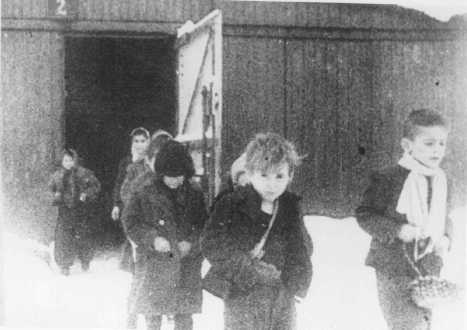
Soon after liberation, surviving children of the Auschwitz camp walk out of the children’s barracks. Poland, after January 27, 1945. — United States Holocaust Memorial Museum

Soon after liberation, surviving children of the Auschwitz camp walk out of the children’s barracks. Poland, after January 27, 1945. — United States Holocaust Memorial Museum

Today is International Holocaust Remembrance Day, the day Soviet troops over ran Auschwitz in 1945. This week I received a note from an Israeli survivor friend, shortly after the passing of one of her liberators, Carrol Walsh. Sara lost over 60 of her family there- and her immediate family was saved only because the day they arrived at Auschwitz, the death machinations were working at full capacity and her transport was rerouted to Belsen. She was liberated on 13 April on the evacuation transport near Farsleben, known here as the Train Near Magdeburg…

In her letter she asks important questions of me. I have responded the best that I could, below.

Dear Matthew,

 We were very sad to hear that Carrol Walsh passed away. Only lately did I get to know him, and he risked his life in order to save ours. It is a pity we did not get to meet more.

I can’t express in words the loving feelings for the young tank commander that for sure always had a smile on his face, and never stopped smiling after we met- 65 years after the victory. I am sure Carrol Walsh made the best out of his life; I was fulfilled to know him and his beautiful family.

I read about his profession in the years of his life. It was interesting to see how much meeting with us affected him.

I thank you for your unusual courage to initiate the exciting meeting [reunion].

I suppose you were very excited for the event you had initiated. Did the idea come in different parts? I am trying to understand the development of your thinking.
When you first wrote to me about the meeting [invitation to the proposed reunion], it was on the day we were released- the 13th of April. I got home after meeting my brothers and celebrating the release [liberation]day. I couldn’t relax, I immediately told all my brothers. I was so happy, as if it was happening again.

The meeting completed a missing part in the picture for me, after all the horrifying things we went through we couldn’t even dream of a miracle like that coming out of the blue.

I cannot go back more to the extermination camps and escort groups because I don’t have the physical nor mental power to do that anymore.

There are questions that bother me.

Are you able to answer them?

Why shouldn’t the world forget and let this be over?  

A. So, some people do want to forget. Others will say that it did not happen. For those reasons, it must never be forgotten. This is the biggest crime in the history of the world.

As Walsh states, how could humanity have stood by and let that happen?

Does my work, the hard work I do, do anything against the forgetting?

A.The most impressionable minds in the world are those of the youth. It is they who the Nazis “educated”; it made it easier for the crimes to be committed. This is why they must hear now.

The work that you, and I do, has an impression. I hope to continue this work after you must slow down. Please remember that.


You are a historian, should the memory be kept?

A.The memory must be kept. As educators it is our duty to keep it alive. We must fight those who trivialize or denigrate its importance.

Is there a proper way to keep the memory?

A.There is no one way except to be open to the discussion of humanity and how humans could do this to one another. We must also bear in mind however, that the soldiers who helped the suffering to new life bore their own pains in doing so, yet also made a choice to redeem humanity. Some did not sleep soundly for years.

I think this is so, and also must not be forgotten. The war brought out the most evil in the world. But I think it also revealed some goodness in the form of the soldiers who liberated or otherwise cared for the victims.

Who should be documenting everything, the “victim” or the “aggressor”?

A.The aggressor fades from memory. New generations asks questions. It is true that some are bothered by the questions. But the young will always be curious and want to know- is this a stain on the German people? I know some Germans today who work very hard to keep the memory alive, as you also do.

The victims give the testimony. This is all they can do. But it is the evidence of the crime, and one that new generations must work with. That is why your work is so important.

Who is in charge of making the conclusions?

A.I would say that institutions such as the United States Holocaust Memorial Museum and Yad Vashem are the world leaders in this area. I have been trained, well, I should hope, by the USHMM. I do not know enough about the German institutions but I hope to raise enough funds to travel to the camps and study there this summer.

Read Full Post »

I made this video tribute a few years ago for my students. When it ends, they always sit in silence. The speech at the beginning was to striking sanitation workers in Memphis the night before he was killed.

Even though his birthday was last week, we stop and recall today.

For the sake of humanity.

You may enjoy. Five minutes of your time. Click the little gear for HD viewing.

Good also for kids to see to begin the conversation.

Peace and every good wish.

Read Full Post »

« Newer Posts - Older Posts »