Feeds:
Posts
Comments

Archive for the ‘Uncategorized’ Category

A Conversation with Rona Arato, author of THE LAST TRAIN: A HOLOCAUST STORY

By Sharon Salluzzo

In The Last Train, Rona Arato deftly tells her husband Paul’s remembrances of his life between April 1944 and November 1945. Paul was five years old when he, his ten-year-old brother, Oscar, and their mother (his father had already been taken away to a work camp) were taken from their home and forced into a ghetto, put in boxcars and taken to a farm in Austria, and finally to Bergen Belsen Concentration Camp. In April 1945, Paul and his family were again put in boxcars. American soldiers, who were in combat at the time, liberated the train near Farsleben, Germany. The physical and psychological horrors endured by Paul make a very strong impact. Rona lets the events carry the book.

But the story doesn’t end there. In September 2009, Hudson Falls, NY history teacher, Matt Rozell, held a Holocaust Symposium and a reunion for the train survivors and the soldiers who liberated the train. They spoke with students, and with one another. It was a time of great emotion, constantly moving between sorrow and joy. I am so glad that Rona included Paul’s remarks to the students in her book. I was fortunate to be in the audience at the symposium, and I will never forget listening to Paul as he spoke. I grew up having seen a photograph that Paul waited sixty years to see. My father was one of the U.S. soldiers who liberated the train. I sat next to Rona at dinner that last night of the reunion. She said she wanted to write Paul’s story. Four years later it has now been published. I am delighted to share a conversation I recently had with her.

Sharon: What kind of preparation did you have to do in order to write THE LAST TRAIN?

Rona: I often tell people that when I married Paul, I married the Holocaust. While it was at the symposium at Hudson Falls High School that I became determined to write Paul’s story, I have been accumulating information and background since our marriage. To get a better understanding of his background, I interviewed Holocaust survivors for Steven Spielberg’s Survivors of the Shoa Visual History Foundation between 1994 and 1998. Paul had applied for family reparations after the War, and I read the outlines. Occasionally, he would tell me some of his experiences. In the late 1970s or early 80s, he and I visited Karcag, Hungary, Paul’s hometown. It was still under Communist control and very much the way it was when Paul lived there. The roads were mud. Some of the people were still pumping their water from the community well. I was able to get a feeling for his life and what they had been through. Writing this book was an emotional journey but also a fascinating journey. I heard the testimony of other train survivors during the symposium. One of them, Leslie Meisels, had worked with Paul for years before they discovered they were both on that train. Isn’t that an amazing coincidence? Of course I was doing research through books and online websites right up to publication. In fact, I had to call my editor and say “Stop the presses!” as I discovered a key fact. We had thought that these Hungarian Jews were rounded up and sent off by Nazi SS guards. Paul and I learned that it was actually Hungarian Gendarmes under SS troops who were sent by Adolf Eichmann. Paul said to me, “No wonder I could understand them. They were speaking Hungarian.” The end papers of the book are a copy of the transport page from the Bergen Belsen Memorial in Germany. The United States Holocaust Memorial Museum checked facts for me. And my editor was wonderful in telling me where I needed to fill in background information.

Sharon: Paul has his sixth birthday during this time. How do you get into the mind of a six-year-old boy who is held in a Nazi Concentration Camp?

Rona: While Paul’s childhood in Hungary and mine in the United States were very different, the timeframe was the same. It was easy for me to go back to what it was like growing up in the 1940s. I have a good imagination and can close my eyes and remember what it felt like to be that age. In addition, my grandchildren are young, and I am able to observe them and their reactions to situations.

Sharon: There are a number of photographs, including Paul’s parents as a young married couple, and Paul’s nursery school picture. How were these preserved?

Rona: Their house in Hungary was bombed, so there were no pictures left there after the war. Some photos were sent to Paul’s uncle in Cleveland. After the war, almost every town made a Yizkor book – Yizkor is the Hebrew word for memorial. These books chronicle the history of the town, the Jews who lived there before the war and list those who did not return. Paul’s nursery school picture comes from the Karcag book. When Paul and I visited Karcag, we photographed the water pump and the Synagogue. Some of the photos in the book were taken by the soldiers on the days the train and the camp were liberated. Did you know that the photograph of the woman and her daughter emerging from the death train is now on a list of the 40 most iconic Jewish pictures?

Sharon: That is amazing, Rona, because until a few years ago, it was known to only the soldiers who liberated the train. My Dad kept it in his top dresser drawer. When he told his story to (history teacher) Matt Rozell, Matt put it on his website. The Internet has been a powerful tool in spreading this story.
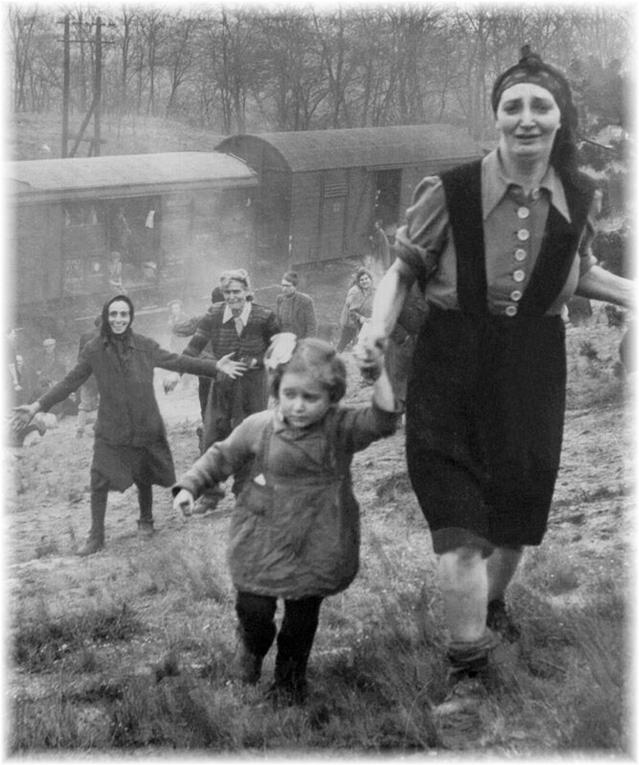
moment-of-liberation1.jpg

Rona: That was how we learned about the work Matt Rozell was doing. My son read an article on the Internet about the train and sent it to me. I gave it to Paul who recognized it as the train he had been on. We contacted Matt who said he was organizing a symposium at Hudson Falls High School. It was there that Paul and your Dad (Carrol Walsh) met. I included that wonderful picture of Paul and your Dad embracing right after Paul said, “Give me a hug. You saved my life!”

Sharon: Not only is it a great picture of Paul and Dad, but it captures the feeling of all the survivors who had spent a lifetime searching for the soldiers who saved them.

Sharon: How did you approach the actual writing and selection of words and language?

Rona: I wrote the story in English, not Hungarian, but I wrote in a way they might have spoken. I tried to use the vernacular of the time. We don’t have a record of their exact words but we do know how they would have spoken, and what they were feeling at the time. When I have included Hungarian or Yiddish words, I have included explanations for them. Writers always need to listen to how people speak.

Sharon: THE LAST TRAIN recounts historical events for which you have created dialogue between characters. How would you classify this book?

Rona: I would call it creative nonfiction, or fictionalized nonfiction. The events that happened to Paul are all true. Occasionally, I needed a bridge between incidents or to show the passage of time. When I created a scene, I discussed it with Paul for authenticity. For example, I included a scene in which Paul sights the return of the storks, and has a conversation with his mother. I needed something to create a sense of time and place, and what they were feeling in the absence of Paul’s father. When Paul told me there were storks that returned every spring, I knew I had found the bridge I needed. My intention was to recreate the history. To bring the reader along, the writer needs to show the drama of the events.

Sharon: There are many heart-stopping scenes: when Paul is confronted, nose-to-snout with the ferocious German Shepherd dogs; when he is separated from his mother and brother at the train station; when he sneaks through Bergen Belsen to visit his uncle; and, of course, when the SS guard shoots the boy standing next to Paul.

Rona: I was not going to include that last event. I thought it was too strong for my audience. I was telling my editor about it, and he insisted that I include it. He said it was important to tell exactly what happened.

Sharon: What did Paul think of the way you portray him?

Rona: When he first read it he said, “You are making me look like a bratty little kid.” I responded, “Well, you were!” But what I actually meant by that is he acted like a typical 5 or 6 year-old in that he was terrified. But his own distinctive personality also shows through where he was both feisty and stubborn. These were important traits to have.

Sharon: Why did you include the reunion in the book?

Rona: The reunion was approximately 60 years after their liberation. It was, without a doubt, one of the most amazing shared experiences of my life. The powerful feelings shared by the soldiers and survivors radiated to their families and to the students at the high school. They were reunited because a high school history teacher interviewed a soldier and the information was put on his website. For the survivors and soldiers to share this experience with the students is so important. These students will share what they heard with their children. They are the ones who will pass along what happened. It was a life changing experience for everyone involved.

Sharon: What has surprised you most about the publication of THE LAST TRAIN?

Rona: That the audience goes beyond middle school and high school. Their parents and other adults are reading the book and responding.

Sharon: What would you like to see children and adults take away from this book?

Rona: This is a universal story of survival. I want my readers to see how this family and their extended family took care of each other and watched over each other. Paul’s mother was suffering with typhus and her young sons literally propped her up at roll call so the soldiers would not see how ill she was. Oscar became a father figure for Paul. He told Paul to stand up straight and not to cry. In the camps you don’t break down. I want my readers to be able to say, “Thank God I have the right to show my emotions. It’s okay to be a kid.”

Sharon: Thank you for speaking with me today. Paul’s family returned to Hungary, but life changed tremendously. He eventually came to Canada. Is there another book here?

Rona: There very well could be! It was not easy getting out of Communist Hungary.

The Last Train offers so much in terms of discussion points. It makes a huge impact in its 142 pages. It would be a great introduction to a study of the Holocaust for high school students. It is also accessible for 10 year-year-olds. Adults will truly understand the importance of both parts of this story. Of course there are the general topics of World War II and the Holocaust but there are also topics of bullying, physical and psychological fears, strength and courage, mother-child relationship, sibling relationship, family and friendship, defining a hero, the impact of a photograph, and hope. It is a story of captivity and deliverance; a story of new-found friendships, deep respect and a sense of inner peace discovered sixty years beyond the events of World War II.

WATCH PAUL ARATO SPEAK TO STUDENTS FOR THE FIRST TIME

Rona’s presentation on THE LAST TRAIN includes a Power Point display including original photographs. It is suitable for children nine and up as well as adults. For more information about Rona Arato, her books and her presentations, visit www.ronaarato.com.

To book Rona for a visit, go to www.childrenslit.com/bookingservice/arato-rona

If, after reading The Last Train, you would like more information about the train to Magdeburg and the Hudson Falls High School symposium, please go to Matt Rozell’s site: https://teachinghistorymatters.com/. By the way, train survivors are still contacting Matt from all around the world. Frank Towers, the lieutenant who oversaw the liberation, has made it his life’s work to locate any remaining survivors. To date, about 350 have been found.

found at http://www.clcd.com/features/th_Rona_Arato_Final.php

Read Full Post »

Numbers dwindling, WWII veterans continue poignant reunions, renewing bonds forged in battle

Article by: DAN SEWELL , Associated Press
NOTE: I was reading this article in my hometown paper yesterday. Frank Towers is mentioned halfway in. Then I remembered some time ago the AP contacted me looking for info on WW2 reunions, and I gave them Frank’s contact info. So yes this is another cut and paste update, but I did have something to do with the article! That’s 1st Lt. Frank Towers- the guy charged with shuffling dazed Holocaust survivors to food and shelter, April, 1945…. He’s 96, planning another reunion in Savannah in Feb. I’ve been to his last 6 reunions. There is nothing like getting up at 6am for breakfast with a table of these guys.

DAYTON, Ohio — Paul Young rarely talked about his service during World War II — about the B-25 bomber he piloted, about his 57 missions, about the dangers he faced or the fears he overcame.

“Some things you just don’t talk about,” he said.

But Susan Frymier had a hunch that if she could journey from Fort Wayne, Ind., with her 92-year-old dad for a reunion of his comrades in the 57th Bomb wing, he would open up.

She was right: On a private tour at the National Museum of the U.S. Air Force near Dayton, amid fellow veterans of flights over southern Europe and Germany, Young rattled off vivid details of his plane, crewmates, training and some of his most harrowing missions.

“Dad, you can’t remember what you ate yesterday, but you remember everything about World War II,” his daughter said, beaming.

When Young came home from the war, more than 70 years ago, there were 16 million veterans like him — young soldiers, sailors and Marines who returned to work, raise families, build lives. Over the decades, children grew up, married, had children of their own; careers were built and faded into retirement; love affairs followed the path from the altar to the homestead and often, sadly, to the graveyard.

Through it all, the veterans would occasionally get together to remember the greatest formative experience of their lives. But as the years wore on, there were fewer and fewer of them. According to the Department of Veteran Affairs, just a little over 1 million remain. The ones who remain are in their 80s and 90s, and many are infirm or fragile.

So the reunions, when they are held, are more sparsely attended — yearly reminders of the passing of the Greatest Generation.

—When veterans of the Battle of the Bulge gathered in Kansas City this summer, only 40 came, according to organizers, down from 63 last year and 350 in 2004.

—Of the 80 members of Doolittle’s Raiders who set out on their daring attack on Japan in 1942, 73 survived. Seventy-one years later, only four remain; they decided this year’s April reunion in Fort Walton Beach, Fla., would be their last, though they met Saturday for a final toast in honor of those who have gone before them.

—A half-century ago, when retired Army First Lt. Frank Towers went to his first reunion of the 30th Infantry Division — soldiers who landed at the beaches of Normandy and fought across France and Germany — he was surrounded by 1,000 other veterans.

“Now if I get 50, I’m lucky,” said Towers, who is working on plans for a reunion next February in Savannah, Ga. “Age has taken its toll on us. A lot of our members have passed away, and many of them who are left are in health situations where they can’t travel.”

So why persist?

“It’s a matter of camaraderie,” Towers said. “We spent basically a year or more together through hell or high water. We became a band of brothers. We can relate to each other in ways we can’t relate to (anyone else). You weren’t there. These guys were there. They know the horrors we went through.”

___

As many as 11,000 people served in the 57th Bomb Wing that flew missions over German-held Europe from North Africa and the island of Corsica during most of the war. Hundreds survive, according to wing historians and reunion organizers. Only nine veterans made it to this fall’s event.

George Williams, 90, recalled earlier reunions with his comrades, “having a great time yukking it up and talking about things.” No one else from his squadron came to this one.

“All of a sudden, it’s lonesome,” said Williams, a native of Visalia, Calif., who moved after his wife’s death to Springfield, Mo., where his son lives. “All of the people you ran around with are on the wrong side of the grass. You wonder why you’re so lucky.”

But in a Holiday Inn hospitality suite with patriotic bunting, bowls of pretzels and chips with soft drinks at their tables, the stories flowed easily.

Williams remembered the tension of his first mission, his hand ready at the tag that would release him to bail out if necessary. It went without incident, and upon their return to base, a flight surgeon measured out two ounces of whiskey for each crewman. “Sixty-nine to go,” he said then, because 70 missions was considered the tour of duty. Sometimes on later missions, he would pour the two ounces into a beer bottle to save up for a night when he needed numbing.

Robert Crouse, of Clinton, Tenn., is 89 years old, but he remembers as if it happened yesterday the time a shell blew out the cockpit windshield (“you could stick your head through it”), disabling much of the control panel. Another plane escorted the bomber, its pilot calling out altitude and air speed as Crouse’s plane limped back to base, riddled with holes.

Young recalled flying a damaged plane back to base, hearing his tail gunner’s panicked yells as Plexiglass shattered over him. “You could feel the plane vibrate; you fly through the smoke, you smell the smoke and you hear the flak hitting the plane like hail on a tin roof.”

Not all the memories are bad ones. There was the late-war mission when they hit a spaghetti factory instead of the intended target (“Spaghetti was flying everywhere,” recalled Crouse, chuckling). There was Williams’ first Thanksgiving meal overseas: a Spam turkey, spiced and baked to perfection by an innovative cook.

“I still love Spam,” he said.

Then there was R&R in Rome, hosted by the Red Cross. Young men not long removed from high school toured the Colosseum and other historic sites they had read about. They visited the Vatican; some met Pope Pius XII. Williams got a papal blessing of a rosary for his engineer’s fiancee.

“It was pretty good,” Williams said of his war experience, “except when they were shooting at us.”

___

Some of the veterans fear that their service will be forgotten after they are gone. Crouse and others have written memoirs, and many of the reunion groups now have websites, magazines and other publications in which they recount their stories.

“You just hope that the young people appreciate it,” said Young. “That it was very important, if you wanted to continue the freedom that we have.”

Their children remember. Some are joining them at the reunions; others keep coming after their fathers are gone.

At this year’s reunion, Bob Marino led a memorial service and read the names of 42 members of the 57th Bomb Wing who died in the past year. A bugler played “Taps.”

Marino, 72, a retired IRS attorney and Air Force veteran from Basking Ridge, N.J., helped organize the gathering. His Brooklyn-native father, Capt. Benjamin Marino, died in 1967 and left numerous photos from the war, and Marino set about trying to identify and organize them. To learn more about his father’s experiences, he corresponded with other veterans — including Joseph Heller, who was inspired by his wartime experiences with the 57th to write his classic novel “Catch-22.”

“He never talked about any of this,” Marino said, turning the pages on a massive scrapbook as veterans dropped by to look at the photos. “Once in a while, something came out. I wish I had sat down and talked to him about it.”

This was precisely the gift Susan Frymier received at the reunion in Dayton.

She watched as the father who had long avoided talking about the war proudly pulled from his wallet a well-worn, black-and-white snapshot of the plane he piloted, nicknamed “Heaven Can Wait” with a scantily clad, shapely female painted near the cockpit.

She listened as he described German anti-aircraft artillery fire zeroing in on his plane. “I had to get out of there. All the flak … they were awfully close.” He described “red-lining” a landing, running the engines beyond safe speed. His voice suddenly choked.

“Oh, Dad!” said his daughter, and she hugged him tightly.

Read Full Post »

I am reposting this today for Veterans’ Day 2013. Also tune into CBS 6 Albany NY at 6pm this evening for a feature story on him. Frank was in the 30th Infantry Division, which liberated the Train Near Magdeburg; he came to our school.

The morning of December 16, 1944. A lonely outpost on the Belgian frontier.

“Both the enemy and the weather could kill you, and the two of them together was a pretty deadly combination.” Bulge veteran Bart Hagerman. Photo: George Silk/Time & Life Pictures/Getty Images Dec 20, 1944

In subzero temperatures, the last German counteroffensive of World War II had begun. Nineteen thousand American lives would be lost in the Battle of the Bulge. “Hell came in like a freight train. I heard an explosion and went back to where my friend was. His legs were blown off-he bled to death in my arms.” The average age of the American “replacement” soldier? 19.

Of the sixteen million American men and women who served in WWII, four and a quarter hundred thousand died on the field of conflict. In 2011, nearly 1000 veterans of World War II quietly slip away every day. The national memory of the war that did more than any other event in the last century to shape the history of the American nation is dying with them. The Germans threw 250,000 well trained troops and tanks against a lightly defended line on the Ardennes frontier in Belgium and Luxembourg, which created a pocket or “bulge” in the Allied offensive line, the objective being to drive to the port of Antwerp to split the American and British advance and force a separate peace with the Western Allies. What ensued was the bloodiest battle in American history. It saddens me that it comes as a shock to many Americans today that the “Battle of the Bulge” didn’t originate as a weight-loss term.

On a personal note, I have had the privilege of interviewing many of the veterans of this battle. In the high school where I teach, I have been inviting veterans to my classroom to share their experiences with our students. As their numbers dwindled, I smartened up, bought a camera, and began to record their stories. And for the past decade, I have been sending kids out into the field to record the stories of World War II before this generation fades altogether. These men and women have helped to spark students’ interest in finding out more about our nation’s past and the role of the individual in shaping it. On our website we have worked to weave the stories of our community’s sacrifices into the fabric of our national history. And that, to me, is what teaching history should be all about. After all, if we allow ourselves to forget about the teenager who bled to death in his buddy’s arms, if we overlook the sacrifices it took to make this nation strong and proud, we may as well forget everything else. I shudder for this country when I see what we have all forgotten, so soon. But if you are taking the time to read this post I suppose I am preaching to the saved.

I will close with the account of a nineteen year old infantryman who in fact survived the battle and the war, and who I was able to introduce to many Hudson Falls students on more than one occasion. Sixty-nine years ago this December, a day began that would forever change his life.  Frank is now the only living Medal of Honor recipient from World War II left in New York State and New England.

In the winter of 1944, nineteen year old Private First Class Currey’s infantry squad was fighting the Germans in the Belgian town of Malmédy to help contain the German counteroffensive in the Battle of the Bulge. Before dawn on December 21, Currey’s unit was defending a strong point when a sudden German armored advance overran American antitank guns and caused a general withdrawal. Currey and five other soldiers—the oldest was twenty-one—were cut off and surrounded by several German tanks and a large number of infantrymen. They began a daylong effort to survive.

Francis Currey MOH and Ned Rozell March 2010-Ned is friends with the last WWII Medal of Honor recipient in NY and NE, Frances Currey. Yes, the special edition GI Joe he signed for Ned is  19 yr. old Frank!

Francis Currey MOH and Ned Rozell March 2010-Ned is friends with the last WWII Medal of Honor recipient in NY and NE, Frances Currey. Yes, the special edition GI Joe he signed for Ned is 19 yr. old Frank!

The six GIs withdrew into an abandoned factory, where they found a bazooka left behind by American troops. Currey knew how to operate one, thanks to his time in Officer Candidate School, but this one had no ammunition. From the window of the factory, he saw that an abandoned half-track across the street contained rockets. Under intense enemy fire, he ran to the half-track, loaded the bazooka, and fired at the nearest tank. By what he would later call a miracle, the rocket hit the exact spot where the turret joined the chassis and disabled the vehicle.

Moving to another position, Currey saw three Germans in the doorway of an enemy-held house and shot all of them with his Browning Automatic Rifle. He then picked up the bazooka again and advanced, alone, to within fifty yards of the house. He fired a shot that collapsed one of its walls, scattering the remaining German soldiers inside. From this forward position, he saw five more GIs who had been cut off during the American withdrawal and were now under fire from three nearby German tanks. With antitank grenades he’d collected from the half-track, he forced the crews to abandon the tanks. Next, finding a machine gun whose crew had been killed, he opened fire on the retreating Germans, allowing the five trapped Americans to escape.

Deprived of tanks and with heavy infantry casualties, the enemy was forced to withdraw. Through his extensive knowledge of weapons and by his heroic and repeated braving of murderous enemy fire, Currey was greatly responsible for inflicting heavy losses in men and material on the enemy, for rescuing 5 comrades, 2 of whom were wounded, and for stemming an attack which threatened to flank his battalion’s position.

At nightfall, as Currey and his squad, including the two seriously wounded men, tried to find their way back to the American lines, they came across an abandoned Army jeep fitted out with stretcher mounts. They loaded the wounded onto it, and Currey, perched on the jeep’s spare wheel with a Browning automatic rifle in his hand, rode shotgun back to the American lines.

After the war in Europe had officially ended, Major General Leland Hobbs made the presentation on July 27, 1945, at a division parade in France.

source material Medal of Honor: Portraits of Valor Beyond the Call of Duty by Peter Collier.

Frank on TV   http://www.cbs6albany.com/news/features/top-story/stories/hometown-heroes-sergeant-francis-currey-12021.shtml

Frank signs autographs at our school.

Read Full Post »

WWII Doolittle Raiders making final toast

Three of the four surviving members of the 1942 Tokyo raid led by Lt. Col. Jimmy Doolittle, left to right, David Thatcher, Edward Saylor, and Richard Cole, pose next to a monument marking the raid, Saturday, Nov. 9, 2013, outside the National Museum for the US Air Force in Dayton, Ohio. The fourth surviving member, Robert Hite, was unable to travel to the ceremonies. (AP Photo/Al Behrman)

.

DAYTON, Ohio (AP) — The surviving Doolittle Raiders, all in their 90s, considered their place in history for their daring World War II attack on Japan amid thousands of cheering fans, as they prepared for a final ceremonial toast Saturday to their fallen comrades. A B-25 bomber flyover helped cap an afternoon memorial tribute in which a wreath was placed at the Doolittle Raider monument outside the National Museum of the U.S. Air Force near Dayton. Museum officials estimated some 5,000 people turned out for Veterans Day weekend events honoring the 1942 mission credited with rallying American morale and throwing the Japanese off balance.

Acting Air Force Secretary Eric Fanning said America was at a low point, after the Japanese attack on Pearl Harbor and other Axis successes, before “these 80 men who showed the nation that we were nowhere near defeat.” He noted that all volunteered for a mission with high risks throughout, from the launch of B-25 bombers from a carrier at sea, the attack on Tokyo, and lack of fuel to reach safe bases.

Only four of the 80 are still alive. The Raiders said, at the time, they didn’t realize their mission would be considered an important event in turning the war’s tide. It inflicted little major damage physically, but changed Japanese strategy while firing up Americans.

“It was what you do … over time, we’ve been told what effect our raid had on the war and the morale of the people,” Lt. Col. Edward Saylor, 93, said in an interview.

The Brusset, Mont. native, who now lives in Puyallup, Wash., said he was one of the lucky ones.

“There were a whole bunch of guys in World War II; a lot of people didn’t come back,” he said.

Staff Sgt. David Thatcher, 92, of Missoula, Mont., said during the war, the raid seemed like “one of many bombing missions.” The most harrowing part for him was the crash-landing of his plane, depicted in the movie “Thirty Seconds over Tokyo.”

Three crew members died as Raiders bailed out or crash-landed their planes in China, but most were helped to safety by Chinese villagers and soldiers.

Three of the four surviving Raiders were greeted by flag-waving well-wishers ranging from small children to fellow war veterans. The fourth couldn’t travel because of health problems.

Twelve-year-old Joseph John Castellano’s grandparents brought him from their Dayton home for Saturday’s events.

“This was Tokyo. The odds of their survival were 1 in a million,” the boy said. “I just felt like I owe them a few short hours of the thousands of hours I will be on Earth.”

More than 600 people, including Raiders widows and children, descendants of Chinese villagers who helped them, and Pearl Harbor survivors, were expected for the invitation-only ceremony Saturday evening.

After Thomas Griffin of Cincinnati died in February at age 96, the survivors decided at the 71st anniversary reunion in April in Fort Walton, Beach, Fla., that it would be their last and that they would gather this autumn for one last toast together instead of waiting, as had been the original plan, for the last two survivors to make the toast.

“We didn’t want to get a city all excited and plan and get everything set up for a reunion, and end up with no people because of our age,” explained Lt. Col. Richard Cole, the oldest survivor at 98. The Dayton native, who was Doolittle’s co-pilot, lives in Comfort, Texas.

Lt. Col. Robert Hite, 93, couldn’t come. Son Wallace Hite said his father, wearing a Raiders blazer and other traditional garb for their reunions, made his own salute to the fallen with a silver goblet of wine at home in Nashville, Tenn., earlier in the week.

Hite is the last survivor of eight Raiders who were captured by Japanese soldiers. Three were executed; another died in captivity.

The 80 silver goblets in the ceremony were presented to the Raiders in 1959 by the city of Tucson, Ariz. The Raiders’ names are engraved twice, the second upside-down. During the ceremony, white-gloved cadets pour cognac into the participants’ goblets. Those of the deceased are turned upside-down.

The cognac is from 1896, the year Doolittle was born.

__

http://news.yahoo.com/wwii-doolittle-raiders-making-final-toast-081057065.html

**********************************************************************

Below is an original story that we captured.

*          *          *          *          *          *          *

You can view a book preview at the Amazon site. Available in digital and paperback format. Book can also be purchased at http://matthewrozell.com/order-the-things-our-fathers-saw/

Read Full Post »

Holocaust Survivor Clara Rudnick in her home, Photo Erica Miller 8/31/10

Holocaust Survivor Clara Rudnick in her home, Photo Erica Miller 8/31/10

I gave my first talk last night after returning this summer from an intensive 3 week European study tour. Arriving early to prepare and set up, I looked up and in walked Siobhan, a former student, and her mom, followed a little while by an older woman I was surprised and delighted to see- Mrs. Rudnick, or Clara. She gave me a hug and took off her coat and told me that she had taken a cab to the site of the lecture, and, oh, could I please give her a ride home? I was delighted.

During the lecture I recognized her before the audience, and thanked her for coming out. She told the audience how proud she was to live in the “North Country” of upstate New York. Heck, she’s lived here since 1949, a dozen years before I was born! She was moved to tears, as was Siobhan, who gave her a hug.

During the talk, she nodded her head in agreement to many of my points. Afterwards, she pulled out a piece of paper, a short statement that she had written, explaining that she had been meaning to call me.  You see, she was not the only traveler to Europe this summer. While I was in Poland touring Holocaust related sites, Mrs. Rudnick had returned to Lithuania of her youth.

Not an easy thing, given that

a. Clara is 89 years old;

b. Clara is a Holocaust survivor;

c. Clara lost most of her family to the SS Einsatzgruppen and their Lithuanian collaborators.

She and her late husband Abe were two of only 7000 survivors of the 70,000 Jews of Vilna. I was familiar with a lot of the history, but to understand more of what she had gone through, I looked up the following at the USHMM website:

The Lithuanians carried out violent riots against the Jews both shortly before and immediately after the arrival of German forces. In June and July 1941, detachments of German Einsatzgruppen (mobile killing units), together with Lithuanian auxiliaries, began murdering the Jews of Lithuania. By the end of August 1941, most Jews in rural Lithuania had been shot. By November 1941, the Germans also massacred most of the Jews who had been concentrated in ghettos in the larger cities. The surviving 40,000 Jews were concentrated in the Vilna, Kovno, Siauliai, and Svencionys ghettos, and in various labor camps in Lithuania. Living conditions were miserable, with severe food shortages, outbreaks of disease, and overcrowding.

In 1943, the Germans destroyed the Vilna and Svencionys ghettos, and converted the Kovno and Siauliai ghettos into concentration camps. Some 15,000 Lithuanian Jews were deported to labor camps in Latvia and Estonia. About 5,000 Jews were deported to extermination camps in Poland, where they were murdered. Shortly before withdrawing from Lithuania in the fall of 1944, the Germans deported about 10,000 Jews from Kovno and Siauliai to concentration camps in Germany.

Soviet troops reoccupied Lithuania in the summer of 1944. In the previous three years, the Germans had murdered about 90 percent of Lithuanian Jews, one of the highest victim rates in Europe.

Clara was anxious to speak to me. She told me of her trip with her son. Together they returned to Svinsyan, where her parents, two sisters and two brothers lived. To one of my students, a few years back, she told the following story:

On June 21st, 1941, the Nazis came into my town, I lived with my mother and father, two brother and two sisters. In July 4th, they took my oldest brother and burned him alive, with 90 other Jewish teenagers in my town. In the early part of August they came in and took my twin brother, along with another 100 teenagers and dug a big hole and buried them alive. In September they took the whole town about 8,000 people and brought then to where we held our flea markets- this was both of my sisters and my mother- out into the woods where they lined them up and shot them and left them there. This is where my father and I escaped- he knew a lot of men- and we went to farm to farm and hid out until the Nazis would come, and we would leave because if they caught us they would kill us and the people we were staying with, because they were harboring  fugitives.

At the town’s museum, she stopped to ask where the memorial of the murder site, Poligon, could be found. Clara said that they  told her that they did not know where it was, though half the town’s population, many of the families having lived their since the 1300s, had been murdered there.

At the hotel in Vilna she inquired how she could get to Ponary, and was simply told “there is nothing there”. Google Ponary. 110000 relevant results. 70,000 Jews were shot to death there by the Germans and Lithuanians.

Taking the English speaking bus tour of the Old City of Vilna, the guide described the Philharmonic Hall but did not tell the tourists that this was the entrance to the Vilna Ghetto, where she had been imprisoned until being deported to a slave labor camp and later to a concentration camp. When Clara asked why the guide did not mention this, the guide said that she “did not know.”

Maybe the guide was young and was not taught this history in school. Or maybe it was not important enough to be part of the official program. 90 to 95% of Lithuania’s Jews were murdered in the Holocaust. To one lady on the bus, and her son, it was important. In Clara’s words, “In just three days, I learned that Lithuania has not faced it history of the destruction of its 250,000 Jews”.

Clara is happy that I am keeping the memory alive. She put on her coat and climbed up into my pickup truck without assistance. She chatted all the way home as I tried to navigate to her house in the dark. She thanked me over and over. Not at all. Thank you for coming into my life and making me, and my students, a part of yours.

Here is an informative article which reveals exactly what Clara wanted me to know. Responsibility is not big on the list of Lithuania’s priorities.

Read Full Post »

DSC01140One of the things that came up in my talk last night was the question of what does one do in the classroom to use the Holocaust as a jumping point to address current world or national issues. In other words, what is the purpose of teaching the Holocaust?

Another question that always comes up, and came up last night as well, is how can people deny that the Holocaust ever took place?

These are very good questions and ones that I have wrestled with for some time, myself. I guess in formulating my response, I would have to consider my experiences, and relate one to the other.

1. When you really, really study and think about the Holocaust, as I have, the more it becomes clear that the subject is so expansive, there is so much that you do not know. I consider myself fairly well informed and educated on the subject, but as I stated in a previous post, KNOWLEDGE is not the same as UNDERSTANDING. So I guess I will defer to the survivor I know, asked the same question by a student, after giving his testimony to young people: “There will be always be those who deny or minimize the extent of the Holocaust. How can one even begin to understand the magnitude of the crime?”

It IS quite unbelievable, in a sense.

Which begs the question: How could the enormity of this watershed event, the greatest crime committed in the history of the world, happen?

The answer, simple but again in a general sense, too true. Mass ignorance is not an excuse. People knew.

In reality, few people gave a damn. Political leaders had more important priorities. Ordinary people went about their business.

2. Now the extrapolation*. Today in many schools the Holocaust is simplistically packaged up and sold to promote the cause du jour, whatever it may be, from bullying in the schoolyard to consequences of gun control. We boil down the causes to bullying gone wild, or handing over our guns, saying “See? This is what happens”.

Here is the eye opener for many educators out there.

The cause of the Holocaust was not a simple issue of “intolerance”.

Jewish and gentile communities lived side by side and interacted for hundreds of years. Men, women, and little children were not “bullied” to death. They were murdered on an industrial scale.

3. The only lesson I will promote in the classroom is to outline the enormity of the complexity, to go beyond just advocating “tolerance” and “diversity training” to make an attempt of a systematic examination of the abrogation of personal moral responsibility in the face of  an agenda that was made quite clear from the outset.

So what does this look like? Let’s take a quick look.

a. Mein Kampf was published in 1925. And Hitler never killed a single person in anger by his own hand. There is a reason why, in touring our national Holocaust museum, you will find few references in the exhibits to Hitler alone.

b. Mass murder didn’t just “happen”. There were a lot of logistical problems that had to be overcome. Statisticians, bankers, businessmen, engineers and  architects, mechanics and clerks sold the tabulating machines, arranged the train schedules, drew up the gas chambers, tested the crematoria, installed the hardware, and pushed the paper that meant life or death. Teachers taught lessons handed down by the state, doctors and nurses learned how to kill. Lawyers and judges perverted the notion of justice. Town cops and public servants with families back home were drafted into extermination brigades and became murderers of women and children. The few who refused to pull the trigger were not punished severely.

As I was packing up to leave, a doctor friend who attended my talk stopped me and told me that what I was doing was important, if only as a reminder, I suppose. She stated that in a recent public information event on the Affordable Care Act, someone rose and exclaimed with passion that the those without health insurance should be allowed to die. All around her, the statement was greeted with an outpouring of applause.

I’ll refrain from analogies-but, what, then, was it that she took away from the lecture?

Maybe it was the point that there are no simple explanations or lessons, that that there were no monsters, that to label a perpetrator as a monster is to strip him/her of our common link- humanity- which perversely, somehow absolves him, the nonhuman, of responsibility.

Maybe we are not so far removed, after all.

As I was leaving, in a quiet tone, she said:

The veneer is very thin.”

*If you are an educator looking for more guidance, here is a  a short video I made for the teaching of the Holocaust, according to USHMM guidelines.

Read Full Post »

A Backwards Journey into the Holocaust

Matthew Rozell, a history teacher at Hudson Falls High School whose project has reunited hundreds of Holocaust survivors with the American soldiers who liberated them, will speak at a gathering of the NYS Archeological Association, Adirondack Chapter, on Friday evening, October 18, 2013.

Bernd Horstmann, Custodian of the Book of Names, Matthew Rozell, History Teacher, July 5, 2013. Bergen Belsen, Evacuation transports exhibit, based in part on Rozell's work.

Bernd Horstmann, Custodian of the Book of Names, Matthew Rozell, History Teacher, July 5, 2013. Bergen Belsen, Evacuation transports exhibit, based in part on Rozell’s work.

Mr. Rozell has been recognized as ABC World News Person of the Week, the Organization of American Historians Tachau Teacher of the Year, and the NYS DAR American History Teacher of the Year. He is also the recipient of the Washington County Historical Society Cronkite Award, the Glen at Hiland Meadows President’s Award, and most recently, the NSDAR Medal of Education Award and the SUNY Geneseo Alumni Association Educator of the Year Award for 2013.

Rozell will take his listeners on a lecture and photo tour to the authentic sites of the Holocaust, retracing the path of the survivors who are now his friends, beginning with their liberation and traveling backwards in time.  His three week odyssey was made with 23 other educators this past summer and was funded by the Holocaust and Jewish Resistance Teachers’ Program,  the 30th Infantry Division Veterans of World War II, Holocaust survivors, and many other supporters and friends. Rozell is having an article published in a prominent Holocaust education journal this spring.

The program begins promptly at 7:30pm at the Rogers Island Visitors Center, 11 Rogers Island Drive, Fort Edward New York, and is free to the public.

Belzec, Poland. Letter from a survivor to me, the site where she lost her mother. Nearly 70 years later I would have the honor of introducing her to her own liberators.

Belzec, Poland. Letter from a survivor to me, the site where she lost her mother. Nearly 70 years later I would have the honor of introducing her to her own liberators.

Read Full Post »

Traveling compadres Tim, Scott, and Alan in front of our hotel next to the Presidential Palace, Warsaw, Poland, summer 2013.

Traveling compadres Tim, Scott, and Alan in front of our hotel next to the Presidential Palace, Warsaw, Poland, summer 2013. Out for a nightcap and to discuss our shared day.

I am stealing another post from my friend Scott. We traveled together for three weeks this summer on our roller coaster Holocaust tour, and he continued on. Here is a great post with great pictures. Wish I was there with you buddy, but you make it come alive for me and my readers. Great pics, too. Learned a lot. Safe travels. MR


WWII – The Nazis

01 Tuesday Oct 2013

During the 11 day tour of WWI and WWII, we stopped at some important and significant locations to Hitler and the Nazis.  I think it is important to look into the history and development of the Nazis if we want to further understand how this much hate can manifest in a  major government.  If you have been following the news out of Greece and their political party known as Golden Dawn (whose symbol resembles the swastika), I don’t think we are that far away from this still happening.

One stop that marked Hitler’s rise was the site of his Beer Hall Putsch in 1923.  Hitler tried to rally some fellow drinkers from a beer hall in Munich to overthrow the Bavaria State Government.  It failed.  Here is the room he gathered supporters:

Image


This was a great place to be.  However, if you took a moment to think about what happened here, you had to pause.  I think this is a great example of resilience, though, to see people using this space for good things today.

We also stopped in Nuremberg and visited Zeppelin Field – the site of the large Nazi rallies of the late 1930′s you have seen in documentaries and films.  In the 1970′s, the German government passed a law forbidding the destruction of important Nazi buildings.  However, seeing Zeppelin Field it is clear that they are not doing much to preserve these sites.

Image


The podium you see down there is the one Hitler stood on.  You can see this area has become a parking lot and it is also the route of a road race so you can see the racetrack walls on the right.  The field in front of you, blocked by trees, is where Nazi’s rallied.  Here is a close up of the sides:Image

Here is the podium straight on:Image

Image


When I was up there on the podium, I turned around and imagined Hitler walking through the doors behind the podium to the place I was standing – it was a little creepy.  Image

I am impressed and disgusted by the amount of energy and money and resources and humanity spent on this hateful man and his message.  But this field was full of people who supported him.  In the museum nearby, there are videos of older German ladies who recall as young children all the excitement when Hitler came to town.  They told of going home and getting ladders so they could see him when his parade passed by.  And they told the camera this – years later mind you – with smiles on their faces and laughter in their voices.  I did not sense a bit of shame of their role (though they WERE children) in what Germany did during WWII and leading up to.  This was a something that stuck with me.

The Museum I talk about was in the largest building the Nazis were building in Nuremberg.  It was never finished, but the building remains:

Image


To give you a better idea of its size, here is what it looks like inside – that is a motorcoach full sized bus below:

Image


Again, you can kind of see the disrepair this building is in.  It does house a pretty good museum on the history of Nazism and its place in Nuremberg history, but most of the building is crumbling.

Another place we went to was what we call The Eagle’s Nest up in the German Alps overlooking Austria.  This house was a gift to Hitler by the Nazi Party on his 50th Birthday.  We took our bus to the bottom of the mountain is sits upon and then had to take another bus, driven by special drivers to near the top.  This is how we saw the house at this point:ImageImage

Notice the tunnel in the picture above – this was the way to the elevator:Image


From here, we took an elevator up to the house.  The same elevator Hitler took.  Again – creepy.  It felt though like most people here were doing the touristy thing – like we were – rather than once again comprehending the historical significance of this man and this movement.  I couldn’t wait to get off the elevator.

At the house, it was beautiful.  It was much smaller than I had imagined.

Image


Here are some pics from inside.  They turned the living room area into a restaurant now:ImageImage

Here is the signature fireplace:

Image


Hitler must have stood right here on days like this (which was pretty cold up here in the mountains) warming his hands.  I had to get out of here  – so I went outside and enjoyed some spectacular views.  Notice the fresh snow on the surrounding mountaintops:

ImageImage

But no matter how impressive the view was, the reason for this place never escaped my mind.  When we got back down to the bottom of the mountain, we went through some Nazi bunkers that were built here as well:

Image


Inside were these tunnels and rooms:

ImageImageImage


In one room, they made into a memorial for Holocaust victims and names were being read 24/7.  Here is the room and the walls which were covered in graffiti I think encouraged by the museum people:

ImageImage


And this leads us to the details of the Nazi atrocities.  If you have been reading my blog, I have been to 8 or 9 concentration camps already.  I went to another one on this tour – the first camp – known as Dachau.  Here is the train platform and the main building the Jews (and political prisoners, POWs, etc.) went through:Image

The now all too familiar “Work will set you free” sign”

Image


The fence and guard towers:

ImageImage


The area where victims were gathered each day:

Image


The main lane with the barracks outlines and bunks inside:

ImageImageImageImageImage


The gas chamber:

Image


The old crematorium:

Image


When that wasn’t enough, the new crematorium:

Image


Image


You all know what happened here and the horrible thing the Nazis did.  If you want to know more, read my first 12 or so blogs.

There are some symbols of remembrance here, like this sculpture:

Image


And this synagogue:

Image


But this is a horrible place.  My group, many of whom had never been to a camp, where visibly shaken and moved.  That is why it was good that we visited the Court House that housed the Nuremberg Trials after WWII and saw the punishment of those responsible for this.

Here are the gates to the court house:

Image


This is a functioning court house today and the court room that housed the trial is still being used as well.  Here is a pic of what the outside looked like after WWII:Image

The court room today:

Image


Luckily we were there on a Saturday, so we could sit in here all we wanted.  They had little video monitors that you could use to watch parts of the trials.  It was great to sit there and watch, through logic and reason and rules and respect, these Nazis get convicted.  I could have watched this all day.  I could have watched this for a week.  I think I will have to watch the movies again when I get home, but this made me happy being here.

Finally, we visited a German cemetery:Image

Notice the markers in the ground – they represent two Nazis for two German soldiers were in every hole.  Standing there, I could not bring myself to forgive these people.  I almost felt like they did not deserve this burial and respect.  Just then, out of the fog, came our friends – reminding us of the message from the bridge that perhaps it was time to heal.

Image

http://scottdurham.wordpress.com/


Read Full Post »

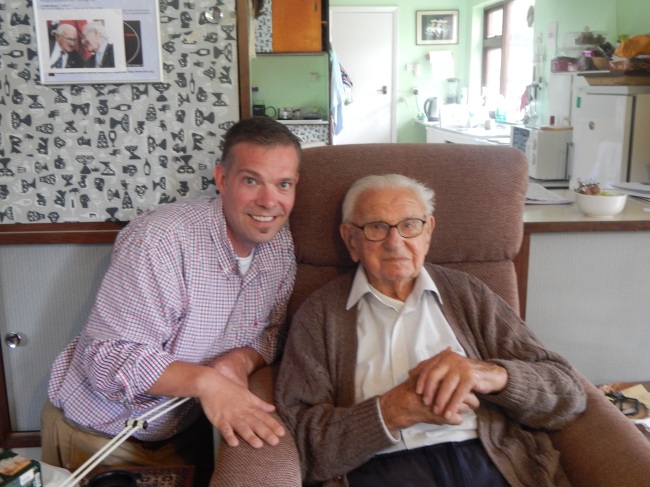
I am sharing this post by my friend and traveling companion Scott Durham, whom I spent a good deal of time with for three weeks on my summer trip this summer. We hung out on the back of the bus and were always up for exploring the towns after hours and discussing and processing our sometimes heavy days with our Holocaust tour work. Scott is still traveling in Europe. One thing I admired about him was his propensity to utter “why not?” Here he is below with one of the most well known rescuers, whose name is synonymous with the Kindertransports. 

Image

London – Sir Nicholas Winton

05 Thursday Sep 2013

On the morning of Aug. 24, 2013 I walked to the Paddington Train Station in London and hopped a train to Maidenhead.  Once arriving in Maidenhead, I asked a woman if there was a bakery in the little town.  There I bought a fresh Apple Cake to go with some fine British Tea I purchased the day before.  I then flagged down a cab and headed to the home of Sir Nicholas Winton.

There is a good chance you have never heard of him.  He was born in 1909 (yep – that makes him 104 this year) and in 1938, at the age of 29, he was on his way to ski in the Alps when a friend asked him to help him in Prague.  Winton went to Prague and saw first hand the plight of the Jews there and begin to figure out ways to get Jewish Children from Prague into British homes.  He set up shop in a hotel/cafe right on Wenceslas Square.  A plaque is there today commemorating his work:ImageImageImage

During the next few months, Winton was able to help rescue 669 children who were then re-settled in Britain.  Most of the parents were murdered in Auschwitz-Birkenau.

Then, Winton went on with his life.  In the 1980′s, his wife found the scrapbook that included all the names and travel plans, etc. of what became known as the Kindertransport.  A local television station invited Winton to a taping of a program about his work.  There, he was surprised to meet some of the grown children he helped save.  But the saved children were surprised too.  Before the scrapbook was found, they had never heard of Nicholas Winton either.  They had thought their parents were just smart enough to find a way to get them out before the Nazis invaded.  They never knew that people like Winton had helped save their lives.

I dare you to watch about a minute and a half of the video below and keep your eyes dry.  Watch starting at about 1:28 and go thru 3:00 (or watch the whole thing):

There is a new documentary about his work that came out this past year or so.  Here is the trailer:

So I was in the living room of this man’s house.  His daughter, Barbara, was there with us and she was instrumental in helping make this meeting happen.  I handed over my poor excuse of a gift (the tea and Apple Cake) and shook Sir Winton’s hand.  He is kind of tired of talking about his work back 70 years ago, so I tried not focus on that.  But somehow we started talking about an article recently written by one of the kids Winton saved named Joe Schlesinger.  The article is called “You Do Know, Right, The World Is Getting Better,” and you can find it here:

http://www.cbc.ca/news/world/story/2013/07/18/f-vp-schlesinger-wonderful-world.html

Winton wasn’t so sure if Schlesinger was right.  By the way, I hate calling him Winton.  I want to call him Nick or Nicky (and he made me feel so at home I feel I could).  But then part of me wants to call him Sir Winton.  I am not sure.

But anyways, Nicky remembered his parents time and about how much more difficult things were.  However, he remembered that people still did things for each other.  He told me about how they would put hay over the cobblestone streets if there was a sick person on the street to help dampen the sound of the horses and carts.

But today he sensed that we might have let the opportunity, with all the technology and wealth of the world, to create a utopia for everyone pass us by.

I asked him how we could maybe still create that utopia.  He talked about how people should live by a standard code of ethics.  He sees too many of our leaders and even every day people not doing so.  What is in the code of ethics, I asked: compromise, love, honor, goodness, decency, kindness, honesty, hard work, among others.  Winton thinks that this way of living transcends politics, generations, religions, etc.  I happen to agree.

It wasn’t until a few days later that I almost felt that Sir Nicholas Winton had challenged me to help teach this to our young people.  I am not sure if he intended to do this, but once again, he has helped inspire someone (me) to be a better person.  But he is so sharp of mind that I am pretty sure he meant to do this.

One thing that him and his daughter share is an overwhelming humbleness.  They both, while proud of what Winton has done and continues to do, acted like it still wasn’t that big of a deal.  In fact, Winton gives most of the credit for the Kindertransport to his colleagues Trevor Chadwick and Doreen Warriner.

I asked him how, in the end, people could be proud of their lives and he said just knowing, “that you did no harm.”  Wow.  Winton continued to help people throughout his life and I asked him why he continued to do it.  He said, “because I enjoy it.”

After a few hours and a few cups of coffee, I stood up to let the Wintons get on with their day.  But I was smiling for another week.  In fact, when I get a chance to tell people about my journey, this is always a highlight.  In fact, Winton’s name came up a lot one night in Bruges, Belgium (but that blog has yet to be written).

My visit with Sir Nicholas Winton was beyond pleasant.  But he has challenged and inspired me to do more.  Whether he knows it or not, Nicholas Winton is STILL making the world a better place, not necessarily for WHAT he did, but more so for simply WHO he is.


Read Full Post »

Francis Curry, WWII Medal of Honor, with students.

Francis Curry, WWII Medal of Honor, with students.

FOUR years ago today the most incredible week concluded with former soldiers and the Holocaust survivors they saved watching this newscast together in cocktail lounge of the Georgian Resort in Lake George along with teachers and students from Hudson Falls High School. Thank you Tara, Mary, Lisa, Rene, and all the staff. And to ABC World News for recognizing the importance of the occasion, and to the United States Holocaust Memorial Museum and the Bergen Belsen Memorial for their attendance and support.

A teacher’s job is to toss pebbles. Several of the participants are gone now, but the ripples here became huge, and no one will forget what they meant, where they came from, or what they have led to.

Watch a story about how a teacher fellow from the Museum reunited Jewish prisoners with U.S. Army soldiers who liberated them from a train near Magdeburg, Germany, on April 13, 1945.

Read Full Post »

« Newer Posts - Older Posts »