Feeds:
Posts
Comments

Archive for the ‘Uncategorized’ Category

A year ago I took one of the most transformative journeys of my life, with 24 fellow educators, to study the Holocaust and the Jewish resistance to it, in Washington, DC, Germany, the Czech Republic, and Poland. I kept an extensive diary and took tons of photographs.  For the next several days, I have decided to go back and retrace my steps and try to process what unfolded for me. Not weighty tomes, but maybe a picture and a note from the diary.
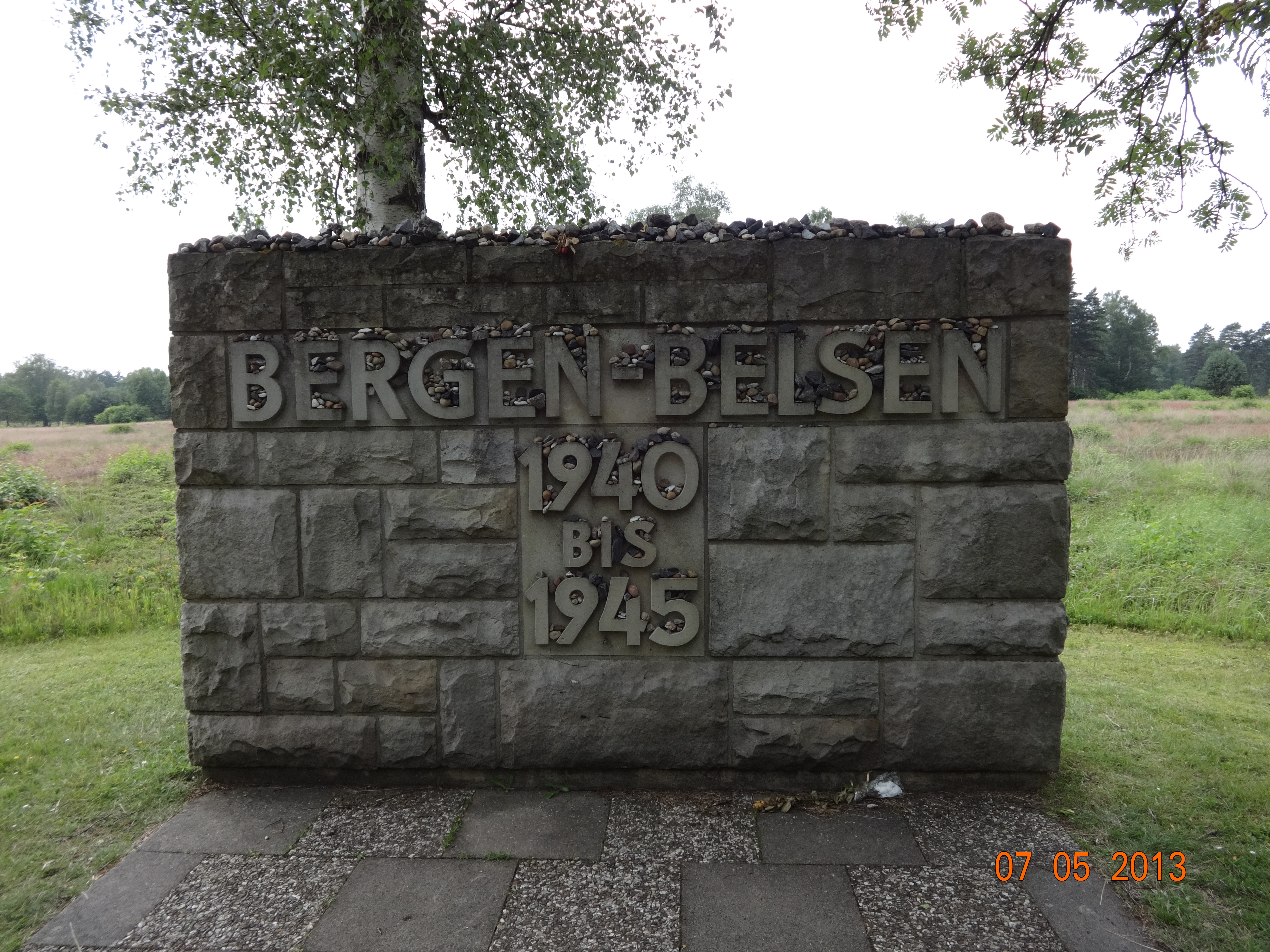
Bergen Belsen on July 5, 2013.

Bergen Belsen on July 5, 2013.

“Belsen! I think they had been in Belsen.”

On July 5, 2013, we are on our way from the hotel in nearly Celle to this destination. Our first concentration camp of the tour.

Trying to remember the name of the concentration camp, the elderly gentleman exclaimed these words as he animated his story from the rocking chair across from me. I was in his daughter’s house on a brilliant July day, twelve summers before. It seems like a lifetime ago. But if I had not taken the time to go there and sit down with him, you would not be reading any of this.

People, mostly news media, get the story wrong all the time.  I had not invited the veteran to class because I had had his grandson. It was a series of coincidences that changed so many lives, but then again, I am sure there are no coincidences.

Is it a coincidence that I am making my first trip to Belsen on the day that he is being laid to rest in his hometown back in New York state? Or that by 8pm I will be traveling on the same spur of tracks toward Magdeburg, on which the Sherman light tank he was commanding sixty-eight springs ago came to the train with 2500 Jewish victims of the Holocaust onboard?

I was picking my young children up from daycare. I knew Tim, the other father there at the same time, picking up his young son. I had his older son in class at the time. Tim knew I liked to talk to World War II veterans, and he invited me to come over and speak to his father in law, a retired NYS Supreme Court justice, who was coming up to stay for the summer. So I took him up on it. What a great man, funny too. We conversed on tape for nearly two hours, and I was about to turn the camera off, and his daughter, Tim’s wife Elizabeth, spoke up:

Daughter: Did you mention the train at all? That was kind of interesting.
CW: No, I didn’t tell him about the train.
MR: What was that?
CW: Well, late in the war, again a nice, beautiful April day… we were shooting like crazy across the top of Germany and Major Benjamin of the 743rd was kind of out ahead scouting a little bit… he came back to the battalion and he pulled my tank and George Gross’s tank [fellow tank commander] out. He told us to go with him. So we did.
We came to a place where there was a long train of boxcars. … I can remember pulling up alongside the train of boxcars, Gross and I, and Major Benjamin. As it turned out, it was a train full of concentration camp victims, prisoners, who were being transported from one of their camps…Belsen!  I think they had been in Belsen, on their way to another camp…
So there they were. All of these people, men, women, children, jam-packed in those boxcars, I couldn’t believe my eyes. And there they were! So, now they knew they were free, they were liberated. That was a nice, nice thing. I was there for a while that afternoon. You know, you got to feed these people. Give them water. They are in bad shape. Major Benjamin took some pictures, and George Gross took some pictures too…

 Bernd Horstmann, Custodian of the Book of Names,  Matthew Rozell, History Teacher, July 5, 2013. Bergen Belsen, Evacuation transports exhibit.

Bernd Horstmann, Custodian of the Book of Names, Matthew Rozell, History Teacher, July 5, 2013. Bergen Belsen, Evacuation transports exhibit.

Twelve years later and here I am. I know some of the historians who work here-they have been to America to meet me- and I am going to see an exhibit that in fact incorporates some of the fruits of my labors. To date, we have reunited over 240 persons who were on that transport with the soldiers who liberated them. And I found the photographs that tell the story so well, photos that through the generosity of the soldiers who shared them with me, are now also in the United States Holocaust Memorial Museum, our national institution.

In brief context: 120,000 prisoners passed through Bergen Belsen, and not all of them Jewish. 52,000 died here, perhaps 30,000 of them were Jewish. Belsen actually began as a POW camp- 20,000 Russians died here in the winter of 1941-42. In 1943, Himmler (the head of the SS) ordered that an exchange camp be set up for Jews who might possess foreign certificates or visas to emigrate, perhaps to use to bargain for German families interned abroad. 14,000 people went through the exchange camp. In November, 1944, thousands of women, and some children, arrived from Auschwitz, to be “housed” near the exchange camp, including Anne Frank and her sister Margot. What they received, in their miserable condition, were 18 oversized old tents which promptly blew down during a winter storm shortly after their arrival. With the arrival also of brutal SS administrators and guards, conditions deteriorated rapidly as the winter of 1944-45 turned into spring.

The camp system began collapsing with the advance of the Red Army in the east and the British and Americans in the West. By the time the British arrived on April 15th at the camp gates, over 50,000 prisoners were suffering from extreme malnutrition, typhus, typhoid fever, and dysentery. Nearly ten thousand corpses lay about as the crematorium had long since broken down. Anne and Margot were dead, as the first Yanks crossed the Rhine River at the end of March. Hundreds died on the day of liberation. A true scene of horror.

Shortly before the liberation, between April 6 and 9, 1945, 6700 men, women, and children from the exchange camp passed through the camp gates and marched several kilometers to the railhead that many had arrived at months or years earlier. Three train transports of cattle cars and shabby passenger cars were prepared and loaded. Some people were executed for attempting to steal sugar beets at the railhead .
The transports would be headed for the Theresienstadt concentration camp, which at the time was far enough from advancing Allied lines and indeed would prove to be the last camp liberated on the last day of the war (I will trace that route later in our journey). Only one train made it there. The other two were liberated, one by the Americans at Farsleben near Magdeburg, and the other by the Russians near Tröbitz.
The first train left Bergen-Belsen on 6 April 1945 and travelled for six days before coming to a stop near the village of Farsleben. It was this transport that the soldiers I interviewed came upon on Friday, April 13, 1945.

I promised no weighty tomes, but maybe it is too late. After an introduction to the history of the site, we  watch the silent movies shot by the British beginning the second day after the liberation. Perhaps you’ve seen the photos or the films.  If you see a photo of a soldier wearing a mask, maneuvering a bulldozer to push corpses into an open pit, that was Bergen Belsen. Just over a month later, the British commander ordered the lice infested, typhus ridden barracks put to the torch. So today, to some visitors, there is nothing here, just inviting walkways with interpretive signage and some markers. Woods, and open fields.

Matthew Rozell and the ruins at Belsen, 7-5-2013. Jerrilyn Miller photo.

Matthew Rozell and the ruins at Belsen, 7-5-2013. Jerrilyn Miller photo.

But on closer inspection, we see the outlines of the past in the ruins. We walk to barracks ten of the exchange camp. You can see the outline at the woodline. Some of the foundation stones are marked with the names of those who passed through them. We retrace the steps from the barracks to the latrine, now many meters away off a footpath in the enveloping woods. Nature reclaims. Out of the corner of my eye, down the long narrow strip mowed to infinity where a fenceline once ran, I see a large deer guide out of the woods, pause and look my way, and vanish just as soon as it appeared. Is it obscene to find in this place now a feeling of inner peace, to find beauty in the stillness of a grey afternoon? Maybe so.

DSC00490Back out to the camp. The solemn monuments marking the mass graves. 1000 Tote. One thousand dead. 2500 Tote. Two thousand five hundred dead. And on and on, elevated mass graves. On to the commemoration room.

Candles are lit, stones are placed, the prayers are recited in Hebrew and English, led by Pauline, the only other New Yorker on the trip with me. We are all moved.

Now I think of Carrol Walsh, the tank commander who led me to this story, the liberator who did not want to be called a hero, or even a liberator. His own memorial service is today, half a world away, but I am here in this place to remember him as well. It is altogether fitting and proper. And I am sure that cosmically, it is also something destined to be.

This evening we depart from Hannover to Berlin. It is pretty crazy and unsettling at the Friday evening platform. 27 people have to run for the train, as the track has changed, with hundreds of others. Our original seats are taken, so we have to find other due to a mixup. But we do not lose anyone, and as I settle in next to a kind stranger, made welcome, I notice our station stops along the way- Brunswick. Magdeburg.

This was not planned, either. We are roughly following the route of the train, and the 30th Infantry Division in 1945. What take us 35 minutes to cover, takes 6 nights and 7 days in April 1945.

We tripped the wires of the cosmos. Today was the culmination of something incredible I am still trying to figure it all out- but this trip is helping me to place in proper context the elements of the greatest crime in the history of the world. As we leave this place of obscene beauty and peace, I think of  the I think of  the survivor’s words:

Remember Me.

136


Read Full Post »

A year ago I took one of the most transformative journeys of my life, with 24 fellow educators, to study the Holocaust and the Jewish resistance to it, in Washington, DC, Germany, the Czech Republic, and Poland. I kept an extensive diary and took tons of photographs.  For the next several days, I have decided to go back and retrace my steps and try to process what unfolded for me. Not weighty tomes, but maybe a picture and a note from the diary.

Memorial Site, Hadamar. July 4, 2013.

Memorial Site, Hadamar. July 4, 2013.

Independence Day and I am on a bus to Hadamar, home of the start of the T-4 program in the heart of Hesse country in Germany.

I’ll let the sign speak for me for a moment. My notes tell me that I wrote that doctors and nurses did the killing. Starving, Injecting, and Gassing. No cases of doctors or nurses who refused. So much for that Hippocratic Oath.

Huge “peer pressure” for families to have their disabled children institutionalized. Spend state dollars instead on the healthy. “Useless Eater” propaganda, posters.

Hadamar.

Hadamar.

T-4 program is not the Holocaust but intersects. How else do you figure out how to build efficient gas chambers? Engineers who build Treblinka, Sobibor, Belzec, and start the mobile van gas chambers at Chelmno get ideas here.

We are here and there are still patients who are served here. We are not allowed into the bowels of the place, where you can still see the early gas chambers. A group of German school kids is there instead, as we do not have the proper appointment set up. Just as well, by all means, get the kids down there.

Instead we hike up to the mass grave at the top of the hill behind the facility.


Mass grave at Hadamar.

Mass grave at Hadamar.

"Compassionate orderly prepares to get rid of useless eater."

“Compassionate orderly prepares to get rid of useless eater.”

A year later, I suppose I should be outside preparing to shoot off fireworks or something. Instead I am thinking about how our own educational system is moving away from prioritizing study like this and focusing instead on test taking, data driving, goal orienting. Soul crushing, mindnumbing, paper pushing bullshit.

So I’ll think of these good doctors and nurses, damn good test takers, mind you,  and leave you with this:

I am a survivor of a concentration camp. My eyes saw what no person should

Anna.

Anna.

witness: gas chambers built by learned engineers. Children poisoned by educated physicians. Infants killed by trained nurses. Women and babies shot by high school and college graduates.

So, I am suspicious of education.

My request is this:  Help your children become human. Your efforts must never produce learned monsters, skilled psychopaths or educated Eichmanns. Reading, writing, and arithmetic are important only if they serve to make our children more human.

473

Read Full Post »

A year ago I took one of the most transformative journeys of my life, with 24 fellow educators, to study the Holocaust and the Jewish resistance to it, in Washington, DC, Germany, the Czech Republic, and Poland. I kept an extensive diary and took tons of photographs.  For the next several days, I have decided to go back and retrace my steps and try to process what unfolded for me. Not weighty tomes, but maybe a picture and a note from the diary.

040So here is Frankfurt. We arrived at 5am local time after a transatlantic flight. Before we even hit our hotel properly we were off on the tour. The old girl goes back a ways. For the last eight hundred years or so, there was a significant  Jewish population, decimated by the occasional pogrom but somehow bouncing back. That is until Kristallnacht, when the largest synagogues were burned to the ground. In 1933, 30,000 Jews lived in Frankfurt; in 1945, only 600 remained (you can read more here).


The Memorial to the Frankfurt Jews was a testament to the tens of thousands denounced and deported, by date and destination, to their deaths by their neighbors and the Nazi regime.

Memorial to the Frankfurt Jews. July 3 2013

Memorial to the Frankfurt Jews. July 3 2013

Each metal bump out has a person’s name. Shortly afterwards, we drove past the Frank House, from which the Frank family made their way to “safety” in the Netherlands, a path followed by many. You know the rest of the story. Anne Frank. We’ll connect more dots later on the tour.


I suppose there is a lot more to Frankfurt but we are not here long, though I do sneak out of the hotel several times to explore, solo and with like minded companions. As this trip begins, so does the wondering. You know, just the night before I heard testimony

Matt Rozell and Henry Greenbaum, Washington, DC, July 1, 2013

Matt Rozell and Henry Greenbaum, Washington, DC, July 1, 2013

of survivor Henry Greenbaum and had dinner with him and the group. He is part of the family on Geddy Lee’s mother’s side, Polish survivors who made their way to North America after the war. If you are not quite sure who Geddy Lee is, he is the bass player and vocalist for one of the most talented power trios on Earth. And he is playing Frankfurt. His mother and father met in a work camp in Poland, then Auschwitz.  His dad was liberated by the Americans at Dachau, his mom by the British at Belsen, where we are heading soon. And they returned for the 50th anniversary of the liberation in 1995, at the invitation of the Germans, with hundreds of others, walking the ground, healing some wounds.

“Dankeschön, Frankfurt!” he happily exclaims several times during the show here. How much do we read into that? Nothing, I suppose.  Though there is something magnificent about Geddy’s roots, the family history, and Rush coming to Frankfurt and just nailing it. The German fans, the lovers of the band, of the music, of Geddy… It literally brings a happy tear to my eye.

And of course the eternal question-what else did the world lose, because of the Holocaust? Unfathomable.

But here is a taste.

Read Full Post »

June 25, 2014


Readers of this blog know that I spend a lot of time wondering. As I spend more time and gain more experience with the topic at hand, I offer up my two cents. But sometimes conclusions are seemingly far afield until they just hit like a lightning bolt. So it was today. The wonder of it all.


I think it is pretty clear that I have one foot planted in another dimension,  and right now I’m straddling a time warp. And it is so interesting to be able to look down and note what is unfolding in time, and maybe how things are related. The “other” dimension changes from time to time, but right now it is firmly rooted in the happenings of seventy or so years ago.


I’m writing a story about a band of Marines, local guys, who went off to war together to fight the Japanese after Pearl Harbor.  Out of the sixteen or so I am aware of, I’ve met and interviewed at least half. And all but three now have passed. So I recently got an email from a daughter looking for me to talk to her dad. He had read some of my stuff, saw that I had talked to his buddies, and was ready now to say something, for the record.


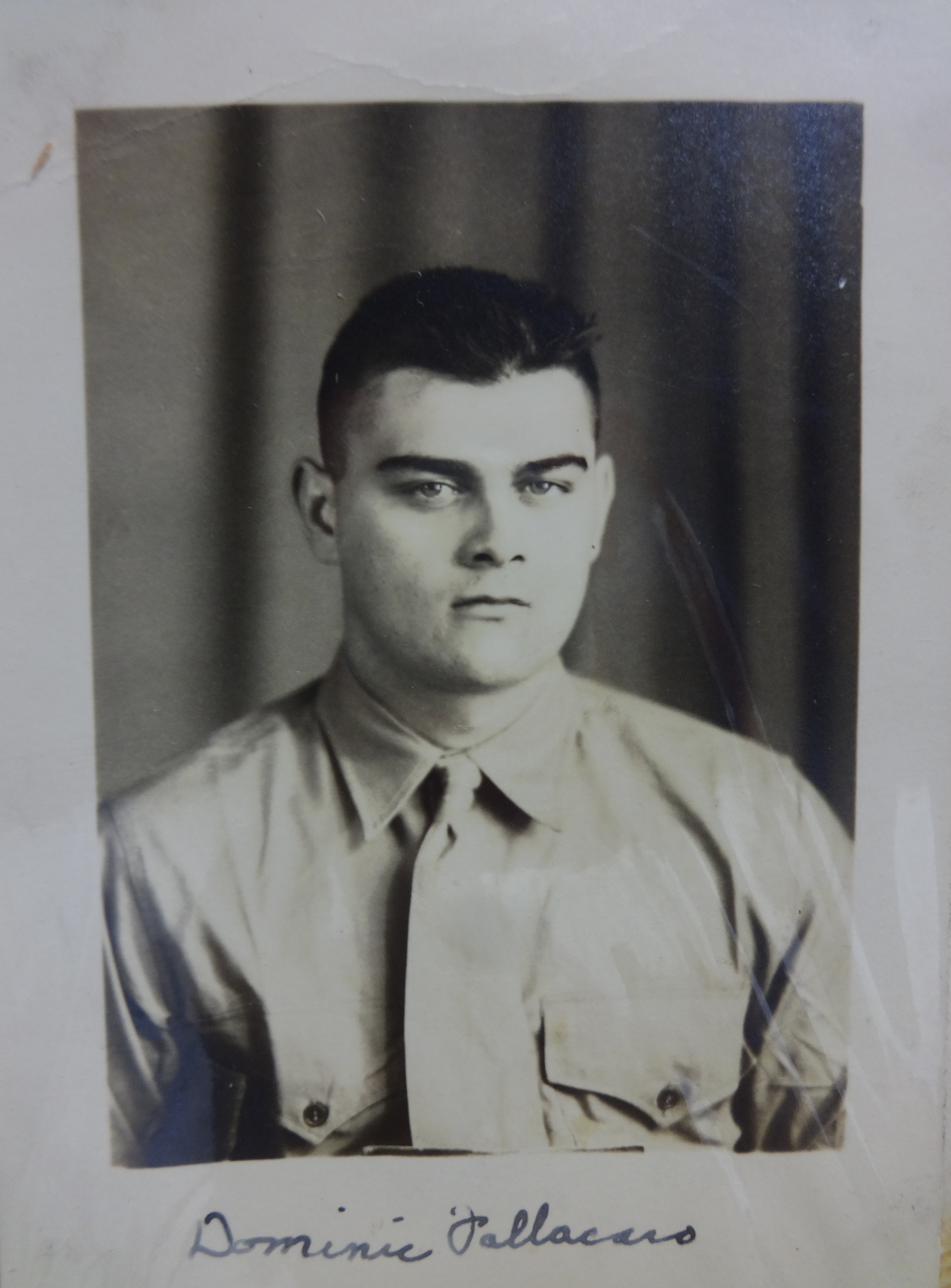
Glens Falls Post Star. Dom Fallacaro, bottom row, third from left.

Glens Falls Post Star. Dom Fallacaro, bottom row, third from left.

It probably hit me midmorning, looking at the newspaper clippings from 1942-3. Seeing the scrapbook pictures of Marines who were going off to fight the war together. Young guys just out of boot, all spiffed out in their new uniforms. Greenhorns with no real idea of what they had gotten into. Some did not return.

I sat across a table from a 91 year old who was telling me the story of World War II from the perspective of a kid growing up in the Great Depression.
So he began to speak, with his wife of six plus decades by his side. Dom was starting stories, and I was finishing them. Not in a rude way. But in a sense, it was like I had been there too. And I think it made his day, in a way. All of Dom’s buddies have died, or the few who remain are dying. It’s a tough time in a veteran’s life.


But here is a “young” guy who knows, before it comes out of Dom’s mouth, that the fellow Marine he meets for the first time aboard a huge LST ship (bound for the battle of Iwo Jima), discovering that Dom is from Hudson Falls, NY (like him) is now taking Dom back to the huge winch on the ship, and proudly showing it off because it was made in their hometown, at the Sandy Hill Iron and Brass Works! (I had heard this same story from another Marine from our hometown, bound for another battle. His father had made that winch.)


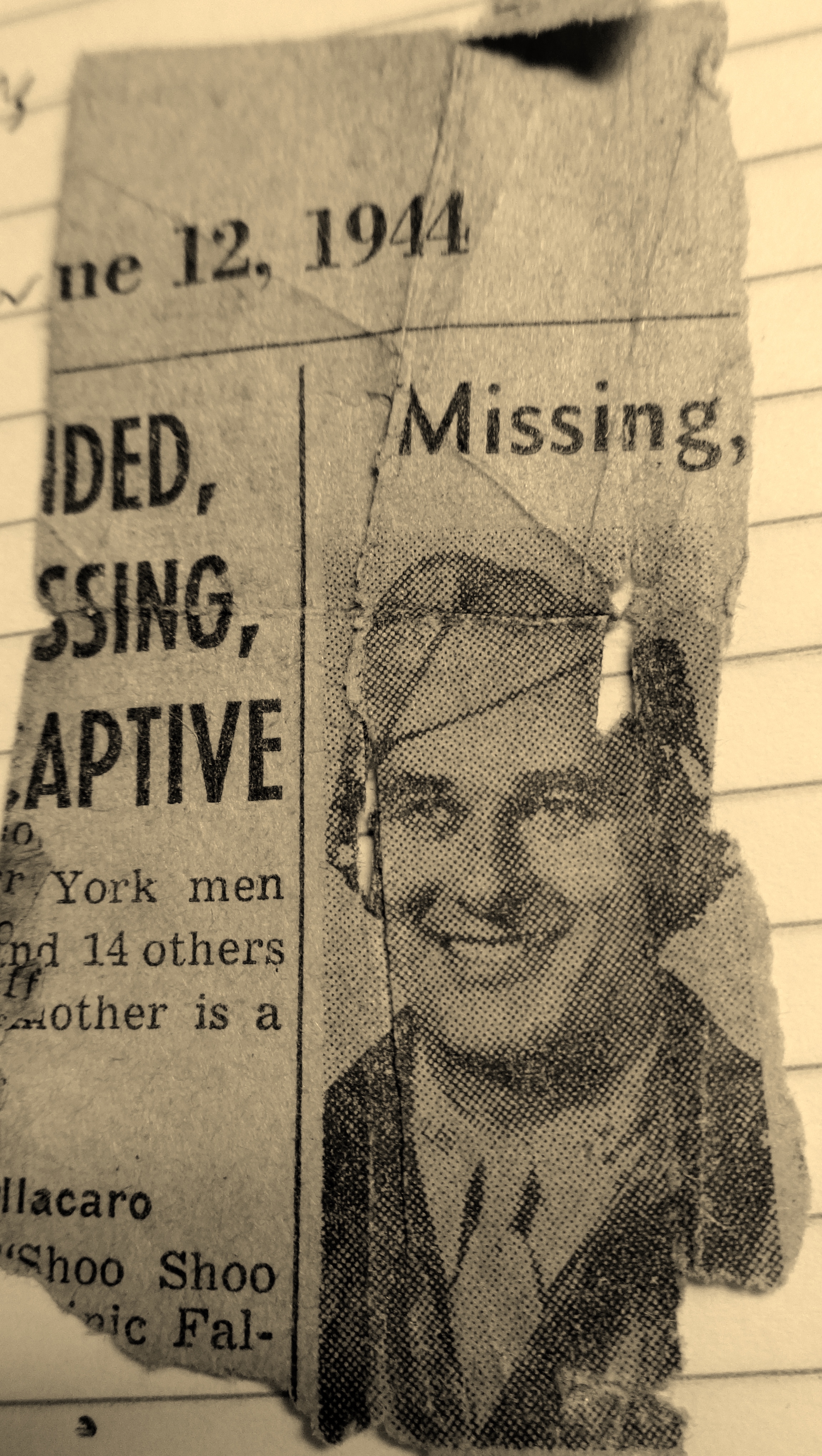
Dom's cousin Dom. KIA June 1944.

Dom’s cousin Dom. KIA June 1944.

Or when Dom began to tell me about his cousin, who shared the same name as he, from Buffalo, NY, who  was killed in 1944 in Europe. His wife Grace pulled a tattered newspaper clipping out of the scrapbook, one that Dom carried in his wallet for years. Dom told me that he was lying down and one of his tentmates from Buffalo was reading the newspaper from home, and tossed it over to him, telling him that “he” had died. Shocked, he clipped his cousin’s death notice and carried it in his wallet for the rest of the war. When Dom started to tell me the story, I knew that a WW II era New Yorker with the same name from Buffalo had died, as I had done some on-line research on Dom before coming to the interview. So I told Dom his cousin had been in the Army Air Corps. He nodded and then we connected the cosmic dots.
About nine months later, Dom suffered an extreme appendicitis attack as the fight for Iwo Jima wound down, and wound up being operated on as they sailed away, nearly dying. The ship he was on had even altered its course to save the young Marine (the doctors demanded the ship stop shifting and zigging and zagging so much during the critical operation. As Dom said, his buddies did not realize he was so important!) He was on Guam returning to his truck driving duties and preparing for what would have been the Nov. 1945 invasion of Japan-his outfit was scheduled to be in the first wave-when the atomic bombs ended the war. So you can guess how he felt about that.

I sat with him and his wife Grace for two hours. Turns out the grandmother I never knew-she died before I was born-would clean and mend the curtains of the family and for the mom and pop store that Dom and Grace ran for forty years, seven days a week, fourteen hours a day.
After the camera was put away, four generations from our little town had lunch at the table at their camp on Glen Lake. For a kid who dropped out at age sixteen-“are you going to be a professional student, or are you going to work?” was the question of the day, in the Depression era-Dom looked around and fairly beamed at what it all meant to him.

He saw things that he put away for many years. Grace knew, from the naps he would stir restlessly in. He might not have shared everything with his family, but his family kept him going and together, they prospered. Now, here, as the old war buddies who survived pass on, maybe it is time for reflection. Dom is a survivor too, and he knows it. What blessings he shared with me today. And I think that is what he really wanted to say to me today, why he wanted to talk. How blessed he is, for his family, for their love, and for the love of his buddies.


After 91 years on this earth, the wonder of it all.

007


Read Full Post »


So, it is the sixth of June again.

American Cemetery overlooking Omaha Beach, the primary landing zone for Americans during the D-Day invasion June 6, 1944. (U.S. Air Force Photo)The ocean pounds the advance of sand amidst the relics of a different age, the hulking remnants of the tide of battle. The surf rolls in and kisses the beach, as the last participants mix on the hallowed bluff above with the politicians who have gathered from all over the world.

Thirty years ago I watched as the American president honored  the fallen, and the living, at the cemetery for the fortieth anniversary. Just out of college, something stirred inside me. Something was awoken.

Thirty years have passed. I began by writing letters to the newspaper. I began to interview D-Day veterans and others. I began to collect stories- not relics, prizes, or artifacts. I really had little interest in captured Nazi flags or samurai swords.

I wanted to talk to the men who were there.

The fiftieth anniversary came next with great pomp and more reflection. It graced the covers of the major newsweeklies. “Saving Private Ryan” stirred the consciousness of a new generation, and reflections of the old. And I learned so much more of the war beyond the beachhead. That there were so many beachheads.

The sixtieth anniversary came around. Students on their bi-annual trips to France would bring me back their photographs and the requisite grains of white sand from Omaha Beach. Teenagers had their emotions  a bit tempered, I think. I would go on to introduce them to so many who were there. When they themselves were teenagers.

So now it is the seventieth. On the 65th, I wrote about a friend who is no longer here for the 70th. Another president spoke today, and the 75th will bring fewer who were there back to Normandy.

*****************************************

Today I would like to introduce you to a survivor of D Day who is still with us.

I first met Bill Gast at a reunion of 30th Infantry Division and 743rd Tank Battalion soldiers at a reunion in March 2008, in which I  was present with several Holocaust survivors who were meeting their liberating soldiers for the first time. Later, Bill came to my high school to speak to students. I think the experience of sharing, and meeting the Holocaust survivors whom the 743rd came upon and liberated, affected him deeply.

Unlike many who may be physically able, Bill has no intention of going back to the sands of Omaha for this anniversary. As he explained to our students in 2009,

“I’m listed [in the event program] as a liberator- however, I am also a survivor of World War II, having landed on Omaha Beach in Normandy, France on D-day and fighting through to the end when the Germans surrendered, May the 7th, 1945.”

“Pictures.

Video games.

Movies.

Words.

They simply do not covey the feeling of fear.

The shock.

The stench.

The noise.

The horror, and the tragedy.

The injured.

The suffering.

The dying, and the dead.”

A  couple weeks ago this article popped up. So glad to see Bill’s name.

*****************************************

D-Day: the view from a tank on Omaha Beach

Washington (AFP) – From inside his tank, the young soldier could see “practically nothing” on Omaha Beach.

Seventy years later, William Gast still wonders whether he rolled over his comrades sheltering from German gunfire that day.

Gast was 19 years old the morning of June 6, 1944. “We came in at H-10, that was 10 minutes before the designated hour.”

He cannot recall why he and his fellow soldiers arrived early, but he has other memories that have never left him.

As part of Company A, 743rd Tank Battalion, 1st Army, Gast remembers the training beforehand in Britain, when he rehearsed driving the Sherman tank onto the landing craft. And then floating in the English Channel.

“Another night we went out and we didn’t come back. That was it.”

Gast got to know the captain of the landing craft that would ferry his tank to the beaches of Normandy.

The skipper promised he would get them close enough that they would not be submerged in water, like so many tanks were that day.

He kept his word.

Another tank unit at Omaha Beach was less fortunate, with 27 of 32 tanks launched at sea five kilometers (three miles) from the coast sinking before they could reach land, despite being outfitted with a flotation screens.

“The order was given to go, we started our engines up, they lowered the ramp,” said Gast.

Amid German shrapnel and sea spray, he “could feel the tracks spinning.”

At last, the tank tracks took hold on the sandy sea bottom and he drove up the beach.


– Like throwing marbles at a car –

Down below in the driver’s seat, Gast tried to steer the tank with the aid of a small, manual periscope.

“You can imagine how much we could see, practically nothing,” he said.

The radios inside the tank were so unreliable that his commander would tell Gast which way to turn by kicking him on the left or right shoulder.

The difficulty in seeing the way ahead has left Gast with a gnawing sense that he may have run over the bodies of American soldiers on the beach.

“The saddest part about the whole thing is, not being able to see, I may have run over some of my own people.

“And if I did, I don’t even know it. I can’t ever get that out of my mind, you know?”

Bill Gast awarded the Silver Star.

Bill Gast awarded the Silver Star.

Corporal Gast heard machine gun bullets hitting the side of the tank, “like throwing marbles at a car — that’s what it sounded like.”

“And there were shells that exploded right beside me. You could feel the tank shake.”

For Gast, it was a day of fear and terror, and following orders without reflection.

“I can’t tell much about what happened, I was scared to death to start with,” he said.

“It was just like putting it on automatic, you just did what you had to do, did what you were told to do.”

By noon, close to 19,000 American soldiers who landed at Omaha were still pinned down on the beach.

– High school sweetheart –

Carefully laid plans had unraveled as the beach became a killing zone, with troops mowed down under a fusillade of German machine gun, artillery and mortar fire.

Small teams of US troops eventually managed to break through on the bluffs between German positions, with the help of combat engineers blowing up obstacles.

The losses were staggering: more than 2,000 dead, wounded and missing on Omaha beach. The exact toll is still unknown. Of the 15 tanks in Gast’s Company A, only five survived without damage.

Gast, from Lancaster, Pennsylvania, earned the Silver Star and the Purple Heart during his combat tour, and went on to marry his high school sweetheart.

Now 89 years old, he recently was awarded France’s Legion d’Honneur at a small ceremony for World War II veterans at the French embassy in Washington.

Bill Gast, Silver Star citation.

Bill Gast, Silver Star citation.

The short, soft spoken man stood up to receive the medal and shook hands with a French diplomat. But he has no plans to return to Normandy for the 70th anniversary of the D-Day landings.

His son, Bill, said his father did not want to relive that day: “It’s important we don’t forget but you try to hide things somewhere.”

http://news.yahoo.com/d-day-view-tank-omaha-beach-104656852.html

*****************************************

Read Full Post »

This story below is an excerpt from my upcoming book. It will be out early this summer for the 70th anniversary of the end of the war.

My friend Jimmy Butterfield used to come to my classroom with his bride of 60+ years, Mary. She would joke with him, and us, and call him by his high school nickname, “But”. Maybe it was “Butt”, I don’t know, but they had fun playing around with each other in front of 17 and 18 year olds.

Jimmy, of course, was blind and hard of hearing. Mary had to yell at him, he would crack a grin under the dark glasses and flirt with her. The girls loved it. When the hearing aide was cranked up to eleven, we would get some echo and feedback, which didn’t seem to bother him, or the students in the class listening to his story. He just liked to talk to the kids.

Several years ago, after the two of them and Danny Lawler (another First Marine Division veteran of really hard fighting in the Pacific at Peleliu and Okinawa) came to my room for an afternoon, I came home to an email from one of my senior girls, telling me how meaningful meeting Jimmy and Mary and Danny was to her and her classmates. I still have it.

You see, Jim Butterfield got struck not once but twice in the head by enemy fire at Okinawa about this time in May  1945 (that is 70 years ago this month, if you are noticing). He was evacuated first to Guam, then to Hawaii and later stateside for over 18 months, and as many operations, for reconstructive surgery.  When he did realize that he would never see again,  he was ready to tell his high school sweetheart to leave him be. Not to get attached to him, a blind man.

Well, she told us what she thought of that. They ran a small mom and pop store back in Glens Falls together until they retired.

Why is Jim’s story important? Well, you’ll have to listen to him tell it. You have the sense of the unfolding realization of the loss he is feeling, but at the same time, wonderment at his and Mary’s resilience in making a successful life afterwards. The sacrifices made by this and other generations of veterans becomes real. We need to also note that Jim came home. Chappy and many others others did not.

Jim never looked for sympathy or pity- and of course would be the first to point out that Memorial Day is for those who did not return. But still, if we are to pause as a nation for one weekend to remember, we can’t forget what this nineteen year old from Hometown USA gave up as well.

Mary passed a year and a half ago. Jim died at home last June. What obstacles they overcame together…

Rest on Jimmy and Mary. Thanks for letting us witness your story.

******************************************

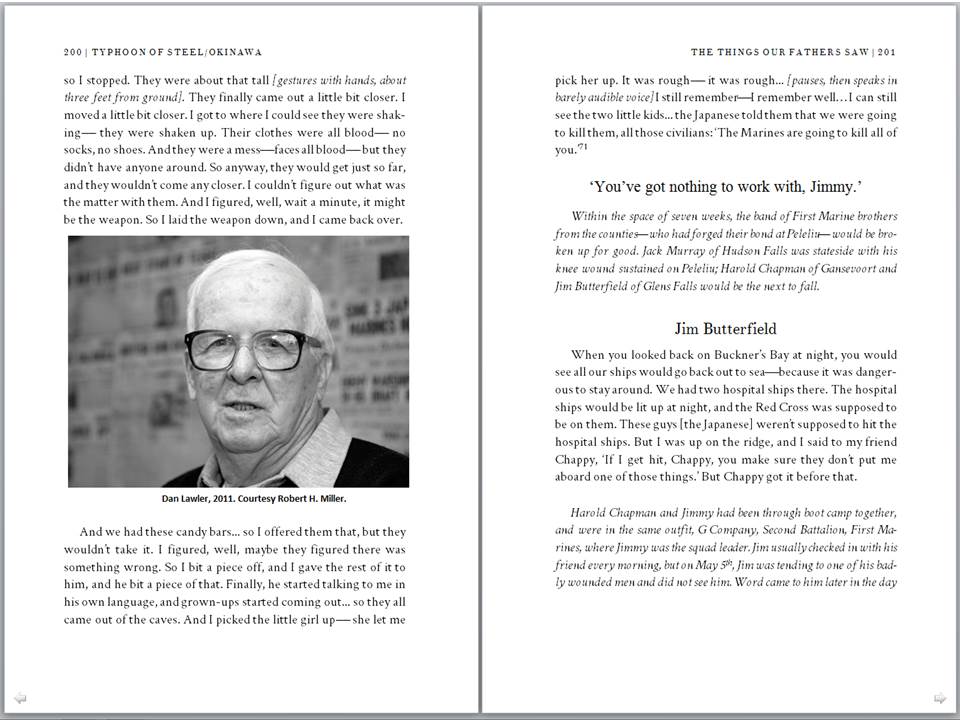
From

From “The Things Our Fathers Saw” by Matthew Rozell.

Book can be purchased at http://matthewrozell.com/order-the-things-our-fathers-saw/

Mary and Jim Butterfield Jan. 2007

Mary and Jim Butterfield in my classroom, Jan. 2007.

*************************************************************


 Book Description: At the height of World War II, LOOK Magazine profiled an upstate New York community for a series of articles portraying it as the wholesome, patriotic model of life on the home front. Seventy years later, a high school history teacher and his students track down over two dozen veterans residing around ‘Hometown, USA’ who fought the war in the Pacific, from Pearl Harbor to the surrender at Tokyo Bay. They resurrect firsthand accounts of combat and brotherhood, of captivity and redemption, and the aftermath of a war that left no community unscathed. Here are the stories that the magazine could not tell, from a special generation of Americans speaking to the youth of America today.  292 pages.


Read Full Post »

Why it's Mr Rozell. Because the internet says it is.

Why it’s Mr Rozell. Because the internet says it is.

You may have seen this article by now. I don’t think that the Common Core is good or bad in and of itself. It’s just that when we forget that true education involves the passing on of the values that make us human beings, we are asking for trouble. And unfortunately in the “Race to the Top”, a lot of the important stuff gets shoved off to the side.

Hard.

I try not to chime in too often when an outrage occurs- I’m not really an outrage bandwagon kind of guy. But you just don’t ask 2000 8th graders to decide if the greatest crime in the history of the world was fact or fiction.

Two thousand.

Eighth grade. Certainly many working at lower than grade level abilities.

Using words like “propaganda” for “monetary gain”, “political scheme” , asking 13 year olds to evaluate the credence of “influencing public emotion” to “gain wealth”. And to go on the internet later to find supporting materials.


Well, it IS out there, the sites that will argue that the Holocaust is just  a ploy for sympathy, that it did not really happen, or could not have been as bad as they say. This I know for a fact.  And it’s a little personal.

**********************************


In a different way however, I think all the children of the Rialto School District learned one of the most important lessons of their entire lives with this whole episode. Mainly that the adults who are supposedly shepherding them and ushering them into this wonderful world of critical “thinking for yourself” were just plain wrong in their judgment, as Deborah Lipstadt points out below. (Not mention dumb, as the administrators first defended the assignment.)

And like Lipstadt, I, too, have been the target of Holocaust deniers. I used to delete the nasty posts and emails. No more. I have found them to be valuable educational tools and entertaining to boot. But when educators encourage students to question facts, to look at the Holocaust from the deniers’ point of view, then we have a problem.

I’ve made plenty of mistakes in my own career. But to think that this could pass muster is just plain stupid thinking, and shows how detached from reality so called educators and administrators can be.

And like a mantra, again I post,  the most fundamental learning I have gleaned over the years:

Israeli educational psychologist Haim Ginott writes about a letter that teachers would receive from their principal each year:

I am a survivor of a concentration camp. My eyes saw what no person should witness: gas chambers built by learned engineers. Children poisoned by educated physicians. Infants killed by trained nurses. Women and babies shot by high school and college graduates.

So, I am suspicious of education.

My request is this:  Help your children become human. Your efforts must never produce learned monsters, skilled psychopaths or educated Eichmanns. Reading, writing, and arithmetic are important only if they serve to make our children more human.


********************************************

California School Asks 8th Graders To Debate Whether the Holocaust Happened

The assignment materials cited Holocaust deniers, and represent a gross failure of judgment—and historical awareness

By Deborah E. Lipstadt|May 6, 2014

After decades spent in the sewers of anti-Semitism and Holocaust denial, I don’t horrify easily. But yesterday I learned that a school district in Rialto, California, assigned 2,000 8th-grade students to write an essay on whether or not they believe the Holocaust was “an actual event in history, or merely a political scheme.”

Put simply, this is the greatest victory for Holocaust denial in well over a decade, if not more.

The language of the assignment is worth reading in full:

When tragic events occur in history, there is often debate about their actual existence. For example, some people claim the Holocaust is not an actual event, but instead is a propaganda took that was used for political and monetary gain. You will read and discuss multiple, credible articles on this issue, and write an argumentative essay, based upon cited textual evidence, in which you explain whether or not you believe this was an actual event in history, or merely a political scheme created to influence public emotion and gain wealth. Remember to address counterclaims (rebuttals) to your stated claim.

When you ask a Holocaust denier why Jews would go to such great efforts to create the myth of the Holocaust, nearly all have the same ready answer: Jews have created this myth in order to deviously exercise political power and enrich themselves. They will cite the two things it is commonly said Jews “got” out of the Holocaust—reparations, and the State of Israel. It’s classic anti-Semitism founded on the notion that Jews deviously access power and do virtually anything for monetary gain, an idea that can be traced to the New Testament’s depiction of Jews in relation to the death of Jesus: The Jews sold out the Messiah and caused great grief to billions of his future followers all for a few pieces of silver. (Never mind the fact that everyone in the story is Jewish, with the exception of the Romans—who were the ones who actually did the killing.)

Along with entries on the history of the Holocaust from About.com and the History Channel, they offered the students supporting “material” titled “Is the Holocaust a Hoax?” that was taken from a Christian site. The document cites the execution technology “expert” Fred Leuchter, a leading denier, and presents a “theory” that Anne Frank’s diary was forged. “Israel continues to receive trillions of dollars worldwide as retribution for Holocaust gassings,” the document continues. “Our country has donated more money to Israel than to any other country in the history of the world—over $35 billion per year, everything included. If not for our extravagantly generous gifts to Israel, every family in America could afford a brand new Mercedes Benz.”

Unbelievably, district officials initially defended the assignment. “One of the most important responsibilities for educators is to develop critical thinking skills in students,” one school-board member wrote in an email to the San Bernardino Sun. “Teaching how to come to your own conclusion based on the facts, test your position, be able to articulate that position, then defend your belief with a lucid argument is essential to good citizenship.” Administrators subsequently backtracked and said the assignment would not be repeated. “The Holocaust should be taught in classrooms with sensitivity and profound consideration for the victims who endured the atrocities committed,” spokeswoman Syeda Jafri wrote in a statement to the Sun.

What this assignment shows is that, at best, the teachers and so-called educators who took part in writing this question have been duped into thinking that there is a legitimate debate about whether the Holocaust happened. At worst, they knew better and looked the other way. The Los Angeles chapter of the Anti-Defamation League believes the school district meant no harm. “ADL does not have any evidence that the assignment was given as part of a larger, insidious, agenda,” the group said in a statement yesterday. But truth be told, I would feel much, much better if we discovered that there were Holocaust deniers among the teachers, because then we could attribute this bizarre assignment to simple nefarious motives. But there don’t seem to be, which means these educators are instead profoundly naive and have accepted the view that Holocaust denial is “another” side of the argument and something to be debated. This is the dangerous legacy of a strain of academic thinking that says there are always two sides to every issue, when in fact some things are true, and others are false.

According to the district, the draft documents were distributed to teachers in February, and no one complained. The teachers who created this assignment and the administrators who passed it on helped fulfill exactly what deniers have been trying to achieve for the past 30 years. Before the creation of the Institute for Historical Review—in Newport Beach, California, an hour or from Rialto—in the late 1970s, deniers, who have been around since the end of World War II, were closely associated with neo-Nazis. Their publications were plastered with swastikas and Third Reich imagery. The institute, intent on having denial be taken seriously, shed anything that smacked of sympathy for Hitler and his cohorts. Their aim was to appear as if they were scholars anxious to “revise” any mistakes in history. That’s why they called themselves “revisionists.” In fact, they were nothing more than anti-Semites and neo-Nazis who use Holocaust denial as a tool—which is why I call them “deniers,” and think it’s important others do, too.

These people persist despite the fact that Holocaust denial is a “tissue of lies,” in the words of Cambridge University Professor Richard Evans. In the words of Judge Charles Grey, who presided in my trial against the denier David Irving, deniers “distort,” “pervert,” and “mislead” about the historical record. Their findings are, he insisted, “unjustified,” a “travesty,” and “unreal.”

Despite my personal encounters with the deniers, I remain someone who believes that Jews often overreact to threats of anti-Semitism. For the past decade, I have often stressed the fact that Holocaust denial is not a clear and present danger: There are, today, far more people engaged in study of the Holocaust than those engaged in or attracted to Holocaust denial. To the extent that I worry, my concern—which I laid out as recently as this week, in a speech I gave Monday night at King’s College, Cambridge—has been that that denial is a future danger, one that it might eventually enter the conversation as a legitimate “other side of the conversation” the further away we get from the event itself.

But this episode in California shows that perhaps I’ve been too optimistic. The Rialto school district says it plans to respond by offering sensitivity training and even quoted George Santayana: “Those who cannot learn from history are bound to repeat it.” But these teachers don’t need sensitivity training. Sensitivity is not what was missing here. These teachers were not “insensitive” to the victims of the Shoah or to Jews. They were just wrong. Critical thinking and a basic understanding of what happened in Europe 70 years ago are clearly in very short supply throughout the ranks of teachers and administrators involved in this fiasco. What they really need are history lessons.

http://www.tabletmag.com/jewish-news-and-politics/171856/california-school-holocaust-denial

You can listen to Dr. Lipstadt here. She’s cool.

Read Full Post »

My wife called me Sunday evening on her way into town to let me know that she had a blowout on her tire and could I please come and fix it?

So I did, in the wind, and rain, on a slope, in the dirt, and yes, a few curse words did fly.

Like how in the heck do you get the spare un-freed from the cable that drops the tire when it is all rusted and corroded? Grrrr.

Not her fault. It was all done in short order and everyone was safe and sound, aside from some new back spasms on my part.. I even let her take Big Red- my sacrosanct Chevy plow truck- to drive to work while the car was in the shop.

So when she dropped me off at school this morning, and then called me 15 minutes later at 7:30  from her school (she’s a teacher too), I immediately assumed she had somehow crashed or otherwise hurt Big Red! I cringed when I picked up the phone….

A soft voice, calm. “Hello, honey, how are you?”

Yep, the same line I got when she called to inform me that my Sunday night was about to get dirty. Nooooooooooooooooooooo……..

************************************

Well, she was calling to say that my mug was on the front page of the local newspaper, very prominently featured, in an article about what  my year-long WWII/Holocaust course has come to be. She was proud of me, and she wanted me to know it. But frankly, none of it could have happened with out her support.

Ever, in a million years. So, thank you honey for not wrecking Big Red, and thank you for being there every step of this incredible journey.

And it couldn’t have happened without supportive administrators, teachers and just everyone in the school community , but especially these kids and their parents who supported me by believing in the power of teaching, and learning. We open new doors fearlessly, even though that new room we enter together has a dozen new doors to open. And that is what is exciting- the taking of the risks together- the kids who were terrified, some of them, at the outset,  to make contact with a member of the WW2 generation, but who forged bonds, built bridges, and created relationships to link themselves to their own history as Americans in the most meaningful way possible.

To share their time, to sit and talk, and to then to process and weave  a new story  into the fabric of our national history. Listening, studying, writing, and presenting.These kids created history! And what is the highest form of learning?Creating new knowledge. {School reviewers, please take note!}

So I am proud of them more than of this new recognition, this milestone of sorts. I do thank the Glens Falls Post-Star {article below} and the reporter Michael Goot for his interest.  And I hope that it somehow serves to inspire new teachers and old, as we wonder about that element that sometimes seems to be missing from our harried workdays, of the real meaning of teaching.

A former administrator hit it on the head for me, in a passing comment from my younger days that has always stayed with me:

In the end, it’s about creating human beings.

***********************************************

Remember

NBC crew documents Holocaust teachings in Hudson Falls

10 hours ago  • 
Glens Falls Post Star, May 6, 2014.

Glens Falls Post Star, May 6, 2014.

HUDSON FALLS –The Hudson Falls High School students in Matt Rozell’s Living History class got to hear a firsthand perspective on the liberation of a concentration camp — nearly 69 years to the day when that event happened.

The class watched a clip of an interview with 88-year-old Rich Marowitz of Albany, a member of the U.S. Army’s Rainbow Division who helped liberate the Dachau concentration camp in on April 29, 1945.

Marowitz recounts going to Adolf Hitler’s apartment in Munich the following day and taking the dictator’s top hat.

Senior Mackenna Wood, 17, said it was amazing to hear Marowitz’s story.

“It gives us a whole other dimension. When you read it in a book, it’s all facts and impersonal,” she said. “When you hear from someone that was actually there, it makes it so much more real. It makes so much easier to relate. I think it’s important to learn from our past.”

Rozell has been interested in World War II and the Holocaust for many years.

Over the years, he has had concentration camp survivors and their liberators meet through giving talks to his class on World War II and the Holocaust.

This year, his teachings on the Holocaust caught the attention of NBC Learn, which is a subscription service of NBC News that provides educational multimedia content for schools.

A crew came to the school on April 28 to film Rozell doing a lesson about the Holocaust.

Rozell’s Holocaust history project began in 2007, when he invited four men who on April 13, 1945 were part of a tank battalion investigating an abandoned train near Magedburg, Germany. They found about 2,500 Jews crammed in boxcars en route to a concentration camp. [clarification: one liberator, Red Walsh, and 3 survivors]

Students taped their testimonials and put them on the website www.teachinghistorymatters.com. More videos get added every year.

“For the past seven or eight years, it’s kind of taken on a life of its own almost,” he said. “We’ve heard from about 250 people who were on the train all across the world,” he said.

NBC Learn segment producer Norman Cohen explained that he is producing a 3- to 4-minute-long video in partnership with Pearson Education about the liberation of concentration camps. The video is part of NBC Learn’s video “field trips,” where cameras follow students as they meet someone who has witnessed history.

While doing an Internet search, Cohen found an oral history that Rozell had done with Marowitz, and Cohen thought it would be nice to have his students interview Marowitz.

However, since Marowitz couldn’t make the trip to Hudson Falls for health reasons, Cohen interviewed him at the New York Military Museum in Saratoga Springs.

Rozell showed excerpts of the interview in his class and lectured on the subject.

The NBC Learn crew filmed the students’ reaction to the interview. The piece will be edited and uploaded next month, according to Cohen.

The class watched the liberation of the Bergen-Belsen concentration camp, where bodies were being dragged around.

Tim Havens Jr., 17, said watching footage from that area is powerful.

“It was graphic. We all had to decompress after the lesson,” he said. [Teacher’s note: PBS Frontline’s “Memories of the Camps”. My students are seniors in high school in studying the events in full context. As I have always promoted, if graphic materials are to be used, it must be with judiciousness and sensitivity. If you are an educator, DO NOT use these materials casually.]

It is important to bring those stories to light, according to Havens.

“There are people that deny the Holocaust,” he said.

Student Matt Connolly’s grandfather, Carrol Walsh, was one of people who helped free the prisoners on the train.

“My grandfather didn’t think of (himself) as a liberator. He never wanted to be talked about as a liberator,” he said.

The class covers the build-up to World War II in the first semester and the Holocaust during the second half of the year. Students are required to record their own interview of a person connected to World War II for the mid-term.

Cheyenne Bishop, 17, interviewed a veteran who was a member of the Signal Corps, which was a noncombat team in charged with maintaining communications between Allied forces. This gave her a new perspective on the war.

“You don’t learn about the behind-the-scenes people,” she said.

Bishop, who is planning to study history in college, said it is important to record these stories because World War II veterans are dying off and, soon, this will be the only way to access their stories.

The stories is what she likes about studying history.

“It’s almost like a huge mystery and that’s what this is, the greatest crime in the history of the world,” she asked.

“Why did it occur and what can we do to stop it in the future?” she added.

Rozell said he enjoyed having the cameras in the classroom.

“It was a good experience for my kids to kind of demonstrate what they learned and why study of this particular segment of history is something that shouldn’t be forgotten,” he said.

http://poststar.com/news/local/nbc-crew-documents-holocaust-teachings-in-hudson-falls/article_566aa5a0-d4ad-11e3-89d8-001a4bcf887a.html


Read Full Post »

April 30 1945 Headlines. Hangs in my classroom.

April 30 1945 Headlines. Hangs in my classroom.

Today, April 29th, is the anniversary of the liberation of Dachau, 69 years on. Today, if it is brought up at all, some of us might respond with a vacant stare. More might shrug and turn away. I suppose that is to be expected. But you know me. I just think that as a nation, sometimes we allow things to slip from memory at our peril.

It was real, and it happened. And it was American GIs who overran this camp and many others in the closing days of World War II.

The men of the 42nd and 45th Infantry Division arrived independently of each other, here, in southern Germany, at Dachau, on this day. A concentration camp, they were told. Their noses gave them a hint of what they were about to uncover, miles before the camp appeared in sight.

Read the headlines, above. Note the sub article:

Boxcars of Dead at Dachau. 32,000 captives freed.

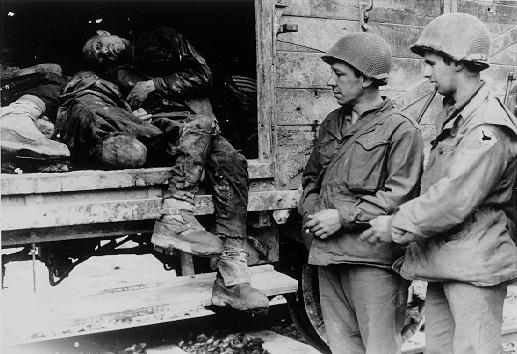
American soldiers view the bodies in one of the open railcars of the Dachau death train. USHMM

American soldiers view the bodies in one of the open railcars of the Dachau death train. USHMM

And so after some resistance, into the camp they entered. Life changing events were about to unfold for the American soldier.

***************************

For me, it’s not about hero worship, or glorifying the liberator or any World War II soldier as some kind of savior. Many of the liberating soldiers I know would resist this, to the point of rejecting the term, “liberator”… “It all sounds so exalted, so glamorous” said one. But they will all accept the term, “eyewitness”.

Witnesses to the greatest crime in the history of the world.

So instead I think it is about honoring their experiences, their shock, the horror, the puking and the crying, the rage-and then, the American GIs recognizing that something had to be done. And they did suffer for it, for trying to do the right thing. Many tried to help by offering food to starving prisoners who just were not ready to handle it, only to see them drop dead. Or having to manhandle these emaciated victims who were tearing away at each other as food was being offered.

Some guys never got over it. How could you?

I have learned so much over the past few years from these guys, just through the way that they carried themselves and tried to cope with what they witnessed. In my World War II studies and Holocaust class, we discuss these issues at length. I’m so lucky to be able to teach it.


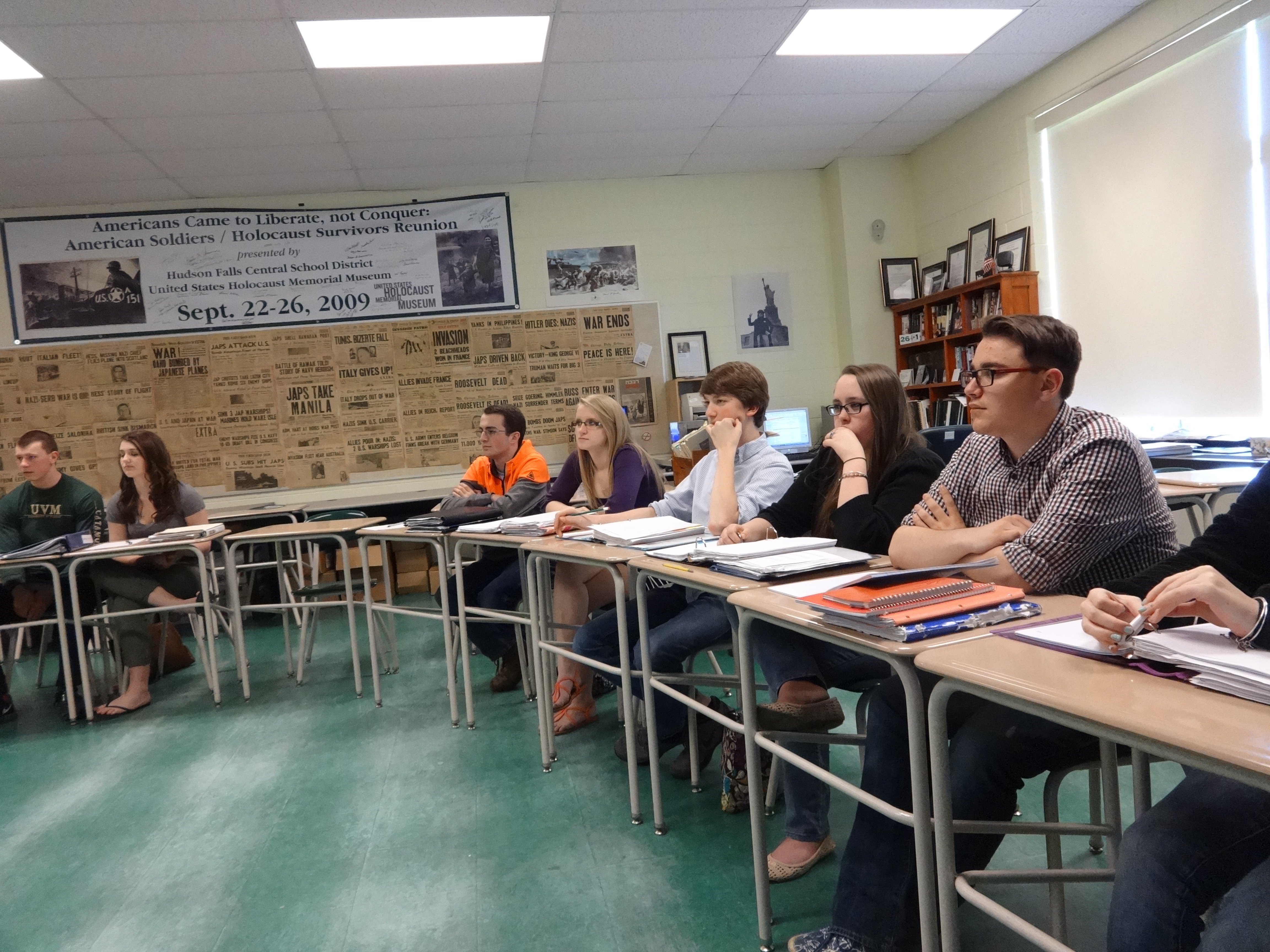
Class of 2014 in my classroom. Watching archival footage of the liberation.

Class of 2014 in my classroom. Watching archival footage of the liberation.

So yesterday, a film crew arrived from NBCLearn, a division of NBC News, all the way up from New York City. No, I did not call them. They found me. They were doing a related story, so I talked them into coming up (shout out here to the producer, Norm).

They decided they wanted to learn something from our kids- ultimately, I think, whether or not history really mattered anymore.

We have had many lessons on the Holocaust, on the victims especially, but also on the  perpetrators and the bystanders. Lessons on the liberation, and what we have been studying all along.

These kids have witnessed soldiers’ and survivors’ testimony. They have interviewed their own subjects, firsthand, and established relationships with this generation. And therefore, they become the new witnesses to the deeds of this generation. And with this, they will carry a new responsiblity. To never forget, and to not let others forget, the lessons of the past.

***************************

The raw film is rolling in the classroom. I guess it’s time for me to see what has happened to change the kids. What have they learned, and how have they grown? But today it is time to set the written exam to the side.

We watch the testimony of the  liberator who had visited our school in the past, and viewed the archival footage and photographs from 69 years ago.

And then editor poses the questions for the kids. “Why is it important to study the Holocaust? “What difference do you think it makes to know about this, our past? What do you think motivated our soldiers to go off and fight? Was it just “patriotism?”

What did your class learn? What have YOU learned?”

The completed video will be shown in schools across the country. Below are some of the kids of Hudson Falls, who make their small town  proud.

Meg V.

Meg V.


Koreena H

Koreena H

Klayton S.

Klayton S.


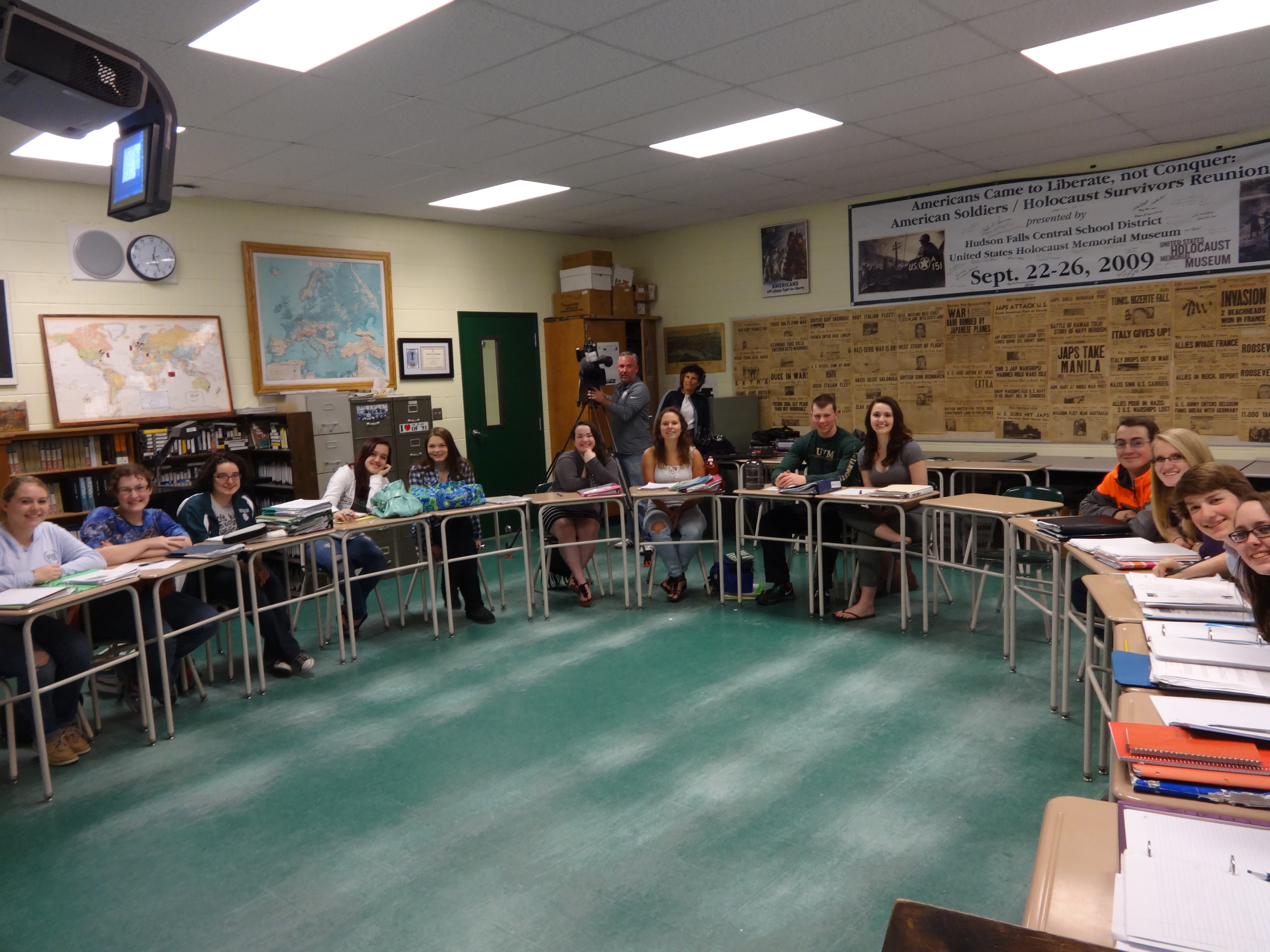
Class of 2014 in my classroom, April 28, 2014. NBC News has arrived.

Class of 2014 in my classroom, April 28, 2014. NBC News has arrived.


Read Full Post »

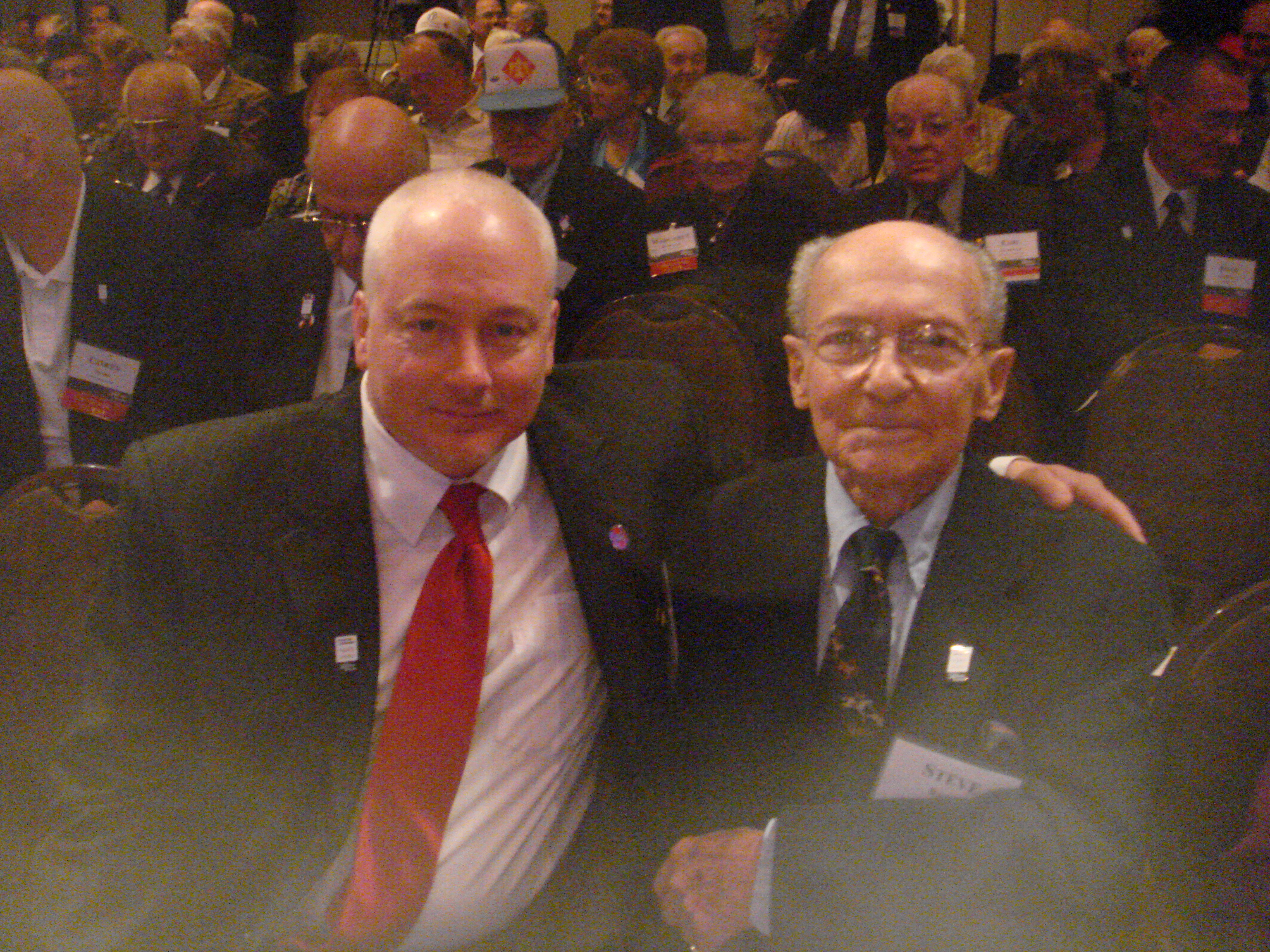
Matthew Rozell, Stephen Barry, National DOR Ceremony, Washington, DC April 2010. This photo was taken the day after the 65th anniversary of Steve's liberation in April 1945. We had just been honored by the director of the United States Holocaust Memorial Museum before the national ceremony in the Capitol Rotunda.

Matthew Rozell, Stephen Barry, National DOR Ceremony, Washington, DC April 2010. This photo was taken the day after the 65th anniversary of Steve’s liberation in April 1945. We had just been honored by the director of the United States Holocaust Memorial Museum before the national ceremony in the Capitol Rotunda.

So, the ripples continue. Somebody said it was like pebbles being tossed into the still water. This may sound strange, but I am keenly aware of the cosmic element. We tripped the wires of the cosmos.

~”It’s not for my sake, it’s for the sake of humanity, that they will remember”~

I got a nice email  recently. My friend Steve Barry was honored Tuesday evening at the United States Holocaust Memorial Museum. Steve’s daughters wanted me to know that his family made a donation in his name and set up two fellowships for scholars at the USHMM in the Stephen B. Barry Memorial Fellowship. His girls mentioned me in their speech Tuesday night in Washington. Thanks ladies. You know he was a hero. He reached out and touched an awful lot of students in the short time that we were together.

Steve will be one of the persons who will be featured in my book. Against all the odds he survived the Holocaust and later even went on to become a US Army Ranger in the Korean War! I was pretty close to him. Right now I am wistfully looking at his homemade holiday greeting cards under my desk glass, and to my left, a foot away, are the shelves containing his Holocaust library, which was passed on to me after he passed away. He was so funny, too.  He told me he nearly “choked on my bagel” a few years back when he opened his newspaper in Florida and read about me and the train he had been looking for, for so many years!

I miss the guy. You can read more about him here.


Steve's name on the wall of donors, USHMM, unveiled April 29, 2014.

Steve’s name on the wall of donors, USHMM, unveiled April 29, 2014.

The inscription kind of says it all. He uttered these words in my very classroom on a Thursday morning to a film crew from New York City, aimed at the 1500 students that he and the other survivors and American soldier/liberators had come to address. That Friday evening of our big soldier/survivor reunion, we watched it together on national news before our final banquet.

You can see the video at the bottom-he’s the one in the preview addressing the interviewer- but the transcript is below.

ABC WORLD NEWS TONIGHT, FRIDAY, SEPTEMBER 26, 2009

Diane Sawyer: And finally tonight, our Persons of the Week. It is a story that began almost 65 years ago in the darkest days of World War II. Yet this week, a new chapter unfolded. An unforgettable reunion of Holocaust survivors, and the American troops who freed them, and all made possible by a high school history class.

Matthew Rozell: This is history coming alive.
Veteran 1, entering school with his wife: Here we are, we have arrived!
Matthew Rozell: This is walking, talking, living history. They’re (the students) shaking hands with the past…

Diane Sawyer: It was 2001 when high school history teacher Matt Rozell decided to begin an oral history project. He and his students would just interview family members in the small town of Hudson Falls, New York, to capture fading stories of World War II.
Interviewer (soldier’s daughter): Did you mention the train [to Mr. Rozell] at all before?
Carrol Walsh, former soldier: No I didn’t tell him about the train.

Diane Sawyer: The students unearthed a forgotten crossroads in history. (Gunfire, archival film footage) Near the very end of World War II, April 13th, 1945, the American 30th Infantry Division was pushing its way into central Germany.
Carrol Walsh: We came to a place where there was a long train, of boxcars.

Diane Sawyer: They found a train, holding nearly 2,500 emaciated Jewish prisoners, many just children, being moved from the Bergen-Belsen concentration camp, to another camp and certain death. Their German guards had just abandoned them, fleeing the Americans.

Carrol Walsh: A feeling of helplessness. What are we going to do with all these people?
Frank Towers, former soldier: We had never ever seen anything so, (pauses) filthy.

Diane Sawyer: The American soldiers fed the prisoners, and brought them to safety.

Stephen Barry: For 42 years I collected anything that I could to try to find any article regarding the train. It just didn’t exist!

Diane Sawyer: But Mr. Rozell’s class put their interviews with veterans up on a website, along with these photographs taken by the American soldiers.

George Gross: Just very courageous people, little girls who with big smiles on their faces, one of them with their arms out, just aware that the Americans are there. [camera pans over 1945 liberation photograph]

Diane Sawyer: Out there on the web, Holocaust survivors all around the world began to notice.

Stephen Barry: I mean, how many people have a picture of their moment of liberation forever? [camera pans over 1945 liberation photograph]

(students and veterans and survivors singing “The Star Spangled Banner”)

Diane Sawyer: A reunion of the survivors and their liberators took place this week at Hudson Falls High School.

Emily Murphy, student: When they speak to us, you can’t say that you feel how they felt. But you get the feeling, you feel like you were there.

Diane Sawyer: In an age where there are still those who deny the Holocaust ever existed, these survivors say they are the living proof.

Stephen Barry: It’s not for my sake, it’s for the sake of humanity, that they will remember.

Diane Sawyer: And so we choose history teacher Matt Rozell, his class, the Holocaust survivors of that train, and the American soldiers who kept them and their story alive. And that is World News for this Friday. I am Diane Sawyer, and from all of us at ABC News, we hope you have a great weekend.

And here is a link to the 2014 United States Days of Remembrance Capitol Ceremony. Steve’s daughters and granddaughters are in the back row!


Read Full Post »

« Newer Posts - Older Posts »