Feeds:
Posts
Comments

Archive for the ‘Uncategorized’ Category

This was published in the Washington Post this week. The link is at the bottom. I repost it for noting the methodology, given some earlier articles about this topic. You can go to the original link to see comments. MR

Has the global Jewish population finally rebounded from the Holocaust? Not exactly.

By Adam Taylor July 2, 2015, Washington Post

In 1939, the global population of Jewish people worldwide peaked at around 16.6 million. That population was soon decimated by the Holocaust, which saw Nazi Germany and its collaborators kill approximately 6 million Jews. In just a few horrifying years, the global population of Jews had fallen by more than a third.

This week, a new report by the Jerusalem-based think tank Jewish People Policy Institute (JPPI) made a startling announcement: The world’s Jewish population was finally approaching 16.6 million again. The announcement sparked headlines around the world, with many observers shocked that it could have taken 70 years for the global Jewish population to return to its pre-Holocaust peak.

The problem is, it wasn’t entirely accurate.

Professor Sergio DellaPergola, perhaps the most well-known expert in Jewish demographics in the world today, is among those who have rebutted the reports. “It is a canard,” DellaPergola told the Times of Israel this week, suggesting that the numbers widely reported were both a result of “misunderstanding” and “journalistic counterfeit.”

When you look closely at the JPPI’s numbers, DellaPergola’s objections make sense. The report makes no bones that the number of self-identifying Jews in the world are around 14.2 million – a number DellaPergola had come to in his own work last year, published

It then, however, adds on to this a number of other people, including those with only one Jewish parent or those who identify as partially Jewish due to their family history. Some 348,000 Israeli citizens who came to Israel under the Law of Return but are not recorded as Jews are also included in the higher figure.

Traditionally, Judaism has a comparatively strict definition of who is Jewish, with halakha (Jewish religious law) requiring either that a person’s mother was Jewish or that they go through a formal conversion process. Not all Jews agree with these definitions, however. The Law of Return, an Israeli legislation that allows Jews to immigrate to Israel, was amended in 1970 to allow “child and a grandchild of a Jew, the spouse of a Jew, the spouse of a child of a Jew and the spouse of a grandchild of a Jew” to enter the country, leading hundreds of thousands of non-Jews to move to Israel.

In a phone call earlier this week, JPPI president Avinoam Bar-Yosef was keen to emphasize that the higher figure included these people, who others might not consider fully Jewish, in order to help with policy discussions (the JPPI report was presented to the Israeli Cabinet on Sunday). The JPPI report argues that there were “changing patterns of Jewish identification” in the past few years, hence the use of the larger number. Indeed, a 2013 Pew study on the nature of Jewish Americans found that more and more people could be considered “partially Jewish,” in part due to the shifting attitudes to intermarriage and religion.

DellaPergola’s own estimates of the world’s Jewish population have made a point of not including these people, noting that if “we add persons who state they are partly Jewish and non-Jews who have Jewish parents, an extended global aggregate population estimate of 17,236,850 is obtained.” DellaPergola disagrees with using these broader definitions, however: “If the United States had 6.7 million holders of a doctorate, and 1 million of these hold a doctorate partly, how many Ph.D.s are there in America?” he asked in the Forward in 2013.

So when will the core Jewish population actually reach its pre-Holocaust heights? Recent estimates by Pew found that the world’s Jewish population would rise by 15 percent in the next two and a half decades, compared to 35 percent for the overall global population, to reach 16.1 million in 2050. DellaPergola’s research has suggested that, had the Holocaust not taken place, the global Jewish population would have been at least 26 million and possibly as much as 32 million today.

Adam Taylor writes about foreign affairs for The Washington Post. Originally from London, he studied at the University of Manchester and Columbia University.

Source: http://www.washingtonpost.com/blogs/worldviews/wp/2015/07/02/has-the-global-jewish-population-finally-rebounded-from-the-holocaust-not-exactly/


Read Full Post »

From my friends in Australia
June 21, 2015 by Henry Benjamin

Five Sydney women, who were little children in April 1945, were  traveling on a train en route from Bergen-Belsen to Thereseinstadt when it was abandoned by the Germans and discovered by the advancing U.S. forces. 

Around the table l-r: Ilonka Blair, Judith Handley, Eva Reed, Lexie Keston. Ana Deleon , and Lea Farkas

Around the table l-r: Ilonka Blair, Judith Handley, Eva Reed, Lexie Keston. Ana Deleon  and Lea Farkas    Photo: Gaby Deleon


The five recently were joined by a sixth survivor to commemorate the 70th anniversary of their rescue by the U.S. troops.

It was the first time the five passengers in the abandoned train had sat down together.

Six years ago J-Wire told the story of the rescue when some of those liberated as children met their liberators for the first time.

You can read it here…   http://www.jwire.com.au/a-school-holocaust-project-re-unites-liberated-with-liberators/

Judith Handley,  Eva Reed,  Lexie Keston, Ana Deleon, Lea Farkas were joined by Ilonka Blair who survived Bergen-Belsen. All are members of  the Sydney Child Survivors Group.

The train at Magdeburg - Pic:  Major Clarence Benjamin - 743rd Tank Battalion

The lunch, hosted by Ana Deleon, gave the women an opportunity to exchange memories of that April day in 1945 when German troops mysteriously disappeared having abandoned the train abandoning their prisoned in Magdeburg, Germany…only to be replaced by the advancing Americans troops who were to liberate them.

Lexie Keston told J-Wire: “Our Liberation was on 13 April 1945.  We were liberated by the 9th US Army Tank brigade, at Farsleben which is 16 km from Magdeburg in Germany.  Apart from  Ilonka Blair  who was liberated at the Bergen-Belsen Camp we were all on a train from Bergen-Belsen and had been travelling since the 7th April. Ana Deleon organised our re-union lunch to celebrate 70 years since our Liberation.  Amongst our little group, we had girls from Hungary, the former Yugoslavia and Poland.”

Judith Handley and Lea Farkas were new to the group having been “discovered” living in Sydney by Ana Deleon. They have joined the Sydney Child Survivors group.

76-yr-old Lexie,  the “baby” of the group, added: “We had all gone our separate ways after the rescue as we had come from different backgrounds. Somehow fate has brought us all together.”

Frank Towers is the last surviving veteran of the 30th Division that had any hands-on experience with this event. He told J-Wire: “I have been in contact with Lexie and Ana.”

http://www.jwire.com.au/on-a-train-to-australia/

Read Full Post »

April 15th 1945                                                                                                                   Somewhere in Germany

You will probably be wondering who I am and what business I have, writing to you.- I am one of the millions of soldiers of the United States Army, who is fighting for all the oppressed peoples of the world and hopes to have reestablished decency and honor to all mankind, with the defeat of Hitlerism.

*****

My friend Varda in Israel sent me a copy of this letter she recently received from the widow of  Mr. Shmuel ‘Tommy’ Huppert of Israel. In it, an American soldier is taking the time to write to the husband of a Holocaust survivor to let him know that his wife and young son (Tommy) have been liberated, and that they have survived the horrors of the Holocaust and the carnage of ‘Hitlerism’.

Young Tommy and his mother, Mrs. Hilde Huppert,  were liberated at Farsleben on the transport from Bergen Belsen on April 13th, 1945. They managed to get to Palestine shortly after liberation, bringing with them many, many orphaned children, including my friend Lily Cohen.  Hilde’s manuscript, Hand in Hand with Tommy, was one of the first Holocaust memoirs completed after the war and a cathartic way for her to attempt to come to terms with what had happened.

It took years to be properly published, as it was originally rejected because it was ‘too soon after the war’. Later, at 93 years of age, Hilde was asked if there was anything specific she wished to convey to American readers of her book. She replied, ‘Tell them I will never forget those American GIs who liberated us from the Germans…I can still recall their amazed faces in that dusty jeep and the U.S. Army symbol. I remember kissing one of them, and I want the American people to know that I am grateful to them.’


READ ALL ABOUT IT IN MY BOOK HERE


One of the soldiers, on the Sunday following the Friday liberation, took the time to send this note on her behalf to her husband in Palestine. It now resides in the collection at Yad Vashem, Israel’s Holocaust Remembrance Authority.

4-15-45 Gartner to Huppert 1

April 15th 1945                                                                                                                      Somewhere in Germany

Dear Mr. Huppert,

You will probably be wondering who I am and what business I have, writing to you.- I am one of the millions of soldiers of the United States Army, who is fighting for all the oppressed peoples of the world and hopes to have reestablished decency and honor to all mankind, with the defeat of Hitlerism.

Two days ago, it was the priviledge (sic) of our unit, to be able to liberate a trainload full of people of all nations imaginable, who were being transferred from a concentration camp near Hannover, to some other place. Our advances were so swift, that the SS guards, left this particular train where it was and took off.

That is how I became acquainted with your wife, Mrs. Hilde Huppert, who asked me to drop you this note, saying, that both she and your son Tommy, are both healthy and well and now being well taken care of by our military governmental authorities. In actual fact, your wife wrote a message for you on a piece of paper in pencil, which she asked me to convey to you. Unfortunately, however, the penciled lines faded in my pocket, and I can no longer read what was written on it. The contents of the message, though, was to let you know that your wife and son are both safe and sound.

I am sure that your wife will soon be able to get into contact with you directly through the Red Cross, and I hope that in a none too distant future, your family will once more be peacefully united.

Sincerely yours,

Cpl. Frank Gartner

Fluent in many languages, Gartner was the translator for the 743rd Tank Battalion’s commander, Col. Duncan. He was originally from Estonia, and resided in Los Angeles, California.

BOOK HERE

If anyone knows more about Frank Gartner, please contact me at matthew @ teachinghistorymatters.com.. 

Transcribed by Alanna Belanger’15 and Alexis Winney ’15.

Read Full Post »

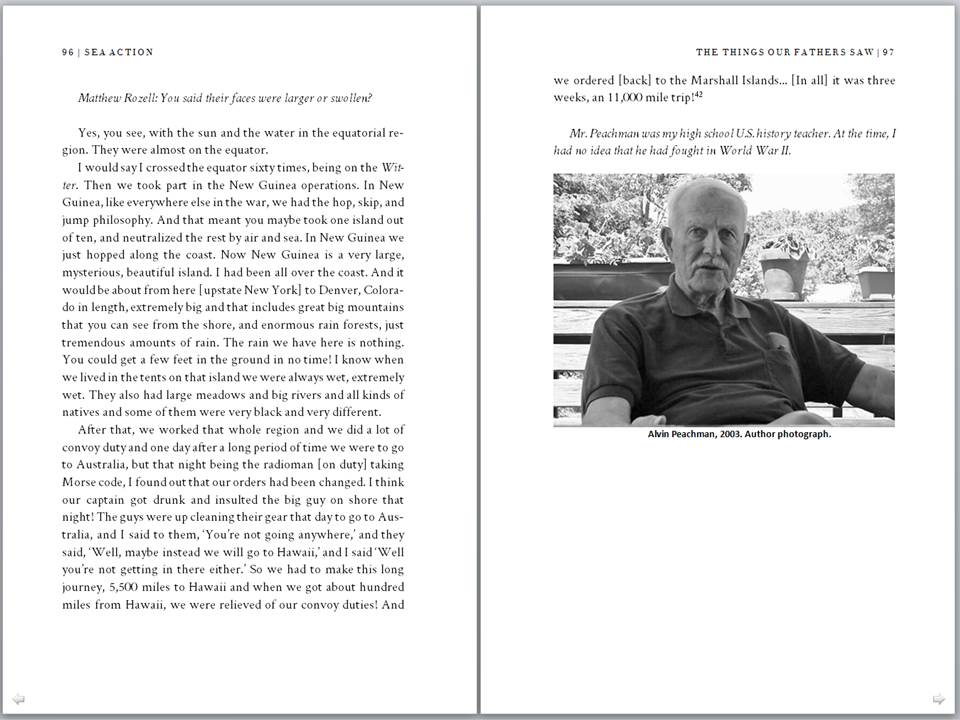
In 2003, I set out to interview a retiree living on the quiet boulevard leading up to our high school. I sat on his backporch with him for a few hours on a late spring afternoon. Born in 1922, he was in the Navy, serving as a radioman on a destroyer escort, and he seemed to be everywhere in the Pacific during World War II. Like John A. Leary, he also spent a great deal of time supporting the Marines, and saw his first action in the South Pacific in the reduction of the massive Japanese base at Rabaul on New Britain.

Mr. Peachman turned 93 this past March. He was my high school history teacher.


Alvin Peachman

From “The Things Our Fathers Saw” by Matthew Rozell.

From “The Things Our Fathers Saw” by Matthew Rozell.


You can view a book preview at the Amazon site. Available in digital and paperback format. Book can also be purchased at http://matthewrozell.com/order-the-things-our-fathers-saw/

*************************************************************


 Book Description: At the height of World War II, LOOK Magazine profiled an upstate New York community for a series of articles portraying it as the wholesome, patriotic model of life on the home front. Seventy years later, a high school history teacher and his students track down over two dozen veterans residing around ‘Hometown, USA’ who fought the war in the Pacific, from Pearl Harbor to the surrender at Tokyo Bay. They resurrect firsthand accounts of combat and brotherhood, of captivity and redemption, and the aftermath of a war that left no community unscathed. Here are the stories that the magazine could not tell, from a special generation of Americans speaking to the youth of America today.  270 pages.

About the Author: Matthew Rozell’s teaching career is now spanning 4 decades, beginning as a quiet kid returning to teach in his own hometown to being recognized as a national History Teacher of the Year and as a recipient of a national Medal for History Education. Rozell is a United States Holocaust Memorial Museum Teacher Fellow, has had his lessons filmed for NBC Learn, and has even been chosen as the ABC World News Person of the Week. He is also a recipient of several state and local awards for history education. He writes on the power of teaching and the importance of the study of history at his website,teachinghistorymatters.com.

He can be reached at marozell at gmail dot com.

Read Full Post »

This story below is an excerpt from my first book. It was published for the 70th anniversary of the end of the war.

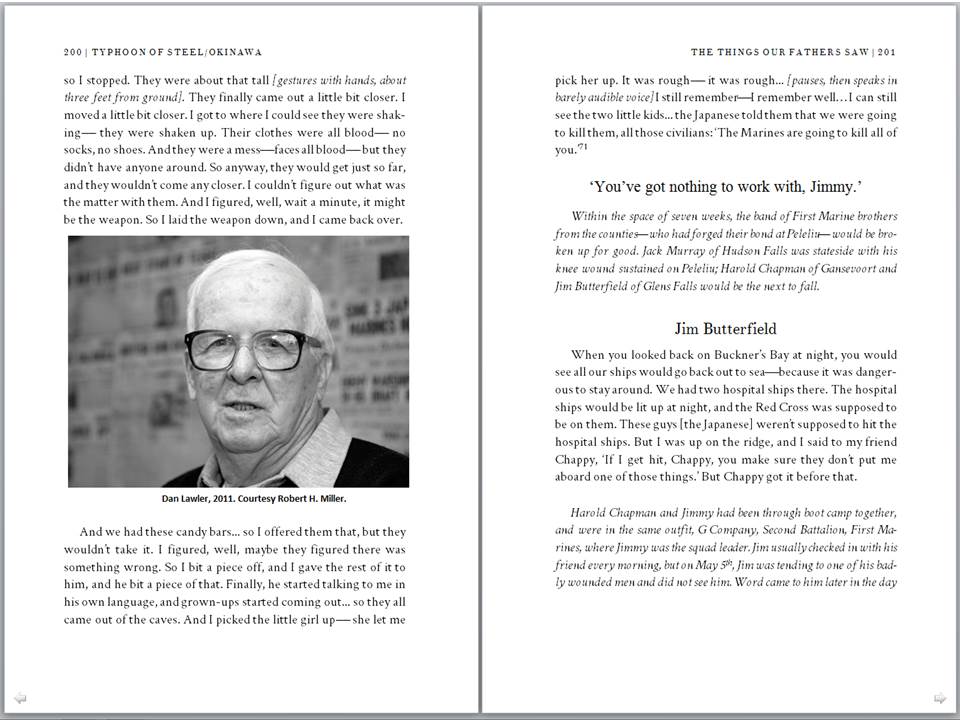
My friend Jimmy Butterfield used to come to my classroom with his bride of 60+ years, Mary. She would joke with him, and us, and call him by his high school nickname, “But”. Maybe it was “Butt”, I don’t know, but they had fun playing around with each other in front of 17 and 18 year olds.

Jimmy, of course, was blind and hard of hearing. Mary had to yell at him, he would crack a grin under the dark glasses and flirt with her. The girls loved it. When the hearing aide was cranked up to eleven, we would get some echo and feedback, which didn’t seem to bother him, or the students in the class listening to his story. He just liked to talk to the kids.

Several years ago, after the two of them and Danny Lawler (another First Marine Division veteran of really hard fighting in the Pacific at Peleliu and Okinawa) came to my room for an afternoon, I came home to an email from one of my senior girls, telling me how meaningful meeting Jimmy and Mary and Danny was to her and her classmates. I still have it.

You see, Jim Butterfield got struck not once but twice in the head by enemy fire at Okinawa about this time in May  1945 (that is 70 years ago this month, if you are noticing). He was evacuated first to Guam, then to Hawaii and later stateside for over 18 months, and as many operations, for reconstructive surgery.  When he did realize that he would never see again,  he was ready to tell his high school sweetheart to leave him be. Not to get attached to him, a blind man.

Well, she told us what she thought of that. They ran a small mom and pop store back in Glens Falls together until they retired.

Why is Jim’s story important? Well, you’ll have to listen to him tell it. You have the sense of the unfolding realization of the loss he is feeling, but at the same time, wonderment at his and Mary’s resilience in making a successful life afterwards. The sacrifices made by this and other generations of veterans becomes real. We need to also note that Jim came home. Chappy and many others others did not.

Jim never looked for sympathy or pity- and of course would be the first to point out that Memorial Day is for those who did not return. But still, if we are to pause as a nation for one weekend to remember, we can’t forget what this nineteen year old from Hometown USA gave up as well.

Mary and Jim have since passed on. What obstacles they overcame together…

Rest on Jimmy and Mary. Thanks for letting us witness your story.

******************************************

From "The Things Our Fathers Saw" by Matthew Rozell.

From “The Things Our Fathers Saw” by Matthew Rozell.


Mary and Jim Butterfield Jan. 2007

Mary and Jim Butterfield in my classroom, Jan. 2007.

*************************************************************

Excerpted from “The Things Our Fathers Saw: The Untold Stories of the World War II Generation from Hometown, USA“. Order the book here.

 Book Description: At the height of World War II, LOOK Magazine profiled an upstate New York community for a series of articles portraying it as the wholesome, patriotic model of life on the home front. Seventy years later, a high school history teacher and his students track down over two dozen veterans residing around ‘Hometown, USA’ who fought the war in the Pacific, from Pearl Harbor to the surrender at Tokyo Bay. They resurrect firsthand accounts of combat and brotherhood, of captivity and redemption, and the aftermath of a war that left no community unscathed. Here are the stories that the magazine could not tell, from a special generation of Americans speaking to the youth of America today.  292 pages.


 H


Read Full Post »

Photographs.

A project by a student in my colleague Sara Kollbaum’s 12th grade class in Nashville, Ill. It was inspired by a story I posted last month.
‘This song was inspired by an individual of the Holocaust, liberator Robert Hays. Please read his story  and spread his story so that we can remember him and all other individuals [affected by] that horrible event.  Enjoy and remember those who fell victim to the Holocaust. To listen to a witness is to become a witness.’
Agreed. As a liberator once told me, ‘I am a “survivor” of World War II, too.’

Photographs

Composed and performed by Easten Hoepker

Verse 1

We grow up and get old

We grow wise and get bold

And we learn while we go

And we think we know

We go fast and go far

We stay near and work hard

We remember our scars

Make us who we are

Pre-chorus

But as time goes on we get caught in the moment

Don’t look back, we’re not going that way

But every once in a while we need a reminder

Not to forget our past

Chorus

A picture can speak a thousand words, they say

But a thousand words can’t explain how it felt that day

So we remember the smiles and tears

And carry them on for others to feel

When words aren’t enough to keep memories alive

We look at our pictures

And they survive

Verse 2

We live on and live strong

We progress and make best

Of the things we can not control

We forgive and we love

We look back and we trust

Our mistakes teach us more than success does

Bridge

We need the past to guide the future

The lessons we learn we never forget

*****************************************************************************************************

Dachau Will Always Be With Us

by Tony Hays

This is not so much a post about writing as one about a writer’s education, about one of those experiences that molds us, shapes us into storytellers.

My father, Robert Hays, was the son of an alcoholic tenant farmer in rural west Tennessee. If the appellation “dirt poor” fit anyone, it fit my grandfather’s family. Daddy served in the Civilian Conservation Corps during the 30s. He and my mother, who was in the woman’s equivalent of the CCC, working as a nurse’s aide at Western State Mental Hospital in Bolivar, Tennessee, met on a blind date in early 1940 and married in September of that year.

But just over a year later, Pearl Harbor happened. America was in the war. My father was among the first of those drafted in 1942. I won’t bore you with the details, but he participated in the North African, Salerno, Anzio, and southern France invasions, saved by the luck of the draw from Normandy. But they slogged through France and on to Germany. On April 29, 1945, Allied troops liberated the Dachau concentration camp. I don’t know whether he entered Dachau that day or the next, but that he was there within hours of the liberation is beyond dispute. A few months later, after more than three years overseas, he came home.

In later years, he would talk occasionally about the war, providing anecdotes that showed the chaos and random chance of battle. He spoke of driving through Kasserine Pass in North Africa just hours before the Germans killed thousands of Allied troops in a stunning attack. He spoke of a friend, defending his position from a foxhole, who was thought dead after an artillery shell landed right next to him. When the dust cleared, the friend was buried up to his neck in dirt, but did not have a scratch on him. He spoke often of Anzio, where he was wounded, and of the massive German air assaults on those soldiers clinging to that tiny sliver of beach along the Italian coast.

But he never spoke of Dachau.

The bodies of former prisoners are piled in the crematorium mortuary in the newly liberated Dachau concentration camp. Dachau, Germany, April 29, 1945.

The bodies of former prisoners are piled in the crematorium mortuary in the newly liberated Dachau concentration camp. Dachau, Germany, April 29, 1945. USHMM.


Ever.

When he died in 1981, we found a photo in his wallet. An old sepia-toned shot like others he had taken during the war, pictures that he kept in an old brown bag. But this one was different.

It showed a pile of naked bodies. Well, really more skeletons than not, with their skin stretched pitifully over their bones. On the back, as had been his habit, was typed simply “Dachau.”

I was confused. Why would he keep this one photo in his wallet all of those years? Especially a photo of a place and event that he never spoke about. It obviously had some deeper meaning for him than the other photographs. If it had been a shot of the building he was in when he was wounded (hit by an artillery shell), I could have seen that. A reminder of his closest brush with death. Yeah, I could buy that. But this macabre photo? That, I couldn’t see.

So, for the next fifteen years, I remained puzzled.

Until the fall of 1996. I was working in Poland, and I had some time off. I took an overnight bus from Katowice, Poland to Munich. It was an interesting trip all in itself. We sat in a line of buses at midnight on the Polish/German border, waiting for our turn to cross, next to a cemetery, as if in some Cold War spy movie. I remember passing Nuremburg and thinking that my father had been there at the end of the war. And then there was Munich.

I spent a day or two wandering through the streets, drinking beer in the Marienplatz. I’m a historical novelist, so the short trip out to Dachau was a no-brainer. Of course it was as much my father’s connection with it as anything else that spurred the visit. But I’m not sure that I was completely aware of that at the time.

Dachau literally sits just on the outskirts of the Munich metropolitan area. I looked at the sign on the train station with a sadness, wondering for how many people that had been one of the last things they saw. It was only later that I discovered there had been another depot for those passengers.

The Dachau Memorial is a place of deep emotion. In the camp proper, mostly all that are left are the foundations of the barracks. One has been reconstructed to give an idea of how horrible life must have been. The camp was originally intended to hold 6,000 inmates; when the Allies liberated Dachau in 1945, they found 30,000. The museum and exhibits are primarily in the old maintenance building. I looked with awe at life size photos of prisoners machine gunned, their hands torn to ribbons from the barbed wire they had tried to climb in a futile attempt at escape.

I followed the visitors (I can’t call them tourists) north to where you crossed over into the crematorium area. It was there that the full brunt of what had taken place at Dachau really hit me. A simple brick complex, it seemed so peaceful on the fall day that I stood before it. But as I read the plaques and consulted my guidebook, as I stepped through the door and actually saw the “shower” rooms where the prisoners were gassed, as I stared into the open doors of the ovens, I felt a rage unlike any I had ever known consume me.
Covering my eyes, embarrassed at the tears, I slipped back outside. It took more than a few minutes to regain my composure. I thought then that I understood why my father kept that photo close to him for so long. It was a reminder of what one group of people had done to another group of fellow humans. The obscenity of it had overwhelmed him as it had me.

That night, I went to the famous Hofbrauhaus in Munich, to wash the images of the ovens away with some beer. I hadn’t been there long when an elderly American couple sat at the table. They were from Florida, a pleasant couple. He had been a young lieutenant in the American army on the push into Munich. In fact, it had been his pleasure to liberate the Hofbrauhaus from the Germans.

Of course, I asked the question. “Were you at Dachau?”

He didn’t answer for several seconds, tears glistening in the corners of his eyes as his wife’s hand covered his and squeezed. Finally, he nodded, reached into a back pocket and pulled out his wallet.

With a flick of his wrist, a photo, just as wrinkled, just as bent, as the one my father had carried landed on the table. It wasn’t the same scene, but one just like it.

Here was my chance, the opportunity to ask the question I had never been able to ask my father. I pulled the photo from my own wallet and lay it next to his. “Why? Why have you carried it so long? To remind you of the horror of Dachau, of what had been done here?”

His face carried the faintest of smiles as he shook his head. “No, son, to remind us of the horrors that we are capable of, to remind us not to go down that road again.”

The difference was subtle, but in that moment, I learned two lessons invaluable to a writer, subtle differences are important, and when you want to know the truth, go to the source.

As I sit here now and look at that same photograph, I realize that it was my father’s legacy to me, of Dachau.

Now, nearly 70 years after that day in 1945, Dachau is still with us, and I hope the legacy left by our fathers always will be.

Dachau, Seventy Years On; The Subtle Difference.


Read Full Post »

There  are ‘wrong’ ways to teach about the Holocaust.

Here are the general guidelines in a project I created for the Museum Teacher program at the United States Holocaust Memorial Museum with fellow Museum Teacher Fellow Sara Kollbaum, set to original music sung and performed by student Kylie James. For students, her song is also a good model of what an expressive and appropriate learning project can be about.

From the original You Tube link: ‘Educational project  completed for the United States Holocaust Memorial Museum in Washington DC to help educators teach the Holocaust. It features the work of Kylie James, student, her song set to photographs collected by USHMM Fellow Matthew Rozell and USHMM Fellow Sara Kollbaum.It is four and a half minutes long. The song begins 30 seconds in.’

This is for Remembrance

Verse 1:         Six million died

Innocents who lost their lives

Children and their mothers all lined up by their numbers

Told that there were showers

They were gassed within the hour

Chorus:          this is for remembrance

For  all of those who lost their lives

And this is for remembrance

Of all of those left behind

So don’t forget the people who died

‘Cause they won’t forget their genocide

Verse 2:         everything was taken

Husbands from their wives

No one can forget the

Day the Nazis arrived

Houses were torn apart all around

Synagogues were burning to the ground

this is for remembrance

For all of those who lost their lives

And this is for remembrance

Of all of those left behind

So don’t forget the people who died

‘Cause they won’t forget their genocide

Verse 3:         how could they do this?

Exterminate more than half a race

Why would they do this

With no remorse like child’s play

How could they do this?

The world just looked and turned away…

this is for remembrance

FOR all of those who lost their lives

And this is for remembrance

Of all of those left behind

So don’t forget the people who died

‘Cause they won’t forget their genocide

this is for remembrance

For all of those who lost their lives

And this is for remembrance

Of all of those left behind

So teach your children, not to hate

Learn from our past, before its too late

This is for remembrance

DOWNLOAD THE GUIDELINES HERE:

http://www.ushmm.org/educators/teaching-about-the-holocaust/general-teaching-guidelines

IMPORTANT EXCERPT:

‘One of the primary concerns of educators teaching the history of the Holocaust is how to present horrific, historical images in a sensitive and appropriate manner. Graphic material should be used judiciously and only to the extent necessary to achieve the lesson objective. Try to select images and texts that do not exploit the students’ emotional vulnerability or that might be construed as disrespectful to the victims themselves. Do not skip any of the suggested topics because the visual images are too graphic; instead, use other approaches to address the material.

In studying complex human behavior, many teachers rely upon simulation exercises meant to help students “experience” unfamiliar situations. Even when great care is taken to prepare a class for such an activity, simulating experiences from the Holocaust remains pedagogically unsound. The activity may engage students, but they often forget the purpose of the lesson and, even worse, they are left with the impression that they now know what it was like to suffer or even to participate during the Holocaust. It is best to draw upon numerous primary sources, provide survivor testimony, and refrain from simulation games that lead to a trivialization of the subject matter.

Furthermore, word scrambles, crossword puzzles, counting objects, model building, and other gimmicky exercises tend not to encourage critical analysis but lead instead to low-level types of thinking and, in the case of Holocaust curricula, trivialization of the history. If the effects of a particular activity, even when popular with you and your students, run counter to the rationale for studying the history, then that activity should not be used.’

Read Full Post »

v-e-day-banner-r1

V-E Day 70th Anniversary Commemoration
Friday, May 8, 2015 ~ 10:30 a.m.
World War II Memorial
Washington, DC.

This event is free and open to the public. However, the limited seating available has been filled. If you are a World War II Veteran or you have a WWII Veteran in your group, please contact hrotondi@wwiimemorialfriends.org.
It is hard to believe that it has been nearly 70 years since millions of people around the globe poured into the streets to celebrate the end of World War II in Europe.

To commemorate this significant date in world history, the Friends of the National World War II Memorial and the National Park Service will co-host a very special V-E Day 70th Anniversary Commemoration on May 8th at 10:30 a.m. at the WWII Memorial.

Former Secretary of State Dr. Madeleine Albright will provide remarks. Born in Prague, Czechoslovakia, Dr. Albright and her family spent the war years in exile in England. Raised Catholic, Dr. Albright did not learn until adulthood that her parents were originally Jewish and that many of her relatives in Czechoslovakia had perished in the Holocaust, including three of her grandparents.

Also taking part in the ceremony will be dozens of World War II veterans and representatives of the United States and the embassies of nearly 30 European Theater Allied Nations who will lay wreaths at the “Freedom Wall” of the Memorial in memory of the more than 400,000 Americans and 60 million people killed worldwide during the deadliest military conflict in human history.

Alex Kershaw, renowned historian and author of “The Bedford Boys: The Story of Bedford, Virginia’s Extraordinary D-Day Sacrifice” and “The Liberator: One Soldier’s 500-Day Odyssey from the Beaches of Sicily to the Gates of Dachau,” will serve as the event’s Master of Ceremonies and Expert Historian.

The ceremony will be followed by the “Arsenal of Democracy World War II Victory Capitol Flyover,” which will include dozens of World War II aircraft flying in 15 historically sequenced warbird formations overhead. The formations will represent the war’s major battles, from Pearl Harbor through the final air assault on Japan, and conclude with a missing man formation to “Taps.” The Flyover is set to start at 12:10 p.m. and last approximately 40 minutes.

http://www.wwiimemorialfriends.org/v-e-day-70th-anniversary

Read Full Post »

At my keynote talk in Rochester, NY, two weeks ago, several people came up to me after the ceremony and greeted me warmly. One man came with an envelope and shook my hand, explaining that his father had been an American medic. In the envelope were photographs and Vincent’s handwritten letter describing a talk that he had had with his dad a couple years before he passed. I have finally gotten around to transcribing it; it comes on the 70th anniversary of his father’s traumatic shock at a subcamp of Dachau where Jewish slave laborers were being worked to death mining out mountains so the Reich could shelter its fledgling jet industries from Allied bombing. Many of the prisoners were dying of typhus. Below you will find the letter and two of his photos.

Vincent F. Butler, Sr.

Vincent F. Butler, Sr.

4/15/2015

Dear Matt,

These are copies made from the original pictures taken by my father, Vincent F. Butler, Sr., at the concentration camp in Landsberg, Germany toward the end of World War II. He did not date the pictures, but I have included a copy in his handwriting of the location. My father was a medic in the XXI Medical Corps when his unit liberated this camp.

My father never really talked about the war except for a funny story once in a while. About 2 years before he died he first showed me these pictures. He described the encounter as “the worst thing I had ever seen”. That says a lot considering he was a frontline medic in Europe. He also said that he “could not understand how someone could do something so horrible against other human beings.” He uttered “Why…Why…Why…” several times during our talk. He gave me these pictures with the directive: “Never let anyone say that this did not happen. It did – I saw it.”

Landsberg Area, Germany. A subcamp of Dachau.

Landsberg Area, Germany. A subcamp of Dachau.

That was one of the few actual directives that my father ever gave me, and I must say, it was his most serious. Looking back, and finally knowing what he had been through, I am sure that this had the biggest impact and was the most traumatic effect on him.

He did talk about how they tried to save as many people as they could. He said they had to very slowly give people food because large amounts would shut their system down. He said he was not aware of these camps until they came upon this one.

Thank you for telling the story so that the Holocaust is never repeated. I think that my father’s pictures and his recollection through me may help in some small way.

Vincent Butler, Jr.


http://www.ushmm.org/wlc/en/article.php?ModuleId=10006171

*************************************************************

Matthew Rozell is a United States Holocaust Memorial Museum Teacher Fellow and teaches history at his alma mater in upstate New York. His work has resulted in the reuniting of 275 Holocaust survivors and the American soldiers who freed them.

His first book, ‘The Things Our Fathers Saw’, is being released to coincide with the 70th anniversary of the end of World War II. His second book, in progress, is on the power of  teaching, remembering the Holocaust, the Benjamin photograph and the liberation of the “Train Near Magdeburg’. He can be reached at marozell at gmail dot com.

Read Full Post »

April 30 1945 Headlines. Hangs in my classroom.

April 30 1945 Headlines. Hangs in my classroom.

Today, April 29th, is the anniversary of the liberation of Dachau, 70 years on.

Today, if it is brought up at all, some of us might respond with a vacant stare. More might shrug and turn away. I suppose that is to be expected. But you know me. I just think that as a nation, sometimes we allow things to slip from memory at our peril.

It was real, and it happened. And it was American GIs who overran this camp and many others in the closing days of World War II.

The men of the 42nd and 45th Infantry Division arrived independently of each other, here, in southern Germany, at Dachau, on this day. A concentration camp, they were told. Their noses gave them a hint of what they were about to uncover, miles before the camp appeared in sight.

Read the headlines, above. Note the subarticle:

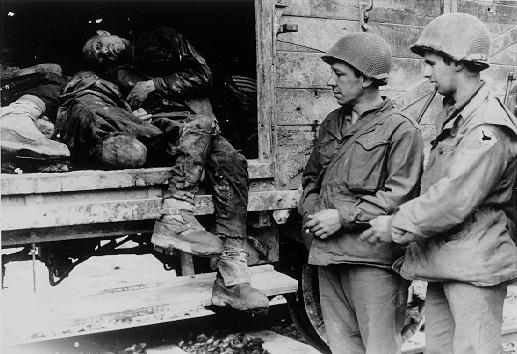
Boxcars of Dead at Dachau. 32,000 captives freed.

American soldiers view the bodies in one of the open railcars of the Dachau death train. USHMM

American soldiers view the bodies in one of the open railcars of the Dachau death train. USHMM

And so after some resistance, into the camp they entered. Life changing events were about to unfold for the American soldier.

***

For me, it’s not about hero worship, or glorifying the liberator or any World War II soldier as some kind of savior. Many of the liberating soldiers I know would resist this, to the point of rejecting the term, “liberator”… “It all sounds so exalted, so glamorous” said one. But they will all accept the term, “eyewitness”.

Witnesses to the greatest crime in the history of the world.

So instead I think it is about honoring their experiences, their shock, the horror, the puking and the crying, the rage-and then, the American GIs recognizing that something had to be done. And they did suffer for it, for trying to do the right thing. Many tried to help by offering food to starving prisoners who just were not ready to handle it, only to see them drop dead. Or having to manhandle these emaciated victims who were tearing away at each other as food was being offered.

Some guys never got over it. How could you?

I have learned so much over the past few years from these guys, just through the way that they carried themselves and tried to cope with what they witnessed. In my World War II studies and Holocaust class, we discuss these issues at length. I’m so lucky to be able to teach it.

Last year, I was privileged to teach a lesson to my high school seniors for NBC Learn, which was shared with other districts across the nation. This year, I stumbled upon this piece by the late author Tony Hays, who writes about his liberator father and his own encounter with the past. Thanks to the Get It Write folks; the original link is at the bottom.

***

Dachau Will Always Be With Us

by Tony Hays

This is not so much a post about writing as one about a writer’s education, about one of those experiences that molds us, shapes us into storytellers. I read yesterday the story of Joseph Corbsie, whose father, a World War II veteran, left him with a special legacy from the war, from the hideous Nazi concentration camp at Dachau. I feel a particular kinship with Mr. Corbsie.

My father, Robert Hays, was the son of an alcoholic tenant farmer in rural west Tennessee. If the appellation “dirt poor” fit anyone, it fit my grandfather’s family. Daddy served in the Civilian Conservation Corps during the 30s. He and my mother, who was in the woman’s equivalent of the CCC, working as a nurse’s aide at Western State Mental Hospital in Bolivar, Tennessee, met on a blind date in early 1940 and married in September of that year.

But just over a year later, Pearl Harbor happened. America was in the war. My father was among the first of those drafted in 1942. I won’t bore you with the details, but he participated in the North African, Salerno, Anzio, and southern France invasions, saved by the luck of the draw from Normandy. But they slogged through France and on to Germany. On April 29, 1945, Allied troops liberated the Dachau concentration camp. I don’t know whether he entered Dachau that day or the next, but that he was there within hours of the liberation is beyond dispute. A few months later, after more than three years overseas, he came home.

In later years, he would talk occasionally about the war, providing anecdotes that showed the chaos and random chance of battle. He spoke of driving through Kasserine Pass in North Africa just hours before the Germans killed thousands of Allied troops in a stunning attack. He spoke of a friend, defending his position from a foxhole, who was thought dead after an artillery shell landed right next to him. When the dust cleared, the friend was buried up to his neck in dirt, but did not have a scratch on him. He spoke often of Anzio, where he was wounded, and of the massive German air assaults on those soldiers clinging to that tiny sliver of beach along the Italian coast.

But he never spoke of Dachau.

The bodies of former prisoners are piled in the crematorium mortuary in the newly liberated Dachau concentration camp. Dachau, Germany, April 29, 1945.

The bodies of former prisoners are piled in the crematorium mortuary in the newly liberated Dachau concentration camp. Dachau, Germany, April 29, 1945. USHMM.


Ever.

When he died in 1981, we found a photo in his wallet. An old sepia-toned shot like others he had taken during the war, pictures that he kept in an old brown bag. But this one was different.

It showed a pile of naked bodies. Well, really more skeletons than not, with their skin stretched pitifully over their bones. On the back, as had been his habit, was typed simply “Dachau.”

I was confused. Why would he keep this one photo in his wallet all of those years? Especially a photo of a place and event that he never spoke about. It obviously had some deeper meaning for him than the other photographs. If it had been a shot of the building he was in when he was wounded (hit by an artillery shell), I could have seen that. A reminder of his closest brush with death. Yeah, I could buy that. But this macabre photo? That, I couldn’t see.

So, for the next fifteen years, I remained puzzled.

Until the fall of 1996. I was working in Poland, and I had some time off. I took an overnight bus from Katowice, Poland to Munich. It was an interesting trip all in itself. We sat in a line of buses at midnight on the Polish/German border, waiting for our turn to cross, next to a cemetery, as if in some Cold War spy movie. I remember passing Nuremburg and thinking that my father had been there at the end of the war. And then there was Munich.

I spent a day or two wandering through the streets, drinking beer in the Marienplatz. I’m a historical novelist, so the short trip out to Dachau was a no-brainer. Of course it was as much my father’s connection with it as anything else that spurred the visit. But I’m not sure that I was completely aware of that at the time.

Dachau literally sits just on the outskirts of the Munich metropolitan area. I looked at the sign on the train station with a sadness, wondering for how many people that had been one of the last things they saw. It was only later that I discovered there had been another depot for those passengers.

The Dachau Memorial is a place of deep emotion. In the camp proper, mostly all that are left are the foundations of the barracks. One has been reconstructed to give an idea of how horrible life must have been. The camp was originally intended to hold 6,000 inmates; when the Allies liberated Dachau in 1945, they found 30,000. The museum and exhibits are primarily in the old maintenance building. I looked with awe at life size photos of prisoners machine gunned, their hands torn to ribbons from the barbed wire they had tried to climb in a futile attempt at escape.

I followed the visitors (I can’t call them tourists) north to where you crossed over into the crematorium area. It was there that the full brunt of what had taken place at Dachau really hit me. A simple brick complex, it seemed so peaceful on the fall day that I stood before it. But as I read the plaques and consulted my guidebook, as I stepped through the door and actually saw the “shower” rooms where the prisoners were gassed, as I stared into the open doors of the ovens, I felt a rage unlike any I had ever known consume me.
Covering my eyes, embarrassed at the tears, I slipped back outside. It took more than a few minutes to regain my composure. I thought then that I understood why my father kept that photo close to him for so long. It was a reminder of what one group of people had done to another group of fellow humans. The obscenity of it had overwhelmed him as it had me.

That night, I went to the famous Hofbrauhaus in Munich, to wash the images of the ovens away with some beer. I hadn’t been there long when an elderly American couple sat at the table. They were from Florida, a pleasant couple. He had been a young lieutenant in the American army on the push into Munich. In fact, it had been his pleasure to liberate the Hofbrauhaus from the Germans.

Of course, I asked the question. “Were you at Dachau?”

He didn’t answer for several seconds, tears glistening in the corners of his eyes as his wife’s hand covered his and squeezed. Finally, he nodded, reached into a back pocket and pulled out his wallet.

With a flick of his wrist, a photo, just as wrinkled, just as bent, as the one my father had carried landed on the table. It wasn’t the same scene, but one just like it.

Here was my chance, the opportunity to ask the question I had never been able to ask my father. I pulled the photo from my own wallet and lay it next to his. “Why? Why have you carried it so long? To remind you of the horror of Dachau, of what had been done here?”

His face carried the faintest of smiles as he shook his head. “No, son, to remind us of the horrors that we are capable of, to remind us not to go down that road again.”

The difference was subtle, but in that moment, I learned two lessons invaluable to a writer, subtle differences are important, and when you want to know the truth, go to the source.

As I sit here now and look at that same photograph, I realize that it was my father’s legacy to me, of Dachau. Joe Corbsie’s father left him something more tangible, a reminder of the same thing for the same reason, but more forcefully stated — a tiny box of human ash from the ovens.

Now, nearly 70 years after that day in 1945, Dachau is still with us, and I hope the legacy left by our fathers always will be.


Read Full Post »

« Newer Posts - Older Posts »