"for the sake of humanity"… A small town American high school history project changes lives worldwide. These are the observations of a veteran teacher- on the Power of Teaching, the importance of the study of History, and especially the lessons we must learn, and teach, on the Holocaust. Click on "Holocaust Survivors, Liberators Reunited" tab above to begin.
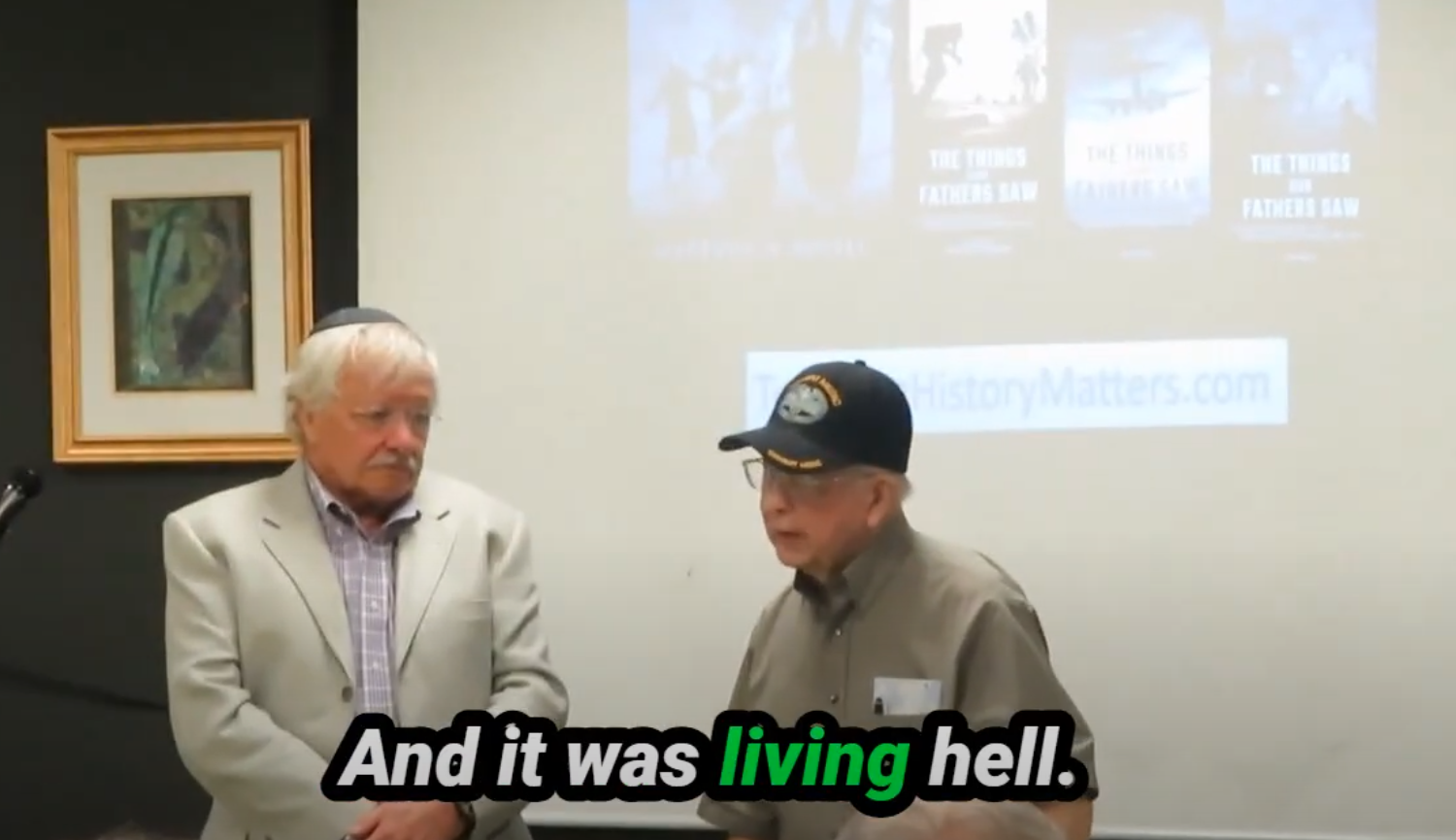
Screenshot of combat Medic Walter Gantz, and child survivor Oscar Schwartz, Warren County Community College, New Jersey, April 2019. Walter was 94 and would pass away before year’s end.
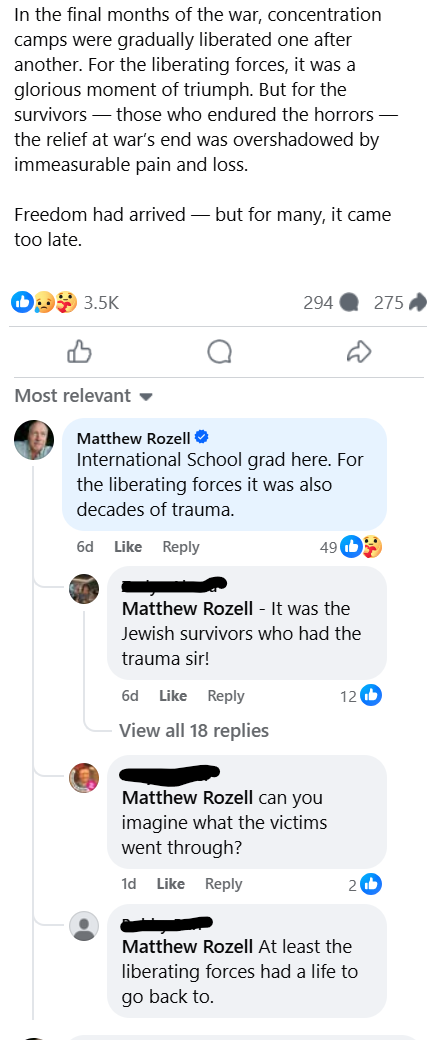
As we enter April 2025, the eightieth anniversary of liberation, more and more posts are rightly being generated on social media regarding it. Yad Vashem, World Holocaust Center, Jerusalem, earlier in the week posted a liberation photo on Facebook titled, “French soldiers meeting Jewish people who survived near Vaihingen, Germany, April 1945.” Their description:
“In the final months of the war, concentration camps were gradually liberated one after another. For the liberating forces, it was a glorious moment of triumph. But for the survivors — those who endured the horrors — the relief at war’s end was overshadowed by immeasurable pain and loss. Freedom had arrived — but for many, it came too late.”
I shared it on my Facebook page, with my own take on their description.
Well, some decided they had to take me to task in the comments, the gist of which was that in pointing out the traumatic effects on liberating soldiers, I was disrespecting the experiences of the people they saved.
I recognize the trauma—I have been honored to know literally dozens of Holocaust survivors—and I have studied for nineteen days at their International School in Jerusalem, as well as experienced several weeks of touring the authentic sites of mass murder and suffering in this greatest crime in the history of the world with top notch scholars and historians and fellow teachers. Also, having been a USHMM Teacher Fellow, I felt pretty well informed enough to add my comment there, just that for the liberating forces, far from being a glorious moment of triumph, it was decades of trauma as well.
I don’t dispute any of their comments, but I think they were making assumptions, so I clarified, “Just as liberation was not the ‘happy end of the story’ for Jewish survivors, it did not end for the soldiers either. And no one is here to ‘compare pain’.”
And that is one of the tenets of Holocaust education. No one can suppose they know what the Holocaust survivors went through, except them, and that is why memoirs are so important. But to talk to the liberating forces, decades later, was also important. Walter Gantz told me, “Matt, for forty years, when our group (95th Medical Gas Battalion) met at reunions, we NEVER talked of Hillersleben. And my parents never knew I cried myself to sleep at night, when I got back.”
I found this video I took at a college in New Jersey where Walter got to meet one of the children he helped to save for the first time, and his take on his visit to Bergen Belsen. The trauma was still apparent after almost 75 years.
That’s all I was trying to say. So now I’ll let Walter tell you. It’s a 3 minute clip. [Only 8 people in the world have watched it thus far. I hope you can, in his memory.]
A schoolkid once asked a survivor I know if anything good came out of the Holocaust. The survivor thought a minute, because it was an important question, and replied, ‘Yes. My rescuers.’ And here is where the story of the ‘Train Near Magdeburg’ will end, for now.
When we talk about the Holocaust, the sheer magnitude of it, there is no happy ending. For every single one of the approximately two-thousand five-hundred persons on the train who was set free, another two-thousand five-hundred persons perished in the Holocaust, most long before the Americans set foot upon the continent. And yet, at the end of the day, if we can say that somehow the soldiers and survivors in this book taught us something, perhaps the meaning is echoed in that three-word response. I have found that in some educational circles the role of the American liberator is presented almost as an afterthought, and I would have to agree that when one is drawn into the unfathomable study of the Holocaust, liberation perhaps figures as a literal nano-episode.
They were not rescuers, in the formal sense of the word—that title is reserved for those without weapons, who risked their lives and usually the lives of their families by hiding Jews or some such noble action—but the nobility of the would-be rescuers who had weapons, the ones still fighting and being killed, the ones wholly unprepared for the catastrophes that played out before them on an hourly basis in April 1945 deserves a larger place in our national examination of the essence of what, indeed, ‘greatness’ is all about.
And here, I hope that the lesson is also one of humility; as they themselves stated in this book, it’s not about hero worship, or glorifying the liberator as some kind of savior. Many of the liberating soldiers would resist this, to the point of rejecting the term ‘liberator’— “It all sounds so exalted, so glamorous,” said one. But they will all accept the term ‘eyewitness.’
Welcome to 2025, a momentous year for World War II remembrance and history. So glad that you can join us for these updates, the ‘octogintennial’ anniversary of the end of the war, and of the greatest crime in the history of the world, the Holocaust.
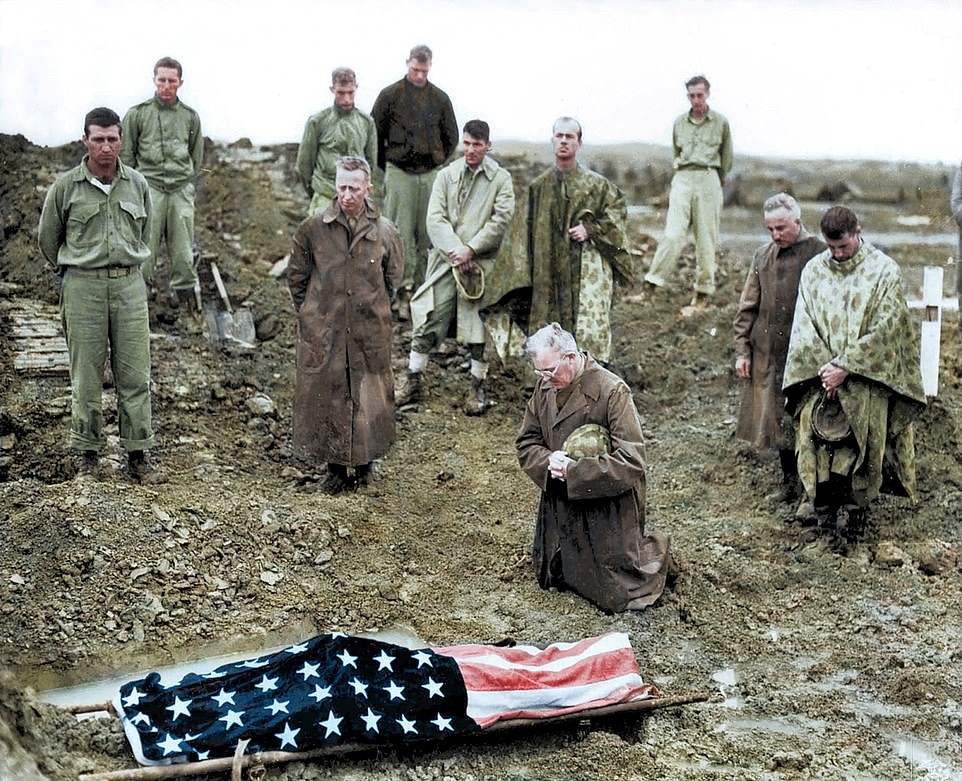
A father buries his son on Okinawa.
As we reflect on the events of April 1945, the final months of World War II, we cannot help but be struck by the deep significance of two momentous moments that unfolded on opposite sides of the globe: the Battle for Okinawa and the liberation of the first concentration camps in Germany. Both are pivotal moments in history, shaping the course of the war and leaving lasting impressions on the men and women who lived through them.The Battle for Okinawa, which began on Easter Sunday, April 1, 1945 and would last until June 22, was one of the bloodiest and most brutal campaigns in the Pacific theater.
For the American forces, it was a grueling and relentless fight to secure the island from the Japanese army, a battle that cost thousands of lives and saw immense casualties on both sides. It was not only a strategic victory for the Allies but a foreshadowing of the price that would be paid in the Pacific as the Allies moved toward the final assault on Japan.
In the photo taken above, Colonel (later Brigadier General) Francis I. Fenton learned his younger son Private First Class Michael J. Fenton had been killed by a sniper. He went to the site and knelt before Michael’s body to pray. When he rose, he said of the other Marine dead, ‘Those poor souls. They didn’t have their fathers here.’
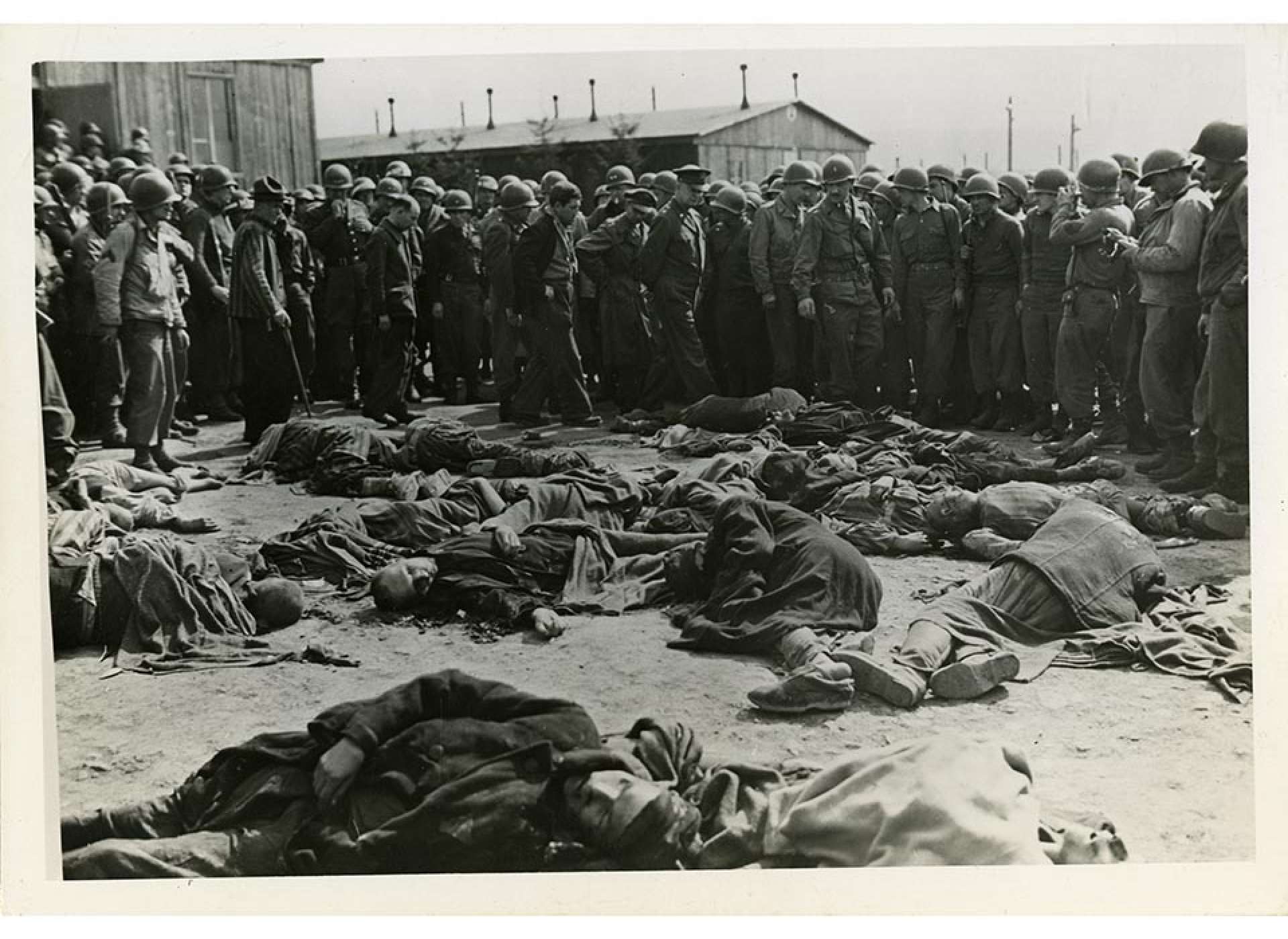
Eisenhower and top brass inspect a subcamp of Buchenwald, Germany, April, 1945.
At the same time, across the Atlantic in Europe, April 1945 marked the liberation of the first Nazi concentration camps, including Buchenwald and Dachau. The horrors uncovered by Allied soldiers began to reveal the shocking tip of the iceberg of the industrial scale mass murder genocide that had taken place.
General Dwight D. Eisenhower, witnessing the aftermath of these atrocities, requested Congressional and press visitations: “The things I saw beggar description… the visual evidence and the verbal testimony of starvation, cruelty, and bestiality were so overwhelming that I became sick and utterly unable to make any sense out of the facts.”
He was prescient in recognizing that someday, there would be those who would minimize the magnitude of the Holocaust, or outright deny that it ever took place. Along these lines, he encouraged American and other Allied soldiers in Germany to visit the camps:
“We are told the American soldier does not know what he is fighting for. Now, at least, we know what he is fighting against.”
While the battles of Okinawa and the liberation of the camps might seem like disparate events, they are linked by the shared theme of human sacrifice and the undeniable cost of war. The soldiers who fought at Okinawa faced fierce resistance and unimaginable challenges, much like the liberators of the concentration camps, who encountered the full scale of humanity’s cruelty. In both cases, they were tasked with missions of unimaginable significance—many just barely out of high school—but perhaps sensing that the world would never be the same after their efforts.
The heroes of these stories, those who fought in the Pacific and those who liberated Europe, lived through experiences that forever changed them—and most would reject the mantle of ‘hero’.As we reflect on their stories, it’s important to remember their sacrifices, their courage, and their commitment to justice; otherwise, I believe, we run the real risk of losing our identity as Americans.
I hope we are worthy of what they did about what they saw.
And as we continue to explore these critical moments in history through the Things Our Fathers Saw series, we are reminded of the power of storytelling. The voices of these veterans and survivors are an invaluable testament to their experiences—stories that need to be told and heard for generations to come.
Rehearsals and recording of the musical score and the soundtrack to our mini-series,A Train Near Magdeburg. Featuring Joshua Bell, violinist, Jim Papoulis, Composer and Conductor, with theColumbus Symphony Orchestra.
Half the episodes for the film series A Train Near Magdeburg have been completed and recording was finished in Columbus Ohio in early March. My wife and I were invited to attend the recording sessions that featured the Columbus Symphony Orchestra conducted by composer extraordinaire Jim Papoulis and featuring top shelf violinist Joshua Bell [‘m told he’s probably the greatest living violinist in the world (my aunt Kathleen at lunch the other day, a classical music guru)]. House was pretty much to ourselves: Ohio Theater, Columbus Ohio. Great to have them onboard… and all the talented musicians are a part of it now.
This post is an update, two years on, on the occasion of the recording for the soundtrack to our film. In it, we use eight of master luthier and restorer Amnon Weinstein’s Violins of Hope, rescued from the destruction and oblivion of the Holocaust.
On March 4, 2024, Amnon Weinstein passed at the age of 84. Exactly one year to the day of his passing, eight of his violins were in the hands of the Columbus Symphony Orchestra, to record the soundtrack to our mini-series, A Train Near Magdeburg, under the direction of Jim Papoulis, Composer and Conductor, with the Columbus [Ohio] Symphony Orchestra. Please watch the clip to see Amnon’s violins brought to life again, and read the article for more about his life. Director Mike Edwards reads the biographies of the violin’s original owners to the musicians who will play them.
Violins of Hope. Train to Magdeburg tour of Israel, 2023.
We are in Jerusalem now, the City of God, after 22 hours of travel.
The last time I was here, I was studying at Yad Vashem, Israel’s Holocaust Martyrs and Heroes Remembrance Authority in the summer of 2016. That is when liberating soldier Frank Towers left us.
I am here with filmmaker Mike Edwards, crew Joe Hammers and Josh Fronduti, scriptwriter Lee Shackleford and his wife Karen and my wife Laura. Our mission is to interview a dozen Holocaust survivors of the train near Magdeburg. We landed on Shabbat, the sabbath day morning. Ben Gurion airport in Tel Aviv was very quiet.
Returning impression of Jerusalem. Growing upward, the city of cranes. Busy.
Hotel Agripas in Jerusalem, a central location found for us by our friend Ellen, a fifteen-minute stroll from the Old City. My wife and I walked down the first day, made it to the Church of the Holy Sepulcher. My third time, Laura’s first. She was moved to tears. Trapped in a procession of Eastern European pilgrims chanting prayers on the Via Dolorosa going the opposite direction. We wait for the Spirit to pass by, and we are back to our hotel for the transport to film at our first stop, the family behind the Violins of Hope project in Tel Aviv.
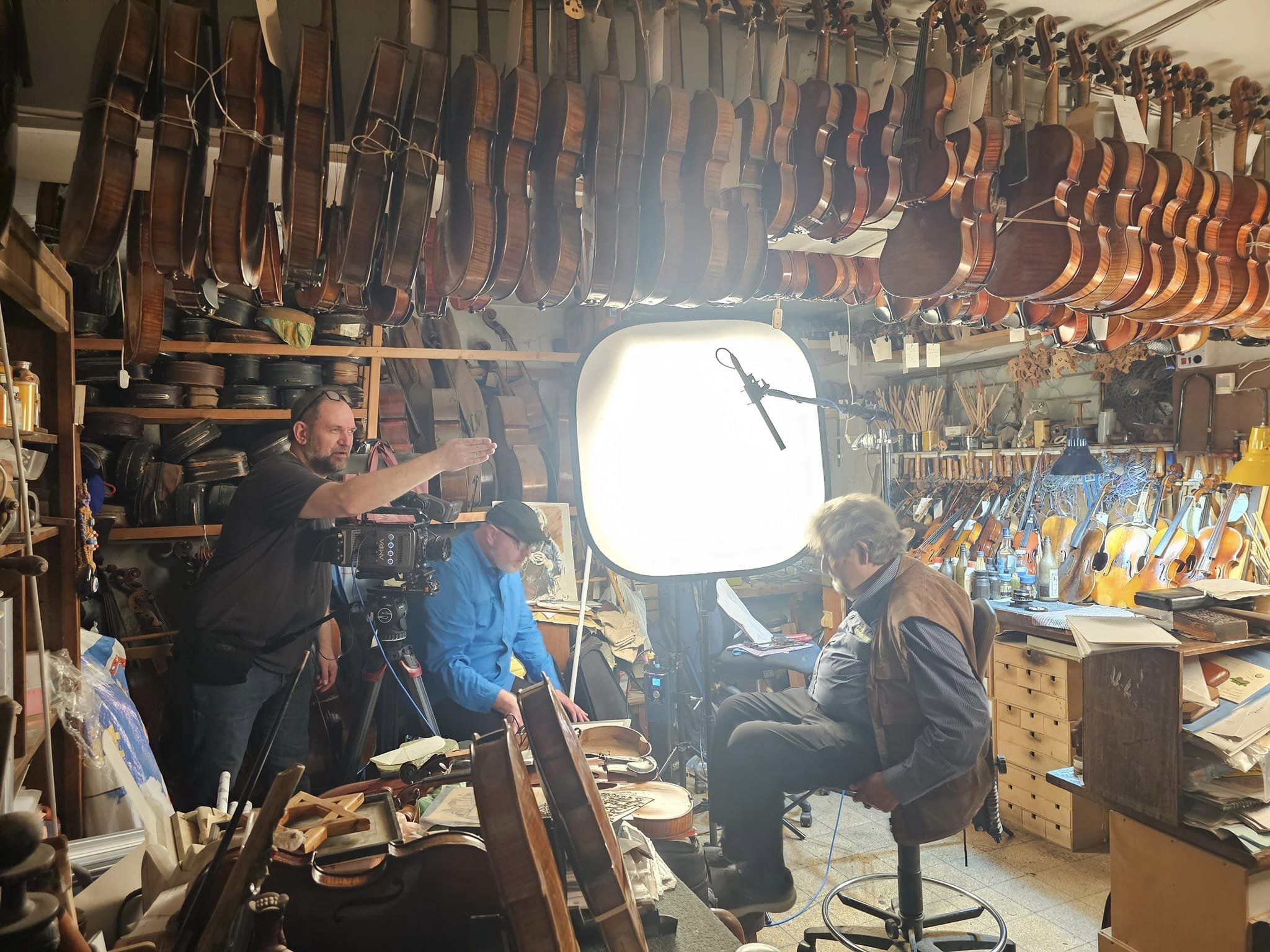
We arrive after an hour or so, greeted outside by nearly 84-year-old Amnon Weinstein at his ground level workshop. Joe and Josh set up the film shoot, as always, and we go across the street to meet his beautiful wife at an outdoor café. They are so happy to see us, Assi his wife is radiating goodness and love for the Americans who have come to tell a story of the Holocaust, passionate about history and life, the daughter of one of the famed Bielski partisans. She won’t let us pay or clear away the cups at the end.
We retire back at the shop, and Amnon begins to tell his story. The family emigrated to Palestine in 1938 from Poland, his father a violin maker, opening a shop right here in Tel Aviv when it was a brand new city, growing along the coast. As a boy, Amnon is puzzled one day in school when a teacher asks about families and grandparents; only one child in an elementary class of 35 has grandparents. He asks his mother; he remembers to this day the first shock of his life- when she wordlessly opens a book, directing the youngster’s attention to the graphic photos of the horrors of the Holocaust.
He became a master luthier, like his father, building and repairing violins for world class performers; he knows them all. Over time, though, survivors brought their violins, many German made fine specimens, and tell him that he must buy them, take them off their hands, or they will discard them. Many cannot bear to pick up the instrument that once brought them so much joy, after surviving the Holocaust, some even forced to play as train transports arrived at the camps, to add a false sense of comfort, for those about to be murdered. So he does acquire them-how can he not?-and others with a provenance of the Holocaust.
Mike asks how he feels when he plays, or sees others play these now restored instruments, the Violins of Hope. Amnon puts his hands on his shoulders. “I feel like I am carrying the weight, the music, telling in a way the stories of the six million. The violins are their voices speaking to us once more.” His son and third generation luthier Avi travels the world now showcasing the violins from the collection now numbers about 120.
Joe, Mike, Amnon setting up the shoot.
He moves to his workbench, sometimes using his ‘stick’, his cane. “I am nearly eight-four. This is all I do now; I no longer build from scratch. It is important, and I think I can get the collection up to 140 or so pieces before I ‘move on’. I do not welcome death, but I think it is a natural progression”, he gestures with a wave of the hand.
We record him working, picking up many of the same carving knives I see in my own woodworking shop at home. I ask him about the wood, the sharpening of his tools. “At the bench I am 21 years old again. I get lost in the work for hours.”
He has summoned one of his young clients from across town, and Tamir arrives, a natural 21-year-old prodigy, a future virtuoso in training. We move to Amnon’s office. Amnon goes to the vault and brings out one of the prized restored Violins of Hope. Young Tamir begins to play. Amnon watches him contentedly from his desk. Mike asks Tamir to play Hatikvah (The Hope), now Israel’s national anthem. The 140-year-old violin of a victim is playing the 21-year-old soon to be master. “The violin is playing me.”
Violin master luthier Amnon listens to the young prodigy Tamir.
Violin-Hatikva-Tamir Tavor and Amnon Weinstein at the shop. From the Train to Magdeburg tour of Israel, 2023.
Amnon will admit to being concerned about the state of the world, the terrible war in Ukraine, the state of political turmoil in his own land where he has virtually lived the history of the state of Israel since before its birth in 1948, but now to the point of losing sleep at night, to the point of impatience and frustration. When asked to comment on the famous Benjamin photograph of the liberation of the train in the spring of 1945, he simply says, “And why did it take so long?” In hindsight, liberator Carrol Walsh had reached the same conclusion years before. Film director Mike points out, and the title of this blog points out, that education is the key. We hope that our film helps in some small way to heal the world, as Amnon’s Violins of Hope travel the world with the same mission, to remember the millions, and to hopefully help the world refocus its energies away from hate, war, persecution, destruction.
Matthew Rozell and Amnon Weinstein at the bench.
Michael Edwards and Amnon Weinstein at the bench.
It has been a wonderful, emotionally draining day. We bid our new friends goodbye, and promise to carry on the mission.
We sit down with our first survivor tomorrow.
Amnon Weinstein, Who Restored Violins From the Holocaust, Dies at 84
Many were left behind by victims of the gas chambers. He let the instruments be heard again in musical tributes through his organization, Violins of Hope.
By Michael S. Rosenwald, The New York Times
Published March 21, 2024
Amnon Weinstein, an Israeli luthier who restored violins belonging to Jews during the Holocaust so that musicians around the world could play them in hopeful, melodic tributes to those silenced in Nazi death camps, died on March 4 in Tel Aviv. He was 84.
His death, at a hospital, was confirmed by his son Avshalom Weinstein.
Mr. Weinstein was the founder of Violins of Hope, an organization that provides the violins he restored to orchestras for concerts and educational programs commemorating the Holocaust. The instruments have been played in dozens of cities worldwide, including Berlin, at an event marking the liberation of the Auschwitz concentration camp.
“Violins of Hope, it’s like a huge forest of sounds,” he said in a 2016 PBS documentary. “Each sound is standing for a boy, a girl and men and women that will never talk again. But the violins, when they are played on, will speak for them.”
There are more than 60 Holocaust-era violins in his collection.
Some belonged to Jews who carried them in suitcases to concentration camps, and who were then forced to play them in orchestras as prisoners marched to the gas chambers. Others were played to pass the time in Jewish ghettos. One was tossed from a train to a railway worker by a man who knew his fate.
“In the place where I now go, I don’t need a violin,” the man told the worker, in Mr. Weinstein’s telling. “Here, take my violin so it may live.”
Mr. Weinstein hunched over his desk over a violin that he is in the middle of repairing. He wears the same outfit as in the last photo, as well as glasses and a large wristwatch. A row of violins hang from the ceiling behind him.
The son of a violin repairman, Mr. Weinstein worked in a cramped and dusty workshop in the basement of an apartment building on King Solomon Street in Tel Aviv.
“Walking in there was like stepping in time,” James A. Grymes, a University of North Carolina-Charlotte music professor who wrote a book about Violins of Hope, said in an interview. “It really felt like you were in Stradivarius’s workshop — the smells of varnish, there’s parts of violins everywhere. It’s like he was the Willy Wonka of the violin.”
One afternoon in the 1980s, a man with a prisoner identification tattoo on his arm arrived with a beaten-up violin that had, like him, survived Auschwitz.
“The top of the violin was damaged from having been played in the rain and snow,” Mr. Grymes wrote in “Violins of Hope: Violins of the Holocaust — Instruments of Hope and Liberation in Mankind’s Darkest Hour” (2014). “When Amnon took the instrument apart, he discovered ashes inside that he could only assume to be fallout from the crematoria at Auschwitz.”
Mr. Weinstein, who had lost hundreds of members of his extended family in the Holocaust, nearly turned the man away; working on such an instrument seemed too emotionally fraught. But he ultimately repaired the violin, and the man gave it to his grandson to play.
Mr. Weinstein didn’t reflect much about working on Holocaust-era violins again until the late 1990s, when he was training his son to become a luthier. The experience made him reflect on the role of violins in Jewish culture, from the shtetls of Eastern Europe to klezmer bands to Itzhak Perlman’s soaring concertos.
“It was kind of a must for the young generation to learn to play the violin,” he said in the PBS documentary. “And when you have a violin, Friday or Saturday evening, always somebody was taking it and playing on it.”
During a radio interview, he asked listeners to bring him instruments connected to the Holocaust. Soon, families began showing up at his workshop with violins that had been stored away in attics and cellars, each with its own haunting story.
Mr. Weinstein was especially shaken by those recovered from concentration camps after the Allied invasion of Germany in 1945.
“This was the last human sound that all of those people heard, the violin,” he said in a 2016 radio interview on WKSU in Ohio. “You cannot use the name beauty. But this was the beauty of this time, these violins.”
Mr. Weinstein holding the body of a violin with a swastika and other symbols etched into it. Behind him are various instruments hanging on the walls as well as portraits of people holding their violins.
Three old violins on display, each with Jewish symbols etched into them.
Amnon Weinstein was born on July 21, 1939, in Mandatory Palestine and grew up in Tel Aviv. His father, Moshe Weinstein, was a musician and violin repairman. His mother, Golda (Yevirovitz) Weinstein, was a pianist and a secretary in her husband’s workshop. They had immigrated from Lithuania in 1938, just as the persecution of Jews was escalating in Germany.
Mr. Weinstein grew up helping in his father’s violin shop. In his early 20s, he moved to Cremona, Italy — a city long known for its master luthiers — to study violin making. He continued his training in Paris under Étienne Vatelot, one of the world’s most renowned luthiers. In 1975, he married Assaela Bielski Gershoni, whose father was a Jewish resistance fighter during World War II who was made famous in the 2008 film “Defiance.”
After his father’s death in 1986, Mr. Weinstein took over the family violin shop; he started Violins of Hope a decade later. The first concerts with the violins in the collection took place in Turkey and Israel in 2008. Others followed in Switzerland, Spain and Mexico, as well as in Ohio, North Carolina and Virginia.
“Each concert is a victory,” he would often say.
A man in a black T-shirt stands while playing a violin that is tucked beneath his chin. Behind him are other musicians, seated in front of music stands and holding their own instruments.
Musicians, especially Jewish ones, have described playing violins from the collection as a soul-stirring experience.
“It’s emotional for me because I’m not there to play this violin, I’m there to let it speak,” Niv Ashkenazi, a violinist who recorded an album featuring an instrument from the collection, said in an interview. “Our jobs as musicians is to just let these violins shine through.”
In addition to his son Avshalom, who plans to continue the Violins of Hope project, Mr. Weinstein is survived by his wife; two other children, Merav Vonshak and Yehonatan Weinstein; and seven grandchildren.
In 2016, Mr. Weinstein was awarded the Order of Merit of the Federal Republic of Germany, one of the country’s highest honors.
During the award ceremony, Germany’s foreign minister at the time, Frank-Walter Steinmeier, spoke directly to Mr. Weinstein.
“A human soul lies behind each of your priceless violins,” he said. “A human who was persecuted, tormented, silenced by unimaginable violence and cruelty.”
Mr. Steinmeier spoke about the man who had tossed his violin from the train. He described a prisoner playing a violin in Auschwitz.
“Each violin represents a person, Amnon,” he said. “And when your violins play, they represent six million people.”
Welcome to 2025, a momentous year for World War II remembrance and history. So glad that you can join us for these updates, the ‘octogintennial’ anniversary of the end of the war, and of the greatest crime in the history of the world, the Holocaust. Iwo Jima,1945. National Archives.
As we look back on this week in history, we reflect on two defining moments of World War II that occurred in March of 1945, each marked by incredible human bravery and sacrifice: the end of the Battle of Iwo Jima and the crossing of the Rhine River by U.S. forces. Both events shaped the course of history, and their stories remind us of the extraordinary courage and resilience of those who fought. The End of the Battle of Iwo Jima In my last post, I wrote about my friend Art LaPorte, the 17-year-old Marine who was puzzled by the flag raising on Iwo four days into the campaign, since the battle was far from over with. 80 years ago, on March 26, the Battle of Iwo Jima was declared completed, though some defenders were surrendering as late as 1949! For the U.S. Marines, after weeks of intense fighting, the toll was overwhelming. The famous photograph of the flag raising atop Mount Suribachi on Feb. 23 finally symbolized not just military triumph, but the deep human cost—nearly 7,000 American lives were lost, over 19,000 wounded, and the toll on the Japanese defenders was far worse. ***********************************************************************************************************
The Crossing of the Rhine River Meanwhile, on the European front, U.S. forces were preparing for their own major breakthrough: crossing the Rhine River. By March 1945, Allied forces were closing in on Germany, and the crossing of this natural barrier was a decisive move toward victory. On the night of March 23, 1945, treadway rafts were launched and pontoon bridges were under construction. The stakes were high: As one writer put it, “The Rhine was more than a river. It was a sacred waterway to the Germans, the source of most of their legends and myths. And at this stage in the war, crossing the Rhine was the last barrier between the advancing Allied armies and the conquest of Germany. If the Germans could hold their beloved river, they might be able to stand off the Allies.”
The cost was also high. Albert Tarbell, a paratrooper with the 504th Parachute Infantry Regiment, 82nd Airborne Division, recalled:
“The 505th made the river crossing first, and when we got there, just as we got off the pontoon onto the dry land, we see this tank hit a mine on the road, and took this 40-ton tank and it just flipped it right over! That’s how powerful the mine was. The Germans had planted the mines, and they had put detonators in there so that after maybe the 10th of each vehicle went over, it would set it off, so you didn’t know when it was going to blow up, or where it was.
And so they said, ‘Go over on the side, go over around it, and go alongside the road.’ We had no sooner gone about 20 feet up ahead when a truck hit another mine, and it blew the guys right out. I could see one guy, he looked like he must have been sitting in the back of the truck, it looked like if you threw a hat up in the air, you know, just flopping up in the air, and the truck went way up in the air! Boy, that was awful!”
Yet as the spring progressed, it was clear that the war in Europe might end soon.
“Now, we really were [moving fast], and we started getting more prisoners giving up to us; groups, maybe platoon-sized. We started getting jeeps up there to ride in. I said, ‘God, this is the way to fight a war.’ It was walking and running, and we were riding in jeeps across this open field; there was a whole line of us, we got to the end of this open field and there was a little bit of woods, and behind the woods there was three Tiger tanks sitting there! That’s when I knew, I said, ‘Hey, this war’s winding down.’ Those guys could have had a field day with us. They could have just wiped us right out.
So we went from one town to the other. One place there was a whole company, their platoon all lined up, ready to surrender to us. And then another time we kept on going, the truck traffic kept getting heavier, and heavier, and heavier. At one point, I don’t know whether it was that same day, I think it was, or it might have been the day after, we got to this one point where it got so bad, we put outposts out to direct traffic. Zimmerman, myself, and George Height was with me again, it seems like everywhere I went he was with me, following me, so we directed traffic. ‘Vehicles to your right, walk on foot to your left.’ Those German guys were throwing their weapons away, and this and that, and oh man. And they even had a calvary ride through [to surrender], God, beautiful horses. But some of these solders were pathetic, you know, worn out, clothes worn and torn, beat up, you know, tired, battle worn.
Towards about dark, a staff car pulled up and out got, you know how you see in movies, German officers, got shiny boots on, got shiny long leather jackets on, the whole nine yards of it—that’s the way these guys were dressed. One said, in perfect English, he said, ‘Where is your general’s command post? This is the commanding general here!’
From what I gathered after, it must’ve been the commanding general of that 21st German Army that surrendered to us. They wanted to surrender to us instead of to the Russians, to get out of the path of the Russians as they were coming in.
So I said, ‘What do you want to see our general for?’ He said, ‘This is the commanding general here, we’re going back there with your general, and we’re going to regroup and fight the Russians!’
I looked at Zimmerman, then I looked at Height, and I said, ‘Well, I’ll tell you what you do, you just go right down this road here, to my right, there’s some MPs down the road, they’ll show you right where to go.’ And I think that was the commanding general of the 21st German Army! They looked like they were in pretty good shape. We laughed, but they were serious. They probably were put in prison; our general wouldn’t have had anything to do with them.”
For those who survived the final push into Germany, the crossing marked a turning point in the war in Europe. They were pushing toward the heart of Nazi Germany, with the prospect of victory finally within reach—but then they encountered the evidence of the greatest crime in the history of the world—the Holocaust. For battle hardened soldiers, it was almost too much.
The Human Cost of War
Both of these events—though separated by vast oceans—remind us today of the price of freedom. These soldiers, almost all of whom were young men just beginning their adult lives, faced insurmountable odds. Their experiences, full of courage, sacrifice, and determination, offer us powerful lessons in resilience and hope.
Welcome to 2025, a momentous year for World War II remembrance and history. So glad that you can join us for these updates, the ‘octogintennial’ anniversary of the end of the war, and of the greatest crime in the history of the world, the Holocaust.Today is special for several reasons, two of which I will outline below.
Road to St. Vith, January 24, 1945. National Archives.
On December 16, 1944, the Battle of the Bulge began as Hitler’s last ditch effort to drive a wedge between the advancing American and British forces with a quarter million man German counteroffensive following D-Day and the Normandy breakouts of the summer and fall. Today, January 25, eighty years ago, all German forces had been pushed back to their original starting points; while the fight was not over for a long shot, today marked a turning point in the war in Europe. Nineteen thousand American boys were killed in the bloodiest US battle of WWII, over the course of six weeks, in the coldest winter in European memory. Average age, 19. 80 years? Was it really that long ago?
USHMM via Reuters.
Also on this day in 1945, the German SS dynamited the building of gas chamber and crematorium V in Auschwitz-Birkenau to destroy the evidence of their crimes as the Red Army approached from the east. The liberation of Auschwitz, the most notorious killing center of World War II, was at hand, the eightieth anniversary of which will be commemorated on Monday, January 27; one of my good Holocaust educator friends is co-leading a delegation of 50 or so survivors for this occasion. Talli and I were there together in an emotional journey I wrote about in my book, A Train Near Magdeburg.
This gas chamber operated from April 1943 to January 1945; Zyklon B was dumped in through openings after people were inside. 1.1 million people were murdered here, in a VERY short amount of time.
So what does it all mean, eighty years on? Time marches on, but as you may have read in my books, it’s not so much ‘how soon we forget’, as it is, ‘did we take the time to listen‘ the first time around, to our teachers, to our veterans? Do we as Americans even know our history? You know, in my books, I let the veterans and survivors speak for themselves, and for their friends and family who were killed or murdered. [I’m preaching to the choir now, and that’s the last thing I want to do-but hopefully we don’t move on until we pause and say their names.]
And I’ll leave you with an upbeat note- I went into the classroom again in December to talk about Pearl Harbor and a local kid who died there, as I discussed in my first book, The Things Our Fathers Saw, Vol. 1, Voices of the Pacific. First time since retirement, and I’m happy to report the old man still has it, and the teenagers were HUNGRY for this knowledge, just like they were when I taught them at this high school in upstate NY. I left them all with free copies of that book with 19 year old Randy Holmes remembered in it. I’ll leave you with some books mentioned in this email below for further reading, and report back soon with some updates as 2025 moves on, with the anniversaries, and with our upcoming mini-series.Exciting!
Nineteen thousand American boys were killed in the bloodiest US battle of WWII, over the course of six weeks, in the coldest winter in European memory. Average age, 19. Here is one 19-year-old’s story. 80 years? Was it really that long ago?
Just a quick note: I’m at my old holiday haunt at the Shirt Factory, 21 Cooper Street, Glens Falls, NY., 11 to 5, Friday, Saturday, Sunday in the tea shop first floor 106, 11 to 5, to accommodate my fans for in person meet and greet and signings, and see my local friends! Don’t forget, I will have the new book OVER THE HUMP, now 11 in total (3600 pages and a million words, no fooling), with bundle Black Friday savings. I retired my shop space there on the 3rd floor focus on my creative endeavors. There’s only one of me… thanks always for the love and support. Mini-series news soon!
25 or 30 years ago, during a symposium with Pacific veterans in the Hudson Falls High School library, I overheard local Pacific veterans discussing among themselves during a break about a kid, Randy Holmes, from Hudson Falls who was killed at Pearl Harbor on Dec. 7, 1941. I asked them more, and snuck down to the ‘vault’, and dug out the 1942 yearbook. His classmates had dedicated it to him as he had left school early to join the Navy. He was killed on the Oklahoma. Yesterday, his finally identified remains were interred at Arlington 83 years later. Trishna Begam, local Albany anchor and reporter, knew of my connections to WW2 and HF, and told me after getting a press release from the navy, and found Randy’s great niece. Then she took the time to come up to Moss St. Cemetery to interview me, and Randy’s great-niece, also in the story below, contacted me. Though my lifelong mission was to bring him back to HF to lay next to his parents, Arlington will do! I am glad he is remembered, but my students and I never forgot. No one called him Harry, by their way. He was Randy to his friends and family in our hometown of Hudson Falls. He opens and closes my first [2015] book.
Pearl Harbor sailor from Hudson Falls buried in Arlington National Cemetery.
HUDSON FALLS, N.Y. (NEWS10) — The remains of a local Navy sailor who died 82 years ago were laid to rest at Arlington National Cemetery Thursday afternoon. The U.S. Navy says Harry R. Holmes was aboard the USS Oklahoma during the attack on Pearl Harbor. His local connection is still cemented in his hometown of Hudson Falls and well documented by retired high school history teacher Matthew Rozell.
At the Moss Street Cemetery in Hudson Falls, Rozell showed NEWS10 the marker that sits in place for the hometown hero who was almost lost to time.
Rozell explained, “His grave is right here. He left school early. He would’ve graduated with the class of 1942.”
The young sailor died in action at Pearl Harbor. “My big question was ‘Where is his body? Where is he?’” Rozell wondered for years.
The Navy answered that this year. According to Capt. Jeff Druade, the director of the Navy Casualty Office, Project Oklahoma was started in 2015 to identify service members lost on the Oklahoma during the attack. Three hundred eighty-eight service members were unaccounted for — among them Fireman 3rd Class Harry Randolph Holmes. On December 7, 1941, Holmes was aboard the USS Oklahoma when Japanese torpedoes hit the hull and capsized the battleship in less than 12 minutes. His remains were identified eight decades later through DNA profiling.
“He was loved. He had a mother, father who are over there behind us. And they were never able to bring their son back,” Rozell added.
Letter reveals what soldier who inspired ‘Saving Private Ryan’ left at Normandy This October, 82 years after his death, his country was determined not to forget the young sailor’s sacrifice. He was brought to his final resting place at Arlington National Cemetery.
“A young boy at 19 years old, set foot out to protect our country,” said Rachael Bubbs, a great niece to Holmes.
Bubbs was present, along with her father, to honor her great uncle’s bravery and service. Through DNA profiling and matching samples with surviving family members, the Navy tracked down Bubbs in Florida.
“He was buried in the Punch Bowl for so many years, but now he’s going to one of the greatest cemeteries,” she said. “When everything was presented to me, it was an honor to be truly connected back to that true piece of history.”
It’s history that’s been etched into the stone in his hometown. Rozell explained, “It’s an important moment in the North Country because he was one of the first killed in WWII from New York. He was only 19. He didn’t get to graduate with his classmates.”
Those classmates knew Holmes by his middle name, Randy, as Rozell would learn from members of the class of 1942. “Listening to his friends, WWII vets, all gone now, they are no longer with us — it was Randy, Randy, Randy. H Randolph Holmes.”
They helped keep his life of service alive. “I dug through the archives, found the yearbook. That’s when I saw the picture of him taken in the backyard of his family home in Hudson Falls.
It’s the only photo of Holmes from a full page from the high school yearbook. He was known as a popular student with a sterling character. Bubbs said, “He went to war for our country, to fight for it. Pearl Harbor is the start of where we are today.”
His country ensuring that Holmes is revered for the generations to follow.
Project Oklahoma has individually identified 356 crew members of the Oklahoma through DNA and matched with surviving family members.




 Teaching History Matters