Feeds:
Posts
Comments

Archive for the ‘Uncategorized’ Category

Helen Sperling passed away last week. She was an incredible woman, a Holocaust survivor whose mantra was “Thou shalt not be a bystander.”

I spoke at the annual Yom Hashoah lecture that she sponsored for her community in Utica a few years back. She lived about 100 miles away, so her friend Marsha drove her to Saratoga Springs, the halfway point for us, so that she could meet me and vet me for herself before committing to my lecture. I passed the test. later, my friends at the USHMM found some of her liberation documents for me, which I sent to her. I even found one of the US soldiers who liberated her, in the town near me.

The article and post below is from a couple years ago. I love the photo. Godspeed, Helen. Rest assured that all those whom you touched, will keep the memory alive.

******

Helen is a friend of mine. She was liberated in April 1945 by a division of American soldiers that included our high school secretary’s uncle.

At her invitation I traveled to central NY to speak 2 years ago.

She is still going strong. I love her! Her central message to students-“The world needs saving. So, get to it!”

BY RACHEL MURPHY
Rome Observer Staff Writer

Staff Photo by RACHEL MURPHY--Curtis Thompson, an eighth grader at Strough hugs Helen Sperling, a 93-year-old who survived the Holocaust. Sperling shared her story with the eighth grade class on Wednesday, after she finished every student hugged her.

ROME, NY. — Holocaust survivor Helen Sperling, 93, recounted the darkest moment of her life before a crowd of more than 300 eighth-graders at Lyndon H. Strough Middle School on Wednesday.

Sperling spoke for two hours about her time in the concentration camps.

Sperling was born to a middle class family where she lived in Poland.

During a school vacation when she was 22 years old, the Germans invaded her home and took her family into a ghetto.

“For the first time in my life, I was completely and utterly helpless,” she said.

During her time in the ghetto, Sperling remembered being able to contact a close friend to wish her a happy birthday. But when Sperling called her friend, who was a Gentile, the friend responded with a racial slur.

“You did not realize who was your friend and who was your enemy,” she said.

She explained that like many other Jewish families, hers was eventually taken from the ghetto and separated into prison camps. She was first placed into Ravensbrück, where she was forced to perform demeaning tasks the Nazi’s used as a way to break her spirit.

But despite the torture, hunger and fear, Sperling managed to survive, along with her younger brother.

“Ninety-nine percent of our survival was sheer luck,” she said. “A little tiny bit of it was hanging on to dignity. Once you lost that, you didn’t have a chance.”

Sperling’s parents did not survive.

Her family was among the 6 million other Jews that were sent to death camps and were killed by the Nazis.

Sperling placed two family photographs on a table nearby as she spoke to the students.

“These are mine, and I miss them terribly,” she said of her family members.

However, she continues to share her story to hopefully inspire and educate others.

“I want them to know that they can do something. I don’t want them to be bystanders,” she said.

Sperling added that even though it is difficult to retell it’s worth it.

“As long as I can do and as many schools as I can cover I want to,” she said.

Assistant Principal Michael Stalteri explained that he hopes the students learn from Sperling’s life and positive outlook.

“Her story resonates with what goes on in their lives when they’re being persecuted, picked on, harassed, bullied or made to feel different,” he said. “Hearing Mrs. Sperling’s story of triumph and her message is exhilarating.”

After Sperling finished her story each student hugged her, and she gave them an anti-bullying bracelet.

http://romeobserver.com/articles/2013/03/15/news/doc5140d89a9dd53321768186.txt?viewmode=fullstory

Read Full Post »

Vet tells his story: from Pearl Harbor to the classroom

by Liza Frenette

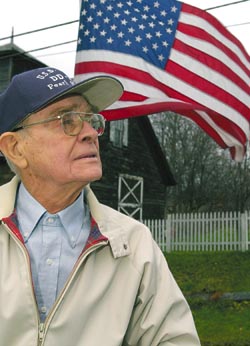
Alvin Peachman

Nineteen-year-old Alvin Peachman was playing pingpong when he heard about the Japanese attacks on Pearl Harbor on December 7, 1941. His heart might have skipped a few beats, like a ping-pong ball skittering across the table. But it didn’t take too many heartbeats after that for him to enlist in the Navy.

“We heard the news on the radio. There was no TV then,” he told students at Hudson Falls High School recently. The idea of the U.S. Navy being so outrageously attacked seemed unthinkable.

“We thought it was a joke. Then, we heard President Roosevelt ask Congress for a Declaration of War. And I knew that I’d be in it,” Peachman said. “There was war fever. There were posters to inflame your patriotism.”

Always interested in history and geography, he said he knew right where Pearl Harbor was. Information about Pearl Harbor Day can be accessed in a free lesson plan at the American Federation of Teachers’ “Share My Lesson” site.

“I volunteered for the Navy. You had to be in perfect physical condition,” Peachman said.

At the time, he was working on the docks in New York City, where he’d come to find work away from the coal mines of Appalachia, where he grew up. He unloaded coffee on the piers. “I could rip the pier up!” he boasted.

It’s been a long time since Peachman was in front of a classroom, teaching students about history. But, at 93, he still lives just down the street from the small and rural Hudson Falls High School where he taught from 1951 to 1983. So he came on over recently to spend several hours with two classes of students, talking about his experiences during WWII. He fought in the Pacific Theater, which spilled out on a map behind him for students to see. A white-haired man with sparkling blue eyes, he sat comfortably in front of the students, wearing a brown cardigan, telling them how he slept in a hammock on his ship with 50 men in a room the size of their classroom.

He showed them a metal chunk from a kamikaze plane that attacked the U.S.S. Witter, a destroyer escort ship off Okinawa. Peachman worked as a radio operator and barely escaped death. Students marveled at the piece of history.

Peachman earned $21 a month for his service in the military, but he had to pay $6.50 of that for insurance because, he recalled, “If you got killed and didn’t have insurance, your mother got nothing.”

His service included fighting in the Guadalcanal, Solomon Islands, the Marshall Islands and New Zealand. When fighting on land, he said his helmet served as a wash basin to shave and wash. Many comrades got malaria or other tropical diseases. “You’d get dysentery and be so sick, you wish you were dead,” he said.

Sometimes he was “10,000 to 12,000 miles away from anywhere on the ship,” he said. He crossed the equator a half dozen times and lived through a typhoon, where waves slammed the ships sideways. People had to be tied down so they didn’t get washed away. More than a thousand lives were lost during the two-week storm, Peachman said.

Those weren’t the only challenges.

“I saw no girls for two years and that bothered me,” he said, as students laughed with him. “You go nuts!”

He got out of the service on a Friday and enrolled in college in New York City the following Monday. “I studied like a bulldog,” he said. He worked on Wall Street and then for Western Electric, but his commute was long and he found the city crowded. He went to New York University to get his history degree, and then found a listing for a teaching job in Hudson Falls.

“When they told me the train fare was $15, I almost collapsed,” he said, breaking out into a huge smile.

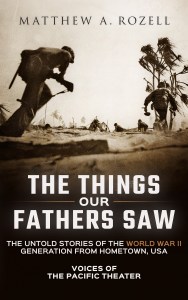
His host for the day at the school was Matt Rozell, who used to be Peachman’s student. Now, Rozell has written a book, The Things Our Fathers Saw (The Untold Stories of the WWII Generation from Hometown USA — which includes interviews with Peachman and many other veterans. Peachman also passed around a book with photos of his bombed out ship and pictures of his comrades.

“This book will help to remind those who are young and who are living in today’s confused world, that freedom is not free,” Peachman said.

http://blogs.nysut.org/blog/2015/12/07/pearl-harbor-attack-prompted-dockworker-to-enlist-retired-vet-and-teacher-tells-students/


Read Full Post »

Searching for Randy…

Randy Holmes monument, Hudson Falls. He is not home-yet. Photo by me, this past summer.Moss St. Cemetery.

Randy Holmes monument, Hudson Falls. He is not home-yet. Photo by me, this past summer.Moss St. Cemetery.

74 years. Randy Holmes is the start of my book, and a chapter on searching for him finishes it. His remains were underwater for 18 months. It’s time to bring him home, to lay next to his parents.

https://www.washingtonpost.com/local/after-74-years-bones-from-pearl-harbor-tomb-ship-may-be-identified/2015/12/06/60263b86-8ee7-11e5-acff-673ae92ddd2b_story.html

Read Full Post »

This past Friday, I spoke to scores of educators interested in the Holocaust and genocide, people who were also attempting to teach about these crimes against humanity. As a teacher, you have to be very committed to do this seriously- just to try to attempt to understand these events, let alone teach about them to young people.

I was invited by the New Jersey Council of Holocaust Educators in cooperation with the Center for the Holocaust, Human Rights, and Genocide Education at Brookdale College. I have my take on things, and that is what I am working on now, in my new book. I was also in some pretty good company.

My good friend and fellow educator Alan Bush, who drove two hours on his own time to come out and support me (even though he told me I was not as attractive as the previous speakers).

My good friend and fellow educator Alan Bush, who drove two hours on his own time to come out and support me (even though he told me I was not as attractive as the previous speakers).

In the morning Alexandra Zapruder engaged with the teachers by reading excerpts from her seminal work, Savaged Pages, Young Writers’ Diaries of the Holocaust, creating a dialogue about how the young people who left behind diaries left so much more than just the written word of their time of horror and oppression. This was not Anne Frank, but a deeper dialogue about attempting to make sense of the senseless, and the conflicting emotions that really encourage us to look into the abyss, beyond the standard narrative of what we think we know about the Holocaust- powerfully, from teenager to teenager. And Alex is the perfect vessel.

Meline Toumani read from her book, There Was and There Was Not: A Journey Through Hate and Possibility in Turkey, Armenia, and Beyond, about growing up in the Armenian Diaspora community and her process of discovery in the context of the conflicting narratives of Armenian genocide of 1915 and her attempt to get to the root of her own self identity. Her book came out on the eve of the 100th anniversary, and the topic resonates especially as we try to make sense of the larger picture of genocide and the ripples that these actions, and our own re-actions, create. She spent her entire 30s in the process, and this is what also fascinated me, as her book is classified as a memoir. I am now tearing through her work, making notes, highlighting certain passages. For the passionate, writing indeed becomes a huge part of your life.

Then it was my turn.

I fumbled a bit, looking up this website to display for the crowd and typing in misspelling after misspelling for the Jumbotron, but quickly won them over by simply showing the teachers a photo of my classroom

the last generationand reminding them that I was also missing a day of school today,  but what were were all doing together had a meaning and importance that really transcended our normal daily routine. It was okay- we were in this together, and I would show them how one person could make a difference and that one person is YOU, the teacher.

So I began to tell my story, the one that I will be detailing in my upcoming book, about how I had no intention of becoming a teacher, in fact, NO intention of ever returning to my hometown after high school–and how seven years later I was living in a room off my parents’ garage, and working on the other side of the desk in the high school I swore I would never return to.  And it was survival mode for the first few years. If someone had shown me the easy way out, I would have jumped. But I did not, *for some reason*, and because I stuck with it I was standing before them that day, about to tell my story.

So I did. They laughed, and they got emotional. There were powerful messages imbedded in the narrative that followed, though I tried not to point them out. I didn’t have to-they got it. Some people teared up. I think I did too, when I showed the videos and remembered the people that I have lost over the course of this wonderful journey. So I share it here again for the benefit of those who maybe would like to see it again, or might like to use it in their own classrooms.

It is the story of my main character, the “liberator” Carrol “Red” Walsh, who passed three years ago this month, and Steve Barry, the 20 year old survivor who graphically describes his Holocaust experience, his day of liberation, and searching for so many years and finally finding his liberators, due to my teacher project. I forgot to tell my attentive audience that after Steve made it to the USA, he was drafted and served as a US Army Ranger in Korea- and that he called himself the “Happiest Korean Conflict Draftee”. Or that after he passed, his daughters boxed up his library of Holocaust-related books, and sent them to me. But I did tell them that forevermore, his words will remain inscribed in granite at the Donors’ Wall of the United States Holocaust Memorial Museum- “It’s not for my sake that people should remember the Holocaust, it is FOR THE SAKE OF HUMANITY”.

Steve's name on the wall of donors, USHMM, unveiled April 29, 2014.

Steve’s name on the wall of donors, USHMM, unveiled April 29, 2014.

When I was finished, there was no real time for a Q and A session left-but people streamed over to me, taking my hand in many instances, and thanked me for something really simple-inspiration. And that is what meant the most, that these people were TEACHERS, like me. I drove the next the five hours on a cloud, just thinking about the day.

We have so much power to change the world, so much responsibility. Especially those of us who take on these topics. We get so caught up in the day to day milieu- we don’t see the forest. Today, thanks to the program and its organizers and speakers, we all at least caught a glimpse of it. The chief architect and MC, Colleen Tambuscio, radiated the collaborative enthusiasm that really carried the day and tied everything, and everyone, together.

*So, the ripples continue, and the generations go forth. Somebody said it was like pebbles being tossed into the still water. This may sound strange, but I have become keenly aware of the cosmic element-

We have the power to trip the wires of the cosmos.


Read Full Post »

the last generation

My 93 year old friend Alvin Peachman came into school on Friday. He was once a teacher at this same high school, and I was once his history student. Now he is in my first book, and it was one white haired old man interviewing another, before a polite and rapt audience of tenth and twelfth graders in my classroom. My friend Liza from the New York State United Teachers, who did a nice story on us for Veterans Day, also came up.


alvin 3

Alvin even brought in a fragment of the kamikaze plane that tried to do him in when it crashed into his ship, killing scores of his shipmates. As a radioman he would have been a target on the bridge of the ship, supporting the invasion of Okinawa, but he was not near that part of the ship when the suicide pilot struck that day.

Before the interview session began, I asked for a show of hands of the number of kids who knew of a World War II veteran, like Alvin, who was still alive. Two kids volunteered. Nearly thirty years ago, it was two hands in the air for every kid. And that is how this whole project got started.

Alvin was from a generation that knew firsthand of the Civil War veterans, and his father and his uncles were all veterans of the Western Front in World War I. He had a good day with the kids, and made them laugh on several occasions. But it got me to thinking. This is the last generation of kids to ever hear firsthand the stories of the most cataclysmic events in the history of the world, World War II and the Holocaust.

The students came up to Alvin after the lesson, some seeking his autograph, others just wanting to shake his hand and hang out a while longer with him. I think it made his day. I know it made theirs and it is not something they will soon forget- that they actually met a genuine World War II survivor and now have that tangible link to the past.

I hope it is not the last time, but they are certainly the last generation.

the last generation 4

Read Full Post »

Last night we were all jolted out of our comfortable lives with the news of the attacks in Paris by what appears to be, once again, the handiwork of radical Islamists. I felt distress as the waves of Twitter updates came cascading in from Europe. Distress at the live updates, the storming of the Bataclan Theatre, the rising body counts, the survivor descriptions of what was unfolding, the young people being murdered on a Friday night out.  I felt distress at sitting on the couch in a warm comfortable home reading the updates. But what can one do?

So I sat there, maybe like you, feeling helpless. Maybe feeling guilty as well, for at times lately it seems as if I am rushing through my life with no time or appreciation for the little things, which, in truth, are the only things that matter.

Saturday morning now. After getting more updates on the latest crimes against humanity in Europe, I think back to an email I got this week from a producer of an about to be released film that features some of my work as a Holocaust/World War II educator, and as a “connector” between Holocaust survivors and their American soldier-liberators. He says ‘thank you’ for my help, my input and my interview, and that the documentary is ready for viewing with a private code, before its world premiere on Nov. 19th.

But I’ve been in documentaries before, and I’m busy, so I had put it off. Until just now, when I watched it for the first time.

And the light bulb just went off, like the kid in the class who finally gets the ‘big picture’. Like the 90 year old liberator to whom I  had introduced  people he saved 62 years ago, and to whom I taught about the Holocaust-for the first time in his life– who proclaimed excitedly “Yes! Yes! Now I know what I fought for!” And although on some level I have always ‘gotten it’, I see more clearly that this is what I am teaching for, and speaking for, and writing about-that this is what I am here to do-“to prevent one of history’s darkest chapters from repeating.”

***

We were at the last reunion of the 30th Infantry Veterans of World War II in Nashville, where I met Evelyn Marcus, the daughter of survivors and whose mom was liberated on the Train near Magdeburg in 1945. Raised in the Netherlands, she emigrated to the USA about a dozen years ago, due in large part to a rising wave of antisemitism sweeping that country, and Europe. And now she confronts it, after meeting her mother’s actual American liberators, and returns to the Netherlands for a deeper understanding of what is happening. And she is determined to make a difference.

And so am I. It’s what we do to honor the lives stolen, and to remember that we are all part of humanity and each one of us has a responsibility, and a role to play. I hope you have an opportunity to see the film. Maybe it’s time to ‘get it’ that ‘never again is now’.

*

FRANK, EVELYN

My name is Evelyn Markus. I am a Jew. I was born and raised in the Netherlands where my family history goes back more than 400 years. I grew up in the 60s and 70s in the world’s most liberal city –Amsterdam, where I enjoyed life with my long-time partner, Rosa. But 15 years ago, things started to change.

 We noticed and personally experienced rising anti-Semitism sweeping across Europe. As second-generation Holocaust survivors, we sensed a familiar evil on the horizon. In 2004, we decided to leave Europe for the United States, the nation that liberated my family from the horrors of the Holocaust.

 70 years later, I now understand the need to fight for freedom and the importance of acting on principles. America has molded my mission -–to tell the world, through my story —that Never Again Is Now.

FRANK


Watch the trailer.

NAIS

http://www.neveragainisnowfilm.com/#open


The film premieres on TheBlaze TV  on Thursday, Nov. 19 at 8PM. It will be released later to larger outlets, like Amazon.

Some quotes:

“If we bear all this suffering and if there are still Jews left, when it is over, then Jews, instead of being doomed, will be held up as an example.” 

Anne Frank

“Never in our training were we taught to be a humanitarian.  We were taught to be soldiers.”

Frank Towers

“It really is an incredible thing and I think about it all the time. I think it’s really important to keep the memory and the history alive.”

Matt Rozell

“My message was to make up for what Hitler destroyed. That was my function in life.”

Rosa Zeegers

“Life in the Netherlands if you are Jewish and you’re not ashamed oyour Jewishness is a predicament”

Ayaan Hirsi Ali

“The Jews were killed for the simple fact that they were Jews, and that made a very deep impression on me.”

Rabbi Raphael Evers

“These are the final struggles of a lost fight. Jewish life in Holland is almost non-existent.  In that regard, Hitler won.”

Leon de Winter

“At the end of the day for my children, if they want to live a Jewish life, I would honestly not advise them to stay in Europe.”

David Beesemer

“If you feel what happens, the horror of it, and you feel the pain of individuals it’s so much more important than if you just know facts.”

Jessica Durlacher

“I think if you have an opportunity to speak for those who are voiceless, who might be victims, I think it’s a responsibility.”

Qanta Ahmed


Read Full Post »

In a video interview with LookTV, Matthew Rozell describes his new book in preparation for his upcoming lecture at the Hyde Museum, Sunday, November 15, 2015.

The Things Our Fathers Saw - Front CoverAt the height of World War II, LOOK Magazine profiled Glens Falls and surrounding communities for a series of articles portraying them as “Hometown, USA”, the wholesome, patriotic model of life on the home front. Decades later, history teacher Matthew Rozell and his students tracked downed over thirty survivors who fought the war in the Pacific, from Pearl Harbor to the surrender at Tokyo Bay.  In the his new book, The Things Our Fathers Saw, first-person accounts of combat, brotherhood, captivity and redemption are presented for the first time.  Mr. Rozell will discuss his book and the aftermath of the war that left no American community unscathed- the stories that the magazine could not tell, from the perspective of a vanishing generation speaking to America today.
Book signing will follow the lecture.

LINK TO EVENT: http://www.hydecollection.org/events_and_programs/Coming_Home_Reflections_on_the_70th_Anniversary_of_the_End_of_WWII_545.htm

http://www.looktvonline.com/matt-rozell-the-things-our-fathers-saw/


Read Full Post »

I have just returned from an invitation to participate in Toronto’s Neuberger Holocaust Education Centre’s Holocaust Education Week, spending some time with maybe a thousand high school kids at the Cardinal Newman Catholic High School. I had  a morning and an afternoon session.

image (1)

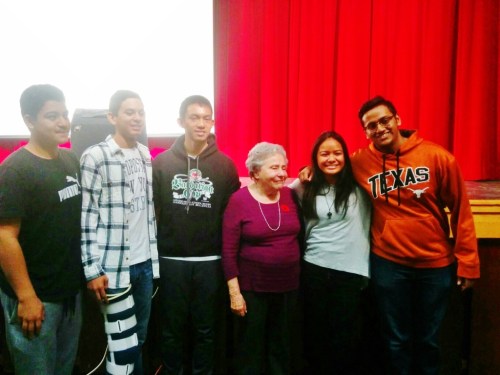
Holocaust survivor Ariela Rojek and her young admirers at Blessed Cardinal Newman Catholic High School.

I had an hour in the morning and I ended early so that they could come up and meet Ariela, my  “adoptive mother”. You see, a few years back, I connected her and several Toronto area survivors with their actual American liberators. Yesterday, at a family gathering at her daughter’s house, she brought out the scrapbook and showed me the pictures of her parents and family who did not survive the Holocaust, and even the original letter that her father wrote on the eve of his transfer from prison to Auschwitz-where he would be murdered, along with her grandfather and uncle. Ariela’s mother, only 36, both of her grandmothers, her other grandfather and two aunts were murdered at Belzec.


With Mark Celinscak, York University professor and author of the new book, "Distance from the Belsen Heap: Allied Forces and the Liberation of a Nazi Concentration Camp", and survivor Leslie Meisels before our afternoon talk.

With Mark Celinscak, Trent University professor and author of the new book, “Distance from the Belsen Heap: Allied Forces and the Liberation of a Nazi Concentration Camp”, and survivor Leslie Meisels before our afternoon talk.

Toronto talk descriptionIn the afternoon, I was with my good friend Leslie Meisels, an experienced speaker who told the kids about his Holocaust journey, and the miracles in his life that led he and I to be on the same stage together. Leslie was from Hungary, and liberated on the same day as Ariela, on the same train, and by the same soldiers. I did my bit and turned it over to him, and relayed questions from the students to him.

Now when you are teaching it is true that many times you have no idea of whether or not you are getting through to the kids. Some may have a bored expression as you hammer the message home, eyes not meeting yours, or looking like this is the last place they want to be. But in the end, you know, it behooves us as educators to give them space, and maybe time, to process. (And I did include a brief “debriefing guide” for teachers to use if they wanted to, after the presentation.)

But it was the outpouring of love for the survivors who were with me today, that really made my trip, and my efforts worth it.

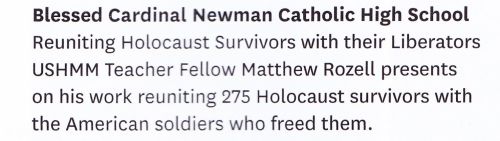
Holocaust survivor Leslie Meisels with Blessed Cardinal Newman Catholic High School students  where they learned about reuniting Holocaust survivors with their American liberators. Photo by Joan Shapero.

Holocaust survivor Leslie Meisels with Blessed Cardinal Newman Catholic High School students where they learned about reuniting Holocaust survivors with their American liberators.

Leslie and Ariela are family, and a new group of students became witnesses to the greatest crime in history, and one that the world allowed to unfold. In the end my message was to simply amplify the lessons these survivors, and liberators, have inspired through their example- that we are all part of the family of mankind and that in living out our lives, we have the responsibility to make a difference- and that one person can make a change that will ripple onward for generations to come.

Read Full Post »


This is an important story which aired on Oct. 4th on CBS 60 Minutes. I’ve known about Father Dubois for quite some time and we do have mutual friends/acquaintances. His book,  The Holocaust by Bullets, can be ordered here. I’m glad that his important work is having such an impact, and being recognized as groundbreaking. Remember, we are only 75 years after the events… As I am at work on my own book about the Holocaust, I find myself admiring a kindred spirit, in a sense. I’m not Jewish, but Catholic like him, but that is hardly relevant, except to call attention to what happened from the perspective of a non-Jew. For deniers, it won’t make a difference-but as we study, and interview, we become witnesses, too. 

He can’t mark the mass graves that he finds, and sadly I already knew what to expect when I reached the comments section of the article. And I am told that Father Dubois has received death threats at his residence in Paris.

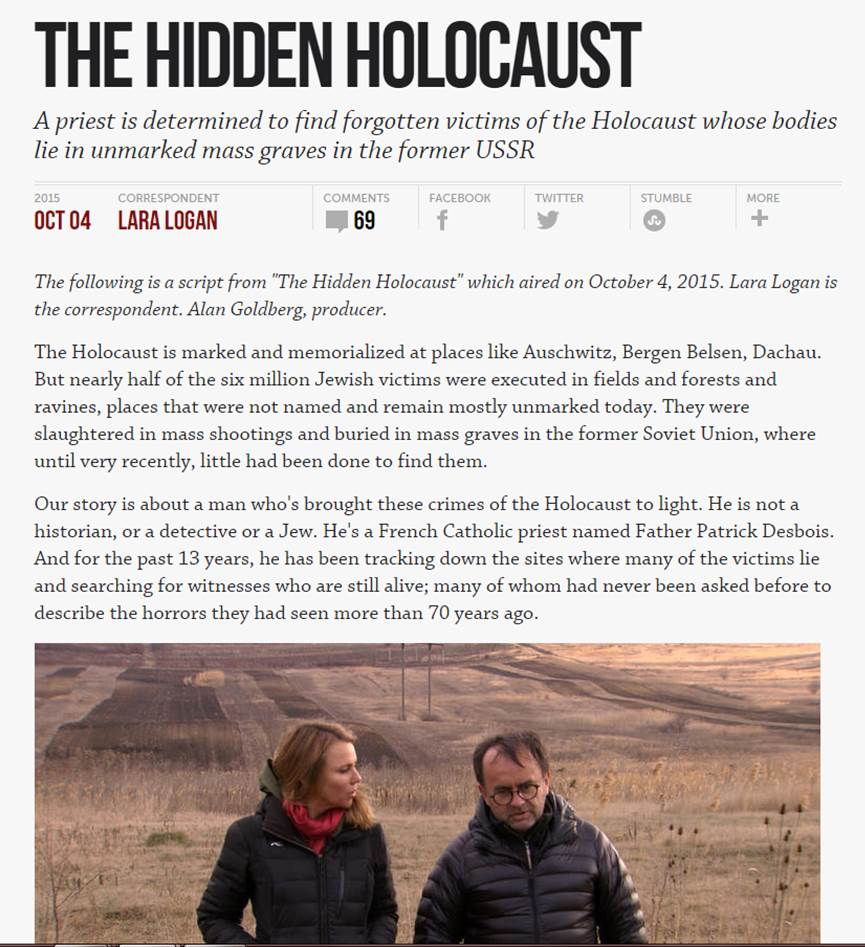
hidden holocaust

“The Holocaust is marked and memorialized at places like Auschwitz, Bergen Belsen, Dachau. But nearly half of the six million Jewish victims were executed in fields and forests and ravines, places that were not named and remain mostly unmarked today. They were slaughtered in mass shootings and buried in mass graves in the former Soviet Union, where until very recently, little had been done to find them.

Our story is about a man who’s brought these crimes of the Holocaust to light. He is not a historian, or a detective or a Jew. He’s a French Catholic priest named Father Patrick Desbois. And for the past 13 years, he has been tracking down the sites where many of the victims lie and searching for witnesses who are still alive; many of whom had never been asked before to describe the horrors they had seen more than 70 years ago.”

Lara Logan: So what you’re learning here is completely unrecorded?

Father Desbois: Yeah, if we didn’t come, we’ll never know they killed Jews. These Jews would have never been counted as dead, never known, and the mass grave is totally unknown.

Gheorghe brought us down this road where, he said, all the Jewish families from the village were taken. He told us the day of the shooting he was tending to cows nearby. Now 70 years later, we watched as he traced the victims steps to the edge of the ravine.

Read the transcript and view the report: http://www.cbsnews.com/news/hidden-holocaust-60-minutes/

http://www.yahadinunum.org/

Rleated article: Voices of ghosts: Remembering the Holocaust’s mass killings
‘I have lived with the Holocaust my entire life — and I still don’t understand how this could have happened’

Read Full Post »

Pearl Harbor survivor was quick to share memories

OCTOBER 04, 2015 2:00 PM • BILL TOSCANO

Editor’s note: Every life has a story. In this column, we pay tribute to people who have died recently.

I wrote about Mr. Ross and his passing a few weeks ago. This article appeared in the Post Star yesterday as he was being laid to rest. The reporter had contacted me for comment. And just so folks are aware, I asked him not to mention my recent book unless it was okay with Mr. Ross’ family. Rest easy, Barney. You made a lot of people happy in this life.

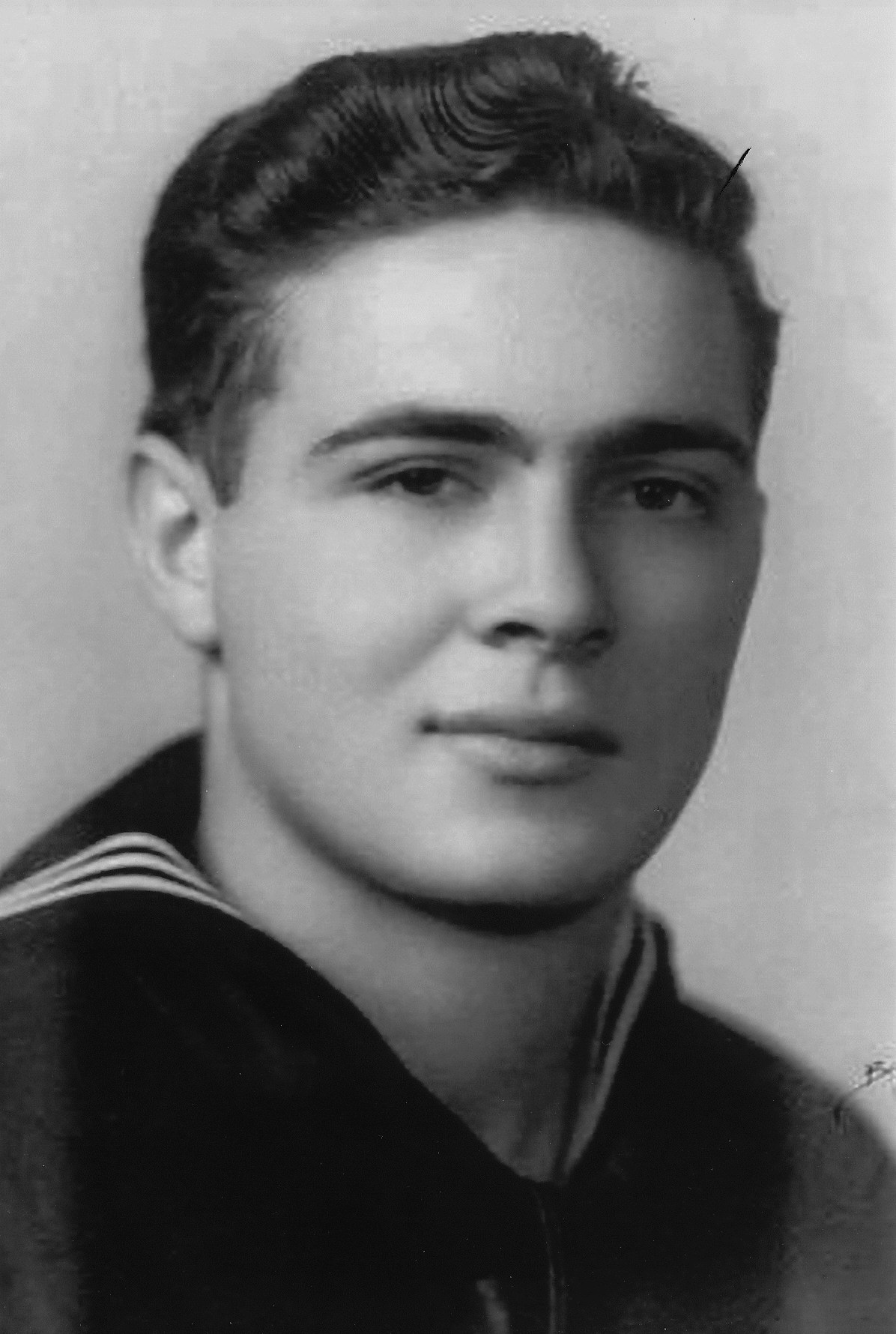
Barney Ross by Erin Coker, Courtesy Post-Star

Barney Ross by Erin Coker, Courtesy Post-Star

There’s a footnote at the bottom of Page 21 of Matthew Rozell’s recently published “The Things Our Fathers Saw” that sums up the late Barney Ross perfectly.
“In his remembrances, Mr. Ross’ voice began to break up recalling his friends who had passed before him. Barney brought smiles through the tears as he reminded my students that, ‘I may get emotional, but I’m still a tough guy.’ “
Rozell and his students at Hudson Falls High School were among many who heard Ross’ first-hand story of the attack on Pearl Harbor, the Pacific War and the signing of the surrender in Tokyo Bay.
Over the years, he had to think a little harder and sometimes needed prompting, but once the Whitehall native started telling his story, the memory and emotion took over.
Gerald A. “Barney” Ross, 94, died Thursday, Aug. 27, at Indian River Rehabilitation and Nursing Center in Granville, and with him died another memory of the attack that brought the U.S. into World War II. Ross, a lifelong resident of Whitehall, was one of an estimated 2,000 to 2,500 survivors remaining out of 60,000 who were at Pearl Harbor on that day of infamy.
Ross was a 1940 graduate of Whitehall High School and played on the 1939 unbeaten, untied, unscored-upon team. He was a hunter, fisherman and lifelong communicant of Our Lady of Angels Roman Catholic Church.
Following graduation, Ross enlisted in the U.S. Navy in August 1940. He served on the USS Blue during the Japanese attack on Pearl Harbor on Dec. 7, 1941.
Ross met Alice Marie Doyle at a USO dance in Philadelphia, and they were married in 1946. He operated Ross’s Restaurant in Whitehall and was later employed as a machine operator at Decora Industries in Fort Edward, retiring after many years of service.
Indelible memories
Gerald An electrician’s mate aboard the USS Blue, Ross found himself in the destroyer’s magazine during the battle, feeding ammunition to an anti-aircraft gun on the top deck.
“I’d get a shell, put that in the hoist,” Ross said in one of his many interviews. “And I’d get a powder and put that in the hoist. That way, I was feeding the gun. … I feel that we did our job.”
He had been in the harbor on the USS Blue when the Japanese planes dove out of the sky and dropped their bombs, and when the enemy submarines simultaneously sent torpedoes into American ships, in the surprise attack on America’s Pacific fleet.
“When the Japanese attacked, I was on the deck waiting for a boat to take me to a church service,” Ross said. “We saw a plane dive toward the USS Utah, then within minutes, it was the worst devastation you could ever imagine — the USS Arizona was blown up and the USS Oklahoma was turned over on its belly.”
Over the past seven weeks, at least five other survivors of the attack have died, including Joe Langdell, who at 100 was the oldest survivor of the USS Arizona. Eight men who served on the Arizona during the attack remain alive.
Ray Chavez, who at 103 years old is believed to be the oldest living survivor of the attack, recently threw out the first pitch at a San Diego Padres game.
In all, 2,000 to 2,500 of the 60,000 survivors are thought to still be alive, according to USS Arizona Memorial officials. More than 2,400 Americans died during the attack, including 68 civilians. Most — 1,177 — were killed when the Arizona exploded and caught fire.
‘A real nice man’
Rozell said he had not been in touch with Ross recently, but the man left a deep impression on him.
“He came across as a real nice man — down to earth, with a great warmth for the students he met in my classroom. A man who loved his town, his family and the entire region. But having survived the shock of Pearl Harbor, he always left us with a warning: ‘Be vigilant.’ That was in 1988 [1998].”

Ross was one of the first of many veterans to visit Rozell’s classroom. He is the first veteran quoted in “The Things Our Fathers Saw.”
“As a nation, we were sleeping; it is a terrible thing to say, but we just …” Ross is quoted as saying.
“I was just standing there waiting for a motor launch to take me to a bigger ship to go to Mass, to go to church! We had no inkling, no inkling whatsoever,” he added.
“We were sitting there like sitting ducks! Here are men, if you can visualize, men struggling to get out of the ships. A lot of them were sleeping in because they had the day off. It was a horrible thing! This fleet was coming to blow us off the face of the earth.”
Paying respects
Ross is survived by his wife and his three sons, Gerald F. Ross and his wife, Patricia, of Hartford, Dennis A. Ross and his wife, Angella Gibbons, of Marshfield, Vermont, and Christopher D. Ross of Whitehall.
Ross lived at Indian River Nursing Home in Granville for the past six years, and his wife still lives there.
A Mass of Christian burial was celebrated Saturday at St. Mary’s Roman Catholic Church in Granville.
Rite of Committal will be celebrated at 1 p.m. Monday at Gerald B. H. Solomon Saratoga National Cemetery in Schuylerville with full military honors.

http://poststar.com/lifestyles/columns/local/epitaph/pearl-harbor-survivor-was-quick-to-share-memories/article_f37b8284-0a58-5d8f-b5c5-8576e20dd2bc.html

Read Full Post »

« Newer Posts - Older Posts »