Feeds:
Posts
Comments

Archive for the ‘Uncategorized’ Category

I’ve been working a bit lately on my next two upcoming books, The Things Our Fathers Saw II and the one closest to my heart, working title, A Train Near Magdeburg or The Last Transport. And I have been struggling with that book for years. It’s a hard story to tell because it has to be done right, the first time.

TNMMy own personal connection and closeness to the subject has been documented at this blog since 2007, when we hosted the first reunion before a student audience at our high school, when we knew of only 2 liberators and 4 survivors. Today, that number has grown over 7 fold. Unbeknownst when we began, this story has grown and taken over the second half of my career as an educator.

Trying to take on the subject matter of the Holocaust as a classroom teacher is a daunting task, and one not to be taken lightly. Trying to convey that through the eyes of your survivor friends is exponentially difficult. But when you open yourself up, palms up and arms out, especially at the authentic sites where millions of families suffered, there is a coupling of the past and the present.

It’s not an easy thing to open yourself up to. But if you think that it is all in the past, you are very, very mistaken.

Now throw into the mix the experience of the young American boys, battle hardened and hardly innocents by now, who stumbled across the train and the horrors of the Holocaust. Confronted with the reality of sick and starving people, and a war in its closing days where the enemy, the perpetrators of this evil, are still shooting at them. They have a mission they have been tasked with, and it’s not a humanitarian rescue operation that they trained for.

Oh no. They had no idea. Many of these young guys were haunted for life by what they encountered.

A picture is worth a thousand words, so they say. In my case, more like one hundred thousand. Behind the camera, the major in the jeep snaps a photo as specters emerge from the springtime morning mist. The little girl turns her head in terror at the two monsters clamoring behind the jeep with the white star,  Tanks 12 and 13 of the 743rd Tank Battalion and the 30th Infantry Division of the United States Army. It is April 13, 1945, deep in the heart of the Reich. Friday the 13th. Tank 13 stays on after securing the perimeter to protect the vulnerable from their would-be murderers.

For the young beautiful men with perfect teeth and handsome uniforms, the first instinct is to recoil. This is not natural and these people have been reduced to stinking animals. Lice infested. Stench ridden. Infected with bad, bad disease. Revulsion and vomiting is a common reaction.  These are not human beings.

But, they are.

They are.

And what are we going to do about this? The battalion commander cocks his .45 and calmly places it to the head of the local burgermeister when he displays reluctance to comply with the order to open homes and feed the prisoners.

And next up on the roller coaster ride for the incredulous GIs  is stomping rage and jags of crying. Generations later, an 89 year old tells me, “My parents wondered why I couldn’t sleep at night, after returning home.”

The soldiers transport the victims out of the line of fire. The medics get to work. People continue to die, but somehow humanity returns. The war ends. The survivors and the soldiers go their own ways, most refusing to speak of this time for decades. For many, the trauma passes onto the children  of the generations that come after.

And then, in the twilight of living memory, a high school teacher with an unassuming project has the encounter with the unknown photographs, and asks the unasked questions.

Seventy years later, across time and space, the portal has been entered. The wires of the cosmos have been tripped. And the universe channels the unassuming power of love across the abyss as the aged rescuers and survivors and their descendants are brought together to meet again.

It is a miracle of healing and reconnection. A cosmic circuit has been completed, but maybe, in some small way, another pathway to undoing a tragic cycle is opened. And it is not a coincidence.

As I wrap up this post, I am pinged with an email from my ‘second mom’ in Toronto, survivor Ariela. She was 11 when she was liberated on the train with her aunt. Her parents and grandparents were murdered in Poland by the Germans. She’s good on Facebook, but has a tough time with email. She’s thinking of me, and the book which has to tell the story. The email comes through now, loud and clear.

This is the train that should have led to death. Instead, it leads to life, and a legacy of the triumph of good over evil. And maybe, just maybe, amidst all of the horror and the suffering, there is a lesson here, somewhere.

I’d like to think so.


Read Full Post »

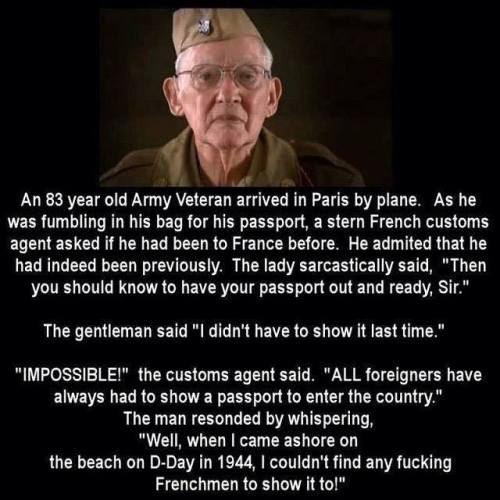
Here is one that has been making the rounds for a while (note the age of the veteran- he would have been 11 in 1944). I’ve gotten it forwarded to me or seen it online for like the 25th time since it first appeared about a dozen years ago.


83 yr old army veteran


Give it to him, Gramps!

Too bad it’s not true. You can substitute the American soldier for British or Canadian, if you really want to google it.

I suppose I should laugh, take it as a joke, if that was the purpose.  There are rude customs officials, for sure. And on my first read,  I’m sure the tale resonated at some level that made me proud.

But, then I read comments online like this:

“I have heard about that encounter before and I love to hear it re-told……too bad some of the nations thatt America has liberated or protected no longer appreciate it….or even seem to remember.” 

And since that seems to be a very common reaction, maybe it’s time to call bullshit.

Here’s why.

I know a ton of American World War II veterans who returned to France and the Low Countries after they retired, well after the war. And far from forgetting, the memory of what the liberators underwent is indelibly seared into the consciousness on the continent where our troops fought, three generations later, and passed on to the children in who live in those places today. They turn out by the THOUSANDS to greet our veterans, and adopt the graves of fallen Americans to care for in their lands.

This American soldier was killed a month before the war ended and lies in the Netherlands, his grave tended by three generations of the same family. And the little guy, probably the 4th generation, is not American.

The vets are honored everywhere they go. One of my overseas acquaintances even runs a private museum (link above) dedicated to the sacrifices of the American soldiers who liberated his town in the Netherlands. I have been to WWII reunions here in the States where citizens and film crews from these countries have flown over to attend and honor these veterans. They are welcomed back to the concentration camp memorials in Germany with red carpet treatment and private tours.

The meme makes us feel good for our imaginary veteran, I suppose. But I get more misty-eyed watching my ninety-something year old friend from Buffalo, NY, Dick Lacey, riding in the jeep, overwhelmed at all the attention, who can only choke back five words- “Wow! Look at all the people!”  – seeing the crowds who have come out to wish him well.

***

Read this article for starts. Look at the monuments to honor the American sacrifices throughout NW Europe, through the eyes and the ears of our veterans returning one last time.

PNGAnd did you know that France’s highest award, the Legion of Honor, is given to American veterans who fought in France? The Legion of Honor was created by Napoleon, and is reserved for  outstanding service to France. A lot of my friends have received it in ceremonies at French embassies or consulates, and it proudly donned on very special occasions.  [Download the form below if you know a qualifying vet, before it is too late.  They don’t award it posthumously.] So when it comes to our veterans, so much for that legendary French snobbery and ingratitude.

The Legion d’Honneur for US Veterans

Upon presentation of their military file as detailed hereunder, US veterans who risked their life during World War II to fight on French territory, may be awarded this distinction. Those selected are appointed to the rank of Knight of the Legion of Honor.

thank you very much


Read Full Post »


Clara Rudnick around age 15.

Clara Rudnick around age 15.

I’m sharing a pair of articles that I think are illuminating on the state of affairs regarding the Holocaust in Lithuania. In previous posts I have told the story of my friend Clara Rudnick who somehow was able to survive where most all of her friends and family in Lithuania were murdered. She also bravely went back for a visit in 2013 with her son, and found that people did not know, or pretended not to know, what happened only a couple generations back.

New book prompts soul-searching in Lithuania about Holocaust-era complicity

Jewish Telegraphic Agency, Feb. 17, 2016

By Cnaan Liphshiz

As the author of a best-seller that deals with female sexuality after 50, the Lithuanian novelist Ruta Vanagaite is used to embarrassing questions from journalists about her private life.

But even she was astonished when a reporter for a popular television station demanded to see her birth certificate to ascertain the veracity of claims that she is Jewish.

The question came during an interview about Vanagaite’s latest book, “Musiskiai” (“Our People”), a travelogue about the Holocaust consisting of interviews with witnesses to the atrocities perpetrated by Lithuanians against their Jewish neighbors.

The book’s publication last month has triggered the first major public debate in Lithuania about local Lithuanians’ complicity in the genocide of the Jews. It currently tops the best-seller list of the Pegasas chain of bookstores and has prompted officials to promise to publish this year the names of 1,000 Holocaust perpetrators they have been keeping under wraps for years.

Vanagaite, who is 61 and not Jewish, visited killing fields in Lithuania and Belarus to research the book, which she co-authored with Efraim Zuroff, the renowned Nazi hunter and director of the Simon Wiesenthal Center’s Israel office. Though she found the journalist’s request to see her birth certificate unsettling, she complied anyway.

“I know where it’s coming from,” Vanagaite told JTA. “Lithuanian involvement in the Holocaust is such a taboo that being a Jew or a Russian spy are the only explanations for wanting to talk about it.”

But that is beginning to change thanks to Vanagaite’s book.

“In one fell swoop, the book has brought a wave of truth telling about the Holocaust to the mainstream of society who follow the large media outlets,” said Dovid Katz, a Yiddish scholar in Vilnius who has campaigned for historical accuracy on the Lithuanians’ Holocaust-era role in the near annihilation of the Lithuanian Jewish community of 220,000. “It is of notable importance that a born and bred Lithuanian author tells the simple truth as it has never been told in a trade book not intended for scholars and specialists.”

Geoff Vasil, a spokesman for the Jewish Community of Lithuania, said “the turning of the tide within Lithuanian society” on this issue “now appears to be taking place like never before.”
The 304-page volume has prompted not just the official Jewish Community of Lithuania but also local media outlets to demand the government publish its list of suspected war criminals. The government received the names in 2012 from its own Genocide and Resistance Research Center but failed to publish them or issue any indictments. The center’s director now has promised to publish the names by 2017.

Vanagaite’s book also has highlighted the fact that despite ample evidence and testimonies of widespread complicity, not a single person has been imprisoned in Lithuania for killing Jews during the Holocaust.

“Germany, Austria, even Hungary and Poland have had this reckoning a decade ago, but there’s a strong resistance in Lithuanian society to follow suit and confront this stain in our history,” Vanagaite said. Yet failing to do so, she said, “will mean we will be branded as a whole nation of murderers, and rightly so, because we refuse to acknowledge and condemn a murderous fringe.”

Vanagaite experienced this reluctance personally last year when she made an unwelcome discovery that served as her motivation to write the book in the first place.

In researching the life story of her grandfather — a well-known activist against communist Russia’s occupation of Lithuania until 1991 — she found documents that showed he helped German authorities compile a list of 10 Jewish communists during World War II. The German authorities then gave him some Jews to work on his farm as slave laborers before they were murdered.

“It was devastating,” Vanagaite recalls. “This was a man who was a hero to me and my family.”

In Lithuania, locals who fought with the Germans against the Red Army are widely revered as patriotic freedom fighters — including Juozas Ambrazevicius, the leader of the Nazi collaborationist government. In a funeral organized by the central government, Ambrazevicius was reburied in 2012 with full national honors in the city of Kaunas. Four years earlier, Lithuanian prosecutors investigated for alleged war crimes four Jews who fought against the Nazis with the Russians. The investigation was dropped amid an international outcry.

Lithuania is the only country whose government officially branded Soviet occupation as a form of genocide. That “Soviet-sponsored genocide” is commemorated in Lithuania far more prominently than the Holocaust. And even any mention of the Jewish genocide had been absent from Vilnius’ state Museum of Genocide Victims until 2011.

“Exposing that some Lithuanians who are considered patriotic heroes are really war criminals would undermine the good-versus-evil narrative,” Katz noted.

It is precisely Vanagaite’s credentials as a good Lithuanian from a good Lithuanian family that has made her message so piercing to fellow Lithuanians, said Zuroff, the co-author of “Our People” and longtime critic of Lithuanian governments.

“My voice [about Lithuania] was loud in international media, but I was not getting heard inside Lithuania, where I was pretty much portrayed as an enemy of the people,” Zuroff told JTA. “It took someone like Ruta to achieve that.”

The second part of Vanagaite’s book is about her travels with Zuroff, where they spoke to octogenarians who witnessed mass executions. Referencing Zuroff – a reviled figure by many Lithuanians, including well-known cartoonists and nationalist columnists – Vanagaite titled that part of the book “Journey with an Enemy.”

But Vanagaite and Zuroff are not in full accord. She believes that in lieu of Lithuanian introspection, the extent and cruelty of Lithuanian complicity has been vastly exaggerated – including in survivors’ testimonies. She cast doubt on testimonies about a man who was boiled alive in Panevezys and an account that locals, after slaughtering dozens of Jews in Kaunas, sang the Lithuanian anthem. Zuroff says he has no reason to doubt these accounts.

“But these details are less significant in light of the movement that this book started,” he said.

Meanwhile, Vanagaite is experiencing the public denunciation that for years has been directed at Zuroff, Katz and other critics of Lithuania’s refusal to prosecute Holocaust perpetrators.

Cast as a Kremlin agent in some publications and as a closeted Jew in others, Vanagaite says some of her friends no longer wish to speak to her.

At a book fair next month, Vanagaite says she will hand out stones to visitors of her booth with the following instruction: “Any Lithuanian who’s certain that their family wasn’t involved in the Holocaust should throw one right at me.”

Source: http://www.jta.org/2016/02/17/news-opinion/world/new-book-prompts-soul-searching-in-lithuania-about-holocaust-era-complicity

Author explores Holocaust in Lithuania: ‘Our own boys used to go shooting people after school’

The Lithuania Tribune

Friday, January 29, 2016

Author Rūta Vanagaitė recently presented a book, “Our Own”, about the Holocaust in Lithuania. Although historians have been researching the topic for years, the Lithuanian society has yet to realize and acknowledge the part their compatriots, ordinary Lithuanians, played in the mass killings of Jews, Vanagaitė says.  It is a book dedicated to the 75th anniversary of the great Jewish massacre in 1941 when almost the entire Jewish community in Lithuania was killed. In total, about 200,000 Jews were killed in Lithuania between 1941-1944. There were 227 mass killings of Jews all over Lithuania. “I took this theme because I was struck by how feared it is in Lithuania. I wanted to understand what really happened in our country and to our people, and why it happened. This is not a historical book – this is a book for self-development. I know that Lithuania did not wait for this book. That is why I wrote it. It was the most important moment, when somebody had to write this book. Those witnesses are 85-90 years old, they will no longer be with us in a few years,” said Vanagaitė.

While writing the book, she researched archives and travelled to killing sites across Lithuania, together with the ‘Nazi hunter’ Efraim Zuroff, to talk to living witnesses. “They are now 85 or 90 years old. Over the last 75 years, no one came to ask them about [the Holocaust], so now they are afraid to talk,” Vanagaitė tells in an interview to the LRT TV programme Dėmesio Centre.

How would this explain the enthusiasm with which Lithuanians took part in massacring Jews during World War Two?

There wasn’t much enthusiasm, except for a few [who] were motivated by it. The rest were simply doing their work.

But it seems that your book is precisely about how willingly Lithuanians were killing Jews?

Those who took part in the killings for spoils were probably willing. Ordinary Lithuanians joined battalions because they were told that those battalions were the seeds of the army of independent Lithuania, that they would be going to fight against the soviets and defend Lithuania. At first, these battalions would be sent to guard buildings, later Jews, and after that they took the Jews to pits and lined them up. It took enormous willpower to say “I will not shoot.” But there were some who did not shoot Jews.

Would they get away with it?

Yes. Officers [overseeing the killings] were usually Lithuanians, Germans would not even go to massacre sites in the provinces. If a Lithuanian officer saw that your hands were shaking, how could he be sure you would not turn and shoot at him? If he saw you were nervous, on the edge, you would not even get a weapon. But there were some who wanted to shoot. Those with enthusiasm were the marginals. Meanwhile those who were joining the battalions were motivated by a sense of duty or something else. Some wanted money, others had no home, yet others loved their country and hated the Soviets. There were those who killed 20,000 people with their own hands over four years.

While researching for the book, you must have read everything written on the topic in Lithuanian?

I have. But my main sources were files [in archives] and conversations with people. An ordinary person would not go to archives and spend six months going through files. Or read all the books. So my goal was to put all information into 300 pages so people could grasp what really happened.

Why did you take up this subject?

I have done several other projects [on the Holocaust] before, I find the topic interesting, although I do not have any Jewish ancestry myself. There are few Jews left in Lithuania, only several thousand, but we continue to hate them. Moreover, there is great fear and reluctance to discuss the subject. People working in public institutions are particularly fearful. You give a new angle on the subject. What was your goal? I tried to take a closer look at people who killed, to understand them, to see how they started, what motivated them. We still don’t know what was happening by the pits. All we know is that thousands of Jews were killed and that it was the marginals who did it. But what do we know about the fact that they wouldn’t shoot children, but pound them against trees to save bullets? That there have been found a lot of children’s bodies with intact skulls? This means they were buried alive. Do we know about the incredible anti-Semitism that the Lithuanian government of the time fostered? It emboldened people, they would be told that Jews were lice, mites, communists and what have you. We can still hear people saying that Jews were communists. These are words of Hitler and Goebbels. You visited the killing sites.

Are there still many witnesses left?

Yes. There are people living near each killing site who remember well. They are now 85 or 90 years old. Over the last 75 years, no one came to ask them about it, so now they are afraid to talk. No one, except Romas from Šeduva, agreed to tell me their name or take a picture. They said they were afraid, that someone might come and kill them. Who will come, who will kill, I asked. Lithuanians, they said.

“Nazi hunter” Efraim Zuroff, director of the Simon Wiesenthal Center who attended the presentation of your book, said that the Lithuanian government was reluctant to do much about the Holocaust. What did he mean?

When the United States deported war criminals – Kazys Gimžauskas, Aleksandras Lileikis, Algimantas Dailidė – the process was stalled and not one criminal was sentenced. I am surprised by one more thing. I went to the government to enquire about a list of 2,055 names prepared by the Genocide and Resistance Research Centre; this list is gathering dust at the government’s chancellery since 2012. I asked if it were possible to take that list out, to give it to prosecutors. The Genocide and Resistance Research Centre worked three years compiling the list of 2,055 names and there are tens of thousands files left; the centre does not know what to do next. This is what I was told by the deputy chancellor: whatever we do, the Jews will never have enough.

In your book, you dethrone certain individuals and events in Lithuania’s anti-Soviet resistance. Like the June 1941 uprising, Lithuania’s provisional government, the white-bands (anti-Soviet volunteer squads).

The June uprising was started by a man named Norkus who hoisted a Lithuanian tricolour on the Resurrection Church in Kaunas. Later, he was one of the commanders of the Nation’s Defence battalion and, in early July, 3,000 innocent people were killed under his command. The white-bands were very expertly used by the Nazis. The Lithuanian government of the time set up the first concentration camp at the 7th Fort in Kaunas, where these Jews were murdered. The killings were directed by a man who, just days before, had raised a Lithuanian flag at a church. What is he? A hero?

You also write that even priests were rather lenient about such “sins”. For instance, a Catholic church in Minsk offered absolutions to Lithuanians who killed Jews in Belarus.

Each battalion had a chaplain who would hold service every Sunday. At times, the guys would go to the confessional five at a time. To make it faster, the sins were identical after all. Afterwards they’d sing the Lithuanian anthem.

What is it that you want people to take away from your book? The take-away is very simple. All this happened at the intersection of very many unfortunate circumstances. Thousands of young Lithuanians were pushed into this. I cannot blame them, nor can I justify them. If, under particular circumstances, it happened once, can we be sure it won’t happen again? How can we condemn the boys of Islamic State, if our own boys of 15-16 years used to go shooting people after school? This has happened and it can happen again.

We cannot close our eyes to truth, however painful and ugly it is.

Source: http://en.delfi.lt/lithuania/society/author-explores-holocaust-in-lithuania-our-own-boys-used-to-go-shooting-people-after-school.d?id=70250476

Read Full Post »

Holocaust Survivor Clara Rudnick in her home, Photo Erica Miller 8/31/10

Holocaust Survivor Clara Rudnick in her home, Photo Erica Miller 8/31/10

I have a friend who lost her entire family and just barely survived the Holocaust in her homeland of Lithuania, and elsewhere.

I gave a talk a while back and Clara was there. Here is what I wrote then:

I gave my first talk last night after returning  from an intensive 3 week European study tour. Arriving early to prepare and set up, I looked up and in walked Siobhan, a former student, and her mom, followed a little while by an older woman I was surprised and delighted to see- Mrs. Rudnick, or Clara. She gave me a hug and took off her coat and told me that she had taken a cab to the site of the lecture, and, oh, could I please give her a ride home? I was delighted.

During the lecture I recognized her before the audience, and thanked her for coming out. She told the audience how proud she was to live in the “North Country” of upstate New York. Heck, she’s lived here since 1949, a dozen years before I was born! She was moved to tears, as was Siobhan, who gave her a hug.

During the talk, she nodded her head in agreement to many of my points. Afterwards, she pulled out a piece of paper, a short statement that she had written, explaining that she had been meaning to call me.  You see, she was not the only traveler to Europe this summer. While I was in Poland touring Holocaust related sites, Mrs. Rudnick had returned to Lithuania of her youth.

Not an easy thing, given that

a. Clara is 89 years old;

b. Clara is a Holocaust survivor;

c. Clara lost most of her family to the SS Einsatzgruppen and their Lithuanian collaborators.

She and her late husband Abe were two of only 7000 survivors of the 70,000 Jews of Vilna. I was familiar with a lot of the history, but to understand more of what she had gone through, I looked up the following at the USHMM website:

The Lithuanians carried out violent riots against the Jews both shortly before and immediately after the arrival of German forces. In June and July 1941, detachments of German Einsatzgruppen (mobile killing units), together with Lithuanian auxiliaries, began murdering the Jews of Lithuania. By the end of August 1941, most Jews in rural Lithuania had been shot. By November 1941, the Germans also massacred most of the Jews who had been concentrated in ghettos in the larger cities. The surviving 40,000 Jews were concentrated in the Vilna, Kovno, Siauliai, and Svencionys ghettos, and in various labor camps in Lithuania. Living conditions were miserable, with severe food shortages, outbreaks of disease, and overcrowding.

In 1943, the Germans destroyed the Vilna and Svencionys ghettos, and converted the Kovno and Siauliai ghettos into concentration camps. Some 15,000 Lithuanian Jews were deported to labor camps in Latvia and Estonia. About 5,000 Jews were deported to extermination camps in Poland, where they were murdered. Shortly before withdrawing from Lithuania in the fall of 1944, the Germans deported about 10,000 Jews from Kovno and Siauliai to concentration camps in Germany.

Soviet troops reoccupied Lithuania in the summer of 1944. In the previous three years, the Germans had murdered about 90 percent of Lithuanian Jews, one of the highest victim rates in Europe.

Clara was anxious to speak to me. She told me of her trip with her son. Together they returned to Svinsyan, where her parents, two sisters and two brothers lived. To one of my students, a few years back, she told the following story:

On June 21st, 1941, the Nazis came into my town, I lived with my mother and father, two brother and two sisters. In July 4th, they took my oldest brother and burned him alive, with 90 other Jewish teenagers in my town. In the early part of August they came in and took my twin brother, along with another 100 teenagers and dug a big hole and buried them alive. In September they took the whole town about 8,000 people and brought then to where we held our flea markets- this was both of my sisters and my mother- out into the woods where they lined them up and shot them and left them there. This is where my father and I escaped- he knew a lot of men- and we went to farm to farm and hid out until the Nazis would come, and we would leave because if they caught us they would kill us and the people we were staying with, because they were harboring  fugitives.

At the town’s museum, she stopped to ask where the memorial of the murder site, Poligon, could be found. Clara said that they  told her that they did not know where it was, though half the town’s population, many of the families having lived their since the 1300s, had been murdered there.

At the hotel in Vilna she inquired how she could get to Ponary, and was simply told “there is nothing there”. Google Ponary. 110000 relevant results. 70,000 Jews were shot to death there by the Germans and Lithuanians.

Taking the English-speaking bus tour of the Old City of Vilna, the guide described the Philharmonic Hall but did not tell the tourists that this was the entrance to the Vilna Ghetto, where she had been imprisoned until being deported to a slave labor camp and later to a concentration camp. When Clara asked why the guide did not mention this, the guide said that she “did not know.”

Maybe the guide was young and was not taught this history in school. Or maybe it was not important enough to be part of the official program. 90 to 95% of Lithuania’s Jews were murdered in the Holocaust. To one lady on the bus, and her son, it was important. In Clara’s words, “In just three days, I learned that Lithuania has not faced it history of the destruction of its 250,000 Jews”.

Clara is happy that I am keeping the memory alive. She put on her coat and climbed up into my pickup truck without assistance. She chatted all the way home as I tried to navigate to her house in the dark. She thanked me over and over. Not at all. Thank you for coming into my life and making me, and my students, a part of yours.

***

Here then, is some welcome news from Europe. But you have to wonder how far it will really go.

“Lithuania pledges to publish names of 1,000 suspected Holocaust perpetrators”


Following the publication in Lithuania of a groundbreaking book on local complicity during the Holocaust, a state museum on genocide said it would publish a list of 1,000 suspected perpetrators.

Terese Birute Burauskaite, who heads the Vilnius-based Genocide and Resistance Research Centre of Lithuania, said her institution would “this year try to publish a book” containing “over 1,000 Lithuanian residents who are connected to the Holocaust,” the news website Delfi.lt reported Tuesday.

Burauskaite made her remarks in an interview on the findings of a book titled “Musiskiai” (“Our Own”) that was released last week. Co-authored by the Israeli Nazi hunter Efraim Zuroff and Ruta Vanagaite, a local author who began studying the Holocaust after discovering that members of her own family played a role in the murder of Jews during the genocide, the book focused media attention on the controversial issue of local complicity.

In 2012, the museum gave the government a list containing 2,055 names of supposed perpetrators, Vanagaite said in the Delfi interview last week about her book, but Vilnius neither published it nor made any attempt to investigate the people concerned.

Rimantas Vaitkus, a deputy minister for education, told Delfi: “We do not have such a list,” explaining that compiling one was up to the genocide center. But Burauskaite, the center’s director, said her organization had discussed the list with the government. After studying the list for three years, she said her organization eliminated approximately 1,000 suspects.

According to Zuroff, the list was published in 2012 briefly on the website of the museum but taken offline after 24 hours.

The book by Zuroff, who is the Israel director of the Simon Wiesenthal Center, and Vanagaite chronicles their journeys last summer across Lithuania, where they spoke with people who witnessed locals killing Jews. Its 2,500 copies were sold out within two days of its Jan. 26 publication release.

More than 95 percent of the 220,000 Jews who lived in Lithuania during the Holocaust were murdered, many of them by local Nazis and Nazi collaborators. Some of the perpetrators are celebrated as heroes in Lithuania, where many perceive them as national heroes for their opposition to Russian domination of the country.

“There has been a stubborn reluctance in Lithuania to start the retrospection that went on elsewhere in Europe,” Zuroff said. “There are signs this book is changing that.”

http://www.jpost.com/Diaspora/Lithuania-pledges-to-publish-names-of-1000-suspected-Holocaust-perpetrators-443624

Read Full Post »

I hope you had a great weekend. I decided to spend my weekend with a fellow who has been gone for a while. And I had a blast.

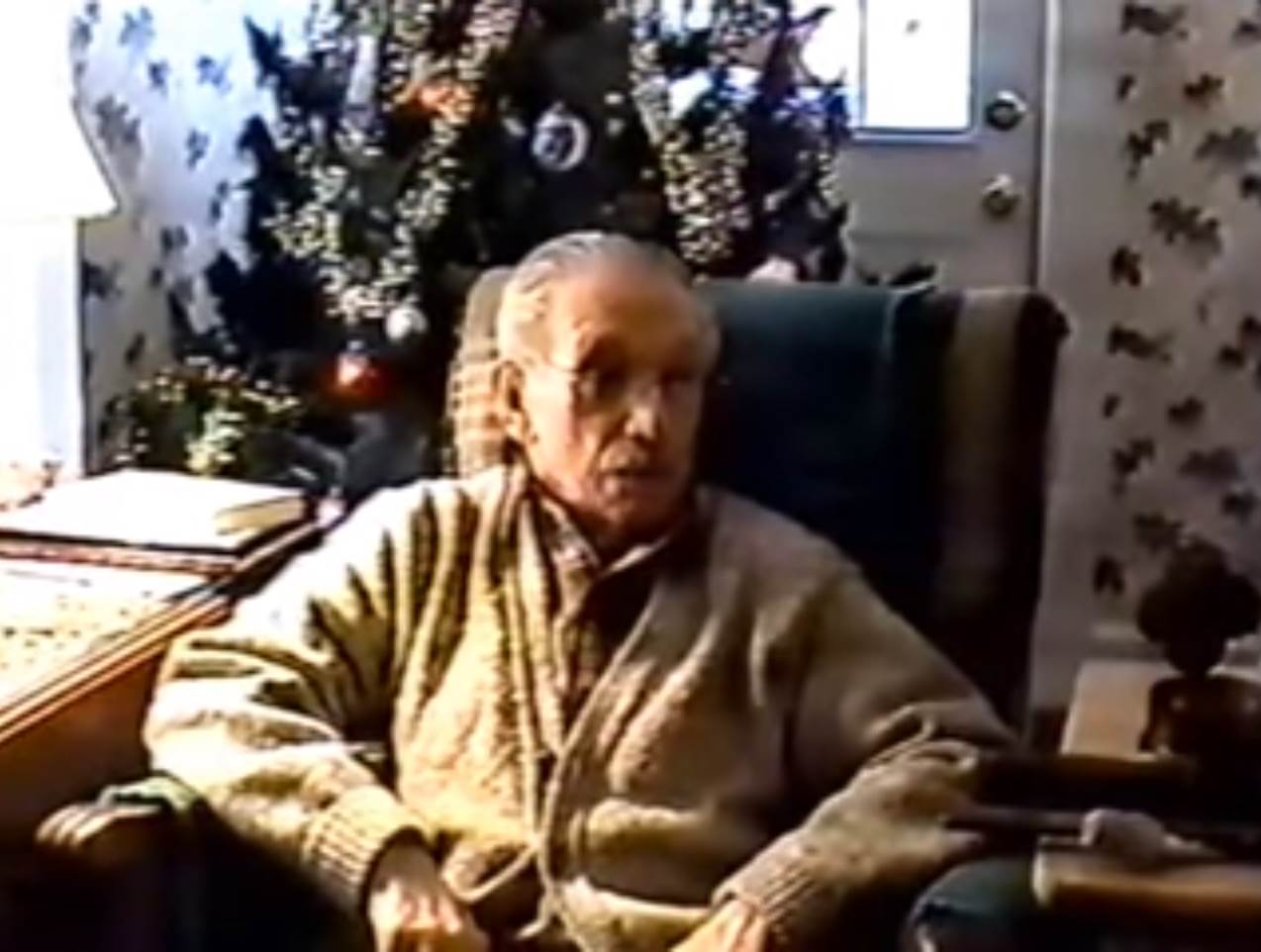
tom collins jan 04

This weekend I edited an interview we did six or seven years before the our veteran, sitting comfortably in his favorite chair in his button-down sweater in front of the Christmas tree, passed. He was suddenly alive, animated, an old man telegraphing the emotions and feelings long buried about some of the most formative years of his life-conveying them to a young person who was genuinely interested; who CARED.

When you edit a raw interview, you have to absorb it all first. The surroundings, the line of questioning, the emotions and the back and forth of the memory machine. You pray that the transcriber, if it was not you originally, was relatively engaged and committed to a literal interpretation. And thank goodness for the advent of the digital access to the tapes we made, when we donated a copy to the New York State Military Museum.

We’d move on a minute’s notice and find a place to put our guns into position. [When we were in combat] there was fear, lots of it. But I was in charge of the howitzer and the gun crew. We might be getting shelled ourselves and our infantry getting pounded. We sometimes found ourselves in fluid situations. The Germans might be attacking or we might be attacking and it was very fluid—we might be moving forward or backing up. You never knew—[behind the lines], you never knew what was happening, whether we had them on the run or whether they were counterattacking—so we had to think in terms of getting things ready to move, because we might have to get the hell out of here. We had the fear but we were so busy and had so much to do and make sure it got done that it sort of beat the fear. In other words, you were scared to death, but you did the best you possibly could.

Armed with all this, without putting words in the subject’s mouth, I have to arrange his recollections in line with the actual events of the day. Thus it was with Mr. Tom Collins, an artillery sergeant responsible for a 105 mm gun crew in Italy.  As it turned out, he was interviewed by his own granddaughter, one of my students a long time before he passed. And he told her things that he had never told anyone else in his life–but only because she cared, and asked the right follow-up questions. That is clear in the transcript she produced for her project afterwards.

When we got home, the sudden change [to civilian life] seemed difficult for me. I felt more and more that I had changed, so I would stay home. I didn’t go anywhere. It took me a couple of weeks before I would go out, you know, go downtown. I remember the first few times I went uptown from there—I wouldn’t go unless my sister was with me, I wouldn’t go alone. I can’t really put words on it but I really felt strange. I felt unusual. I thought, ‘Will I talk right, will I act right?’ because when we were in the army, foul language was common place and using crazy phrases like the southerners used, things like that, it became the way I was speaking and living. But [after a while] I warmed up and I was fine.

Tom Collins passed in 2011. Yet because of the prescient efforts  we made, years and years ago, he will live on in the minds of more than just his family. You can see more about him below, and you can read about him in the upcoming book I am working on. You did good, young Catie.

Thank you, sweetheart. It was a pleasure.

Rest on, Tom Collins.

(You can order the first book here.)


Read Full Post »

Why should I think about yesterday
and lose this beautiful today?
Why should I worry about a tomorrow
that may never be?
So live for today
Because yesterday will never return,
And who knows what tomorrow will be.
–Holocaust survivor Frank Burstin

affectionately known as “Pop”

Read Full Post »

edwin israel by matt rozell

edwin israel by matt rozell

I’m working on my second and third books simultaneously, the trilogy of World War II and Holocaust stories that have shaped my life though the narratives of those who lived through it. One of the most gratifying things is recalling the conversations I recorded over the course of nearly two decades. Most of the subjects are now deceased.

Edwin Israel participated in the invasion of Normandy, Sicily and North Africa. He received 2 Bronze Stars. One time he captured three soldiers who were trying to kill him, marching them back to his lines at gunpoint, with an empty rifle pointed at them. Another time he evaded capture by pretending he was dead and lying down on top of a German soldier he had just mortally wounded. When the enemy patrol passed, the dying German, in perfect English, told him to take his stuff.

I got up and [this German I shot] starts talking to me in English, he says he’s from Coney Island, in Brooklyn, he went to visit his mother in Germany and they put him in the army. And he was dying, and he says to me, ‘you can take my cigarettes; you can take my schnapps’. Then he died right underneath me. And I imagine he knew I had shot him…

He was a first scout who navigated his way back to his lines at night by following the stars. One time he crossed through a minefield and back without knowing it.

Before the invasion of Normandy, he rolled craps all night before going in on Omaha Beach. He had all the money at the end, and loaned out money to the guys who wanted to keep playing. Not one of them survived.

His beloved captain, who had been his CO all through the war, warned him about the mines on the beach before disembarking. The first thing that he did after that was step on a mine and get killed.


Everything was very lucky for me.  I just happened to do this, or happened to do that.  When they counterattacked that time on the hill, I just figured I’ll lay down on top of that soldier and make believe I’m dead. I used to go scouting at night by the stars—I used to look up and see where certain stars were, so that I could find my way back. That was how I found my way back when the fellas and I went to the mountain—by stars—through the minefield. We were so lucky. But you know, I never worried about getting wounded; it never bothered me.  I was only worried about getting captured, never worried about getting shot.  I said, ‘They’re not going to shoot me.’  That was my attitude. I volunteered for everything. I only worried that I was going to get captured.  With my name, I figured, oh, they’re going to kill me. That’s the only thing I worried about.


I interviewed him four months before he died, twelve years ago. The tape was then buried but has since been rediscovered. Lately I have been working on and editing his transcript for days. There is a noble feeling akin to resurrecting these men that makes the time so worthwhile.

Look for the next book this summer. We’re bringing Ed back.

TOFS Book Presentation


Read Full Post »

Be the Light.

A Christmas Story, by Me

~The Dark Santa~

The holiday festivities once again roll back around and the Dark Santa is trolling in the background to keep order and decorum. In our house, he is never relegated back into the box; he is always on guard and looking out over the children, good and bad, tinkering his bells to announce his arrival and ready with his switch to be used on misbehaving bums. But this year he has a special message to deliver, and this evening before Christmas, he comes gently in the night to remind me of a few things.

1206151173b

I created this particular Dark Santa and a batch like him back in 1992. I don’t think we made more than a couple dozen, me and the good wife, back in the days BC (before children). I would watch the local PBS station on Saturday morning as my hero Rick Bütz, the Adirondack woodcarver, would turn a hunk of wood into something real and alive. My teaching career was just underway, and Laura and I had just moved from my parents’ house, where we had shacked up in desperation as poor newlyweds, to a beautiful new home that my good friend had built. We were young and independent, free with time and money. The road was wide open. Then one Saturday Rick created a belsnickel, and as he brought the block to life, he told the story of Santa’s cranky cousin. From the history pages:

“He is typically very ragged and disheveled. He wears torn, tattered, and dirty clothes, and he carries a switch in his hand. A few nights before Christmas, a rap would come at the door. A cross-looking man wearing furs would step through the door. He held a hickory switch in one hand and a sack laden with candy and nuts in the other. One by one, he called the children in the house forward and asked them to recite a poem, a Bible verse or math equations. He’d warn them to behave. Then he’d toss the goodies on the floor — but woe to children who forgot their manners and greedily dove for the candy and nuts. They might feel the sting of the switch on their backs. But there was still time to mend their ways before Santa visited on Christmas Eve.”

For some reason, the little guy just spoke to me. I went on a tear, laying out the template and carving away, shaping the body, incising the eyes, and curving the lines down in his beard with the compact woodcarving kit my youthful wife bought me. She would paint his robe and the mittens, I would drill and nail his free-swinging arms in place, complete with broomstalk switches, and we would move on to the next one. So off the toy assembly line they marched, the first one finding his way to my parents’ mantelpiece over the fireplace—Mom and Dad just loved him. The rest were dispatched to many of my closest friends and relatives, and maybe to some of their friends; I don’t think I sold any.

Two decades plus later, my late parents are a warm memory. My not-so-young bride and I wake up nights and worry for our own children, our students, and other loved ones in this fouled-up world, as my folks surely did for us. And coming down the stairs one morning recently, Dark Santa jumps out at me from his perpetual place on the window ledge, as if to say, “Okay, bud. Now it’s your turn.”

I decide to fetch the camera, take his photo, and not exactly in the true spirit of Christmastime, I post Dark Santa up on my Facebook page, shouting but not writing the words I am feeling:

Happy Holidays, World. You have been a bad world, full of ignorance and intolerance and demagoguery and divisiveness. Maybe it’s time you felt the switch.

But maybe that’s not what the little guy had in mind. In response to my post, one by one, our friends and relations post pictures of him and stories of how this gift they received from us years ago still takes an honored place at Christmastime. And I notice that most of the soldiers in the dark army of Santas we sent marching out into the world two decades ago have returned without the switches of days gone by.

*

Today the little guy spoke to me again. On this day before Christmas break, I head into school, still not entirely with the mood—today is the darkest day of the year, after all. But first thing, one of my young charges bounds into the room before her scheduled class time. “Good morning, Mr. Rozell. Would you like a candy cane?” She is shiny-eyed, smiling, radiating goodness and purity and love and everything that is right with the world. Though I harbor a distaste for candy canes, I am powerless to refuse and take one from the box with a simple ‘thank you, sweetness’. She smiles again and nods and turns and bounds off again. I’m comforted, somehow. But as soon as she leaves, I set it down and go back to pick at my mindless mountain of paperwork.

An hour later and she is back in the room and settling in to be lashed with a day-before-vacation exam. But before the test can begin, she is up out of her seat and excitedly rushing my desk like a linebacker barreling in to drop the quarterback, with phone in hand. And that is exactly what she is going to do. A hundred-something pound girl is about to drop me. Alyssa has to show me a photograph that she just received from her teacher-mother in a neighboring school district.

She turns the phone towards me, and standing on a school desk miles away is the DARK SANTA who has been lately making a good show of interrupting my life. Her mom had found him in her elementary school classroom and just now turned him over, and there was MY NAME burned into his underside, a generation ago—and it looks like this guy’s switch is also missing in action.

Like the proverbial bottle cast out to the sea in my youth—full of hope and promise—this Dark Santa returns to me again, specially hand-delivered by Goodness, Purity, and Love, on the darkest day of the year. I can only figure that my mother, who had once nurtured children in that very school, is responsible for this somehow:

Be still.
Feel the warmth.

See the good.

Be the light.

Read Full Post »

Seventy one years ago, it began. Hitler’s last gamble would claim more American lives than any battle in U.S. History. Frank Curry was there, and on a cold winter day in December, saved five men and kille scores of Germans singlehandedly. Frank was in the 30th Infantry Division, which liberated the Train Near Magdeburg; he came to our school.

The morning of December 16, 1944. A lonely outpost on the Belgian frontier.

“Both the enemy and the weather could kill you, and the two of them together was a pretty deadly combination.” Bulge veteran Bart Hagerman. Photo: George Silk/Time & Life Pictures/Getty Images Dec 20, 1944

In subzero temperatures, the last German counteroffensive of World War II had begun. Nineteen thousand American lives would be lost in the Battle of the Bulge. “Hell came in like a freight train. I heard an explosion and went back to where my friend was. His legs were blown off-he bled to death in my arms.” The average age of the American “replacement” soldier? 19.

Of the sixteen million American men and women who served in WWII, four and a quarter hundred thousand died on the field of conflict. In 2015, on the downward bell curve slope, nearly 500 veterans of World War II quietly slip away every day. The national memory of the war that did more than any other event in the last century to shape the history of the American nation is dying with them. The Germans threw 250,000 well trained troops and tanks against a lightly defended line on the Ardennes frontier in Belgium and Luxembourg, which created a pocket or “bulge” in the Allied offensive line, the objective being to drive to the port of Antwerp to split the American and British advance and force a separate peace with the Western Allies. What ensued was the bloodiest battle in American history. It saddens me that it comes as a shock to many Americans today that the “Battle of the Bulge” didn’t originate as a weight-loss term.

On a personal note, I have had the privilege of interviewing many of the veterans of this battle. In the high school where I teach, I have been inviting veterans to my classroom to share their experiences with our students. As their numbers dwindled, I smartened up, bought a camera, and began to record their stories. And for the past decade, I have been sending kids out into the field to record the stories of World War II before this generation fades altogether. These men and women have helped to spark students’ interest in finding out more about our nation’s past and the role of the individual in shaping it. In our books we have worked to weave the stories of our community’s sacrifices into the fabric of our national history. And that, to me, is what teaching history should be all about. After all, if we allow ourselves to forget about the teenager who bled to death in his buddy’s arms, if we overlook the sacrifices it took to make this nation strong and proud, we may as well forget everything else. I shudder for this country when I see what we have all forgotten, so soon. But if you are taking the time to read this post I suppose I am preaching to the saved.

I will close with the account of a nineteen year old infantryman who in fact survived the battle and the war, and who I was able to introduce to many Hudson Falls students on more than one occasion. Sixty-nine years ago this December, a day began that would forever change his life.  Frank is now the only living Medal of Honor recipient from World War II left in New York State and New England.

In the winter of 1944, nineteen year old Private First Class Currey’s infantry squad was fighting the Germans in the Belgian town of Malmédy to help contain the German counteroffensive in the Battle of the Bulge. Before dawn on December 21, Currey’s unit was defending a strong point when a sudden German armored advance overran American antitank guns and caused a general withdrawal. Currey and five other soldiers—the oldest was twenty-one—were cut off and surrounded by several German tanks and a large number of infantrymen. They began a daylong effort to survive.

Francis Currey MOH and Ned Rozell March 2010-Ned is friends with the last WWII Medal of Honor recipient in NY and NE, Frances Currey. Yes, the special edition GI Joe he signed for Ned is 19 yr. old Frank!

Francis Currey MOH and Ned Rozell March 2010-Ned is friends with the last WWII Medal of Honor recipient in NY and NE, Frances Currey. Yes, the special edition GI Joe he signed for Ned is 19 yr. old Frank!

The six GIs withdrew into an abandoned factory, where they found a bazooka left behind by American troops. Currey knew how to operate one, thanks to his time in Officer Candidate School, but this one had no ammunition. From the window of the factory, he saw that an abandoned half-track across the street contained rockets. Under intense enemy fire, he ran to the half-track, loaded the bazooka, and fired at the nearest tank. By what he would later call a miracle, the rocket hit the exact spot where the turret joined the chassis and disabled the vehicle.

Moving to another position, Currey saw three Germans in the doorway of an enemy-held house and shot all of them with his Browning Automatic Rifle. He then picked up the bazooka again and advanced, alone, to within fifty yards of the house. He fired a shot that collapsed one of its walls, scattering the remaining German soldiers inside. From this forward position, he saw five more GIs who had been cut off during the American withdrawal and were now under fire from three nearby German tanks. With antitank grenades he’d collected from the half-track, he forced the crews to abandon the tanks. Next, finding a machine gun whose crew had been killed, he opened fire on the retreating Germans, allowing the five trapped Americans to escape.

Deprived of tanks and with heavy infantry casualties, the enemy was forced to withdraw. Through his extensive knowledge of weapons and by his heroic and repeated braving of murderous enemy fire, Currey was greatly responsible for inflicting heavy losses in men and material on the enemy, for rescuing 5 comrades, 2 of whom were wounded, and for stemming an attack which threatened to flank his battalion’s position.

At nightfall, as Currey and his squad, including the two seriously wounded men, tried to find their way back to the American lines, they came across an abandoned Army jeep fitted out with stretcher mounts. They loaded the wounded onto it, and Currey, perched on the jeep’s spare wheel with a Browning automatic rifle in his hand, rode shotgun back to the American lines.

After the war in Europe had officially ended, Major General Leland Hobbs made the presentation on July 27, 1945, at a division parade in France.

source material Medal of Honor: Portraits of Valor Beyond the Call of Duty by Peter Collier.


Frank signs autographs at our school.

Read Full Post »

leo p dean I recently signed one of my books to World War II veteran Leo Dean, which  former student Cassie K.  purchased for him for Christmas at my last book signing. Leo was a member of the handpicked 517th Parachute Infantry Regimental Combat Team, which saw action in Europe and heavy fighting in the Battle of the Bulge, which broke open 71 years ago this week. Later, he got to go to southern France several times to revisit the towns that they liberated, with a contingent of reenactors and veterans, who were welcomed by the French people with love and open arms.

I did not know Leo, I but wish I had. Leo passed away at work at the age of 91 last week.  Rest easy, Leo.

He is an article by Paul Post of the Saratogian that appeared in 2014.

Might as well jump: WWII vet to celebrate 90th by skydiving

By Paul Post, The Saratogian
POSTED: 04/29/14, 11:45 AM EDT |FORT ANN

Leo Dean took up skydiving at 75, when some people that age have resigned themselves to a rocking chair.

This Saturday, weather-permitting, the World War II veteran will celebrate his 90th birthday by making his 162nd jump in Fort Ann, and he’s looking for other daredevils to join him.

While a relative newcomer to the sport of skydiving, Dean is no stranger to jumping out of airplanes. During the war, he belonged to the 517th Parachute Regimental Combat Team that suffered heavy casualties during the invasion of Southern France, and later fought with ground forces in the Battle of the Bulge.

“My cardiologist asked me, ‘Are you still skydiving?’ I told him, ‘It’s better than the pills you give me.’ It keeps my adrenaline pumped up,” Dean said, laughing.
Nothing much seems to stop him.

Renee Farley, a close family friend, said she was lounging on a beach in Jamaica one day when a parasailer drifted by, waving at her. Sure enough, it was Dean.

Last spring, the Albany resident was a special guest at The Great Escape theme park, where he helped christen the Screamin’ Eagles, a new thrill ride.

Saturday’s planned outing, led by Adirondack Skydiving Adventures, is obviously a bit riskier — and higher off the ground. In deference to his late wife Helen’s wishes, Dean gave up parachuting for most of his adult life. After she passed away, he began having second thoughts.

“I wondered if I still had the nerve to step out the door of a plane,” Dean said. “When I got up there, I said, ‘What the heck am I doing here?’”

Several friends have already agreed to jump with him on Saturday. However, at least two more are needed. If eight others take part, Dean will be allowed to jump for free.

“The best gift we could give our hero and friend is to share this special day with him,” Farley said. “An even better gift would be to jump with him.”

Dean said he wrote to former president, World World War II veteran and parachutist George H. Bush, inviting him to go along on his birthday adventure. Bush marked his 75th, 80th and 85th birthdays with parachute jumps.

“He wrote back and said, ‘Sure, if Barbara lets me,’” Dean said.

Dean likes to kid about his skydiving pursuits, but turns serious when reflecting about his wartime service.

“Even when I was a little kid, I wanted to be a soldier,” he said. “I went to Christian Brothers Academy, a Junior ROTC (Reserve Officers’ Training Corps) school. In my senior year, I was cadet captain and company commander.”

As a teen, in the 1930s, he went to month-long Citizens’ Military Training Camps, a summer program held each year from 1921-40 that gave young men basic military training. But unlike the National Guard and Reserves, there was no obligation to call-up for active duty. One of the largest camps was near Plattsburgh.

Dean faked his age so he could join the program early.

“I went to my first one in 1939,” he said. “At 15, I was firing machine guns over Lake Champlain.”

Five years later, however, Dean was fighting an enemy that shot back. He got his first taste of combat north of Rome, in the summer of 1944. On Aug. 15, his 517th parachute team left Italy and crossed the Mediterranean for a night-time jump into Southern France.

Although overshadowed in history by D-Day, two months earlier, this highly successful invasion was critical to the war’s outcome. Working in concert with the 3rd, 36th and 45th Infantry Divisions, Dean’s airborne group began liberating one small French town after another, at great cost in American lives.

He’s already purchased airline tickets to return back there this Aug. 15 for solemn memorial services at a U.S. military cemetery. He’s been there each of the past 10 years.

Dean said each town that was liberated still holds parades, in which he’s participated, and ceremonies to mark the date of their freedom from Nazi control.

“Those French people on the Riviera are really very good,” he said.

The combat lasted 90 days until November as Dean’s outfit pushed German forces into northern Italy. The Allied thrust also drove northward in France.

A month later, he was preparing for a parachute the next spring into Germany, when Hitler counter-attacked with the Battle of the Bulge. Dean was quickly transferred north and spent the winter of 1944-45 in northern France and Belgium.

“I almost froze to death up there,” he said. “What a contrast from the French Riviera. The Bulge started in mid-December. I never got pulled out of line until the first week of February.”

After Germany surrendered in May, fighting still raged in the Pacific against Japan. That summer, Dean was ordered back to the U.S., expecting to be sent to Alaska to prepare for an invasion of northern Japan. However, two days before his troop ship reached New York, he learned that Japan had surrendered, too, following the atomic bombings of Hiroshima and Nagasaki.

“I lucked out on that one,” Dean said.

Coming home, he went to Siena College, became a certified public accountant and had a long career in the insurance business. Never one to stay idle, his latest job is with Norvest Financial Services in Latham.

“I didn’t say I go to work,” he said. “I said I go to the office and I take long lunch hours.”

Dean understands why most people don’t care to take part in Saturday’s skydiving celebration. However, anyone who shows up can enjoy a champagne toast afterward. Adirondack Skydiving Adventures is located at 10913 Route 149 in Fort Ann, 9.3 miles east of Route 9.

Dean’s jump is scheduled for 9:30 a.m.

Even those who don’t make it can still help him.

“Pray for good weather,” he said, smiling.

http://www.saratogian.com/general-news/20140429/might-as-well-jump-wwii-vet-to-celebrate-90th-by-skydiving

Leo P. Dean

Read Full Post »

« Newer Posts - Older Posts »