Feeds:
Posts
Comments

Archive for 2011

JACKSONVILLE, Fla./HUDSON FALLS, N.Y. — As World War II came to a close in 1945, a small American tank battalion discovered a train full of Jewish prisoners abandoned in the German countryside. Sixty-five years later, the survivors and liberators were reunited.

At the World War II museum at Camp Blanding, the walls are lined with historical artifacts and articles. “That is my actual uniform,” said Frank Towers.

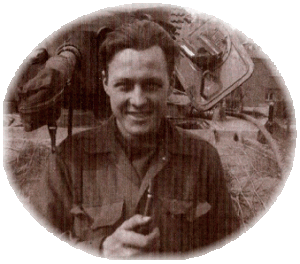
At 92, Towers volunteers at the museum every week. He shares the stories behind each piece of history, including his own. Towers, a lieutenant at the time, was assigned to the 30th Infantry Division of the United States Army during World War II.

As the war came to a close, the 30th swept through the German countryside, liberating the towns and people held captive by the Nazis.

On April 13, 1945, a tank battalion from the 30th came across the freight train, stopped at the bottom of a hill outside the town of Magdeburg.

“We had never seen any of this torture they were talking about until we came up on this train. Then, of course, we became believers,” said Towers.

Twenty-five hundred Jewish prisoners from the Bergen-Belsen concentration camp were inside the boxcars.

Sick, starved and likely headed to their deaths, twice the number of prisoners were packed into cars, forced to stand on the train for the past six days.

“They were skin and bones. They’d been tortured,” Towers recalls.

During the Holocaust, more than 100,000 Jews died in the Bergen-Belsen Camp alone; a small percentage of the six million who ultimately lost their lives at the hands of the Nazis.

With Allied forces closing in, the Nazis began evacuating Bergen- Belsen to hide evidence of the atrocities committed there. “It was hard to believe anyone would do this to another group of human beings,” Towers said.

As a liaison officer, Towers knew the roads well, and was tasked with transporting the victims. “Out of the battle zone, to safety, food, clothing and shelter,” he said.

The liberators loaded the survivors into trucks and delivered them safely to American military grounds. For Towers, this was just part of the job.

After the war, Frank was assigned to occupation duty in another part of Europe. His wife, Mary, joined him. Later, the couple moved back to the states and eventually settled in Alachua County, outside Gainesville.

Towers didn’t dwell on his war time experiences over the years, he said, though he always felt connected to the people his division helped rescue from the train.

“As one of the [survivors] remarked to me, ‘We were born again. Our life started all over again, for us,'” Towers recalled.

Almost a lifetime later, liberators like Towers are finding out just how much their actions meant.

In late September, a crowd gathered on a high school stage in a small, upstate New York town. A handful of veterans, now close to 90, stood side-by-side with the people they helped save -liberators and survivors united once again.

“It’s a very emotional meeting for all of us.”

This gathering was years in the making. When Hudson Falls High School history teacher Matt Rozell asked his students to interview veterans for a project, the story of the train near Magdeburg was uncovered.

“Each account is absolutely memorable. There’s a common thread through every single one,” Rozell said.

He posted the story on the internet, and survivors – the children and young Jewish people rescued from the train – began contacting him from all over the world, he said.

Carolle Walsh, who lives in Tampa now, was one of the first tank commanders from the 743rd to discover the train.

After a few days’ reunion, he considered the people he helped save to be dear friends.

“It’s sort of become like old friends. Initially coming to the train, how would I ever expect to see anyone who was on the train [again]? At that age and time I would have never considered the fact. So it’s like seeing old friends now,” Walsh said.

They’re grandparents now, Rozell said. “I definitely think there’s a feeling of wanting to know what happened to them.”

Sara Atzmon and her family were part of the Jews of Belgium, rounded up by the Nazis and forced to live in ghettos, then concentration camps.

“I lost 60 persons from my family. Sixty, not 16. My father, my brothers, my grandmother. It’s crazy,” said Atzmon.

She was only 11 when she arrived at Bergen-Belsen. Atzmon remembers being cold all the time. She was given only one child’s shoe; on the other foot she wore a red women’s high-heel.

“We were afraid. Children were not people you explained something to,” she recalled.

For decades, she never knew how to find the words to say thank you to her liberators, her “angels” as she calls them.

“It was an impossible dream,” Steven Barry, who is from Hungary. He was 20 when the Americans freed him from the train.

A member of the Hungarian Army Labor Battalion, he and a comrade were captured as they went underground to escape the Nazis.

His desire to understand his own history led him to Hudson Falls, and Frank Towers. “We kind of hugged, kissed and cried. Because basically, I saw him 65 years ago,” Towers said of the meeting.

Barry agreed.

“Can you imagine an army that landed on D-Day and fought its way through unbelievable conditions, getting shot at and then rescuing 2,500 flea-bitten Jews? I mean if you tell this to somebody, they’ll think you’re lying. It just doesn’t happen. But it did,” he smiled, grasping Towers’ hand in his.

Barry emigrated to the U.S. after World War II, and joined the U.S. Army; he served in the Korean War.

He lives in Boca Raton, Fla., now, and communicates regularly with Towers. The two share a bond not only with each other, but with every Jewish survivor and American liberator on that German hillside in 1945.

“We’ll always be special friends. There’s a bond there that will never be broken. No question about that. It’s something that doesn’t happen every day,” Towers said.

“It’s once in a lifetime, our meeting. It really is,” Barry agreed.

Atzmon and her surviving family members moved to then-Palestine after the war. She joined the Israeli army and got married.

At age 55, she began painting her experiences as a little girl in a Nazi concentration camp.

Today, her work – paintings on giant canvases – hang in galleries all over the world, including a permanent exhibition in Germany.

She travels often, speaking to school-aged children about the Holocaust. “I am very grateful. [The liberators] saved our life. They give life for my family and all people,” she said.

Over the years, Hudson Falls High School students and faculty have recorded more than 100 interviews with veterans and survivors.

The purpose of the project is to preserve the stories and pass them on to future generations, so the Holocaust and the people affected by it are never forgotten.

When Towers returned to Northeast Florida from New York, he received a message from Tampa resident Alex Kopfur. He had seen a television clip of the Hudson Falls reunion and contacted Towers to see if they could meet.

A week later, Kopfur arrived at the Camp Blanding museum with questions. “How many cars were on the train?” he asked Towers, handing him pictures of his mother and father.

“I really don’t know,” Towers replied, showing Alex a registry of camp prisoners.

Kopfur doesn’t remember much about the train; he was only a small Polish child when he and his parents were rescued.

He is thankful to have had the opportunity to meet just one of his liberators.

“I’ve had many arguments with people about why the United States should be overseas. I always say I remember being rescued by American troops overseas, so I can not argue against that,” Kopfur said.

He is one of several who have contacted Towers in the past few months.

“Anything that brings people together like this enriches my life. I feel good about it. To meet Alex, Sara, Fred, and the others… Carolle Walsh, Mr. Barry,” Towers recalled.

On the 65th anniversary of the end of the Holocaust, the liberators and survivors continue to make connections.

“The words are too small to say them. What can I tell them? That they give us life? The future? This is the future,” Atzmon said.

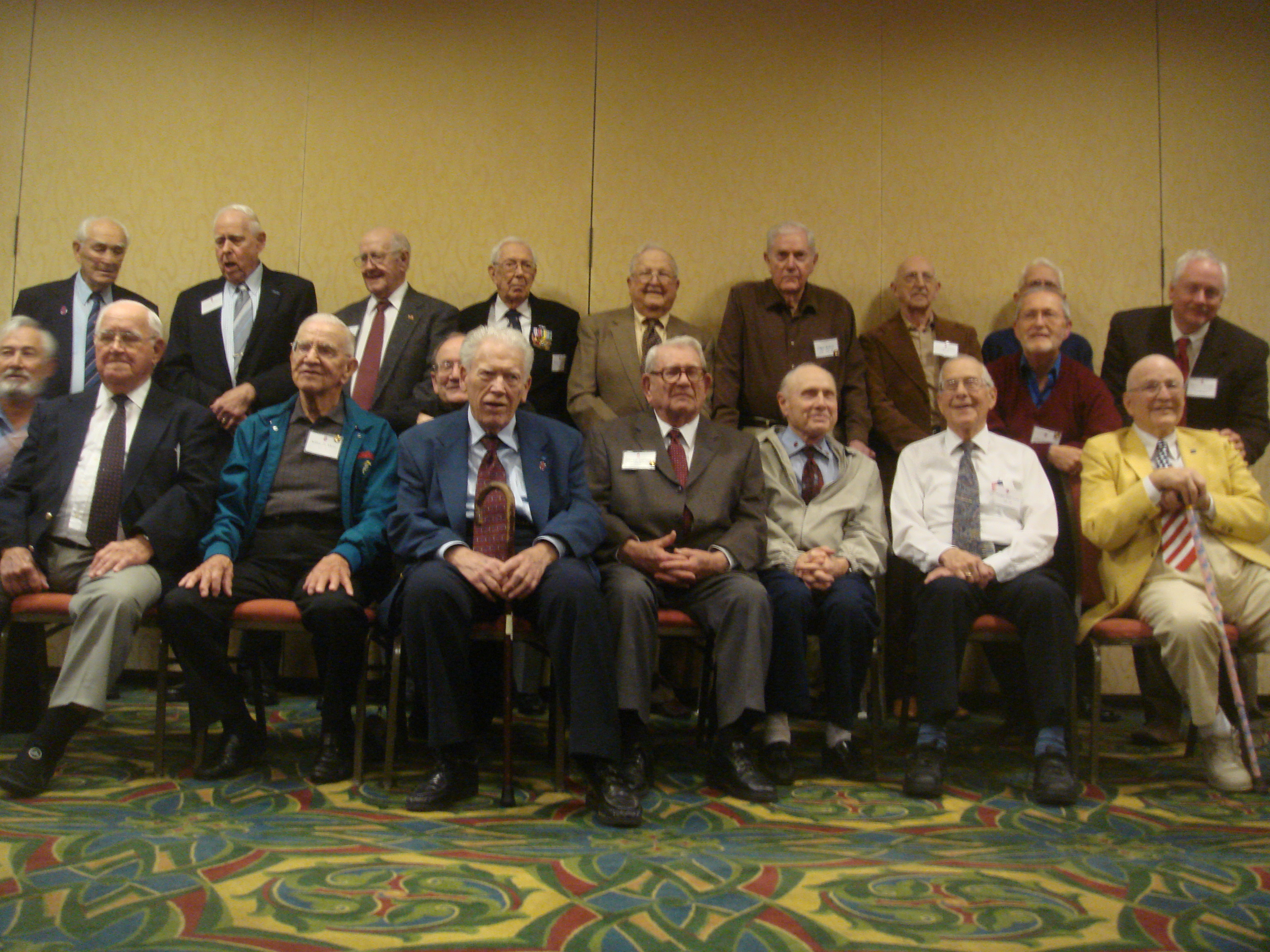
In March, several traveled to Nashville for another reunion hosted by the 30th Infantry Division.

Earlier this month, Matt Rozell joined a group of survivors in Washington, D.C., for the National Holocaust Days of Remembrance Ceremony.

While his friends were at the Capitol, Frank Towers returned to Normandy, France, once again to speak to a group of citizens about the rescue of the train prisoners.

If you’d like, leave your own memories from World War WII in the comments section below.

MORE:

To learn more about the Hudson Falls World War II Living History Project, CLICK HERE.

First Coast News
Read Full Post »

It is April 13th, the 66th anniversary of the liberation. And in no small coincidence, I have been granted approval to travel to Israel with liberator Frank Towers to meet over 50 survivors of the train near Magdeburg liberated on this day in 1945.
Read below the moving narrative of Dr. George C. Gross, his remembrance of the liberation day, written 10 years ago, before he was aware of any of the survivors. He got to know quite a few before he passed on Feb. 1, 2009. Greetings to all the survivors on the day of your rebirth, and to the soldiers who, in “just doing our jobs”, saved the world.

A Train Near Magdeburg

Foreword:

Excerpt from Wayne Robinson, Move out Verify: the Combat Story of the 743rd Tank Battalion (Germany, no publisher, 1945), 162-63:

There was another sidelight to the death of fascism in Europe.  Only a few of the battalion saw it.  Those who did will never forget it.

A few miles northwest of Magdeburg there was a railroad siding in wooded ravine not far from the Elbe River. Major Clarence Benjamin in a jeep was leading a small task force of two light tanks from Dog Company on a routine job of patrolling. The unit came upon some 200 shabby looking civilians by the side of the road.  There was something immediately apparent about each one of these people, men and women, which arrested the attention. Each one of them was skeleton thin with starvation, a sickness in their faces and the way in which they stood-and there was something else.  At the sight of Americans they began laughing in joy-if it could be called laughing.  It was an outpouring of pure, near-hysterical relief.

The tankers soon found out why.  The reason was found at the railroad siding.

There they came upon a long string of grimy, ancient boxcars standing silent on the tracks.  In the banks by the tracks, as if to get some pitiful comfort from the thin April sun, a multitude of people of all shades of misery spread themselves in a sorry, despairing tableaux  [sic]. As the American uniforms were sighted, a great stir went through this strange camp. Many rushed toward the Major’s jeep and the two light tanks.

Bit by bit, as the Major found some who spoke English, the story came out.

This had been-and was-a horror train.  In these freight cars had been shipped 2500 people, jam-packed in like sardines, and they were people that had two things in common, one with the other:  They were prisoners of the German State and they were Jews.

These 2500 wretched people, starved, beaten, ill, some dying, were political prisoners who had until a few days before been held at concentration camp near Hanover.  When the Allied armies smashed through beyond the Rhine and began slicing into central Germany, the tragic2500 had been loaded into old railroad cars-as many as 68 in one filthy boxcar-and brought in a torturous journey to this railroad siding by the Elbe.  They were to be taken still deeper into Germany beyond the Elbe when German trainmen got into an argument about the route and the cars had been shunted onto the siding.  Here the tide of the Ninth Army’s rush had found them.

They found it hard to believe they were in friendly hands once more: they were fearful that the Germans would return.  They had been guarded by a large force of SS troopers, most of whom had disappeared in the night. Major Benjamin, knowing there were many German Army stragglers still in the area, left one of the light tanks there with its accompanying doughboys as a protective guard.  The Major then returned to Division headquarters to report the plight of these people.

For 24 hours, the crew of the tank remained on watch as their charges streamed about the vehicle, crying and laughing their thanks of rescue, and those who could told stories of slavery, oppression, torture, imprisonment, and death.  To hear their stories, to see before them the results of inhuman treatment lifted still another corner of the cover which, on being removed, exposed the full cruel spirit of Nazism which permitted such things to be. And this was but one of the many such stories being brought to light as Allied soldiers ripped into the secrets of Adolph Hitler’s Third Reich.

The train needed some badly needed food that night.  More, the promise of plentiful food the next day was given to them.  The commanding officer of the 823rd Tank Destroyer Battalion was seeing to it that such food would be available.  He had ordered German farmers of the surrounding towns to stay up all night, if necessary, to get food to these people.  Other Americans concerned themselves with locating living quarters to get the concentration camp victims away from the evil-smelling freight cars before more of them died and were covered by a blanket or just left lying in their last sleep beside the railroad tracks.

Sgt. George Gross (relayed to Matthew Rozell, March, 2002):

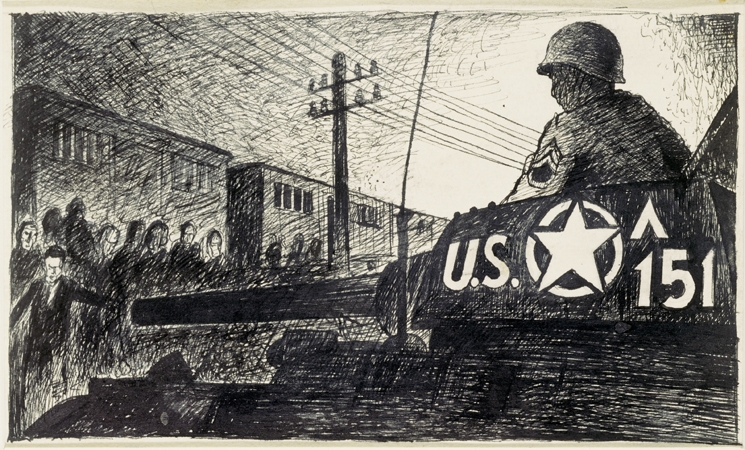
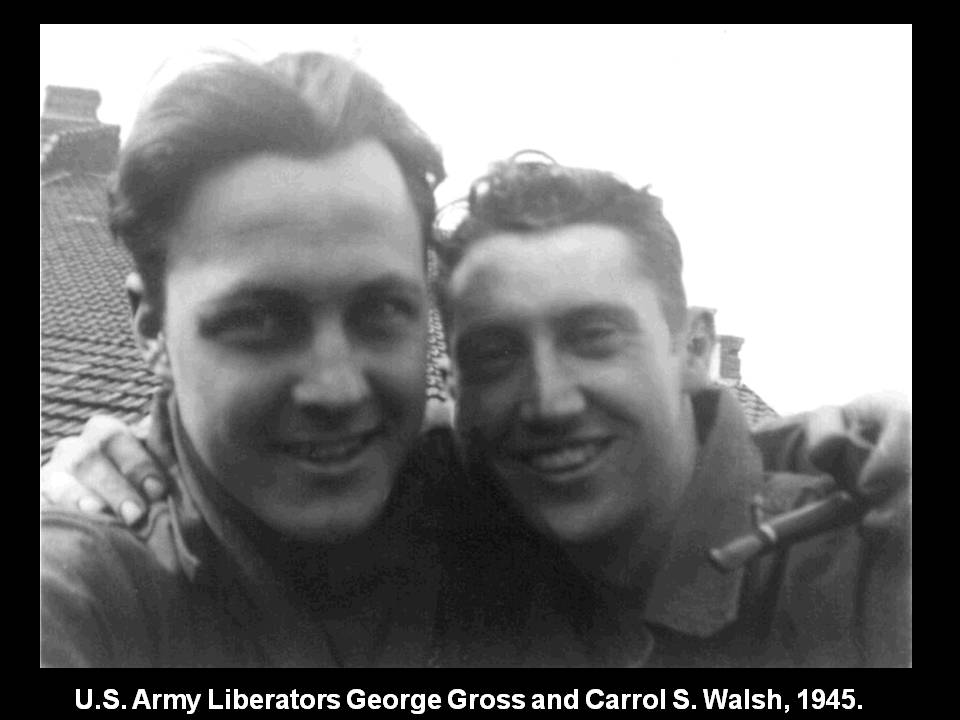
On Friday, April 13, 1945, I was commanding a light tank in a column of the 743rd Tank Battalion and the 30th Infantry Division, moving south near the Elbe River toward Magdeburg, Germany. After three weeks of non-stop advancing with the 30th from the Rhine to the Elbe as we alternated spearhead and mop-up duties with the 2nd Armored Division, we were worn out and in a somber mood because, although we knew the fighting was at last almost over, a pall had been cast upon our victories by the news of the death of President Franklin D. Roosevelt.  I had no inkling of the further grim news that morning would bring. Suddenly, I was pulled out of the column, along with my buddy Sergeant Carrol Walsh in his light tank, to accompany Major Clarence L. Benjamin of the 743rd in a scouting foray to the east of our route.  Major Benjamin had come upon some emaciated Finnish soldiers who had escaped from a train full of starving prisoners a short distance away. The major led our two tanks, each carrying several infantrymen from the 30th Infantry Division on its deck, down a narrow road until we came to a valley with a small train station at its head and a motley assemblage of passenger compartment cars and boxcars pulled onto a siding.  There was a mass of people sitting or lying listlessly about, unaware as yet of our presence. There must have been guards, but they evidently ran away before or as we arrived, for I remember no firefight.  Our taking of the train, therefore, was no great heroic action but a small police operation.  The heroism that day was all with the prisoners on the train.

Major Benjamin took a powerful picture just as a few of the people became aware that they had been rescued.  It shows people in the background still lying about

Farsleben train, moment of liberation, 4-13-1945

trying to soak up a bit of energy from the sun, while in the foreground a woman has her arms flung wide and a great look of surprise and joy on her face as she rush

es toward us.  In a moment, that woman found a pack left by a fleeing German soldier, rummaged through it, and held up triumphantly a tin of rations.  She was immediately attacked by a swarm of skeletal figures, each intent upon capturing that prize. My yelling did no good, so that I finally had to leap from my tank and wade through weak and emaciated bodies to pull the attackers off the woman, who ran quickly away with her prize.  I felt like a bully, pushing around such weak and starving fellow humans, but it was necessary to save the woman from great harm.  The incident drove home to me the terrible plight of the newly freed inhabitants of the train.

I pulled my tank up beside the small station house at the head of the train and kept it there as a sign that the train was under American protection now.  Carroll Walsh’s tank was soon sent back to the battalion, and I do not remember how long the infantrymen stayed with us, though it was a comfort to have them for a while. My recollection is that my tank was alone for the afternoon and night of the 13th.  A number of things happened fairly quickly.  We were told that the commander of the 823rd Tank Destroyer battalion had ordered all the burgermeisters of nearby towns to prepare food and get it to the train promptly, and were assured that Military Government would take care of the refugees the following day. So we were left to hunker down and protect the starving people, commiserating with if not relieving their dire condition.

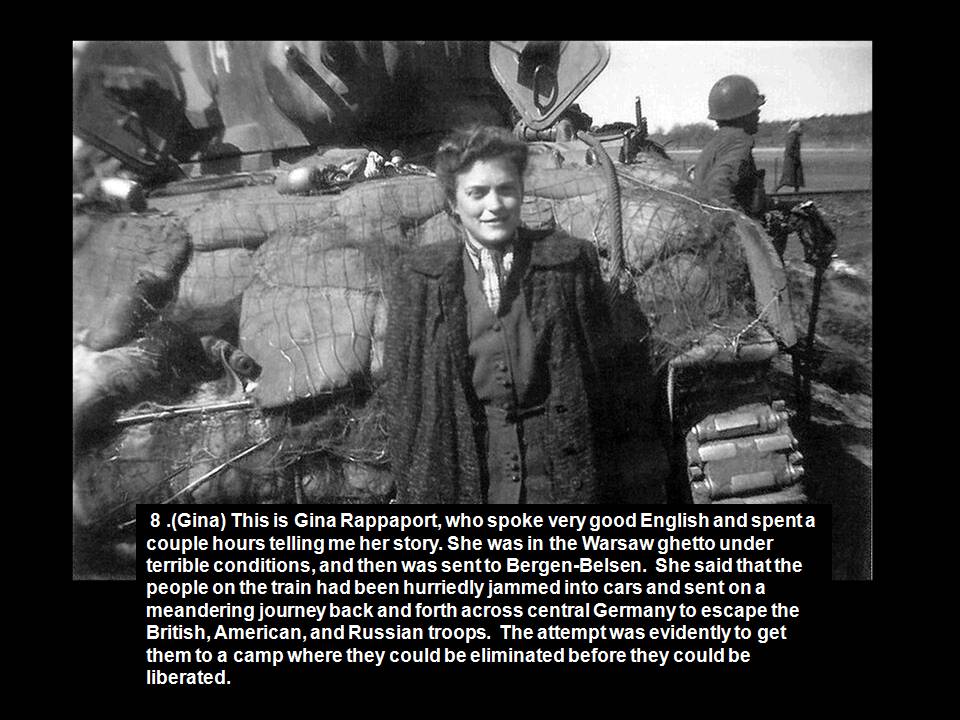
I believe that the ranking officer of the Finnish prisoners introduced himself to me and offered to set up a perimeter guard. I think I approved and asked him to organize a guard, set out pickets, and handle the maintenance and relief of the outposts. However it happened, the guard was set up swiftly and efficiently. It was moving and inspiring to see how smartly those emaciated soldiers returned to their military duties, almost joyful at the thought of taking orders and protecting others again.  They were armed only with sticks and a few weapons discarded by the fleeing German guards, but they made a formidable force, and they obviously knew their duties, so that I could relax and talk to the people. A young woman named Gina Rappaport came up and offered to be my interpreter. She spoke English very well and was evidently conversant with several other languages besides her native Polish.  We stood in front of the tank as along line of men, women, and little children formed itself spontaneously, with great dignity and no confusion, to greet us.  It is a time I cannot forget, for it was terribly moving to see the courtesy with which they treated each other, and the importance they seemed to place on reasserting their individuality in some seemingly official way.  Each would stand at a position of rigid attention, held with some difficulty, and introduce himself or herself by what grew to be a sort of formula:  the full name, followed by “a Polish Jew from Hungary”-or a similar phrase which gave both the origin and the home from which the person had been seized.  Then each would shake hands in a solemn and dignified assertion of individual worth. Battle-hardened veterans learn to contain their emotions, but it was difficult then, and I cry now to think about it. What stamina and regenerative spirit those brave people showed!

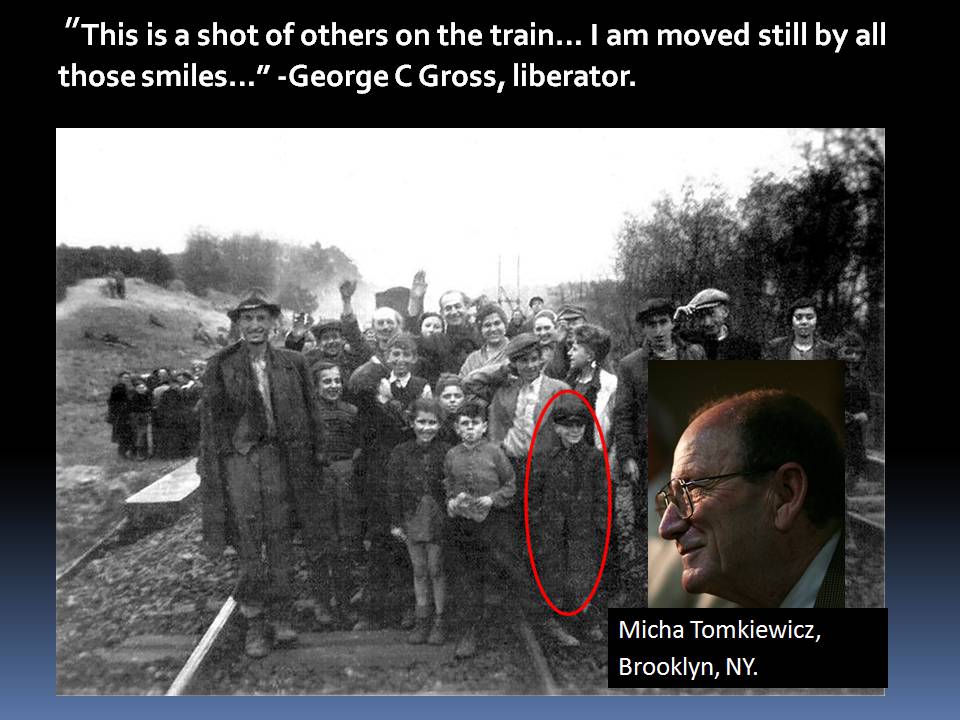
Also tremendously moving were their smiles.  I have one picture of several girls, specter-thin, hollow-cheeked, with enormous eyes that had seen much evil and terror, and yet with smiles to break one’s heart.  Little children came around with shy smiles, and mothers with proud smiles happily pushed them forward to get their pictures taken.  I walked up and down the train seeing some lying in pain or lack of energy, and some sitting and making hopeful plans for a future that suddenly seemed possible again. Others followed everywhere I went, not intruding but just wanting to be close to a representative of the forces that had freed them.  How sad it was that we had no food to give immediately, and no medical help, for during my short stay with the train sixteen or more bodies were carried up the hillside to await burial, brave hearts having lost the fight against starvation before we could help them.

The boxcars were generally in very bad condition from having been the living quarters of far too many people, and the passenger compartments showed the same signs of overcrowding and unsanitary conditions.  But the people were not dirty.  Their clothes were old and often ragged, but they were generally clean, and the people themselves had obviously taken great pains to look their best as they presented themselves to us.  I was told that many had taken advantage of the cold stream that flowed through the lower part of the valley to wash themselves and their clothing.  Once again I was impressed by the indomitable spirits of these courageous people.

Frank Towers, a World War II veteran who helped liberate 2,500 Jews on a train bound for a Nazi concentration camp, meets Bruria Falik of Woodstock, who was on the train, at Arbor Ridge at Brookmeade in Rhinebeck. (Photos by Karl Rabe/Poughkeepsie Journal)

I spent part of the afternoon listening to the story of Gina Rappaport, who had served so well as interpreter.  She was in the Warsaw ghetto for several years as the Nazis gradually emptied the ghetto to fill the death camps, until her turn finally came.  She was taken to Bergen-Belsen, where the horrible conditions she described matched those official accounts I later heard.  She and some 2500 others, Jews from all over Europe, Finnish prisoners of war, and others who had earned the enmity of Nazidom, were forced onto the train and taken on a back-and-forth journey across Germany, as their torturers tried to get them to a camp where they could be eliminated before Russians on one side or Americans on the other caught up with them. Since the prisoners had little food, many died on the purposeless journey, and they had felt no cause for hope when they were shunted into this little unimportant valley siding.  Gina told her story well, but I have never been able to write it.  I received a letter from her months later, when I was home in San Diego.   I answered it but did not hear from her again.  Her brief letter came from Paris, and she had great hopes for the future.  I trust her dreams were realized.

We were relieved the next morning, started up the tank, waved good-bye to our new friends, and followed a guiding jeep down the road to rejoin our battalion.  I looked back and saw a lonely Gina Rappaport standing in front of a line of people waving us good fortune.  On an impulse I cannot explain, I stopped the tank, ran back, hugged Gina, and kissed her on the forehead in a gesture I intended as one asking forgiveness for man’s terrible cruelty and wishing her and all the people a healthy and happy future. I pray they have had it.

George C. Gross

Spring Valley, California

June 3, 2001

click here for the ANNOTATED PHOTOGRAPHS

LISTEN to Carrol Walsh and George Gross share their recollections of the liberation of “A Train Near Magdeburg” (9:32)

Read Full Post »

Just back from the reunion of the 30th Infantry Division Veterans of World War II and also the Holocaust survivors whom they liberated on April 13th, 1945.


At the conclusion of my presentation, John, one of the soldiers, said to me, tears in his eyes, “Yes. This is what I fought for. We didn’t really understand why we were over there. This is what we fought for.”

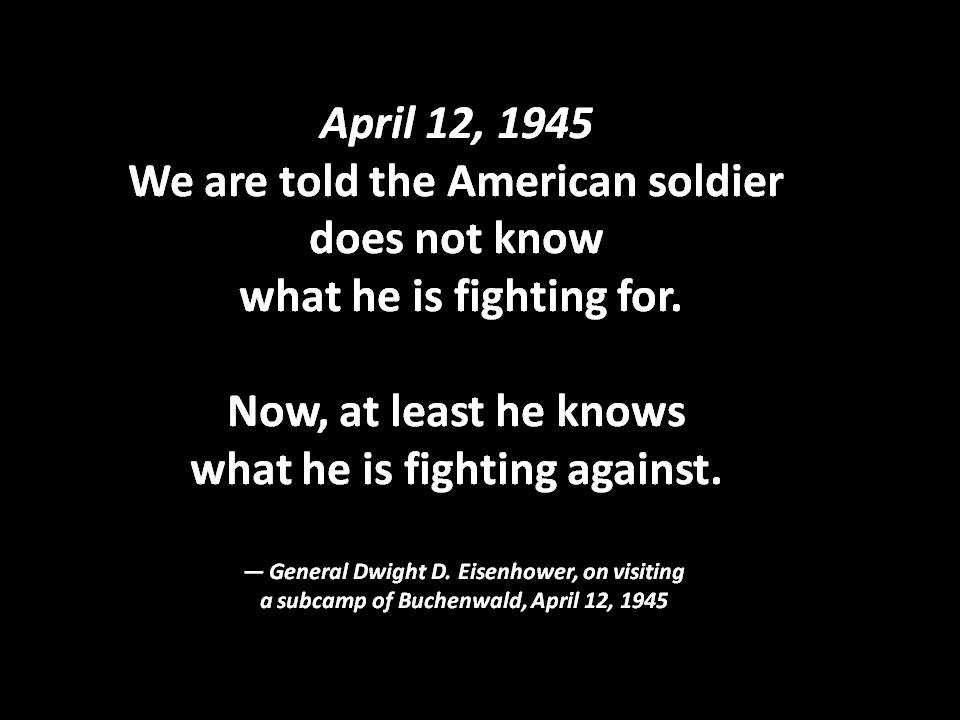
The signature phrase of the United States World War II Memorial in Washington, DC, is that “Americans Came to Liberate, not Conquer.” Yet during their travails across France, the Low Countries, and into Germany itself, many soldiers wondered aloud about the circumstances that took them so far away from home. The drudgery and boredom of Army routine and regulation, not to mention the months of being shot at or shelled, were all taking their toll. However, it slowly became clear to many what they had been fighting for all along as they encountered the evidence of years of Nazi tyranny. And when our soldiers themselves witnessed the atrocities of the greatest crime committed in the history of the mankind, the Holocaust, all questioning ceased.  Americans had indeed come to liberate.

This year, besides the dozen or so old soldiers, we were joined by five Holocaust survivors: Stephen, who at age 31/2 had lost both his parents and was liberated on the train, and Bruria, who told us of how her grandfather passed away shortly after liberation, “beaming like an angel”, content that he had died a free man. George explained the history and the horrors in Bergen Belsen, including losing his father and Micha described his mother’s efforts to recount what had happened in Poland, how his father was shot after jumping from the transport from the Warsaw Ghetto to Treblinka, and how he and his mother survived . And Paul explained that how meeting and becoming friends with his actual liberators was helping him to assuage the scars inflicted upon him, so long ago, but really only yesterday.

This is what I fought for.

Read Full Post »

We are Coming Back to NASHVILLE!!!

We are Coming Back to

NASHVILLE!!!

For the next Annual Reunion of our 30th Infantry Division Veterans, we will be migrating back to Nashville, Tennessee, at the same location that we held our Reunion this past year.  We liked the facilities so well, that we decided to ‘do it again’.!!

The Holiday Inn Airport-Opryland was a very convenient location for everyone, whether driving or coming in by air.  Interstate and local Expressways give easy access to the Hotel, and most all of the major US airlines serve Nashville without having to change enroute in most all cases. More specific directions will be in the next issue of our news, for those of you who will be driving.  Those flying in to Nashville, will have a Shuttle bus available to bring you from the airport to the hotel, at No Cost.  It is Free !

This will be a great Reunion, where many our comrades will be meeting and reminiscing, many of whom will have not met with their comrades for many years, and a few for the very first time.  We always welcome newcomers and want them to be a part of our Old Hickory Family. We extend a cordial welcome also to our many Widows and family members of our Veterans.  We also hope to welcome again, many of the Holocaust Survivors that we liberated in April, 1945, as we have in the past few years, and extend a special welcome to a few of them who have not had the privilege of meeting with their Liberators before.

As  in previous years, we will have our faithful “Old Hickory Re-enactors” with their fabulous display of Old Hickory memorabilia and weapons, which will bring back a lot of  memories.  These guys will be available to explain the meanings and use of equipment, and may put on some demonstrations for us.  They do a fabulous job of representing the original Old Hickory unit of WWII.  Additionally, they provide us with a Color Guard and a bugler at all of our functions, as required.  And last but not least, they have been most cooperative and helpful in operating our Hospitality Room, while we sit around and visit.  They also provide us with some Great Music of the 40’s in the Hospitality Room during our stay.  Real nostalgic Music,  that you can just sit and listen to forever !

We encourage each and every one of you to consider coming to this Reunion, as we never know when it may be the last one.  Our time is running out, and all good things must come to an end at some point, then there will be no more opportunities to see and visit with your old buddies. Start making your plans Now !!! Do not delay any longer.  Make your reservations, send in your Registrations, and plan to be there.  You will get a Full Refund of the Registration if you do need to cancel, if cancelled within 10 days of the beginning of the Reunion – 22 March, 2011.


30th Division Website

For those of you who have computer facilities, we wish to keep you up to date on new Website articles.  For those of you who do not have computer facilities, perhaps you have a family member or a friend, who can bring the Website up and print out such articles that may be of interest.

Our website URL is:  www.30thinfantry.org

One of our latest additions is a new category, “Holocaust”, which is a compilation of much research on the Train that we liberated in Farsleben, Germany on 13 April 1945. It shows a map and the route of this train from Bergen-Belsen to Farsleben.

VA Provides Headstones, Markers for Veterans

Particularly for the families of veterans who pass on to a better place, we wish to notify you that Veterans are eligible for an inscribed headstone or marker for their grave at Any cemetery – National, State Veterans or Private. VA will deliver a headstone or marker, at NO cost, anywhere in the world.  Additionally, eligible veterans may get a “Government headstone or marker, even if the grave is already marked with a private one.” This is a new provision.  Similarly, headstones and markers previously provided by the government, may be replaced at the Government’s expense, if badly deteriorated, illegible, vandalized or stolen”.

For more information, for those of you who have computers or can get one of your children or friends to go on the Internet for you, you can go to:   www.VA.Gov and click on Burial & Memorials, then Headstones and Markers, then General Information.

As a rule, the local funeral director is familiar with this procedure, and will handle all of the details involved in obtaining the Headstone or Marker.  In the event that he will not, or cannot, contact your local “Veterans Service Officer”, usually located in your County seat, and this will be done at no cost to you.

Arrangements will also be made for a full Color Guard and a Bugler, for every veteran, no matter where buried.

Auction / Donations

As perhaps some of you are aware, at the Reunion last year in Nashville, we conducted an Auction, instead of the former “Raffle”.  This saved us a lot of expense and the time of selling tickets, and besides, we had a lot more fun with the enthusiastic and friendly bidding.  So, as it was agreed upon, we will plan to do it again this next Reunion.

So please do not forget to bring some appropriate gift, something that You would like to receive, so that we can have a good session of spirited bidding again, to help replenish our treasury, so that we can continue to maintain our Goals. All such donated gifts will be on display prior to the Auction, so that you can see beforehand, just what you are bidding on, and make up your mind to “get it” !!!

Pre-Registration

30th Infantry Division Veterans of WWII

National Annual Reunion   30 March – 3 April 2011

Holiday Inn Opryland/Airport

2200 Elm Hill Pike  37217; Nashville, TN

Name:________________________________________________

Wife or Companion_____________________________________

Address:______________________________________________

City:_____________________   State_______Zip_____________

Military Unit____________________Phone_________________

E-Mail Address:________________________________________

Registration Includes: Hospitality; Thurs Nite Reception; Friday Breakfast; Friday Lunch; Friday Dinner; Saturday Breakfast; Saturday Lunch &  Banquet.

Please note any special or dietary needs:______________________________________

__________________________________________________________________

Registration cost will be $135.00 Per Person. This includes All Taxes & Gratuities.

Make Checks Payable to:” 2011  Reunion Committee 30th IDV”

In the amount of $135.00 x _____ (No. of persons) = $____________(Check Amount)

Mail check along with this form to:
”2011 Reunion Committee 30th IDV”

c/o Frank W. Towers

2915 W. SR #235

Brooker, FL  32622-5167

352-485-1173

Register NOW; Cancel Later if Necessary

Read Full Post »

I had lunch today with this lovely lady and her companion. Helen Sperling, 90, nursing a broken hip, traveled 4 hours round trip with her delightful companion to have lunch with me and two of my children in Saratoga.  She and Marsha found our story on the Internet and were anxious to make my acquaintance! How honored and blessed I am.This gracious survivor came to meet ME!!!

Our common message- remember the dead, honor the survivors who have rebuilt their lives and their families, but most of all, teach people,  young and old,  to never take anything for granted, and honor the liberators while they are still with us. Amen.

Sweet dreams Helen, and I hope that tonight does not belong to Hitler. I’ll see you again in a few months!

By Ryan Smith, Colgate Maroon News

First published October 29, 2009  http://www.maroon-news.com/news/sperling-shares-holocaust-memories-1.856855

Since the 1970s, Holocaust survivor Dr. Helen Sperling has been speaking to the Colgate community about her experiences during World War II. As in years past, Sperling, who received an honorary doctorate from Colgate in 2000, spoke to a group so tightly packed  that many of the attendees willingly stood through the whole lecture. Sperling’s speech was sponsored by the Jewish Studies Program, the English Department and CORE 151.
Sperling spoke of her childhood, growing up on the outskirts of Warsaw, Poland as a “well-loved, spoiled, independent child.” Her town was more of a familial community, where “birthdays, holidays, everything” were about a broader togetherness.
Before the Germans came, Sperling recalled the “ignorance” that ran rampant among the Jewish members of her small town. They had heard of the Germans, but most thought along the lines of Sperling’s father, “that Germany was the most civilized society in the world,” and it, whatever it may be, could not happen to them.
Thus, when the Germans marched in with their “ugly, ugly shiny black boots,” the populace was completely unaware of the evil that was to come. Willingly, according to Sperling, “Jews registered in the labor office for ‘protection,'” though from what, they did not know.
Sperling’s family did not awaken to their reality until they began to see “neighbors hanging from balconies.” Quickly the community that had celebrated birthdays and holidays together was selling each other out to the Germans: “He is a Jew; she is a Jew.” With such a breakdown in community, it became unclear who the “real enemy” was.
Eventually, the Germans began propagating the idea that Jews were “dirty and lazy.” Soon after, Sperling’s family home was seized by the Germans simply because the commander “liked the house.” When leaving the home her father had built with his bare hands, not a tear was shed. They left behind their valuables, furniture, clothing and her father’s beautiful lilac trees that peppered the property. Not until weeks later, when her father heard his lilac trees were dug up and sent to Germany did the family begin to break.
“It was the first time I saw my father cry,” Sperling said.
Sperling recalled how she felt at that traumatic, memorable moment.
“It was the beginning of six years of utter helplessness,” Sperling said.
The family was moved into the ghetto, which was enclosed by barbed wire, and were forced to either comply with curfew or face death. Initially, death was an individual risk but soon “violating the Germans meant they would kill your whole family.” Regardless, Sperling escaped the ghetto one night to wish her best friend, a Gentile, a happy birthday as they had always done. When the other line picked up, her friend answered: “You dirty Jew, how dare you call me?”
Sperling, to this day feels “something dreadful happened to my soul.” She has avoided returning to Poland out of fear that she may see that same friend on the street over 50 years later.
At times, Sperling had the audience laughing, as she offered to cook for the many standees in attendance. After all, if she could not “give them seats, as a Jewish grandmother, I could cook you something.”
The latter half of her talk focused on her experiences at the concentration camps of Ravensbruck and Buchenwald. There, Jews, prostitutes, gypsies and homosexuals were shaved, numbered and systematically abused and starved.
Sperling recalled for the audience the last time she saw her parents before they were sent to the “showers.”
“When I tell you 6 million people were killed, that means nothing. But they are not numbers; they are mine,” Sperling said, holding up the only pictures she has of them.
Over the next several years, Sperling endured beatings and dehumanization that made her look and feel “sub-human.” At one point, she spoke of an SS soldier that had to strangle a prisoner every night in order to fall asleep. After weeks of hearing the screams, Sperling and the other prisoners “got mad at the victim for keeping them awake.”
The small victories, togetherness and luck kept her alive. She spoke of sabotaging German bombshells in the munitions factory, refusing to accept German food with which they taunted her and caring for each other when the worst of times got worse. As long as she resisted becoming “a slave” she had her mind and there was hope.
Allied Forces eventually liberated Sperling. She spent three years in a hospital during which time her liver was removed and she battled cancer. Years later, an American sponsored her immigration to New York where she married a survivor and raised a family.
To this day she has come a long way in coping with the barbaric evils she faced as a child, but sadly told the audience that although “the days are mine, the nights are still Hitler’s.”
Sperling stressed the importance of awareness and remembrance, echoing the words of Pastor Martin Niemöller:
“First they came for the communists, and I did not speak out—because I was not a communist; Then they came for the socialists, and I did not speak out—because I was not a socialist; Then they came for the trade unionists, and I did not speak out—because I was not a trade unionist; Then they came for the Jews, and I did not speak out—because I was not a Jew;
Then they came for me—and there was no one left to speak out for me.”
Sperling closed by saying that if there is one piece of advice to be had, it is that “there is no survival without love.”
“So, go to it,” Sperling said. “The world needs saving.”

Read Full Post »

2010 Presidential Medal of Freedom Recipient – Gerda Weissmann Klein

“Gerda Weissmann Klein is a Jewish Holocaust survivor. When Klein was fifteen, Nazi Germany took over Poland. In 1942, Klein was separated from both her parents, who were separately sent to Auschwitz; she was sent to the Dulag (Durchgangslager, a transit camp) and later was sent to a series of labor camps. In 1945, the inmates at Klein’s work camp were sent on a 350-mile death march to avoid the advance of Allied forces. She was one of the very few who survived the forced journey. In 1998, the Kleins started the Gerda and Kurt Klein Foundation, which promotes tolerance, respect, and empowerment of students through education and community service.”

http://www.whitehouse.gov/photos-and-video/video/2011/02/16/2010-presidential-medal-freedom-recipient-gerda-weissmann-klein

Gerda, I hope to meet you someday. Matt


Read Full Post »


I am re-posting this today on the anniversary of Dr. Gross’ death.
Yesterday my son turned 11. And at about 11 pm yesterday on the West Coast, Dr. Gross died at home with his family around him.

I just found out. More than anyone else, he is the one responsible for this website and the hundreds of lives changed because of it.

You see, he took the photo that you may not really notice in the heading above, along with 9 other photographs that forever imprint the evidence not only of man’s inhumanity to man, but of the affirmation, hope and promise of mankind. It was he who wrote the prose that led me to the survivors, and vice versa. And it was he who cultivated a deep friendship with me via his wonderful writings and telephone conversation. How amazed and happy he seemed to be to hear from all the survivors.

In the summer of 2001, I did an interview with his comrade in arms, army buddy Carrol Walsh. Judge Walsh put me in touch with Dr. Gross. If you go back through the archives you know the rest of the story. It has changed my life and the lives of my students in that we are now trying to rescue the evidence, the testimony of the Holocaust and the World War Two veterans, for the United States Holocaust Memorial Museum. And today I received in the mail a bulletin from this Museum, reaffirming the mission that Dr. Gross had everything to do with setting me on.

He came into my life during a dark time for me- we had just lost our father (who thankfully, like Dr. Gross, passed on from his own bed at home), and our mother was battling the final stages of Alzheimer’s disease, or dementia, or whatever that nightmare was called…. we began a conversation that has yielded so much fruit.

Lately, I knew he wasn’t well. I actually had looked into flights across the country before Christmas for my son and I to pay a visit, but we just couldn’t seem to swing it financially, with Christmas bills coming in and holiday fares going up. My back up plan, in my head, was to go out in February, when fares were half the cost… Well, February arrived yesterday and now it is too late, I never got to shake the hand of a man who helped reshape my own life, and the lives of so many others.george-gross-1945

His 8×10 liberation photos are mounted in the front of my classroom, with his captions for all to see. So I see George and just one of the noteworthy products of his life, everyday. The captions that he wrote for each are mounted below each print, a testament to his humanity and to his graciousness.

I know it is selfish to feel so bad about the fact that I was not able to literally reach out and touch him. I’m just so damned disappointed.  Right now it’s another dark day for Matt, but I am comforted that he was surely welcomed by his beloved wife, parents, and maybe even my folks as well.

From his statement read at the occasion of the first reunion, September 14th, 2007. Please feel free to add your own comments or tributes. Matt

Sincere greetings to all of you gathered at this celebration of the indomitable spirit of mankind!


Greetings first to all the admirable survivors of the train near Magdeburg, and our thanks to you for proving Hitler wrong. You did not vanish from the face of the earth as he and his evil followers planned, but rather your survived, and grew, and became successful and contributing members of free countries, and you are adding your share of free offspring to those free societies.

You have vowed that the world will never forget the horrors of the Holocaust, and you spread the message by giving interviews, visiting schools, writing memoirs, and publishing powerful books on the evil that infected Nazi Germany and threatens still to infect the world. I am enriched by the friendship of such courageous people who somehow have maintained a healthy sense of humor and a desire to serve through all the evils inflicted upon you.


Greetings also to the dedicated teacher whose efforts have brought us all together through the classes he has taught on World War 2 and the web site he maintains at the cost of hours of time not easily found in his duty as a high school teacher. I know that several of you found your quest for knowledge of your past rewarded by the interviews and pictures Matt Rozell and his classes have gathered and maintained. Selfishly, I am grateful to Mr. Rozell for leading several of you to me, bringing added joy to my retiring years.


Greetings also to all the faculty, staff, students, parents, and friends of the school at which this important gathering takes place. Thank you for your interest in the survivors of the Holocaust and their message.


And special greetings also to my old Army buddy, Judge Carrol Walsh, and his great family. Carrol fought many battles beside me, saved my life and sanity, and resuscitated my sense of humor often. We had just finished a grueling three weeks of fighting across Germany, moving twenty or more hours per day, rushing on to reach the Elbe River. Carrol and I were again side by side as we came up to the train with Major Benjamin, chased the remaining German guards away, and declared the train and its captives free members of society under the protection of the United States Army as represented by two light tanks.

Unfortunately, Carrol was soon ordered back to the column on its way to Magdeburg while, luckily for me, I was assigned to stay overnight with the train, to let any stray German soldiers know that it was part of the free world and not to be bothered again.


Carrol missed much heartbreaking and heartwarming experience as I met the people of the train. I was shocked to see the half-starved bodies of young children and their mothers and old men—all sent by the Nazis on their way to extermination.

I was honored to shake the hands of the large numbers who spontaneously lined up in orderly single file to introduce themselves and greet me in a ritual that seemed to satisfy their need to declare their return to honored membership in the free society of humanity.

I was heartbroken that I could do nothing to satisfy their need for food that night, but I was assured that other units were taking care of that and the problem of housing so many free people.

Sixty years later, I was pleased to hear that the Army did well in caring for their new colleagues in the battle for freedom. I saw many mothers protecting their little ones as best they could, and pushing them out, as proud mothers will, to be photographed. I was surprised and please by the smiles I saw on so many young faces.

Some of you have found yourselves among those pictured children, and you have proved that you still have those smiles. I was terribly upset at the proof of man’s inhumanity to man, but I was profoundly uplifted by the dignity and courage shown by you indomitable survivors. I have since been further rewarded to learn what successful, giving lives you have lived since April 13, 1945.


I wish I could be with you in person at this celebration, as I am with you in spirit. I hope you enjoy meeting each other and getting to know Matt Rozell and Carrol Walsh. I look forward to seeing again my friends whom I have met and to meeting the rest of you either in person or by E-mail. My experience at the train was rich and moving, and it has remained so, locked quietly in my heart until sixty years later, when the appearance of you survivors began to brighten up a sedate retirement.

You have blessed me, friends, and I thank you deeply. May your lives, in turn, bring you the great blessings you so richly deserve.


Fondly yours,

George C. Gross

September, 2007


Read Full Post »

« Newer Posts