Feeds:
Posts
Comments

Archive for 2011

I got a comment on a post yesterday from a professed “skeptic” who does not leave a name, of course (they never do), nor does he share his name at his website, though on his “About” page he does reveal that it  “is about Holocaust history and what I see as malign political influences that have distorted our understanding of history. My interest in the subject came about after I was expelled from a History Honours course run by a University in the city of Melbourne after presenting some material criticising some of the more wild claims in the literature several years ago.  This traumatic experience lead me to investigate further and everything confirmed my initial suspicions.”

Hmm, sounds like a conspiracy to me. Sorry about the trauma, so as he wishes, here is what he left to be published on this site, with my responses.

Hello, I came here after reading Dan Porat’s The Boy, where some of the Hillersleben photos feature.

Hi. Yes, I was consulted by the author, and helped him get some of the photos of the liberation- which was at Farsleben, not Hilersleben.

Maybe I am missing something here, but the people on this train don’t look like walking skeletons to me. German civilian rations were 1600 calories pro Tag 1944/1945, so the fact that the photos you present show individuals that look slim but hardly starved seems to undermine your central thesis – namely History Matters. Clearly, you don’t think so or you would use your material more carefully.
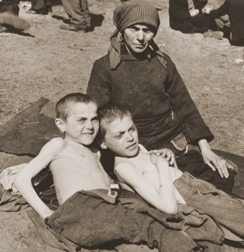
"A woman and two children rest next to a stopped train" 4-14-2011 by Harry E. Boll. USHMM Archives.

Clearly, it was not I, but a soldier who referred to the victims he cared for as “walking skeletons”.  Also, these ” slim”  individuals were so weak that many could hardly stand- again, more eyewitness liberator testimony. Maybe the soldiers are lying, something that has been suggested by skeptics before. Several “slim people” are lying dead on the hillside in the background- and the skeptic has missed the point that the ones physically able to pose for a photograph have done so. Many more could not even get out of the cars without assistance-many were dead inside the cars, literally falling out on top of horrified soldiers as they slide open the doors-something the skeptic would have learned had he/she been more thorough in his research of my work. Perhaps he would suggest that the boys in the photo to the left, taken by US forces the day after liberation, are the picture of health. And thanks for bringing in the plight of the unfortunate German civilians. Perhaps we should compare suffering here as well.

Secondly, don’t you think you are being rather disrepectful of the sacrifice shown by the American GI by continually reducing their experience down to the liberation of some detainees on a train. It verges on insulting to continually insist that people who repeatedly saw their buddies being blown away would privilege the experience of 2500 Jewish people on a train who don’t look starved at all

I think a little ironic that the post above  the one that the skeptic commented on mentions the sacrifice and not the train liberation at all(“Hell came in like a freight train. I heard an explosion and went back to where my friend was.” 67 yrs. ago this week.), a common thread throughout my work, which he must have run across if he used the link in Porat’s book to get to this site. And it is also stated at the bottom of my “About” page, which the skeptic should take the time to read before invoking one’s “skepticism”, that “if you are a Holocaust denier/minimizer/revisionist, and/or run-of-the-mill hate spewer, thank you in advance for sparing  me your epistles… I’ve already heard it all.”  It really can get tiring, but thanks for writing to remind me that I have a better job to do. Sadly, I’ll also be adding the word “skeptic” to my list.

And while I usually refrain from posting photos such as will follow, unfortunately it feels necessary now. The train survivors left this camp 12 days before this photo was taken by British troops.

THE LIBERATION OF BERGEN-BELSEN CONCENTRATION CAMP, APRIL 1945 part of "WAR OFFICE SECOND WORLD WAR OFFICIAL COLLECTION" (photographs) Made by: No 5 Army Film & Photographic Unit A British Army bulldozer pushes bodies into a mass grave at Belsen. The driver of the bulldozer wears a protective handkerchief over his mouth and nose.

Read Full Post »

 World keeps turning. Another soldier enters it. Good to know that there are more than 2 of them alive who had something to do with the liberation of the train. I got a phone call last week from a gentleman in Pennsylvania. We have found another soldier, or more correctly he has found us! Mr. Gantz talked about the trauma experienced by the soldiers in treating the survivors on the train.

Soldiers Walsh and Gross discover the train and save them, Towers transports them to safety and out of harm’s way, Gantz stays with them and nurses them back to health, or buries them at the cemetery in Hilersleben…

Later, I found this newspaper article below.

Innocence of youth helped Walter ‘Babe’ Gantz treat wounded soldiers, concentration camp survivors

By Josh McAuliffe, Scranton Times Tribune

Walter “Babe” Gantz has a ready explanation for how he coped with the horrors of war.

“I was young and carefree, as they say. And foolish, perhaps,” he said with a chuckle.

He was also very brave.

The South Scranton man spent World War II serving as a combat medic with the 9th Army’s 95th Medical Battalion. A surgical team technician, he treated infantrymen suffering from a litany of unspeakable battle injuries, earning the Combat Medics Badge, Bronze Star and Army Commendation Medal in the process.

Most notably, he tended to the emotionally scarred men who fought in the fiercely contested Battle of Hurtgen Forest, and, at the very end of the war, a train full of survivors from the infamous Bergen-Belsen Nazi concentration camp.

He was barely 20 years old at the time.

“I was a tough cookie,” said Mr. Gantz, who just turned 86. “It was tough, but in simple terms, I weathered the storm.”

Enlisted in 1943

Mr. Gantz joined the service in March 1943, less than a year after graduating from Scranton Central High School.

He was sent first to Camp Grant, Ill. Testing there showed that he had an exceptional IQ, so the Army gave him the opportunity to leave his training to take courses at the University of Illinois. The opportunity thrilled him, but after a while he got the sense that he had bigger priorities.

“I thought, ‘There’s a war going on, and I’m going to college? This doesn’t make any sense,'” Mr. Gantz said.

Despite coming from a hunting family and being “weaned on guns,” Mr. Gantz was placed with the medical corps instead of the infantry.

Before heading overseas, he spent time in South Florida, where in February of 1944 he volunteered to take part in a top-secret military experiment in which he and other GIs tested clothing that would be used in the event of a chemical weapon attack.

During the tests, a Canadian bomber plane would fly over the swamps and spray Mr. Gantz and the other volunteers with mustard gas and other chemicals. He ended up with blisters the size of half dollars on his back, but fortunately nothing more serious than that. (Unlike the First World War, neither the Germans nor the Allies resorted to chemical weapons during World War II.)

“My dear parents never knew I was there,” Mr. Gantz said, adding the Army threatened to throw him in Leavenworth Prison if he told anyone about the program.

His involvement in the program earned him the Army Commendation Medal, and he was offered an honorable discharge following the experiments. However, he declined, instead opting to join the 95th Battalion, first in England and then onward to France.

A technician 4th grade, Mr. Gantz was part of a surgical team led by an orthopedic surgeon from Toledo, Ohio. They worked 12-hour shifts out of large tents located about seven miles from the front lines.

As such, they were never out of the combat zone, and several men from his company were killed by German artillery fire.

“I got lucky,” he said. “You’re young. You realize you’re in danger, but you just don’t delve into it.”

There was no shortage of wounded soldiers to treat. He did plenty of stitching, helped out with a number of amputations, subdued and restrained scores of mangled and bloodied young men writhing in utter agony. Often, he was called upon to do things “nurses couldn’t do today,” he said.

One time, a soldier from the 2nd Ranger Battalion came in strapped to a gurney. They thought they had him sedated, but the guy sprung up and punched Mr. Gantz in the face. He lost one of his front teeth and had to get a bridge implant. To say the least, dental work in freezing cold temperatures is far from the most pleasant thing in the world, he said.

Fatigue treatments limited

By the fall of 1944, the 95th Battalion was stationed at the Belgian-German border. During that time, Mr. Gantz and the other members of the unit treated men injured during the Battle of Hurtgen Forest, a particularly brutal series of battles between the Americans and the Nazis that didn’t end until February 1945. The number of casualties was horrendously high – over 30,000 on the U.S. side alone.

Many of the men Mr. Gantz’s unit treated were suffering from “combat fatigue,” or what’s more commonly referred to today as post-traumatic stress syndrome. There wasn’t a whole lot they could do for them, he said, other than sedate them for 48 hours and give them sodium pentothal, i.e. “truth serum,” to get them to open up about the source of their distress.

“We had to strap them down because they would get violent,” Mr. Gantz said. “They would scream. They would have to relive that situation where they lost it.”

That winter, Mr. Gantz helped treat the wounded at the Battle of the Bulge in the Ardennes region, and by the spring of ’45 his unit had made its way into Germany.

In mid-April, they were in the town of Hillersleben setting up a displaced persons hospital when the Allies came across a train that had come from the Nazi concentration camp Bergen-Belsen, where over 35,000 people, the vast majority of them Eastern European Jews, had died of typhus during the first few months of that year.

All told, there were roughly 2,400 emotionally damaged, disease-ridden and terribly malnourished people aboard the train. “Walking skeletons” was an apt description, according to Mr. Gantz.

“We weren’t knowledgeable about these (concentration camps) at the time,” said Mr. Gantz, who visited Bergen-Belsen days after it was liberated. There, he saw countless dead bodies “strewn everywhere.”

“It was hard to explain,” he said. “I cried. And then I prayed for these people. Not only were you angry about what happened, but you felt so helpless.”

Mr. Gantz’s unit spent about six weeks treating the survivors. A good 70 or 80 of them died, mostly of typhus. Among the biggest challenges was acquiring enough food supplies to feed them all. Many could only take their nourishment intravenously.

“A lot of them, if you were to give them food, they would gorge themselves and kill themselves. You had to be very careful as to what they ate,” he said. “Boy, oh boy, they would scream. Those screams would go right through your body.”

“Hillersleben was a living nightmare,” he added. “You don’t shake these horrible scenes from one’s mind.”

Diverted home

When the Germans surrendered that May, Mr. Gantz was sent to the Arles Staging Area in Marseilles, France, where he would wait to be deployed to Japan. He spent the next few months playing in a GI softball league.

In August, he was scheduled to set sail for the South Pacific on the USS Santa Maria. That was until the U.S. dropped atomic bombs on Hiroshima and Nagasaki. Instead, the Santa Maria took him back to the States, arriving in Boston on Sept. 1.

Given all he had seen, the adjustment back to the normal rhythms of civilian life was a difficult one for Mr. Gantz.

“My parents couldn’t understand why I couldn’t sleep at times,” he said, fighting back tears, the scars still stinging some 65 years later.

While a lot of the vets he knew took refuge in the bottle, Mr. Gantz found solace in a life filled with family, faith (“I’ll say I’m a spiritual individual,” he said), hard work and community service. He and wife, Jeanie, raised three daughters. For 28 years, he worked as a material collector at Lucent Technologies. He helped bring slow-pitch softball to the Scranton area, and became a committed volunteer for the local chapter of the American Red Cross.

The war never left him, though, and for years Mr. Gantz took part in reunions with other members of the 95th Medical Battalion. They talked about a lot of things, but never discussed the horrors of Hillersleben.

The reunions came to an end quite some time ago, because, Mr. Gantz explained, “there’s only a handful of us left.” Which means it’s now up to him and the few remaining others to carry on the 95th’s legacy. Certainly, it’s one worth preserving.

Meet Walter ‘Babe’ Gantz

Age: 86

Residence: South Scranton

Family: Wife, Jeanie; three daughters, Debbie, Linda and Doreen; one grandson. He is the son of the late Frank and Rose Gantz.

Education: Graduate of Scranton Central High School

Professional: Prior to retirement, he worked as a material collector at Lucent Technologies for 28 years

Military service: A technician 4th grade with the Army’s 95th Medical Battalion serving in the European Theater during World War II, Mr. Gantz was part of a surgical team that treated wounded infantrymen, including those that fought at the Battle of Hurtgen Forest and the Battle of the Bulge. Toward the end of the war, his unit treated survivors from the Nazi concentration camp Bergen-Belsen. He is a recipient of the Combat Medics Badge, Bronze Star and Army Commendation Medal.

Read Full Post »

The Tennessee Holocaust Commission is focusing on our work this week!Common+Core+Standards+Alignment

Good luck to Frank and George and all the speakers and organizers. I know it will be a resounding success. Wish I could be there with you. Watch for the book at this site, or better yet!  please subscribe in the margin to the right. MR

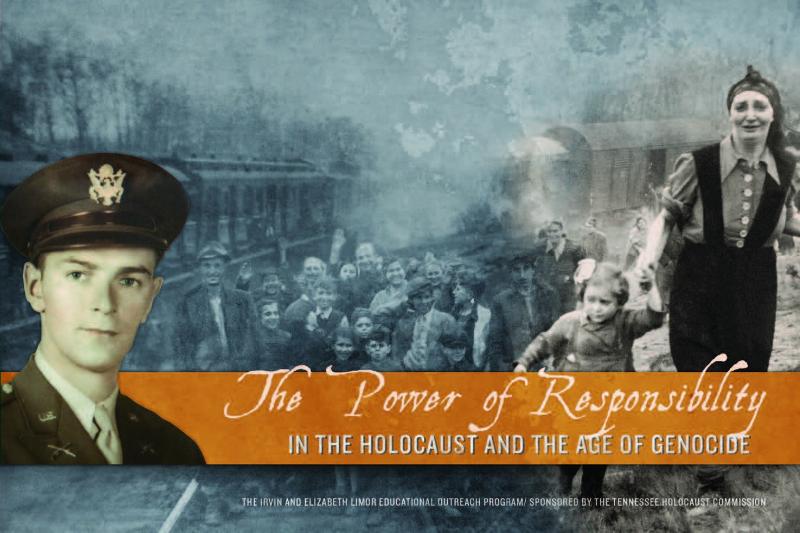
The Tennessee Holocaust Commission (THC) announces the opening of registration for the  Memphis Educational Outreach Program. The program will take place on Thursday, October 27, 2011 from 8:00 a.m. – 3:30 p.m. at Teaching and Learning Academy located at 2484 Union Avenue in Memphis, TN.
This year’s program, The Power of Responsibility in the Holocaust and the Age of Genocide, will highlight the work of the Teaching History Matters Project, the work of a United States Holocaust Memorial Museum Teaching Fellow.  This USHMM Fellow, along with his students, began studying information about a “Death Train” that was liberated at Farsleben, Germany which is near Magdeburg.   The class posted an online journal in attempt to re-connect this train transport of 2,500 Holocaust survivors with the American soldiers who liberated them on April 13th, 1945.   To date over 200 survivors and liberators from this train have been located and reunited.This one-day conference is specifically designed for middle and high school teachers to provide them with additional knowledge and resources about the Holocaust. Educators are encouraged to identify up to four mature students to accompany them to the all day workshop for hands-on activities and interaction with survivors and educators in the field of Holocaust studies.  Teachers intending to bring students are required to fill out a student registration form which can be found on the event home page.

The program is open to all middle and high school teachers, preferably with some experience in teaching the Holocaust.  There is no cost to attend the conference.  Registration is required and space is limited.

Featured Speakers:

Frank Towers
Frank Towers will speak of the experience he shared with his comrades of freeing so many from their imprisonment as well as his part in the Teaching History Matters Project.  Towers, who as a young Army first lieutenant, helped rescue the Jews from the Nazi death train at the end of World War II, recalls, “We’d heard stories about the mistreatment of Jews, about them being tortured and being put to death, but we dismissed what we thought was propaganda. We didn’t believe one group of human beings could do that to another group of human beings. It wasn’t until we saw this trainload of Jews that we believed.”

Dr. George Somjen

Dr. George Somjen, was 15 at the time of his liberation and remembers, “We were, of course, terribly happy,” he said, “but in that extremely emaciated state (I had lost 30 to 40 percent of my body weight), one has a very limited emotional scale. One doesn’t feel much except, ‘I am hungry.’ ‘I am thirsty.’ ‘I hurt.’  Dr. Somjen said of the Reunion, “Throughout my life, they (the American Army liberators) were always an abstract concept. Now suddenly they’ve got shape, voice, life.”

Christina Chavarria

Christina Chavarria, National Outreach Coordinator at the United States Holocaust Memorial Museum, will present a workshop titled, Placing Elie Wiesel’s, Night into Historical and Literary Context.  Elie Wiesel’s philosophy, “…to remain silent and indifferent is the greatest sin of all…,” is a testament to the power of responsibility and this philosophy stands as a summary of Mr. Wiesel’s, views on life and the driving force behind his work.  Night is Elie Wiesel’s personal account of the Holocaust as seen through his eyes as a 15-year-old boy. Ms. Chavarria’s workshop will help teachers to contextualize history through a series of photos as it impacts the narrative of the memoir. Specific writing prompts and themes for the book will be explored. The workshop will conclude with information regarding the US Holocaust Memorial Museum online resources on Elie Wiesel/Night.
Dr. Paul Fleming
Dr. Paul Fleming, principal of Hume-Fogg High School and co-author of The Holocaust and Other Genocides, will present a workshop for teachers on the Nuremberg Trials.  The Nuremberg Trials were the first trials in history held for crimes against humanity.  As noted by one of the lead prosecutors in the trial, Justice Robert H. Jackson, these historic trials imposed a grave power and responsibility on all parties involved. Since 1946, the Nuremberg trials have served as a basis for much of current International criminal law serving as a foundation for human rights and ethics policies around the world.

Link: http://tnholcom.org/news.php?id=38

Read Full Post »

Repairing the World 2011

From international conference at Hudson Falls High School in Sept. 2011, featuring survivor Leslie Meisels and soldier Buster Simmons. National Anthem by HFHS Choraliers under the direction of Mrs. Diane Havern. Photos by Rob Miller and others. 4 minutes. 1st of series of educational videos from conference.

Read Full Post »

HOUR OF LIBERATION

 this was read at the final banquet this year to a hushed gathering of survivors, soldiers, their families, and our students. . Thanks to all for making it very special.

Robert H Miller photo. Final banquet, 9-23-11.

I very much regret that I won’t be with you at the reunion.  Please convey this statement that I wanted to share with you about my hour of liberation which has been on my mind for 64 years.  My name is Martin Spett.  I was born in Tarnow, Poland.  My family and I survived the Tarnow Ghetto, slave labor, a political prison, and two years in Bergen Belsen Concentration Camp.

It was April 7, 1945. as the American and British armies were closing in on the area where Bergen Belsen Concentration Camp was located.  Five hundred people, including my family and myself, were forced to leave our Sonderlager compound. and forced to march 7 km. to a train.  Although I was ill with double pneumonia, I forced myself to follow and keep up with the group.  We boarded the train which already had 2,000 people aboard.  Because of the surrounding allied armies, the train circled for several days.   It stopped in a forest area near the Elbe river.  We were not able to reach our real destination because of the bombed out bridges.  We found out later that we were supposed to go to Theresienstadt Concentration Camp.

The German commandant, who was in charge of the train, not knowing what to do with us, went to a nearby village to call Berlin for instructions.  When he returned, we found out that he had orders to kill everyone aboard the train.  You have to visualize this situation.  Here we were in the middle of a forest with seventy German guards that set up heavy machine guns for our execution were waiting for orders from their commandant.  But, he apparently had a change of heart and did not wish to follow Berlin’s instructions because the American army was closing in on all sides.  During the night, we saw the German army retreating near our train and we saw the American army artillery fire that was aimed in our direction.  We huddled together in fear not knowing what our fate was.

The morning found us still on the train with only a small number of guards and a commandant who was waving to us from a bicycle as he was riding away.  It was a beautiful sunny morning in the forest.  All was calm and quiet.

Later that morning , we heard a loud metallic, rumbling sound.  A few minutes later, an American army tank came into view.  As the tank stopped, an American soldier came from behind the tank and he started walking down the hill towards the train.  He could only go a few steps when our people in their great excitement, fell before his feet, kissing him.  At that time, the German guards surrendered and we then realized that we were liberated.

The soldier stood there with tears in his eyes, telling us that President Franklin Delano Roosevelt had died the day before.  It was now April 13, 1945.

At this point, I would like to thank the brave American soldiers of the 30th Infantry who rescued us from our Nazi oppressors.  Your brave deed has been in my heart for over 64 years.  I never forgot you.

Read Full Post »

Hudson Falls High School students hear firsthand of war, peace

The Glens Falls Post-Star

OMAR RICARDO AQUIJE | Posted: Friday, September 23, 2011 5:18 pm

PHOTOS- Jason McKibben-The Post-Star

HUDSON FALLS — Through music, literature, acting and video, Helen Patton told a story of war and peace.

Helen Patton, granddaughter of Gen. George S. Patton

Since 2004, Patton, the granddaughter of Gen. George Patton Jr., the U.S. Army officer known for his World War II military tactics, has used the arts to help people resolve conflict.

On Friday, she demonstrated it to the students of Hudson Falls High School – along with sharing tidbits of her grandfather’s legacy.

She shared the tale of Palestinian and Israeli youths, who were brought to her organization she set up in honor of her grandfather, the Patton Stiftung Sustainable Trust in Germany.

The two groups – with 10 members each – spent three days with a songwriter in a castle. They had to live with each other and write three songs.

Helen Patton played a recording of one of the songs to the Hudson Falls students. She sang the lyrics, waved her arms, and soon the students were clapping, waving and cheering, before erupting in loud applause when the performance was over.

After the three days, the two groups were sent home, she said.

“It’s damn hard to kill someone if you’ve written a song with them,” she said after the event.

She showed a video clip of a German news program that did a story on her organization, and she read a passage from a war novel.

She called on the help of a World War II veteran to tell stories of her grandfather. As the stories were told, she often acted out certain scenes.

Helen Patton, who’s an actress, singer and director, was the last guest to speak during a three-day event to teach the Holocaust at the school.

The event, entitled “Repairing the World,” united World War II soldiers with the Holocaust survivors who they freed from a Nazi train in 1945.

There were speeches from the son of a World War II veteran now deceased, a living war veteran and several Holocaust survivors who were children on the train.

Robert Miller, an author of war novels, was a speaker Friday morning. Students also watched “Paper Clips,” a Holocaust documentary.

This week’s event is the third reunion since 2007. Due to the difficulty of arranging it and the age of the war veterans and Holocaust survivors, it’s also the last.

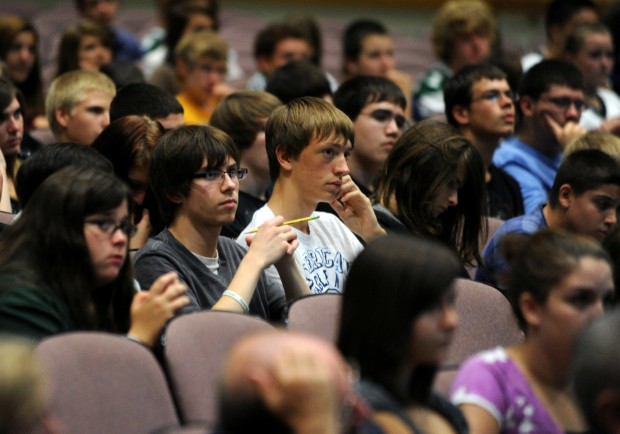
While people were reunited, the event was aimed to educate students.

Following Helen Patton’s presentation, James Bennefield, the high school principal, told students they were the last generation that will hear Holocaust stories straight from the people who lived them.

“I hope all you students realize one thing: You are all very fortunate to hear what you heard firsthand,” Bennefield said.

The event organizers and participants also wanted to teach students the significance of learning the Holocaust to ensure it’s never repeated and to refute the arguments from people who deny it ever happened.

“It was very educational,” said sophomore Tommie Hanlon. “It is something I am never going to forget.”

Fellow sophomore Alicia Russell said hearing the Holocaust stories from people was better than reading it in a textbook.

“I thought it was very interesting to hear everyone’s story,” she said.

After Friday’s afternoon event, students had their photos taken with the former soldiers and Holocaust survivors.

Ariel Guyett, a junior, got an autograph from a veteran for her grandmother, whose husband fought in World War II.

“It’s definitely something kids should learn about because you never want to forget something like this (the Holocaust) exists,” she said.

The former soldiers and Holocaust survivors were honored one last time at the end of the event. Praise was given to the event’s organizers as well.

Matt Rozell, a history teacher and event organizer, thanked the students for their part.

“Don’t forget,” he said. “You are the witnesses. You saw the liberators this week. One person can make a huge difference.”

Read Full Post »

“You gave me my second life”

A Final Meeting: Holocaust survivors, rescuers meet in Hudson Falls

by Omar Ricardo Aquije, Glens Falls Post-Star

Photos by Jason McKibben

Holocaust survivor Ariela Rojek, right, was 11 years old in 1945 when she and 2,500 other concentration camp prisoners aboard a train near Magdeburg, Germany, were liberated by American forces including 1st Lt. Frank Towers, left with his son Frank Towers Jr., center. "You gave me my second life," Rojek told Towers Wednesday, Sept. 21, 2011, at Hudson Falls High School during an event reuniting soldiers and survivors.
Jason McKibben Glens Falls Post Star

HUDSON FALLS — In preparing to become soldiers, they were taught many things, most of all how to fight the enemy. But on April 13, 1945, members of the U.S. Army’s 30th Infantry Division were caught unprepared.

As they cut across Germany, through cold weather and 18-hour days of fighting, they found a train. Inside were 2,500 Jews who were packed together for six days — sick, dirty, with little food, and infested with lice, fleas and ticks.

The soldiers, riding Sherman tanks, knew how to fight, but were not prepared to treat so many people or for the shock of the train conditions.

“What we were to witness in those days was something we were not prepared for,” said Frank Towers, a first lieutenant in 1945, as World War II was nearing its end.

On Wednesday, Towers, 94, discussed his role with the soldiers who found the train, during the first of a three-day program to teach the Holocaust and reunite the former soldiers with the people they liberated 66 years ago.

The event was at Hudson Falls High School and was the third of its kind there since 2007.

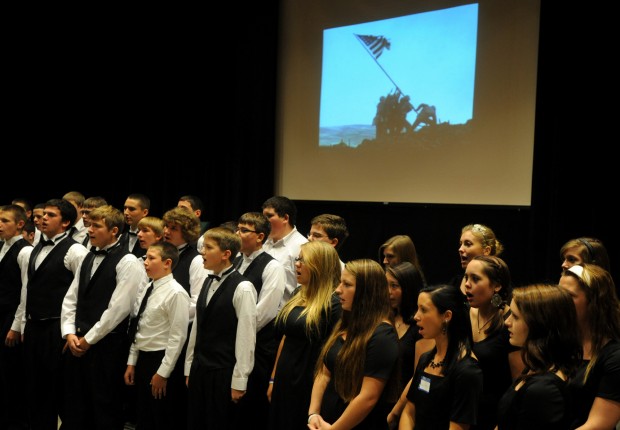
Hudson Falls High School students sing the national anthem in the school's auditorium as a photograph of American forces raising the flag at Iwo Jima is projected on a screen behind them during an event on Wednesday, Sept. 21, 2011, reuniting Holocaust survivors and the soldiers who liberated them
Jason McKibben Glens Falls Post Star

Towers, who traveled from Florida, was one of two former soldiers at the event. Along with them were four men and women who were children on the train.

The Nazis abandoned the train, which was traveling to a concentration camp.

While the U.S. soldiers did not have the resources to treat the passengers, they kept them safe until they could be transported to a military base with a hospital, Towers said.

Towers spoke at a morning event to kick off the program. Through speeches, photos and an audio recording from the 2007 event, the story of the 30th Infantry’s discovery was told. In addition, the former soldiers and Holocaust survivors were honored at the event.

Also explained was the role of the Hudson Falls school. A decade ago, Matt Rozell, a history teacher at the school, interviewed Carrol Walsh, a former soldier, to record his memories of World War II.

It was then that Walsh recalled the day his division found the train near Magdeburg, Germany.

Rozell and his students put the story of the train on a website. Then, over time, people who were passengers on the train found the website and contacted Rozell.

That spawned two reunions, the first in 2007 at the high school, where a handful of Holocaust survivors met Walsh for the first time.

Since then, Rozell has been in contact with 216 people who were on the train and three former soldiers from the 30th Infantry. Some Holocaust survivors and the former soldiers have also been able to meet on their own.

This week’s event will be the last at Hudson Falls because of the difficulty of arranging it and the age of some of the soldiers and Holocaust survivors, Rozell said.

The event uses the theme “Repairing the World” to teach about the Holocaust. There will be speeches from Holocaust survivors, author Robert Miller, and Helen Patton, granddaughter of Gen. George Patton. Helen Patton is the founder of the Patton Stiftung Sustainable Trust in Germany, which uses art and culture to create peace between groups that have sometimes been in conflict with each other.

On Thursday, the Holocaust documentary, “Paper Clips,” will be shown.

Walsh, who was present at the 2007 and 2009 reunions but was absent Wednesday because of health reasons, had a letter read at the morning event.

In the letter, he wrote that rescuing the captives from the train was part of his job as a soldier, and thus he’s owed no debt. Instead, he wrote that the Jews are owed the debt for being victims of genocide, of losing their freedom, dignity, family members and lives during World War II.

“We can best pay that debt by keeping the memories of the Holocaust alive,” Walsh wrote in his letter.

Bruria Falik, a passenger on the train who today lives in Woodstock, attended the reunion. She said she was pleased by the extent of the school to study and teach the Holocaust.

She said she felt “unexplainable gratitude” when meeting the soldiers who liberated her.

“It is overwhelming,” she said. “You can’t ignore the feeling you get to be with Mr. Towers and the other soldiers.”

Leslie Meisels, another passenger on the train, came to Hudson Falls from Toronto, where he lives and speaks at schools about the Holocaust.

“There are no words to describe that feeling,” Meisels said of meeting the soldiers and Holocaust survivors.

After the morning event, students had their photos taken with the soldiers and survivors and obtained their autographs.

Cassandra VanEvery, a high school freshman, said it was hard to believe a group of people would attempt genocide.

“It was very emotional,” Cassandra said of the event.

Freshman Jacob Dimick said the event was hard on him, too. Not only was it difficult to hear about the horrors the Jews encountered, but it also reminded him of the stories he heard from his uncle, who was a soldier during World War II.

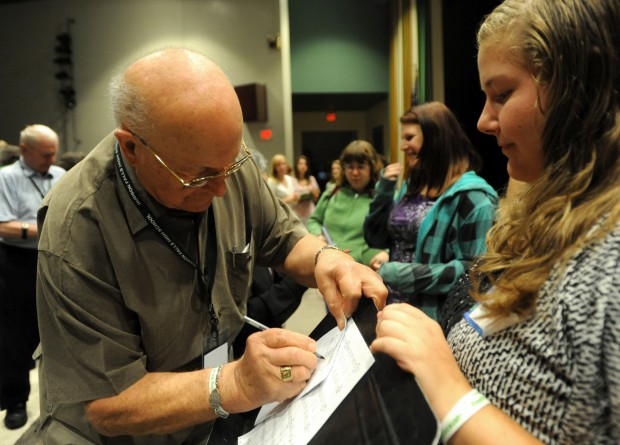
Holocaust survivor Leslie Meisels, left, signs a program for Hudson Falls senior Taylor Bump during Wednesday's "Remembering the Holocaust, Repairing the World" event. Meisels, who currently lives in Toronto, stressed the importance of relaying his experience to young people "so they remember and fight against discrimination, hatred and injustice."
Jason McKibben Glens Falls Post Star

“It’s a wonderful treat to meet them,” Jacob said of meeting the Holocaust survivors. “But people need to understand that it’s a horrible thing what happened to them.”

By recalling history and meeting others who lived it, people like Towers said it’s important for students to learn about the Holocaust so it can never be repeated.

“The message I’m trying to put forth is these students are our future,” Towers said. “I’m trying to convey to them that this (the Holocaust) should never happen again.”

Read more: http://poststar.com/news/local/a-final-meeting-holocaust-survivors-rescuers-meet-in-hudson-falls/article_4326887c-e4a7-11e0-b6ba-001cc4c03286.html?mode=story#ixzz1syWEPw00

Read Full Post »

The final conference is open to the public provided you preregister by calling 518-681-4221. THE LIVE STREAM IS HERE

mms://media.hfcsd.org/reunion

 Holocaust survivors, WWII vets holding NY reunion
September 20, 2011
Associated Press

HUDSON FALLS — Holocaust survivors freed from a Nazi death train by American troops are getting together with two of their liberators in upstate New York.

The five survivors were children or young adults when they and about 2,500 other concentration camp inmates were liberated by members of the Army’s 30th Division in April 1945, just weeks before the end of World War II.

Four years ago this month, the first reunion of train survivors and the soldiers who freed them was held at Hudson Falls High School. That’s where history teacher Matthew Rozell’s World War II project helped the veterans and Holocaust survivors reconnect.

A welcoming dinner is being held Tuesday night at a resort near Lake George. The last of Rozell’s educational reunions is being held Wednesday through Friday at the high school.

Copyright 2011 by The Associated Press. All Rights Reserved.


Wednesday, September 21,  2011

MORNING PROGRAM 9:30am-10:59am

9:30 am-  Block II at Hudson Falls High School Auditorium

THEME: THE LIBERATORS AND SURVIVORS OF A “TRAIN NEAR MAGDEBURG”

9:40am-  Program begins-

Welcome by Mr. James Bennefield,  High School Principal

Introduction by  Mr. Rene Roberge, Hudson Falls High School / Master of Ceremonies

National Anthem

A Letter from Liberator Carrol Walsh

Speaker: Dr. Tim Gross, son of George C. Gross

Speaker: Liberator Frank Towers

Introduction of members of the 30th Infantry Division ,and Holocaust survivors

10:59 am– End of Morning Program

11:00am- 11:30am-Book Fair/Signings, Media interviews

11:30-1pm-               Catered Luncheon, High School Library

12:00-1pm              Film, A Special Reunion/The Story of the Liberation of the “Train Near Magdeburg”


AFTERNOON PROGRAM (Seating Limited; Middle School Here)– 1:00pm-2:20pm

Block IV- High School Auditorium

THEME: LIBERATION

1:05pm:Film, A Special Reunion/The Story of the Liberation of the “Train Near Magdeburg”

Speaker: Liberator Frank Towers

Speaker: Survivor Bruria Falik (Hungary; Woodstock, NY)

Speaker: Survivor Fred Spiegel (Germany; Howell, NJ)

2:20 pm   Questions and Answers/Conclusion of Day’s Activities

*******************************************************************

Thursday, September 22, 2011

MORNING PROGRAM 9:30am-10:59am

9:30 am-  Block II at Hudson Falls High School Auditorium

THEME: SURVIVAL AND LIBERATION

9:40 am-                 Introduction-Program begins-

National Anthem

A Letter to the Chaplain: A Liberator’s 1945 Eyewitness Account of the Farsleben                Train-Mr. Rene Roberge, Hudson Falls High School

Speaker: Survivor Leslie Meisels (Hungary; Toronto, Canada)

Speaker:  Survivor Ariela Rojek (Poland; Toronto, Canada)

10:59 am– End of Morning Program

11:00am- 11:30am-Book Fair/Signings, Media interviews

11:30-1pm-               Catered Luncheon, High School Library

11:35-1pm              Film, Paper Clips, Auditorium

AFTERNOON PROGRAM– 1:00pm-2:20pm

Block IV- High School Auditorium

THEME: HOLOCAUST EDUCATION; REPAIRING THE WORLD

1:05 pm:-    Speaker:  Producer Joe Fab, Paper Clips -“What One Person Can Do”

Mr. Fab has received wide acclaim for his work as producer, writer and co-director of the feature documentary “Paper Clips”.“Paper Clips” has been praised by critics and received numerous film festival awards, both from juries and audiences. It was named one of the top five documentaries of 2004 by the National Board of Review and received the Jewish Image Award in recognition of its promotion of cross cultural communication.

2pm: Survivor discussion to follow with q+a with students.

*************************************************************************

Friday September 23, 2011

MORNING PROGRAM 9:30am-10:59am

9:30 am-  Block II at Hudson Falls High School Auditorium

THEME: REMEMBERING THE SOLDIERS OF WORLD WAR II

9:40 am-                  Introduction-Program begins-

National Anthem

Speaker:  Robert Miller, author, Hidden Hell and Portraits of Service          Upon returning home, too many veterans were met with indifference and did not receive continuing support, struggling to rebuild shattered lives to restore a sense of normalcy. Mr. Miller will discuss his fathers’ POW experience and his upcoming portrait book which focuses public attention on the living veterans of all wars who have experienced the horrors of war on behalf of our nation.

Hardcover version of “Hidden Hell” (formally “Finding My Father’s War”) which describes his father’s experiences as a POW in World War II. $20


Speaker:  Survivor Micha Tomkiewicz (Poland; Brooklyn, New York)

Micha Tomkiewicz was born on May 25, 1939 in Warsaw Poland- three months before the German invasion that started WWII. The family lived together in the Warsaw Ghetto. Toward the end of 1942, he was moved to the Christian side of the city. After the Ghetto uprising and the destruction of the Ghetto, most of his family was transported to the Treblinka concentration camp. His father and two uncles jumped from the train;  his father and uncle were shot and killed by the Germans, but one uncle survived and walked back to Warsaw. In June, 1943, Micha, his mother and the surviving uncle were transported to the Bergen Belsen concentration camp as part of a hostage program that was designed by the Germans. On April 13, 1945, the train transporting the hostages was intercepted near Magdeburg, Germany by a unit of the American 30th Division. Micha and his mother were transported to the Hillersleben Displaced Persons camp. After liberation, Micha was educated in Palestine, which in 1948 became the State of Israel. He is now Professor of Physics and Director of the Environmental Studies program at Brooklyn College of the City University of New York.

10:59 am– End of Morning Program

11:00am- 11:30am-Book Fair/Signings, Media interviews

11:30-1pm-               Catered Luncheon, High School Library

11:35-1pm              Film, Steal a Pencil for Me, featuring train survivors Ina and                              Jack Polak-Auditorium

AFTERNOON PROGRAM– 1:00pm-2:20pm  Block IV- High School Auditorium

THEME: THEME: HOLOCAUST EDUCATION; REPAIRING THE WORLD

1:05pm    Speaker, Helen Patton,  Patton Stiftung Sustainable Trust

In 2004 Helen began drawing from the inspiration of her surroundings to reach out in a personal way for a more empathetic and compassionate world.  She created The Patton Stiftung Sustainable Trust as a natural progression of the enduring peace which her grandfather George S. Patton Jr. helped restore to Europe in 1945. The Trust’s goal is to nurture constructive, sustainable culture in which difficulties can be worked out and dissonance celebrated.

2pm: Survivor discussion to follow with q+a with students.

****************************************************************************************

BOOKS FOR SALE: Rob Miller- Hardcover version of “Hidden Hell” (formally “Finding My Father’s War”) which describes his father’s experiences as a POW in World War II. $25

Fred Spiegel- Once the Acacias Bloomed- Memories of a Childhood Lost– “An extraordinary tale of one man’s indomitable drive to live, and to live in grace despite what happened to him.” $10

Read Full Post »

Steve is one of my good friends and Frank is the featured liberator coming to our 2011 Reunion. Steve wishes he could be here and so do I! I miss the guy!!

If you would like to see a nice clip of Steve reuniting with one of his liberators, you can click on the link. Steve became a US Army Ranger after he was liberated by the Americans.

Read Full Post »

Another honored speaker for our Sept. 2009 and 2011 reunion…

Holocaust survivor Leslie Meisels addresses his liberators for the first time.

“Please allow me to express my utmost gratitude for the gentlemen who liberated us, those brave American soldiers, who were saying that they didn’t do anything heroic, that they just did their jobs. But in doing their job, they gave us back our lives. And for that, I thank you, from the bottom of my heart…”

In part II, Leslie gives a harrowing description of how he narrowly escaped death a few days before liberation.

Read Full Post »

Older Posts »