Feeds:
Posts
Comments

Posts Tagged ‘Holocaust and Jewish Resistance Teachers Program’

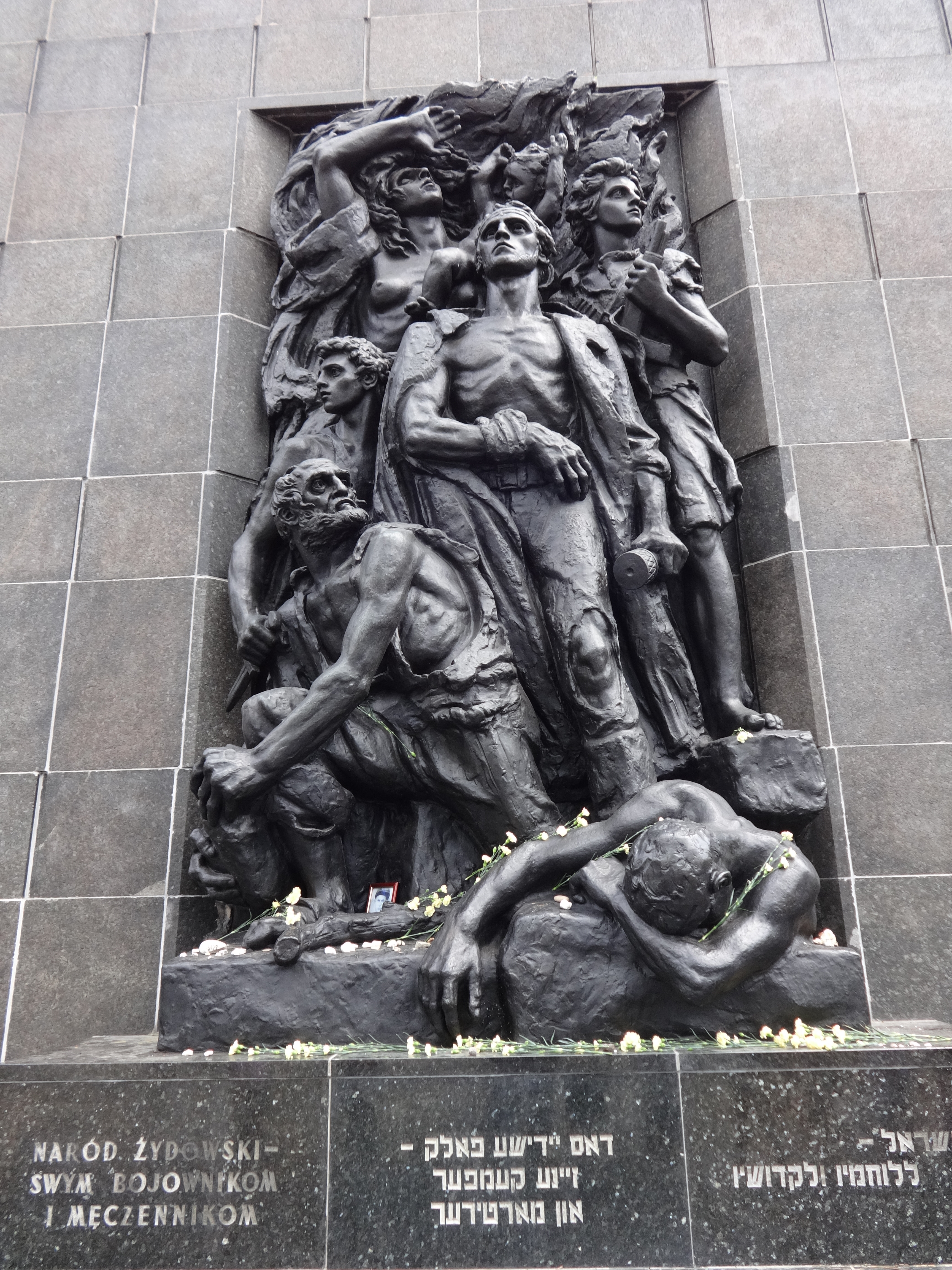
Memorial to the Warsaw Ghetto Uprising.

Today is the 75th anniversary of the Warsaw Ghetto Uprising, which marks the anniversary of the largest single uprising against German oppression of the Jews, which occurred in Warsaw in 1943. It is important to note, however that resistance to evil manifested in many different forms, not just physical ‘pushback’, as I was reminded on my Holocaust and Jewish Resistance Teachers Program tour in 2013. As the anniversary of the Warsaw Ghetto Uprising is now upon us, I share this post, an excerpt from my recent book, also recounting the narrative of a fourteen year old Jewish resistance fighter who was told she had to leave the ghetto by her leaders, so that she might live to remember them and tell this story.

*****

As 1943 dawned, the SS returned to the ghetto for another major deportation. They encountered the first armed resistance from the ghetto fighters and beat a hasty retreat, leaving behind wounded and weapons, and calling off the operation. For the next three months, the ghetto fighters organized and prepared for the final struggle. On the eve of Passover, April 19th, the Germans returned again, this time with the aim of liquidating the ghetto once and for all, in time for Hitler’s birthday on the 20th. By then, there were between 300-350 active fighters; the young were now the real leaders of the ghetto, having decided not between life and death, but rather, how to die.* Aliza recorded her observations of the preparations for the final battle they all knew was coming.
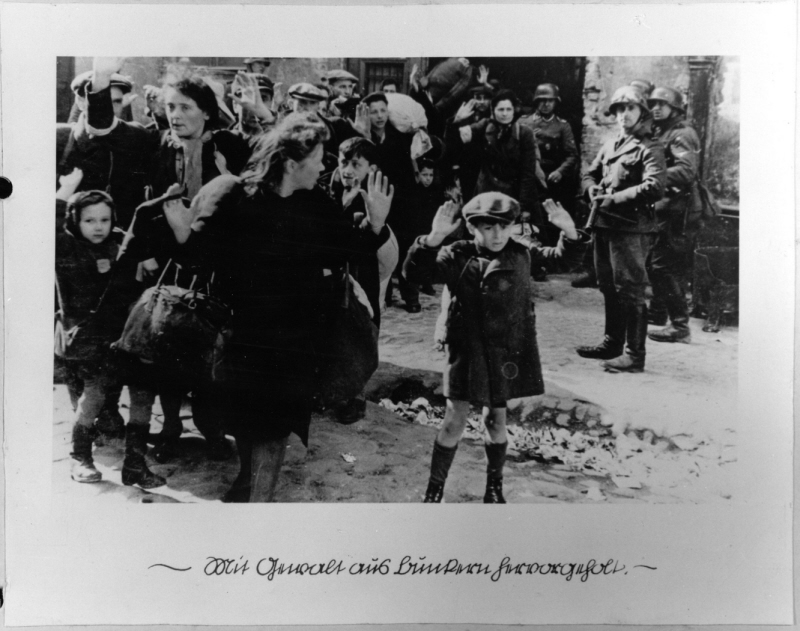
Jews captured by SS and SD troops during the suppression of the Warsaw ghetto uprising are forced to leave their shelter and march to the Umschlagplatz for deportation.  from the notorious Stroop Report. USHMM.

Aliza Melamed Vitis–Shomron

Spring, 1943

As spring approached, the atmosphere in the reduced ghetto changed. We waited for the final ‘aktion’, for the final extermination of the Jews of Warsaw’. People began to build bunkers. Experts turned up, engineers who built bunkers with electric light, in wells and toilets. Most of the bunkers were dug in cellars. There were various ways to enter the bunkers from the ground floor: by raising a cover in the kitchen stove or through an opening in the large stove attached to the wall, or in many other strange ways, according to the fertile imagination of the builders. The ghetto was preparing for a struggle.

March passed, and April came. Talk about the approaching final liquidation of the ghetto intensified. The ghetto was fully aware of it and prepared. It was the calm before the storm, suffused with energy and tension. Frequent shots near the ghetto and sudden evening searches by the SS command cars heralded what was to come. Sending off the people working for Töbens and Schultz factory workshops to Poniatow and Travniki* caused apprehension, even though they had gone of their own free will. If they are sending out the workers, what will happen to all the rest? The companies of the SS General Globocnik *, in charge of extermination, again arrived in Warsaw.

The only possibility left is to escape to the Aryan side, to dress up as a Pole and look for acquaintances or people willing to hide Jews in exchange for money. For a few thousand zloty, one could get a Polish birth certificate and a ration card. People handed over their children to Christian clerics, to monasteries and to peasants in the villages. Sacks were thrown over the walls daily and openly, at least on our side. People paid bribes to the foremen of the work crews to be able to join them going out to work on the Aryan side. Some of them did not look Jewish and were lucky enough to find ‘good’ Poles. Women dyed and oxidized their hair, and created curls by rolling their hair in pieces of paper, to look like blonde gentile girls. But they could not change the color of their eyes, or their dejected and pallid look. A Jew could also be picked out by his hesitant walk, his bent back, and his eyes constantly darting around him. We were so preoccupied by our aspiration to look like ‘goyim’ that we examined ourselves and others: Does that man look like a Jew? Will they recognize him in the street?

Of course, a new profession cropped up among the simple Polish people, with many demanding a bribe, or being paid to be an informer, a blackmailer. We were deeply disappointed; we thought that as witnesses of our tragedy, our compatriots, sharing the same language and culture, they would hold out a hand to save us. But it did not happen. A few of them hid Jews for large sums of money; these were mostly people connected to socialist activities and the left wing parties. Many devout Christians and religious scholars did so without taking money, out of true nobility of spirit. Many others, from among the simple folk, made a living by informing on Jews to the Gestapo, and collaborated willingly out of pure antisemitism. They walked around in the streets close to the ghetto, spied by the gates and the places where Jews worked on the Aryan side and looked for victims. Thousands made a living in this way.

*

The state of our family grew worse. We began to suffer from hunger. There were no clothes left to sell, we lived on the food we had received in the workshop, distributed by the Germans.

Aliza’s family decided to split up to increase chances of survival. Her more ‘Aryan-looking’ mother and younger sister, with a great deal of bribery, subterfuge, and nerves of steel, went into hiding on the Aryan side. Her father decided to take the chance and volunteer to go to the work camp near Lublin. Aliza herself wanted to stay and fight in the ghetto, but now only fourteen she was deemed too young and directed by the leadership of the resistance to make her way to the Aryan side as well, to live to tell the story. 

Aliza’s cousin stayed in the ghetto to fight the Germans. For three days, the resistance fought on, against impossible odds. It was weeks before the ghetto was overcome; there were few survivors.

Lazar

In the morning, we heard dull sounds of firing and explosions. In another house, in Swentojerska Street 34, the Z.O.B. had their positions. People from the organization told us about a mine they had detonated when the Germans decided to penetrate into our area; about battles leaving ten Germans dead; about a ‘peace delegation’ of SS officers who came with a white flag asking for an armistice to pick up their wounded, and how they fired at them at once. The fighters were elated, exhausted—but looked happy.

The battle in most of the houses in that area lasted two days. They ran from house to house. The leader of the group was the commander Marek Edelman. Dozens of fighters took part in the battle; some of them were killed. They went out at night to try to make contact with their friends. They told us that the battle inside the ghetto was still going on, that the fighters had delayed the entry of the tanks and set fire to them with homemade Molotov bottles. They were stationed at windows and changed their positions by moving across the rooftops. We in the shelters decided to open fire only when they discovered us. We made up our minds to defend our families to the end, not let them take us to Treblinka.

On the third day, fighting also broke out in the area of the workshops of Töbens and Schultz. At the last moment many people preferred to move to the Poniatow camp. In the meantime, the Germans began to set fire to the houses. On the second day of the uprising, the fighters told us about fires in the ghetto. We sat in the crowded shelter, praying that they wouldn’t get to us. We had expected the worst, but not fires. The people in the shelter said goodbye to each other. We were in despair, expecting certain death. We could already smell the smoke. Someone came from the neighboring house; people were fleeing from adjacent houses. There were no Germans around. After a night full of dread, just before dawn, we did hear German voices in the courtyard. They were calling to the Jews to come out at once, or else they’d burn us alive.

The artillery was constantly firing incendiary bombs. Whole blocks of houses were on fire. The shelter was not damaged, but the water stopped running. The electricity went out. The walls of the shelter became unbearably hot, smoke penetrated the cellar. We sat there, coughing, wrapped up in wet sheets. People wept, dragged themselves to the courtyard with the last vestige of strength. We had no choice, we would defend ourselves in the yard. The men cleared the opening and gave the order—‘wrap yourselves up in sheets soaked in the remnants of water, lie in the middle of the courtyard, in the garden.’

The yard is full of people, smoke covers everything, the top floors are in flames, the fire is running wild without any interference, parts of walls are collapsing and falling into the yard. People lying on the ground are groaning with pain…

Suddenly, we hear German voices in the street. God! We thought it was all over, that they’ve left us here. What shall we do? Several Germans burst in through the gate…

Lazar was captured and beaten, but managed to escape deportation, and made it to his cousin’s hiding place on the Aryan side.


I saw a different Lazar before me. He used to be arrogant, a show-off. The person sitting here now was thin, withdrawn; he stammered slightly when he spoke. We’ll have to live together in that small room in the cellar. Who knows how long? Until this damned war is over?

The Beginning of May, 1943

They say that the ghetto no longer exists. The wreckage of the houses is still standing; the piles of cinders still crackle, and at night shadowy figures, seeking food and shelter, still move about in there. But the ghetto no longer exists; 500,000 people have gone up in smoke. And those still alive bleed inwardly, their deep wounds will never heal. And maybe there will be no one left when freedom comes? Why are human beings so cruel and evil? They speak about the future, about truth, about Man as proof of God’s great wisdom, and it’s all lies, lies!

I know there are also good people, but they are persecuted; society rejects them as weaklings. Why am I prevented from seeing the wonders of nature and the world, from breathing fresh air?

The full narrative is available here.

******************************************

In 2013 I visited Warsaw, rebuilt; almost nothing remains of the ghetto itself- with slight exceptions.

July 17, 2013

We tour Jewish Warsaw and finally the remnants of the ghetto wall, and also the Umschlagplatz. It is here that forced gatherings for the mass deportations to Treblinka took place. I am also reminded of the scene from the film “The Pianist”.

The Umschlagplatz. As many as 10,000 Jews were deported on some days to Treblinka. Upwards of 300,000 were sent from here to their deaths.
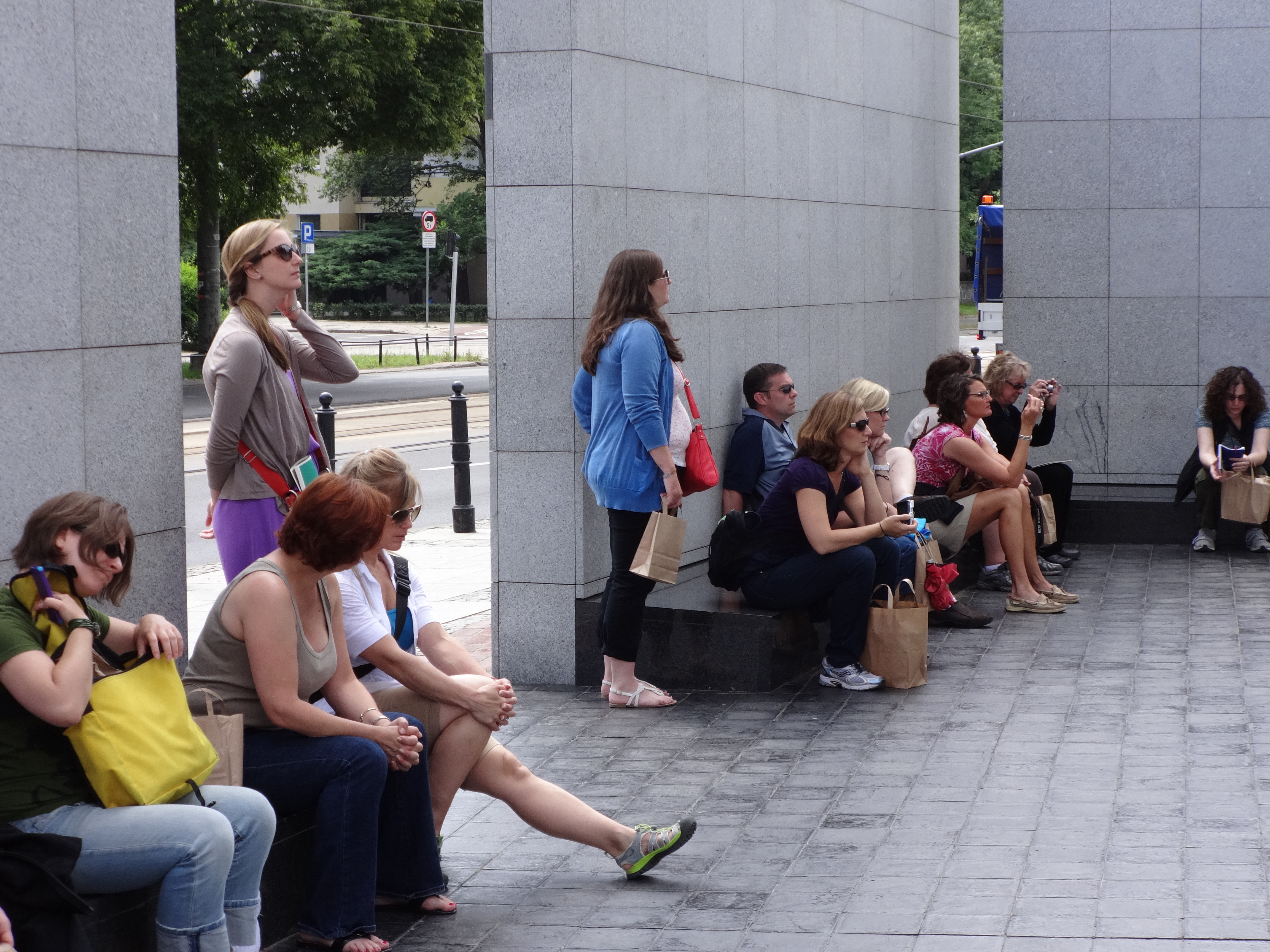
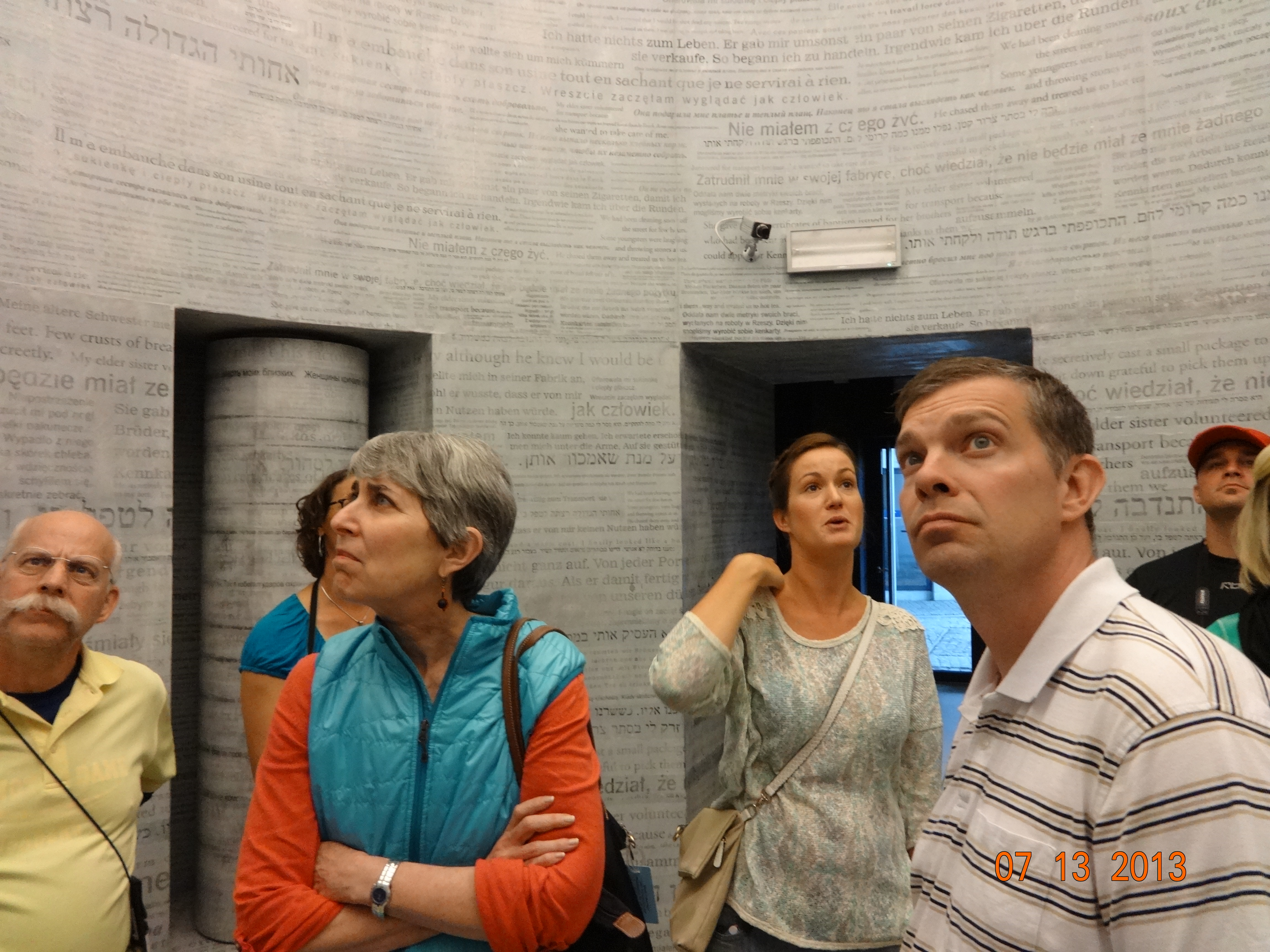
The Umschlagplatz. Our group. 2013.
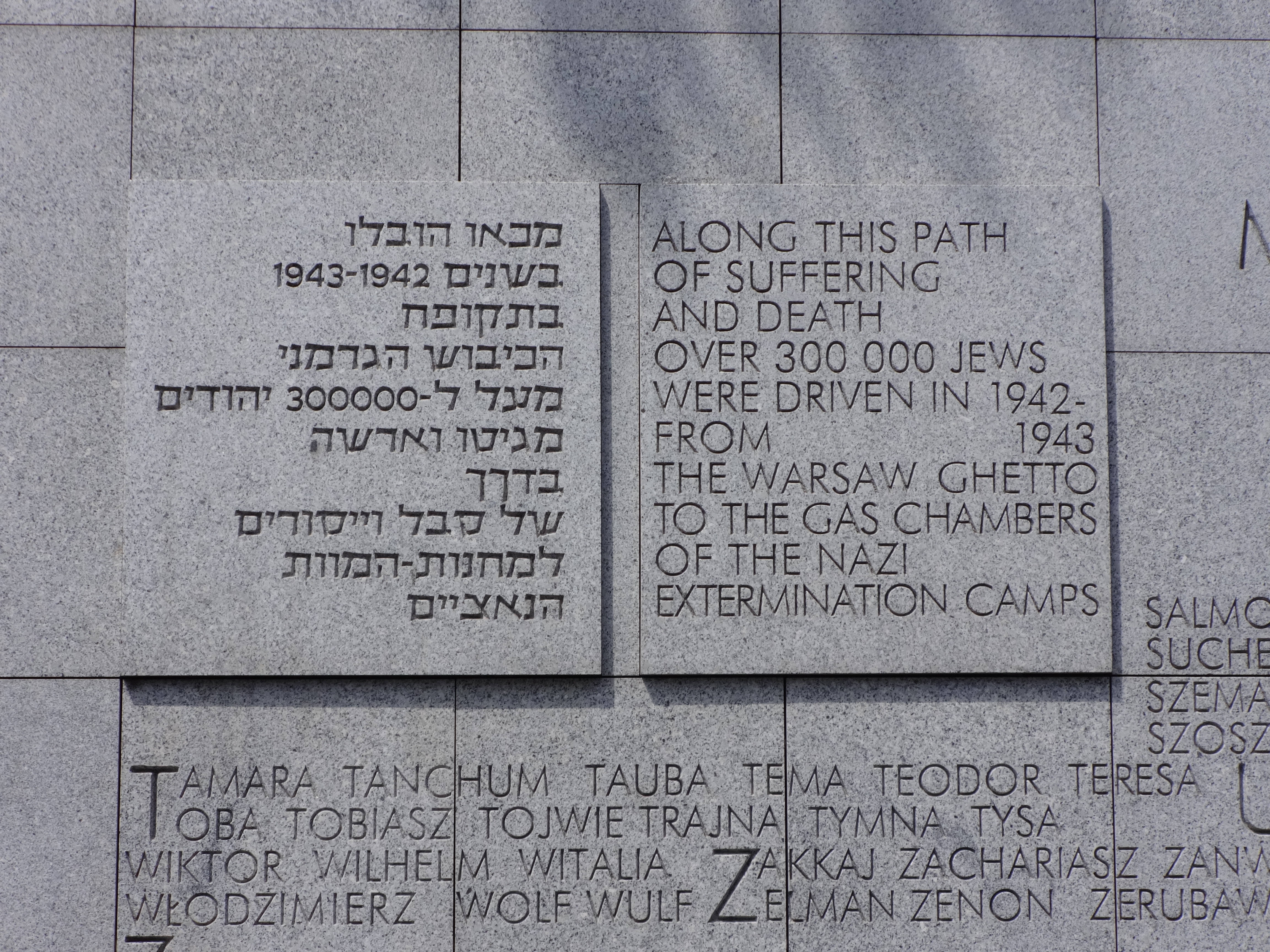
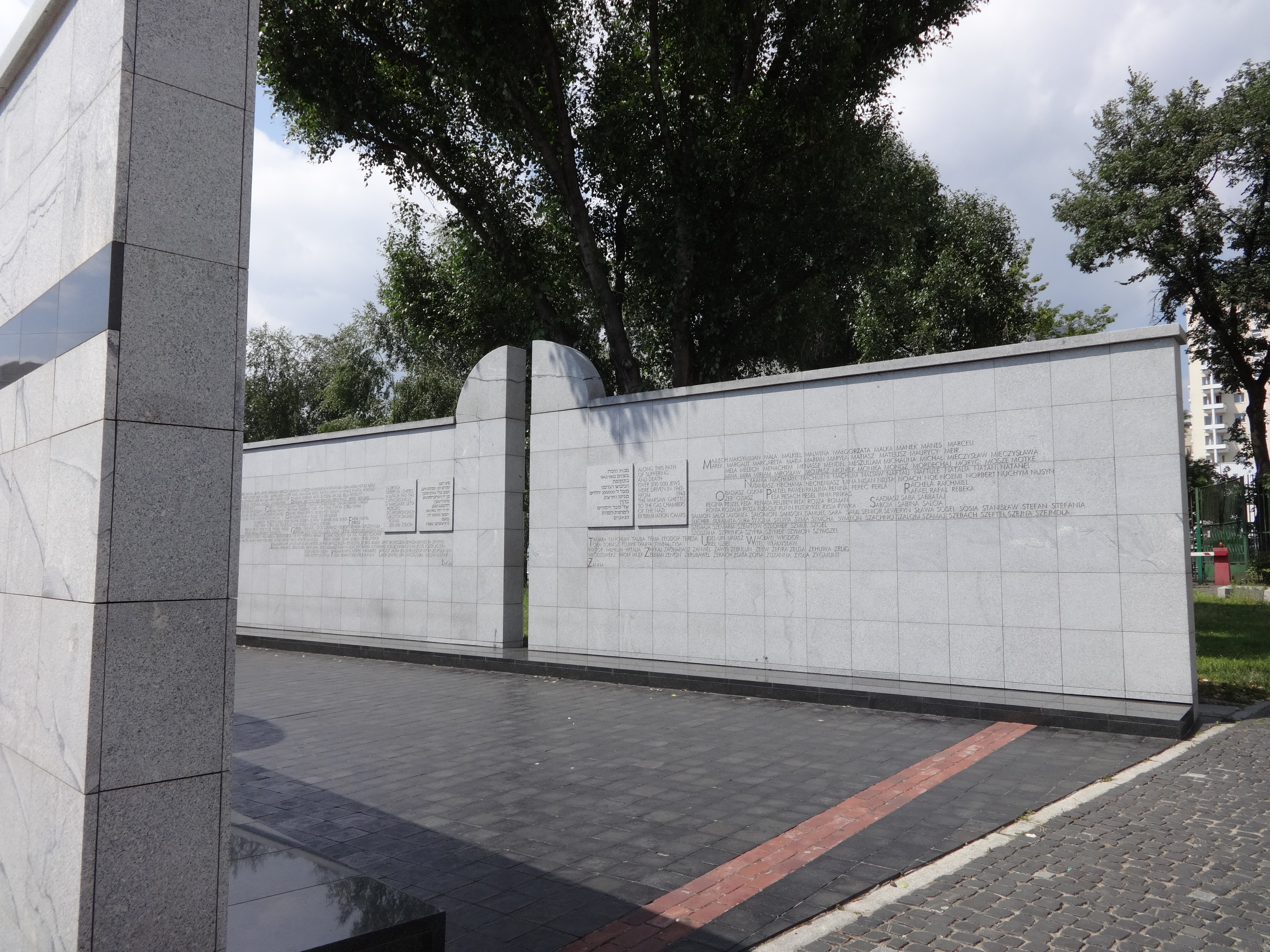
The Umschlagplatz. Our group. 2013.

1227

The Umschlagplatz. As many as 10,000 Jews were deported on some days to Treblinka. Upwards of 300,000 were sent from here to their deaths.

The Umschlagplatz. As many as 10,000 Jews were deported on some days to Treblinka. Upwards of 300,000 were sent from here to their deaths.

We walk the edge of the wall, memorialized in bronze in the sidewalk.
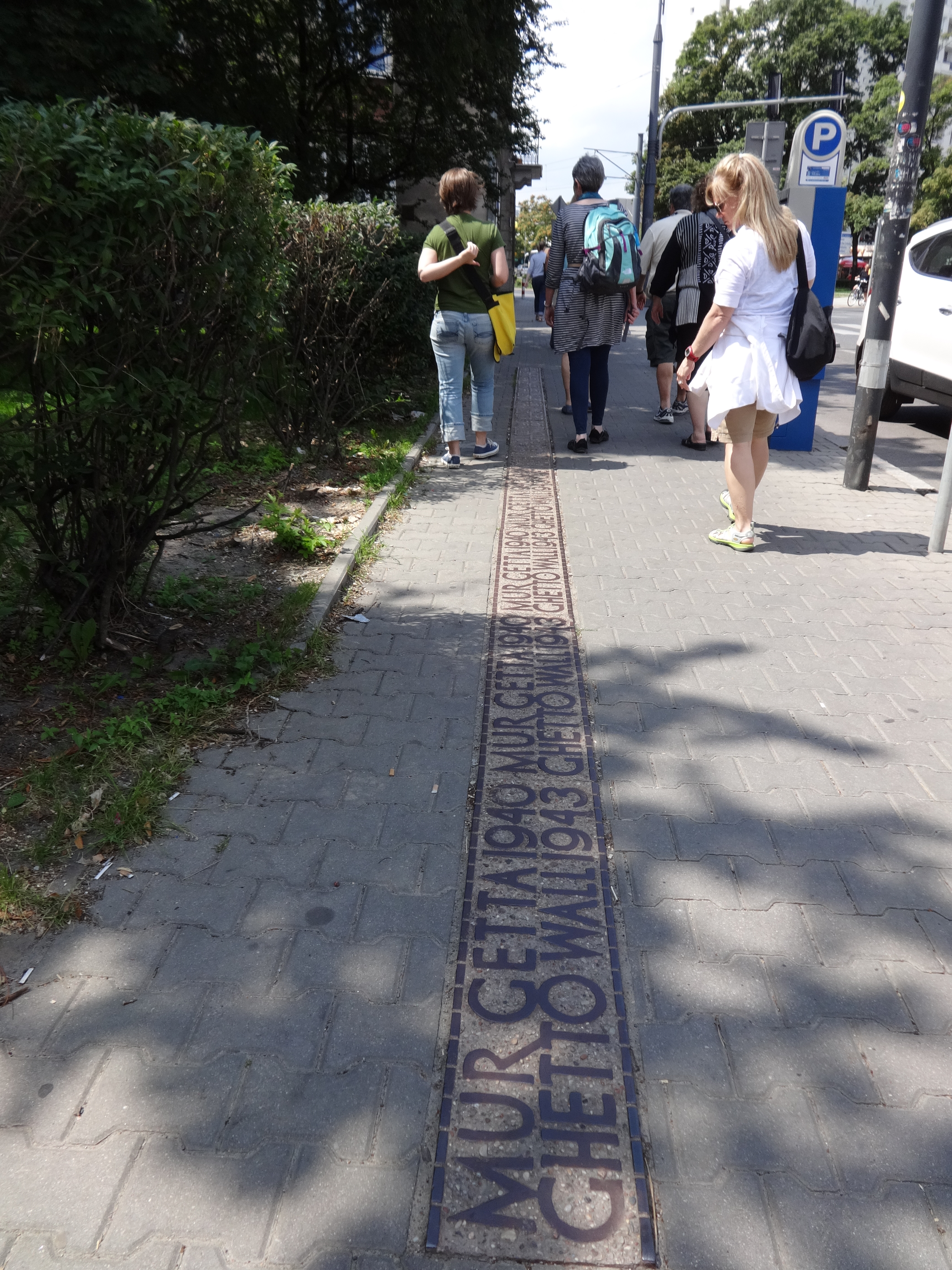
1240

And we come to a section that still stands.
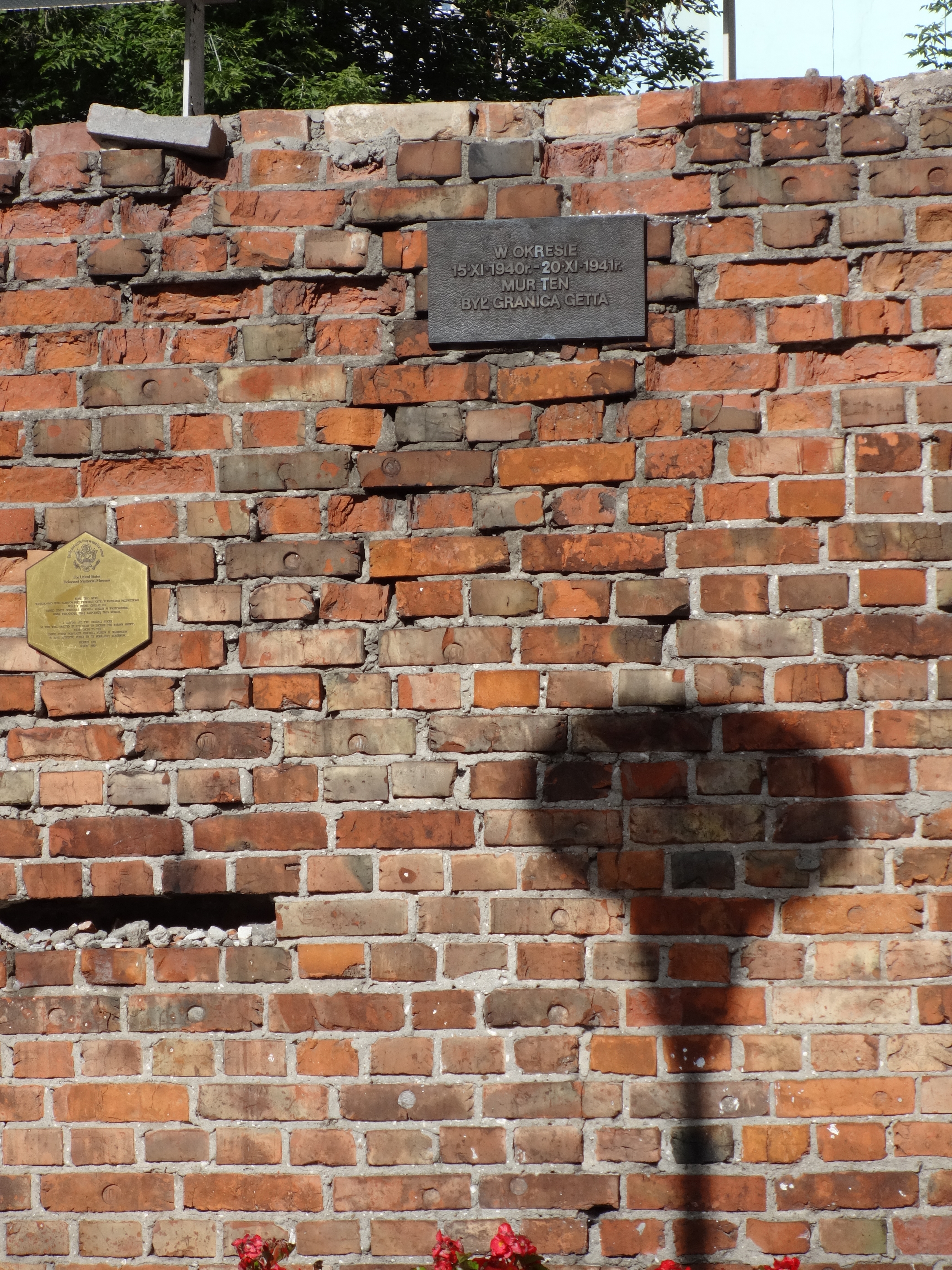
Warsaw Ghetto wall.
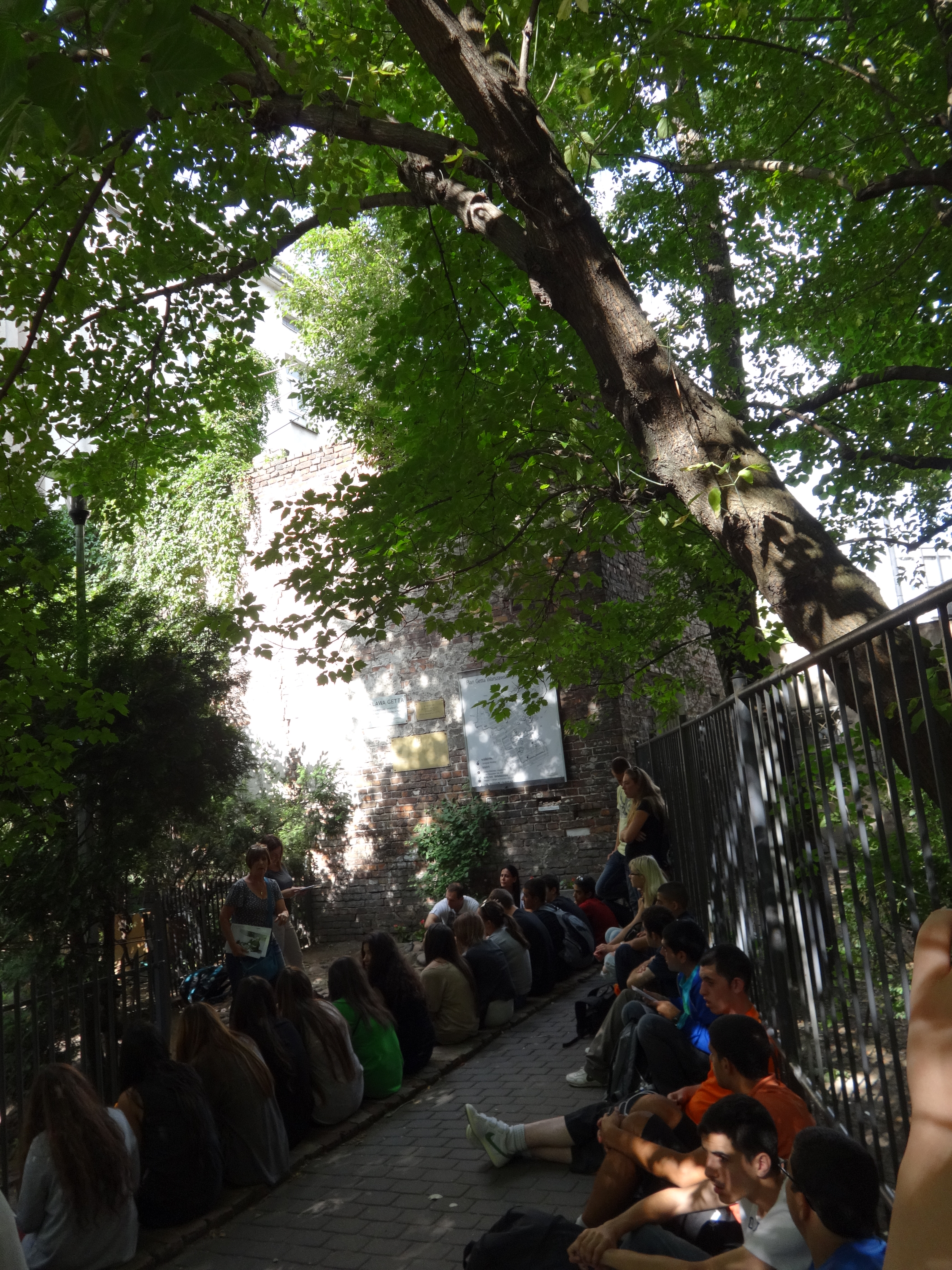
Warsaw Ghetto wall.

Warsaw Ghetto wall. Some Israeli teens are hear, listening to their teacher.

Warsaw Ghetto wall. Some Israeli teens are here, listening to their teacher.

The Warsaw Ghetto uprising was the first open fight in an occupied city against the Germans. And it was conducted by Jewish youth, who held off the Germans for half a month in the spring of 1943. Utterly inspiring and amazing. We make our way to Mila 18, the bunker command post where Mordechai Anielewicz and many of the resistance fighters breathed their last. It is another solemn moment.
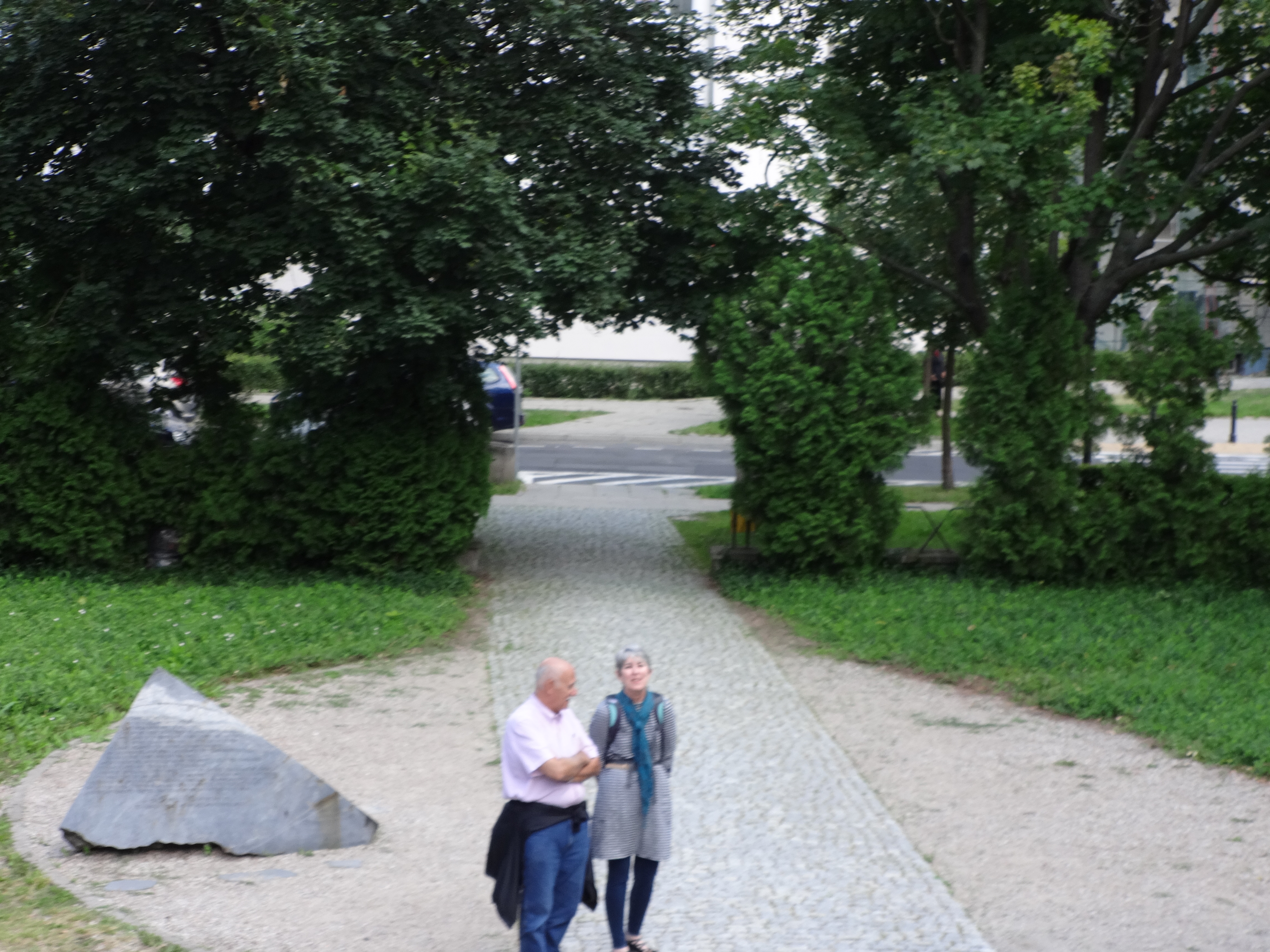
18 Mila Street.
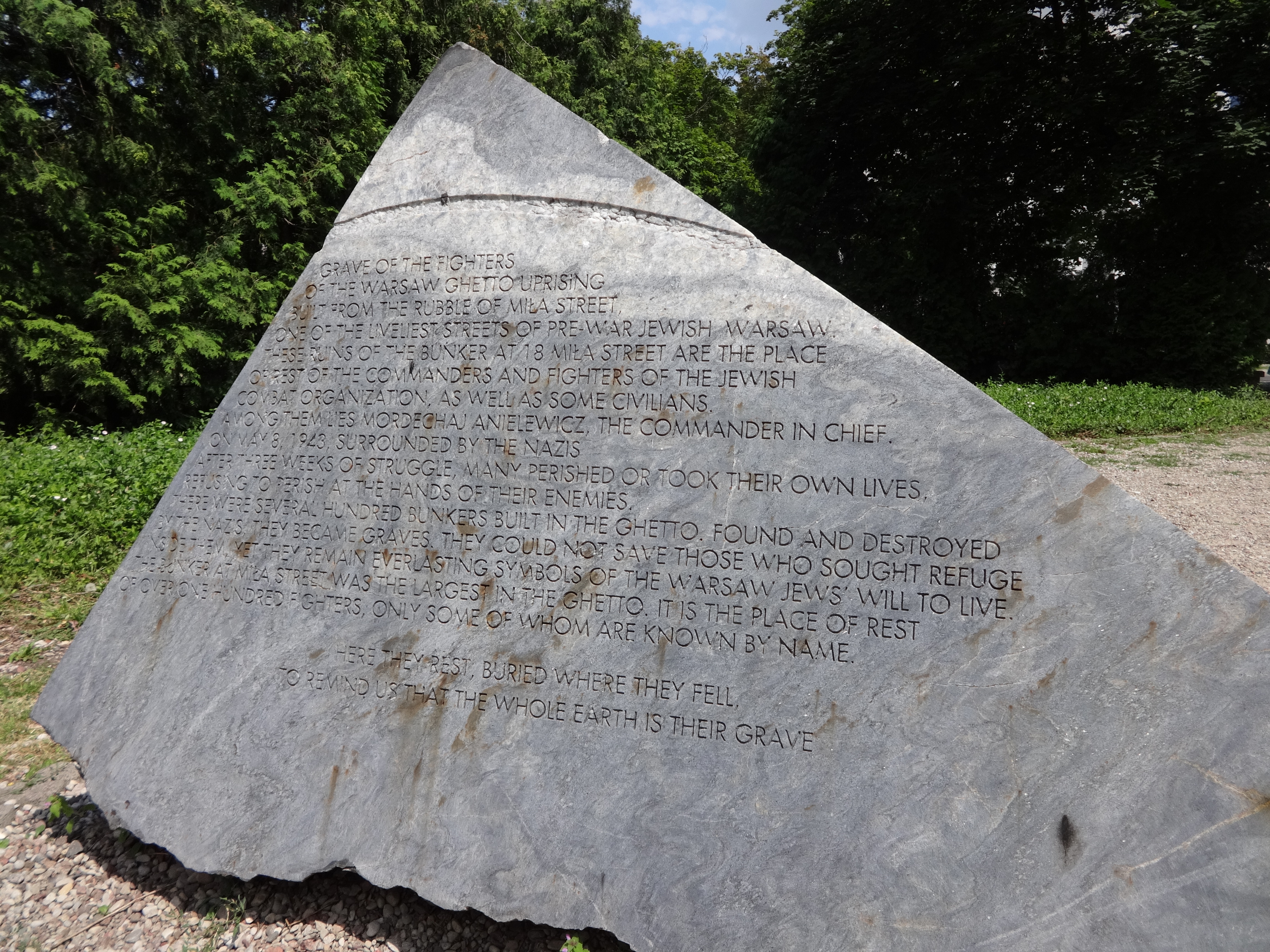
18 Mila Street.

Monument at Mila 18.

Monument at Mila 18.

We know why we are here. We are not only witnesses, but we were chosen to become, for many, the point of entry on the immense and sometimes unfathomable subject of the Holocaust, and the many forms of resistance that were taken during it.  And so rightly, our trip is concluding here. The processing will only come over time.

***

* By then, there were between 300-350 fighters- Bauer, Yehuda. ‘Current Issues in Holocaust Education and Research: The Unprecedentedness of the Holocaust in an Age of Genocide.’ Lecture notes, International School for Holocaust Studies at Yad Vashem, Jerusalem, Israel. July 21, 2016.

* Poniatow and Travniki– forced–labor camps for Jews in Lublin District near the concentration camp Majdanek.

* SS General Globocnik –SS and police leader who directed Operation Reinhard between autumn 1941 and summer 1943.
Read Full Post »

Memorial to Warsaw Uprising

You have heard a lot from me this week because April is a special month for Holocaust commemoration and remembrance. Besides marking the 1945 anniversary of the liberation of many of the camps, it also marks the anniversary of the largest single uprising against German oppression of the Jews, which occurred in Warsaw in 1943. It is important to note, however that resistance to evil manifested in many different forms, not just physical ‘pushback’, as I was reminded on my Holocaust and Jewish Resistance Teachers Program tour in 2013. As the anniversary of the Warsaw Ghetto Uprising is now upon us, I share this post, an excerpt from my recent book, also recounting the narrative of a fourteen year old Jewish resistance fighter who was told she had to leave the ghetto by her leaders, so that she might live to remember them and tell this story.

*****

As 1943 dawned, the SS returned to the ghetto for another major deportation. They encountered the first armed resistance from the ghetto fighters and beat a hasty retreat, leaving behind wounded and weapons, and calling off the operation. For the next three months, the ghetto fighters organized and prepared for the final struggle. On the eve of Passover, April 19th, the Germans returned again, this time with the aim of liquidating the ghetto once and for all, in time for Hitler’s birthday on the 20th. By then, there were between 300-350 active fighters; the young were now the real leaders of the ghetto, having decided not between life and death, but rather, how to die.* Aliza recorded her observations of the preparations for the final battle they all knew was coming.

Jews captured by SS and SD troops during the suppression of the Warsaw ghetto uprising are forced to leave their shelter and march to the Umschlagplatz for deportation.  from the notorious Stroop Report. USHMM.

Aliza Melamed Vitis–Shomron

Spring, 1943

As spring approached, the atmosphere in the reduced ghetto changed. We waited for the final ‘aktion’, for the final extermination of the Jews of Warsaw’. People began to build bunkers. Experts turned up, engineers who built bunkers with electric light, in wells and toilets. Most of the bunkers were dug in cellars. There were various ways to enter the bunkers from the ground floor: by raising a cover in the kitchen stove or through an opening in the large stove attached to the wall, or in many other strange ways, according to the fertile imagination of the builders. The ghetto was preparing for a struggle.

March passed, and April came. Talk about the approaching final liquidation of the ghetto intensified. The ghetto was fully aware of it and prepared. It was the calm before the storm, suffused with energy and tension. Frequent shots near the ghetto and sudden evening searches by the SS command cars heralded what was to come. Sending off the people working for Töbens and Schultz factory workshops to Poniatow and Travniki* caused apprehension, even though they had gone of their own free will. If they are sending out the workers, what will happen to all the rest? The companies of the SS General Globocnik *, in charge of extermination, again arrived in Warsaw.

The only possibility left is to escape to the Aryan side, to dress up as a Pole and look for acquaintances or people willing to hide Jews in exchange for money. For a few thousand zloty, one could get a Polish birth certificate and a ration card. People handed over their children to Christian clerics, to monasteries and to peasants in the villages. Sacks were thrown over the walls daily and openly, at least on our side. People paid bribes to the foremen of the work crews to be able to join them going out to work on the Aryan side. Some of them did not look Jewish and were lucky enough to find ‘good’ Poles. Women dyed and oxidized their hair, and created curls by rolling their hair in pieces of paper, to look like blonde gentile girls. But they could not change the color of their eyes, or their dejected and pallid look. A Jew could also be picked out by his hesitant walk, his bent back, and his eyes constantly darting around him. We were so preoccupied by our aspiration to look like ‘goyim’ that we examined ourselves and others: Does that man look like a Jew? Will they recognize him in the street?

Of course, a new profession cropped up among the simple Polish people, with many demanding a bribe, or being paid to be an informer, a blackmailer. We were deeply disappointed; we thought that as witnesses of our tragedy, our compatriots, sharing the same language and culture, they would hold out a hand to save us. But it did not happen. A few of them hid Jews for large sums of money; these were mostly people connected to socialist activities and the left wing parties. Many devout Christians and religious scholars did so without taking money, out of true nobility of spirit. Many others, from among the simple folk, made a living by informing on Jews to the Gestapo, and collaborated willingly out of pure antisemitism. They walked around in the streets close to the ghetto, spied by the gates and the places where Jews worked on the Aryan side and looked for victims. Thousands made a living in this way.

*

The state of our family grew worse. We began to suffer from hunger. There were no clothes left to sell, we lived on the food we had received in the workshop, distributed by the Germans.

Aliza’s family decided to split up to increase chances of survival. Her more ‘Aryan-looking’ mother and younger sister, with a great deal of bribery, subterfuge, and nerves of steel, went into hiding on the Aryan side. Her father decided to take the chance and volunteer to go to the work camp near Lublin. Aliza herself wanted to stay and fight in the ghetto, but now only fourteen she was deemed too young and directed by the leadership of the resistance to make her way to the Aryan side as well, to live to tell the story. 

Aliza’s cousin stayed in the ghetto to fight the Germans. For three days, the resistance fought on, against impossible odds. It was weeks before the ghetto was overcome; there were few survivors.

Lazar

In the morning, we heard dull sounds of firing and explosions. In another house, in Swentojerska Street 34, the Z.O.B. had their positions. People from the organization told us about a mine they had detonated when the Germans decided to penetrate into our area; about battles leaving ten Germans dead; about a ‘peace delegation’ of SS officers who came with a white flag asking for an armistice to pick up their wounded, and how they fired at them at once. The fighters were elated, exhausted—but looked happy.

The battle in most of the houses in that area lasted two days. They ran from house to house. The leader of the group was the commander Marek Edelman. Dozens of fighters took part in the battle; some of them were killed. They went out at night to try to make contact with their friends. They told us that the battle inside the ghetto was still going on, that the fighters had delayed the entry of the tanks and set fire to them with homemade Molotov bottles. They were stationed at windows and changed their positions by moving across the rooftops. We in the shelters decided to open fire only when they discovered us. We made up our minds to defend our families to the end, not let them take us to Treblinka.

On the third day, fighting also broke out in the area of the workshops of Töbens and Schultz. At the last moment many people preferred to move to the Poniatow camp. In the meantime, the Germans began to set fire to the houses. On the second day of the uprising, the fighters told us about fires in the ghetto. We sat in the crowded shelter, praying that they wouldn’t get to us. We had expected the worst, but not fires. The people in the shelter said goodbye to each other. We were in despair, expecting certain death. We could already smell the smoke. Someone came from the neighboring house; people were fleeing from adjacent houses. There were no Germans around. After a night full of dread, just before dawn, we did hear German voices in the courtyard. They were calling to the Jews to come out at once, or else they’d burn us alive.

The artillery was constantly firing incendiary bombs. Whole blocks of houses were on fire. The shelter was not damaged, but the water stopped running. The electricity went out. The walls of the shelter became unbearably hot, smoke penetrated the cellar. We sat there, coughing, wrapped up in wet sheets. People wept, dragged themselves to the courtyard with the last vestige of strength. We had no choice, we would defend ourselves in the yard. The men cleared the opening and gave the order—‘wrap yourselves up in sheets soaked in the remnants of water, lie in the middle of the courtyard, in the garden.’

The yard is full of people, smoke covers everything, the top floors are in flames, the fire is running wild without any interference, parts of walls are collapsing and falling into the yard. People lying on the ground are groaning with pain…

Suddenly, we hear German voices in the street. God! We thought it was all over, that they’ve left us here. What shall we do? Several Germans burst in through the gate…

Lazar was captured and beaten, but managed to escape deportation, and made it to his cousin’s hiding place on the Aryan side.


I saw a different Lazar before me. He used to be arrogant, a show-off. The person sitting here now was thin, withdrawn; he stammered slightly when he spoke. We’ll have to live together in that small room in the cellar. Who knows how long? Until this damned war is over?

The Beginning of May, 1943

They say that the ghetto no longer exists. The wreckage of the houses is still standing; the piles of cinders still crackle, and at night shadowy figures, seeking food and shelter, still move about in there. But the ghetto no longer exists; 500,000 people have gone up in smoke. And those still alive bleed inwardly, their deep wounds will never heal. And maybe there will be no one left when freedom comes? Why are human beings so cruel and evil? They speak about the future, about truth, about Man as proof of God’s great wisdom, and it’s all lies, lies!

I know there are also good people, but they are persecuted; society rejects them as weaklings. Why am I prevented from seeing the wonders of nature and the world, from breathing fresh air?

The full narrative is available here.

******************************************

In 2013 I visited Warsaw, rebuilt; almost nothing remains of the ghetto itself- with slight exceptions.

July 17, 2013

We tour Jewish Warsaw and finally the remnants of the ghetto wall, and also the Umschlagplatz. It is here that forced gatherings for the mass deportations to Treblinka took place. I am also reminded of the scene from the film “The Pianist”.

The Umschlagplatz. As many as 10,000 Jews were deported on some days to Treblinka. Upwards of 300,000 were sent from here to their deaths.

The Umschlagplatz. Our group. 2013.

The Umschlagplatz. Our group. 2013.

1227

The Umschlagplatz. As many as 10,000 Jews were deported on some days to Treblinka. Upwards of 300,000 were sent from here to their deaths.

The Umschlagplatz. As many as 10,000 Jews were deported on some days to Treblinka. Upwards of 300,000 were sent from here to their deaths.

We walk the edge of the wall, memorialized in bronze in the sidewalk.

1240

And we come to a section that still stands.

Warsaw Ghetto wall.

Warsaw Ghetto wall.

Warsaw Ghetto wall. Some Israeli teens are hear, listening to their teacher.

Warsaw Ghetto wall. Some Israeli teens are here, listening to their teacher.

The Warsaw Ghetto uprising was the first open fight in an occupied city against the Germans. And it was conducted by Jewish youth, who held off the Germans for half a month in the spring of 1943. Utterly inspiring and amazing. We make our way to Mila 18, the bunker command post where Mordechai Anielewicz and many of the resistance fighters breathed their last. It is another solemn moment.

18 Mila Street.

18 Mila Street.

Monument at Mila 18.

Monument at Mila 18.

We know why we are here. We are not only witnesses, but we were chosen to become, for many, the point of entry on the immense and sometimes unfathomable subject of the Holocaust, and the many forms of resistance that were taken during it.  And so rightly, our trip is concluding here. The processing will only come over time.

***

* By then, there were between 300-350 fighters- Bauer, Yehuda. ‘Current Issues in Holocaust Education and Research: The Unprecedentedness of the Holocaust in an Age of Genocide.’ Lecture notes, International School for Holocaust Studies at Yad Vashem, Jerusalem, Israel. July 21, 2016.

* Poniatow and Travniki– forced–labor camps for Jews in Lublin District near the concentration camp Majdanek.

* SS General Globocnik –SS and police leader who directed Operation Reinhard between autumn 1941 and summer 1943.
Read Full Post »

My friend Elaine wrote this. She just returned for the umteenth time taking dedicated Holocaust educators to learn from some very heavy authentic sites in Europe.

The daughter of survivors, Elaine is special person, known by many, who guided me to the places that she writes so hauntingly about. The day we went to Belzec, the men were grouped apart from the women for the first time, nearing the end of a very emotional trip. I remember being confused about it at the time, but Elaine needed to share with the beautiful girls on our trip. I get it now. A year later, I was still processing, and wrote a related post way below. It literally took that long. I still am processing, which is a part of her essay, below. Though I don’t pretend to equate my experience with any other human being’s, I think it is a universal truth that it’s never over.

Thank you Elaine. Matt

By Elaine Culbertson

In the winter my book club read a book called This Republic of Suffering by Drew Gilpin Faust. It’s about the aftermath of the Civil War, particularly about death and dying and the business and customs that sprung up as a result of so many deaths.

At the time I was reading it, I never made the connection that struck me today. Here it is: after the Civil War, a new industry of mourning developed. Families searched for their loved ones on battlefields and in mortuaries; they paid for bodies to be shipped across many state lines (hence the idea of refrigerating the body and more stringent embalming practices were instituted); they saved relics of loved ones including hair and made jewelry from it; they placed markers in places far away from their home burial plots; they placed notices in newspapers hoping to find information about missing combatants; they held ceremonies for people they could not find, establishing markers all over the then US to the Civil War dead. Both sides, North and South, were engaged in this, but the Northerners, being the victors, had the upper hand and could dishonor the dead bodies of the Southerners and claim that they were missing when in fact they had used mass graves, in some cases, to dispose of the dead. The book fascinated me for its scholarship, its directness, and its beautiful writing, but I did not know why it resonated as it did.

Humans need to remember and honor their dead. The mourning period has no defined end, especially when there is no closure. Those distraught family members who could not establish a real burial spot lived with the hope/dread that the dead might not really be gone or that the suffering was not over. Believing that they are dead but not knowing of their fate is an interminable condition of anxiety. Going to Auschwitz and Belzec, one day after another, was like the extended funeral I have been living my entire life. I never knew any of them them but they have loomed large in my life. To be named after them, to be told I look like them, to hear stories about them, and yet not to have the ability to end the mourning period, or perhaps abbreviate it and pack it away for a while, is the legacy of survivors and their offspring.

Even as I write this I find myself moved to tears thinking about those lonely places. While cemeteries are supposed to be peaceful, those places are restless and painful, hardly consoling. I don’t mean the bustling barracks at Auschwitz, but the quiet windy Birkenau where we were pelted with hail. I mean the scorched earth of Belzec where nothing can grow. No matter how many kaddishes are said there, it will never be enough. There aren’t enough stones to commemorate those who died in either place, and although I stood in front of my grandmother’s name, I don’t have a sense of being able to say a true goodbye. I can walk away, but I can never leave.

913

Elaine is a former high school English teacher and school administrator. She is the Chair of the Pennsylvania Holocaust Education Council, and the director of the The Holocaust and Jewish Resistance Teachers’ Program, an intensive three-week living and learning experience in Germany, Poland and Israel for U.S. secondary school teachers who are committed to teaching about the Holocaust and Jewish resistance. Visit their website at www.hajrtp.org, especially if you are a teacher interested growing in this life-changing experience.

***

Matt’s 2013 Belzec experience the day Elaine took him and the group there.

And the cycle, the mystery, the life continues. Belzec.

Read Full Post »

~Matthew Rozell, a history teacher whose project reunited hundreds of Holocaust survivors with the American soldiers who liberated them, takes a backwards journey to the authentic sites of the Holocaust, retracing the path of the survivors who are now his friends.~


A year ago I took one of the most transformative journeys of my life, with 24 fellow educators, to study the Holocaust and the Jewish resistance to it, in Washington, DC, Germany, the Czech Republic, and Poland. I kept an extensive diary and took tons of photographs. And contrary to many assumptions, it was a journey that led to profound understandings about life, not death.  For the next several days, I have decided to go back and retrace my steps and try to process what unfolded for me.

****************************

July 18.

It’s been a helluva trip. I have toured authentic sites, met some good people, forged some pretty strong bonds with other educators as colleagues and friends. I’ve tramped the grounds where hundreds of my Holocaust survivor friends were held and/or had family members perish.

Our teachers in Cracow, Poland, Schindler Factory Museum of Cracow.

Our teachers in Cracow, Poland, Schindler Factory Museum of Cracow.

So. Now it is time to begin processing it all.

Writing this, I have been traveling and pondering for over 24 hours now. I am back in the USA – missing a flight,  the airlines seemingly conspired to help  extend my pensive mood by granting me a complimentary hotel room on the outskirt of nowhere near Dulles Airport- so my adventure will be extended one more night. I hardly know what day of the week it is but in a way that is kind of refreshing.

From Day One I think all of us on the trip are in the same boat- folks you know are excited and proud of you for being selected on an elite study tour for teachers, but maybe question a bit why one would spend $3 or 4K of one’s own treasure*, leave your family and loved ones for three weeks to travel with “strangers”, or forfeit 3 weeks of summer earning potential to tour the sites of the scenes of the greatest crime in the history of the world.

Well, you gotta give them that. This is kind of strange- or so it may seem if you are on the outside cupping your hand on the window glass trying to look in.

I think, as one of my Facebook followers put it,  that we did something very brave. We toured over two dozen places where I figure 3 million people were murdered.

Or to put it in maybe a more appropriate context, we saw, walked through, and touched the ground where  nearly a million families were killed. By no means did we tour the thousands of camps and subsites where millions more lives were destroyed.


The numbers tell the story in a way, but not completely, because try as one might, one cannot understand them. I know the numbers- I have the knowledge- but as Steve our tour historian says, there is a clear difference between knowledge and understanding. Some things are beyond comprehension.


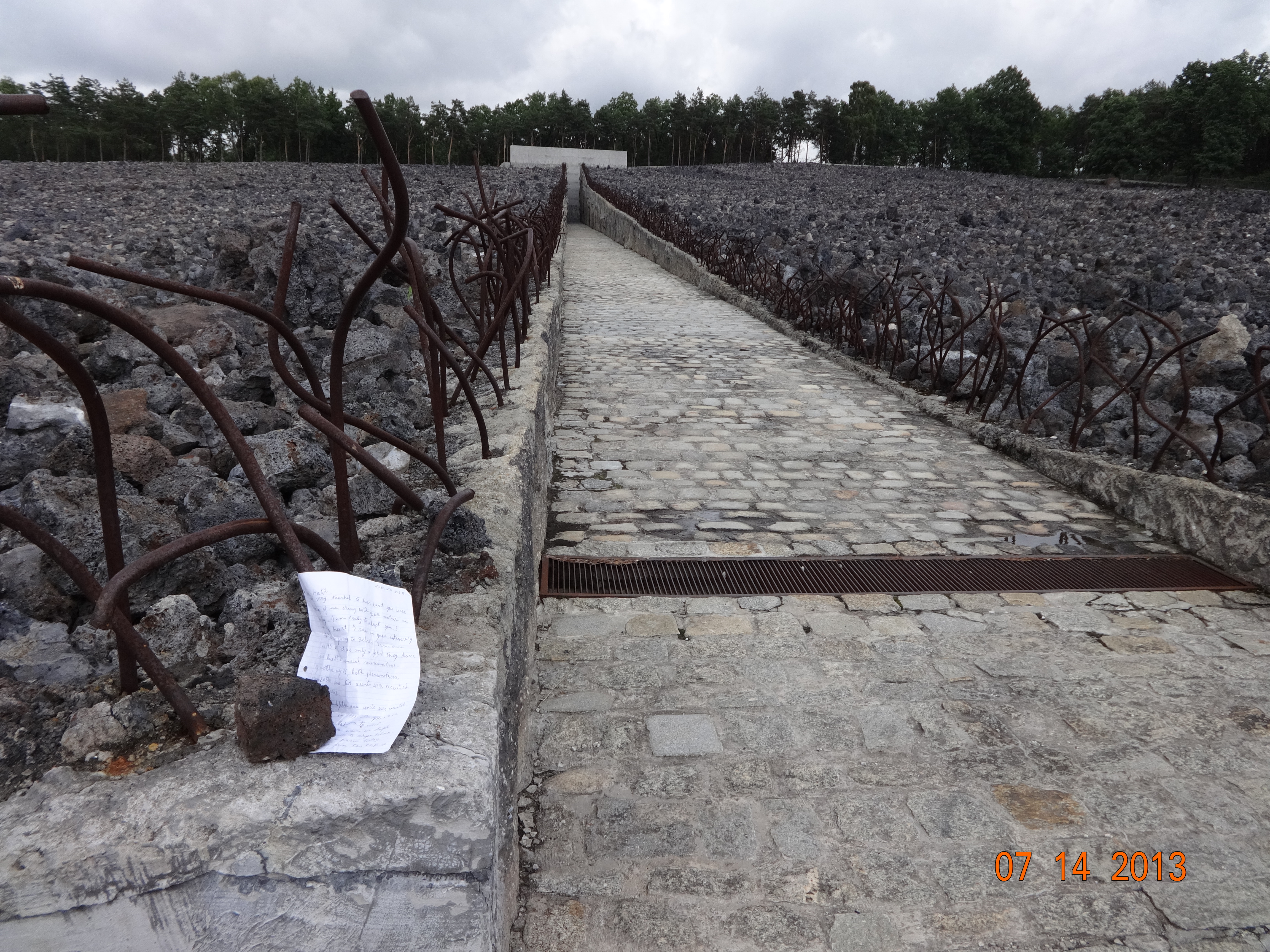
Belzec. Letter from survivor to me, who lost her family there.

Belzec. Letter from survivor to me, who lost her family there.

400,000 murdered in Belzec.

1.1 million in Auschwitz II/Birkenau.

900,000 at Treblinka.

We have been to all of these places in the past three days. People comment that they can’t get their head around it, they can’t begin to fathom the mass indifference to human life that we have witnessed.

Treblinka. 900,000 lost.

Treblinka. 900,000 lost.

So let’s look at what we did come to some kind of understanding about.

What we learned was of the ripple effect of the seemingly small things that illustrated the resilience of the human spirit. That resistance does not have to be just using physical force against your tormentors- it goes way beyond that.

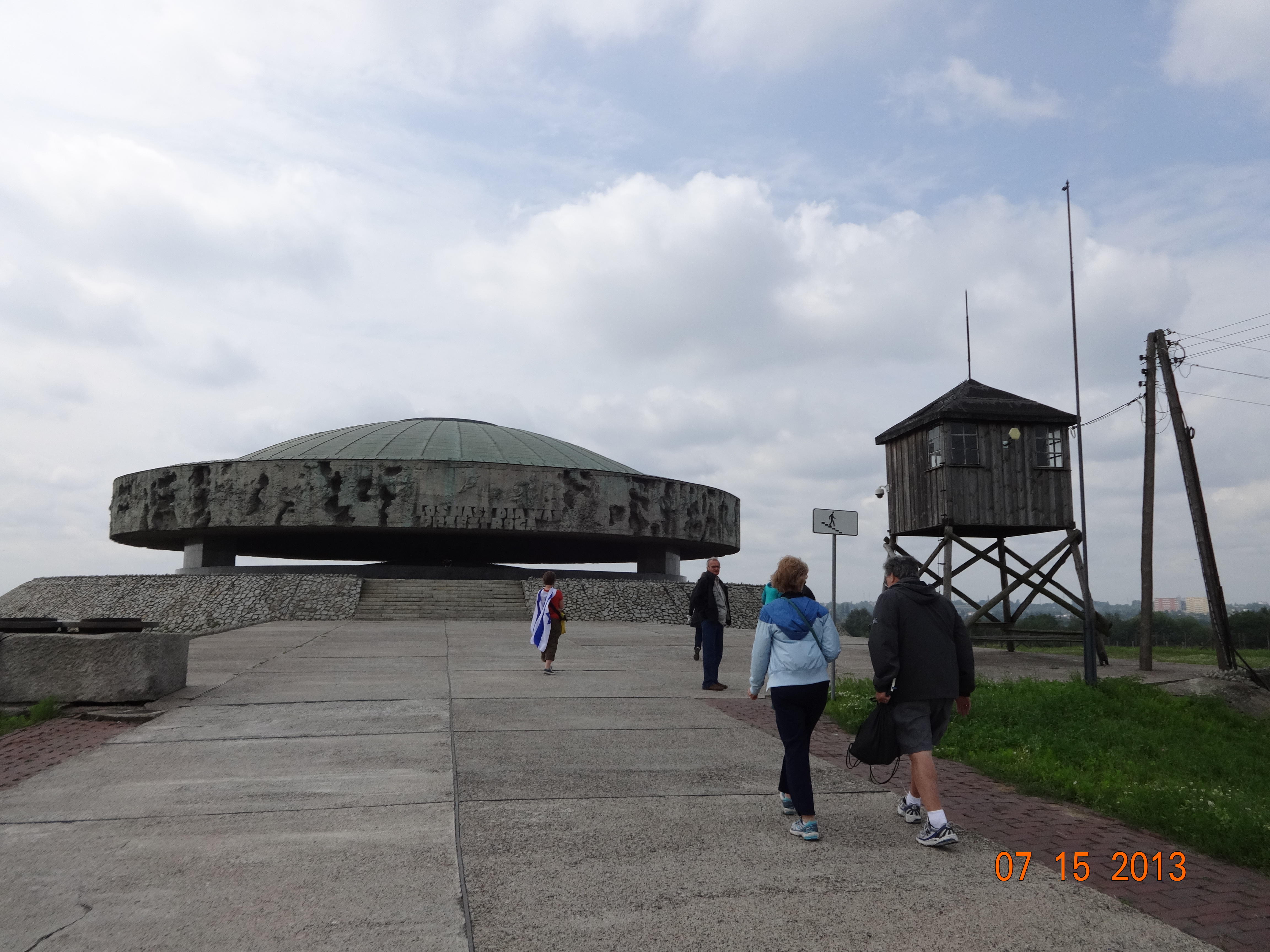
Madjanek. My "I'm in a really, really bad dream day". Under the Soviet era memorial lies a pile of ash and cremated bone the size of a small house.

Majdanek. My “I’m in a really, really bad dream” day. Under the Soviet era memorial dome lies a pile of ash and cremated bone the size of a small house.

The program has been in operation for 30 years, begun by survivors of  the Warsaw Ghetto, those who resisted but survived. Vladka Meed pointed out that the Ghetto Uprising in 1943, which held the Germans at bay for weeks, was begun by the young people. And it is for them, the young,  that we educators make this trip.

So, trying to keep it simple and summing it up:

1. This was not a trip about death. It was a trip about life.  I can’t say that I found God, but this trip was one of the most spiritually reflective journeys that I have ever been on, bordering on a religious experience. So folks will ask when I get home- how was it?-my answer will be:

Righteous.  For me, not epic, not amazing, not awesome.

Righteous.

2. I had many of my Holocaust educational and pedagogical thoughts confirmed and other assumptions challenged. Some ideas presented to me I felt comfortable enough to challenge myself, but in thinking about them, I came to deeper understanding. The most important understanding confirmed is a problem that all teachers must struggle with in our flawed educational system. We have to be diligent about avoiding the promotion of generalization as fact, to avoid doing a disservice to our students. If you are  teaching this history, you had better be versed enough and nuanced enough to accept inconsistencies, problematic complexities, and probe these things to induce a more intricate set of questions to your kids.

3. We have to be willing to accept that perhaps there are no correct answers- a notion that educators  are uncomfortable with- but  one that must  be accepted, nevertheless.  To promote generalities in this complex history, or any history is wrong. But especially this one, it seems to me. It was a watershed event in the history of the world, and for humanity, on many levels.

4. Lastly, it was certainly not just a trip to study how to teach the Holocaust. Perhaps reinforced more was how NOT to teach it. And  at the end of the day, it was a tour not only of authentic sites, but also of the mind, and how to make it work.

Sometimes I thought myself to the verge of tears, behind the sunglasses. Thinking-not only about answers- but about the questions.

And that’s what these teachers “did on our summer vacation”.

Memorial to Warsaw Uprising

Memorial to Warsaw Ghetto Uprising

* thanks to the American soldiers, Holocaust survivors, and special folks who were able to support my efforts.

Read Full Post »

Our teachers in Cracow, Poland, Schindler Factory Museum of Cracow.

Our teachers in Cracow, Poland, Schindler Factory Museum of Cracow.

So.

I have been traveling and pondering for over 24 hours now. I am back in the USA (loved Europe, especially the East, but kissing the ground right now…)- the airlines seemingly conspired to help  extend my pensive mood by granting me a complimentary hotel room on the outskirt of nowhere near Dulles Airport- so my adventure will be extended one more night. I hardly know what day of the week it is but in a way that is kind of refreshing.

I have been thinking about the effects of this trip. From Day One I think all of us on the trip are in the same boat- folks you know are excited and proud of you for being selected on an elite study tour for teachers, but maybe question a bit why one would spend $3 or 4K of one’s own treasure*, leave your family and loved ones for three weeks to travel with “strangers”, or forfeit 3 weeks of summer earning potential to tour the sites of the scenes of the greatest crime in the history of the world.

Well, you gotta give them that. This is kind of strange- or so it may seem if you are on the outside cupping your hand on the window glass trying to look in. I think, as one of my Facebook followers put it,  that we did something very brave. We toured over two dozen places where I figure 3 million people were murdered.

Or to put it in maybe a more appropriate context, we saw, walked through, and touched the ground where  nearly a million families were killed. By no means did we tour the thousands of camps and subsites where millions more lives were destroyed.


The numbers tell the story in a way, but not completely, because try as one might, one cannot understand them. I know the numbers- I have the knowledge- but as Steve our tour historian says, there is a clear difference between knowledge and understanding. Some things are beyond comprehension.

Belzec. Letter from survivor to me, who lost her family there.

Belzec. Letter from survivor to me, who lost her family there.

400,000 murdered in Belzec.

1.1 million in Auschwitz II/Birkenau.

900,000 at Treblinka.

We have been to all of these places in the past three days. People comment that they can’t get their head around it, they can’t begin to fathom the mass indifference to human life that we have witnessed.

Treblinka. 900,000 lost.

Treblinka. 900,000 lost.

So let’s look at what we did come to some kind of understanding about.

What we learned was of the ripple effect of the seemingly small things that illustrated the resilience of the human spirit. That resistance does not have to be just using physical force against your tormentors- it goes way beyond that.

Madjanek. My "I'm in a really, really bad dream day". Under the Soviet era memorial lies a pile of ash and cremated bone the size of a small house.

Madjanek. My “I’m in a really, really bad dream” day. Under the Soviet era memorial dome lies a pile of ash and cremated bone the size of a small house.

The program has been in operation for 30 years, begun by survivors of  the Warsaw Ghetto, those who resisted but survived. Vladka Meed pointed out that the Ghetto Uprising in 1943, which held the Germans at bay for weeks, was begun by the young people. And it is for them, the young,  that we educators make this trip.

So, trying to keep it simple and summing it up:

1. This was not a trip about death. It was a trip about life.  I can’t say that I found God, but this trip was one of the most spiritually reflective journeys that I have ever been on, bordering on a religious experience. So folks will ask when I get home- how was it?-my answer will be:

Righteous.  For me, not epic, not amazing, not awesome.

Righteous.

2. I had many of my Holocaust educational and pedagogical thoughts confirmed and other assumptions challenged. Some ideas presented to me I felt comfortable enough to challenge myself, but in thinking about them, I came to deeper understanding. The most important understanding confirmed is a problem that all teachers must struggle with in our flawed educational system. We have to be diligent about avoiding the promotion of generalization as fact, to avoid doing a disservice to our students. If you are  teaching this history, you had better be versed enough and nuanced enough to accept inconsistencies, problematic complexities, and probe these things to induce a more intricate set of questions to your kids.

3. We have to be willing to accept that perhaps there are no correct answers- a notion that educators  are uncomfortable with- but  one that must  be accepted, nevertheless.  To promote generalities in this complex history, or any history is wrong. But especially this one, it seems to me. It was a watershed event in the history of the world, and for humanity, on many levels.

4. Lastly, it was certainly not just a trip to study how t0 teach the Holocaust. Perhaps reinforced more was how NOT to teach it. And  at the end of the day, it was a tour not only of authentic sites, but also of the mind, and how to make it work.

Sometimes I thought myself to the verge of tears. Thinking-not only about answers- but about the questions.

And that’s what these teachers “did on our summer vacation”.

Memorial to Warsaw Uprising

Memorial to Warsaw Ghetto Uprising

* thanks to the folks that were able to support my efforts. You know who you are!

Read Full Post »

Ravensbruck.

Ravensbruck.

We have visited a lot of sites in Germany since Bergen Belsen-in Berlin, the Wannsee Villa, where preliminary plans for the “Final Solution ” were signed off on after a one day conference, the Memorial to the Murdered Jews of Europe in the heart of the city, the Reichsbahn train platform, Track 17, where the Jews of Berlin were deported almost everyday for nearly two and a half years. We also visited Ravensbruck and Sachenhausen.

Ravensbruck is a couple of hours north of Berlin, in the former East Germany. It is notable for many reasons, probably first that it was a camp for women, and also a training faculty for SS camp guards-3500 women guards were trained here, and about 500 were in service. 130,000 women prisoners passed through here, and towards the end of the war, another 20,000 men.  No barracks are standing today, the houses for the SS leadership remain just outside the camp wall, where they lived with their families. Each day the camp gates would open and thousands of prisoners would stream out into the community for their slave labor assignments. Kind of hard to hide it from the kids. I suppose the attitude was that it was difficult, distasteful work, but the kids had to realized that it had to be done for the wonderful world that they were creating for the children’s future.

Immediately after the war the barracks were dismantled and given to refugees who had fled the Eastern Reich as it collapsed. Some are still used as houses today. The SS women guard barracks is used as a youth hostel education center today. They have a program where survivors interact with the kids for about 4 days, and sleep here at night. Our guide is the historian Matthias H. at the Gedenkstatte (Memorial). He appears to be in his early 40s and is passionate and knowledgeable, as are all of the German historians I have met thus far. Here are some of his observations that strike me the most:

In his opinion, the majority of Germans supported the master race theory. What disturbs him today is that in his opinion, few Germans today seem conscious of this. It is a very complex topic. The historians talk about the mass crimes, and in Matthias’ words, they work on thin ice. The responses range from some people wanted to know more- after all, many of them learned nothing about it from their teachers, many of whom were bystanders or even perpetrators. Some quietly deny the extent-but I have found that as you study it, you learn how vast and almost unbelievable it is in scope. Others, are tired of the topic- “yes, it happened, so what, enough…”

For Matthias, herein lies the greatest danger. It is important to have the past in front of you- NOT in the back of one’s mind, as one moves forward. The lesson may be simply how to “behave” , not just for Germans but for everyone.

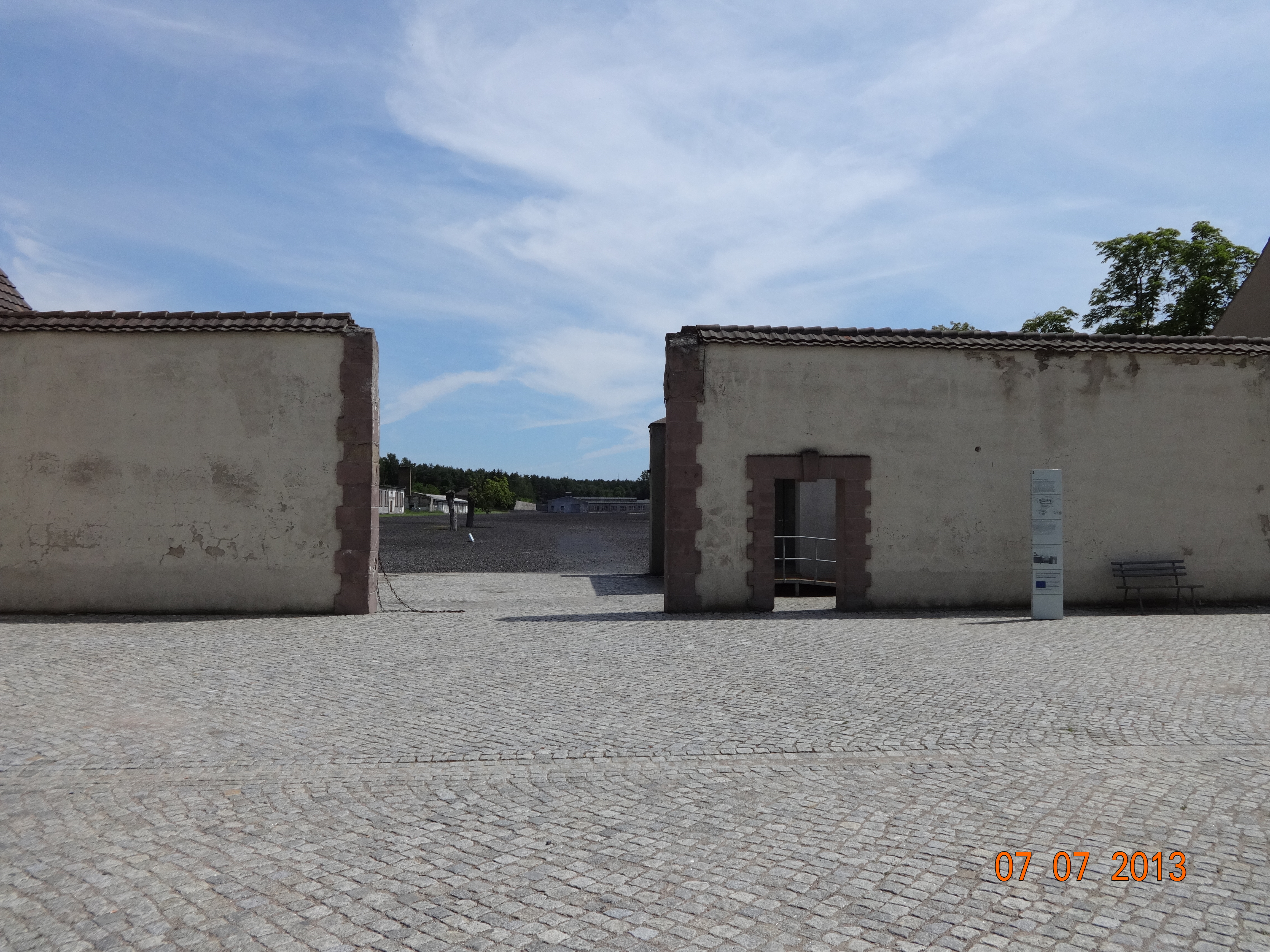
Ravensbruck. Prisoners' gate on left, SS on right.

Ravensbruck. Prisoners’ gate on left, SS on right.

He walks us through the main camp entrance, where thousands of prisoners would pass everyday, explaining that for years he would avoid the single door entrance that the SS guards used-until one day a survivor he was leading on a tour walked through it, to symbolize her victory at this place.

He notes a few additional stories. Survivors corroborate that when new SS female guard recruits would come for training, initially they do not know how to deal with the new job. Industries wanting slave labor must send their own guard recruits, too.  They are not kind, but they do not seem possessed with the will to carry out this abhorrent work. Former prisoners would say that always within about two weeks new staff would have overcome the “cognitive dissonance” that would allow them to do their job without compassion. They become “hardened” and “get over it”.

Ravensbruck was built for 3000 prisoners. At its height it held 35,000. 30,000 were killed here. In the beginning the SS does  NOT want women with children in the camp. But as more and more territory is overrun, the camp swells. After the Warsaw Ghetto uprising in 1944, there are hundreds of pregnant women. Some are forced to abort; as numbers well, women give birth and the babies are taken to a “hospital” where they slowly starve to death. The crematorium works nonstop. Ash piles are created and dumped into the nearby lake as the Russians close in. When the camp is overrun by the Red Army, 2000 women and 2000 men, mostly to infirm to be death marched out of the camp, are found, but not before the Germans had installed a small operating gas chamber, where 5000 Hungarian women were murdered in 1944.

I think that the following story resonated the most with me as an educator of young people.

The butcher’s son delivered fresh cuts of meat nearly daily to the SS mess hall, which still stands. Late in life, the old man tells Matthias of his feeling as a young teen-going through the camp gates to deliver the meat, seeing the emaciated and foul smelling prisoners, and believing fully all he has been taught- that these people are indeed subhuman, vermin to be eliminated. It’s true. Just look at them. Just smell them. Disgusting. Everyday it is the same. They even march through the town to the labor sites. Best to keep a distance from them.

It’s the same until one cold morning when a new transport of women arrive-stripped naked, healthy, humiliated, shivering, crying, shocked, trying to cover themselves in the plaza. Now it is his turn for a shock. These are not subhuman, but girls his age and older, in distress.

And they are naked. He has probably never even seen his mother or sister undressed before. And it is at this moment that he realizes that his teachers and the adults in his life are wrong- that what he is witnessing is a crime. And now perhaps sixty years later he unburdens himself.

Finally, a survivor, Annika, recounts that the Scandinavian Red Cross appeared in the weeks before liberation and in the presence of these new people, the women stroke their hair (as it is growing in again after being shorn off) trying to make themselves presentable. As she is evacuated over the Danish border, something strange happens. People are crying at her miserable condition. At every stop, they crowd around tearfully, and want to help… What is this? Traveling through the towns in Germany, she recounts, no one cried. No one helped. To date, says Matthias, no former German perpetrator has shown remorse for his/her wartime behavior.

The bystanders probably included most of the victims’ neighbors and acquaintances, and certainly most of the townspeople where the crimes were perpetrated,  of thinking age.

But they all knew.

That for me is one of the axioms that will come out on this trip. But, suspending judgement- we were not there ourselves and placed in that positon-we have a lot to think about.

But we must think about this too-Hitler never murdered anyone by himself.

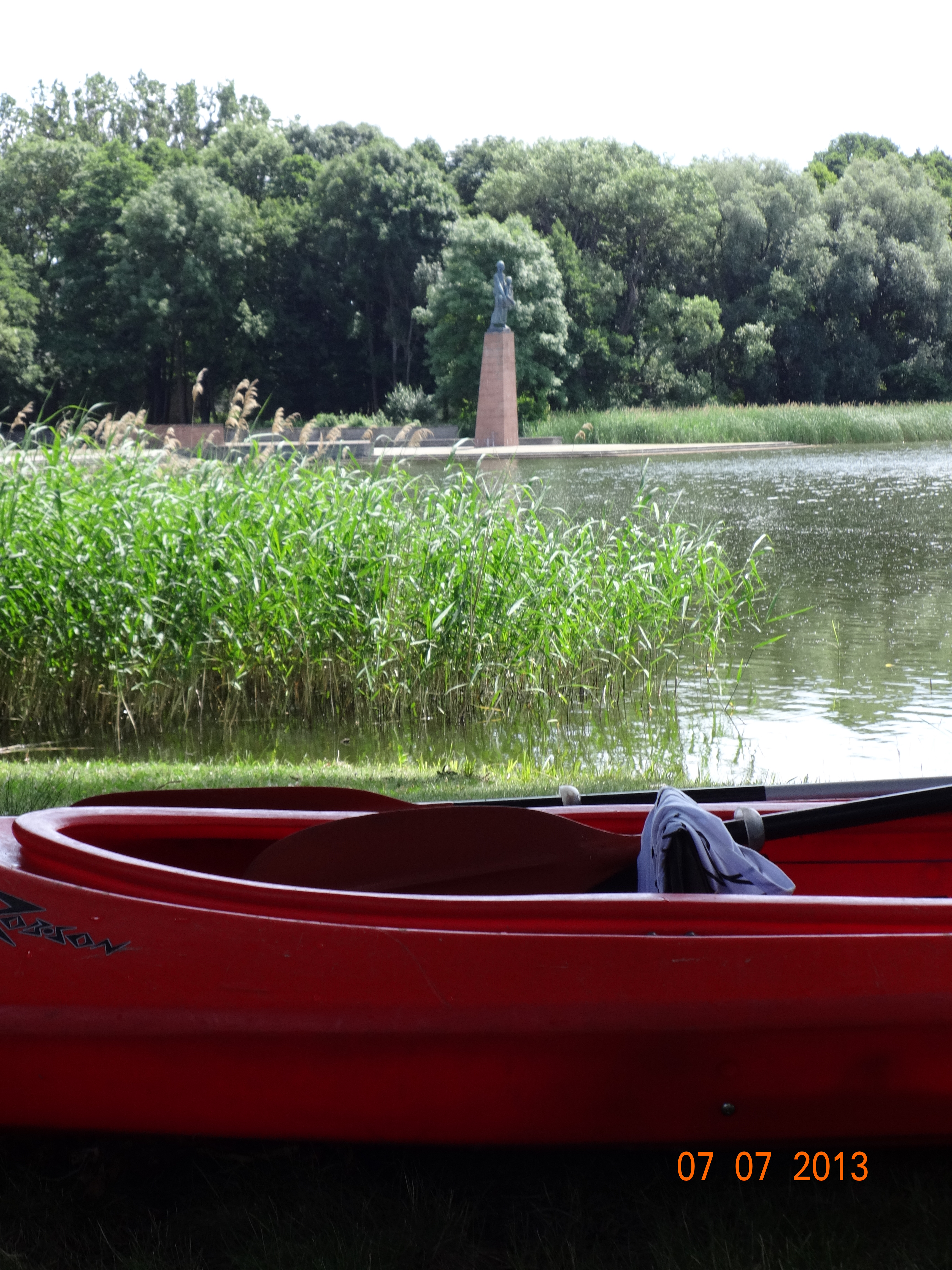
The lake at Ravensbruck, where ashes were dumped.

The lake at Ravensbruck, where ashes were dumped.

Read Full Post »

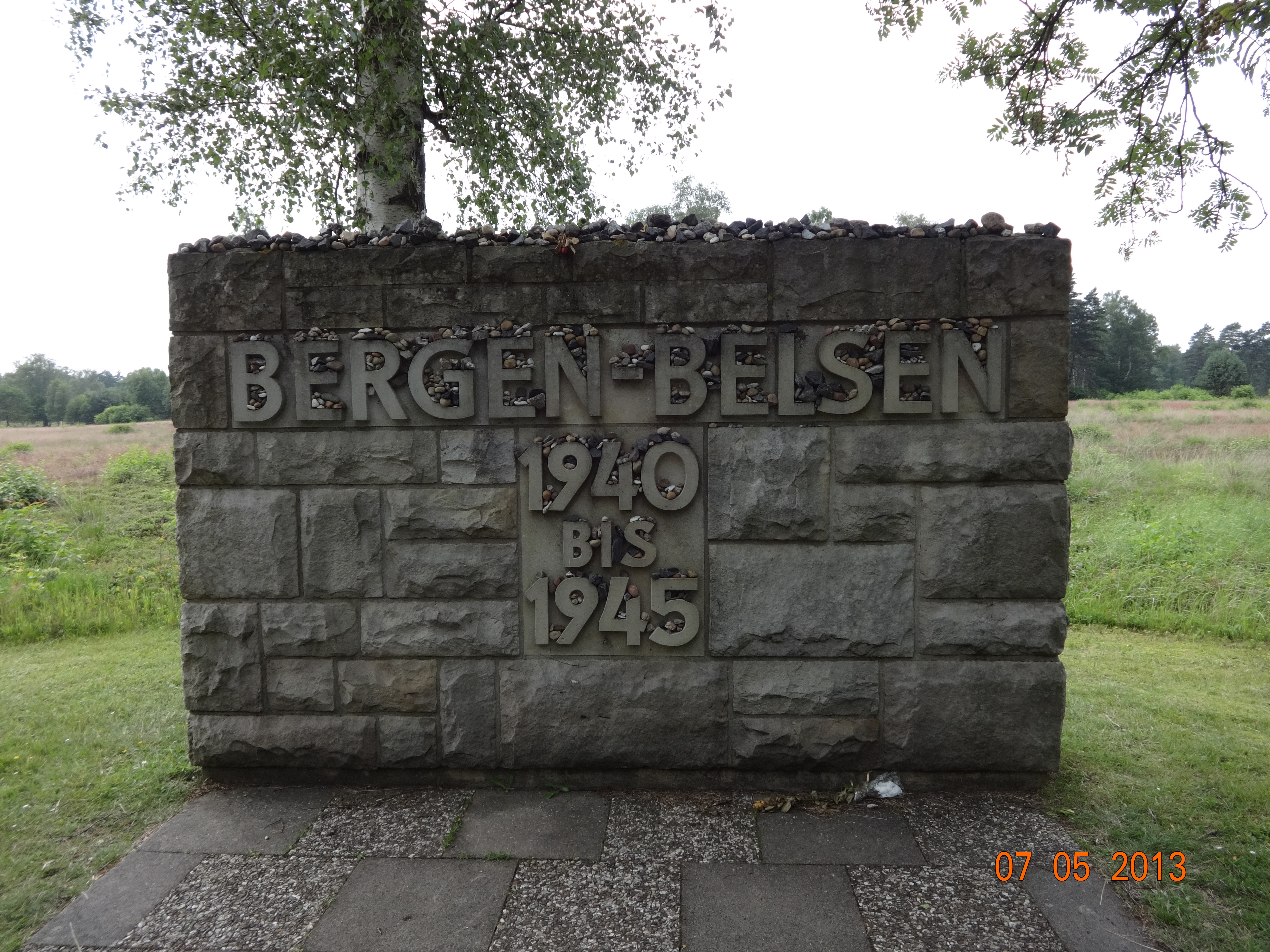
Bergen Belsen on July 5, 2013.

Bergen Belsen on July 5, 2013.

I am in Europe on a study tour of the Holocaust with 25 fellow educators of the United States. I am typing this as the morning breaks in the heart of Berlin, Germany. I had hoped to be able to get on-line and write more frequently but that is just not possible. There is too much to do while we are here visiting these authentic sites. But it is time to stop and reflect on some of the things that I have seen and experienced.

Our itinerary includes stops in Germany, the Czech Republic, and Poland. The power of visiting these sites after studying them so long can not be overstated.

Bergen-Belsen. For me, visiting this place after studying it in depth in relation to the exchange camps that were here was a powerful experience. Readers of the blog know of the stories of many of the survivors of Bergen Belsen who were in the exchange camp and their liberation on April 13, 1945 at Farsleben. Two days ago I got the back story of the exhibition panels you see here, that feature the photographs and the work that our project has uncovered.

In brief context: 120,000 prisoners passed through Bergen Belsen, and not all of them Jewish. 52,000 died here, perhaps 30,000 of them were Jewish. Belsen actually began as a POW camp- 20,000 Russians died here in the winter of 1941-42. In 1943, Himmler (the head of the SS) ordered that an exchange camp be set up for Jews who might possess foreign certificates or visas to emigrate, perhaps to use to bargain for German families interned abroad. 14,000 people went through the exchange camp. In November, 1944, thousands of women, and some children, including the Frank sisters, arrived from Auschwitz, to be “housed” near the exchange camp. What they received, in their miserable condition, were 18 oversized old tents which promptly blew down during a winter storm shortly after their arrival. With the arrival also of brutal SS administrators and guards, conditions deteriorated rapidly as the winter of 1944-45 turned into spring. The camp system began collapsing with the advance of the Red Army in the east and the British and Americans in the West. By the time the British arrived on April 15th at the camp gates, over 50,000 prisoners were suffering from extreme malnutrition, typhus, typhoid fever, and dysentery. Nearly ten thousand corpses lay about as the crematorium had long since broken down. Hundreds died on the day of liberation.

I'm here. Finally.  Jerrilyn Miller photo.

I’m here. Finally. Jerrilyn Miller photo.

So here I am. The bus guides swiftly through the beautiful German countryside. A night in the picturesque town of Celle the evening before has us well rested. The fields and forests bid us peaceful feelings as we move with our rendezvous with the past. It feels as if as we move we are stepping back in time.

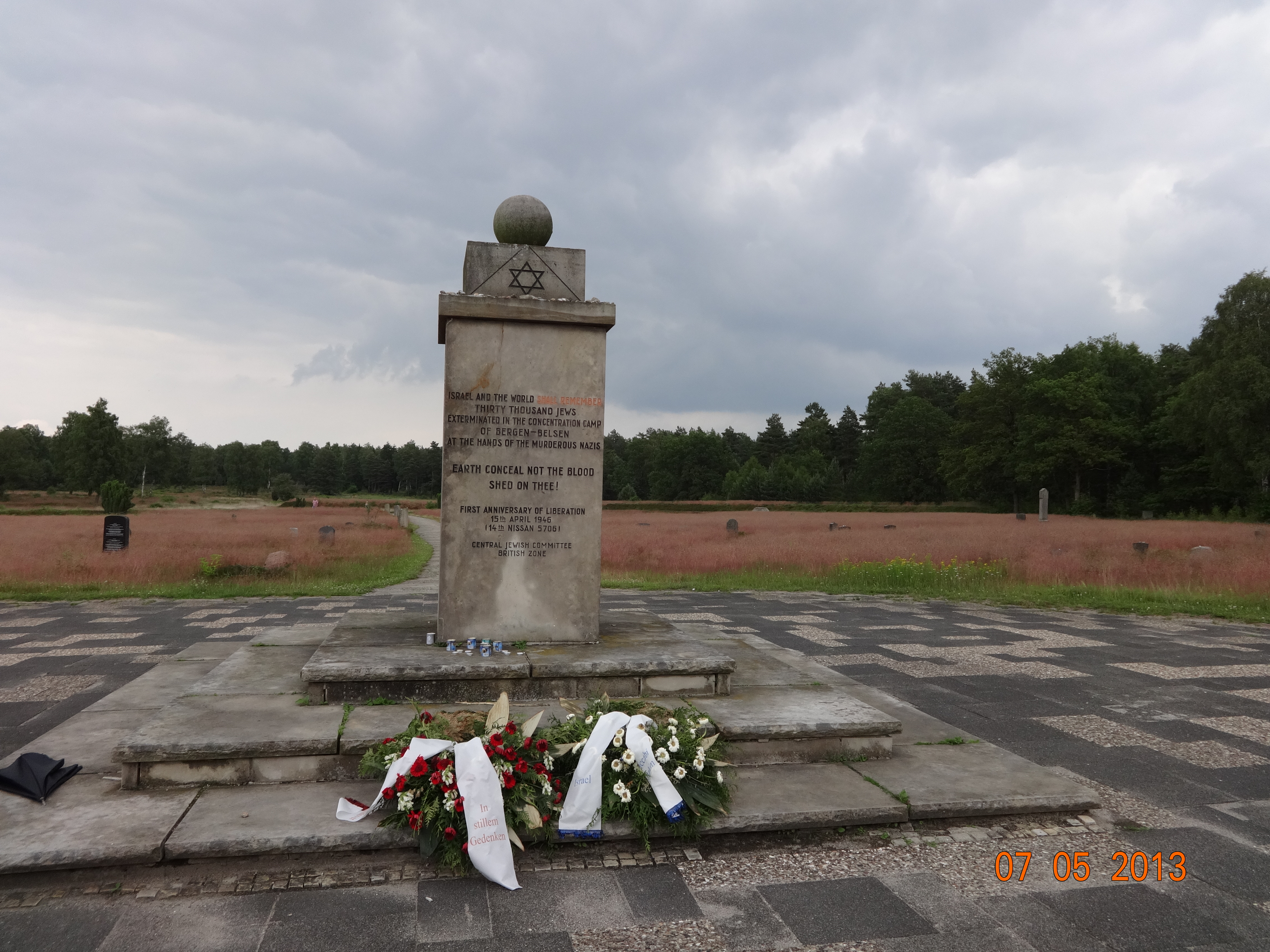
Memorial site, Bergen Belsen.

Memorial site, Bergen Belsen.

We see the road signs for the memorial and I think many of us on the bus draw a collective breath as it turns into the parking lot of Gedenkstatte (Memorial) Bergen Belsen. It is surrounded by trees. We are the only persons, besides staff, who are here. As we disembark off the bus, Tif ties an Israeli flag around her neck so it drapes like a cape. It is quiet. But the birds are singing.

Now I remember that in 2007 I was beginning my first communications with Christian and Bernd, then staff members at the Memorial. They were excited about the opening of their new exhibition hall and education center. Two years later they would fly over, with the historian Thomas, to take part in our 2009 reunion. So now I am here for the first time to see them again.

We meet the staff, who are still preparing for us. I’m listed on the program at lunchtime for a talk about the exchange camps and how the project is incorporated into the exhibition. Bernd enters the room and greets me warmly.

After an introduction to the history of the site, we  watch the silent movies shot by the British beginning the second day after the liberation. Perhaps you’ve seen the photos or the films. Belsen, in 1945, was the last stop, the terminus of the Holocaust, as one historian has described it. It was a scene of horror. If you see a photo of a soldier wearing a mask, maneuvering a bulldozer to push corpses into an open pit, that was Bergen Belsen. Just over a month later, the British commander ordered the lice infested, typhus ridden barracks put to the torch.
So now we are on the grounds of the former camp. As we exit the exhibition memorial hall, we are confronted with a long narrow corridor of concrete that we must pass through, reinforcing the fact that we are moving from present to past. And now we are here.DSC00432
To some visitors, there is nothing here, just inviting walkways with interpretive signage and some markers. Woods, and open fields. But on closer inspection, we see the outlines of the past in the ruins. We walk to barracks ten of the exchange camp. You can see the outline at the woodline. Some of the foundation stones are marked with the names of those who passed through them. We retrace the steps from the barracks to the latrine, now many meters away off a footpath in the enveloping woods. Nature reclaims. Out of the corner of my eye, down the long narrow strip mowed to infinity where a fenceline once ran, I see a large deer guide out of the woods, pause and look my way, and vanish just as soon as it appeared. Is it obscene to find in this place now a feeling of inner peace, to find beauty in the stillness of a grey afternoon? Maybe so. But I feel it.
Back inside, Bernd is talking to our group at the Exhibit where the evacuation transports from the exchange camps are outlined with the photographs of Major Benjamin and Dr. Gross. He explains that between April 6 and 9th, 6700 men, women and children were evacuated on three transports. The “lucky” train was liberated by the Americans on April 13. Friday. One train did make it to the destination of Theresienstadt, where the occupants were liberated the last day of the war. On April 23rd, the third train was liberated by the Red Army at Trobitz, across the Elbe.

 Bernd Horstmann, Custodian of the Book of Names,  Matthew Rozell, History Teacher, July 5, 2013. Bergen Belsen, Evacuation transports exhibit.

Bernd Horstmann, Custodian of the Book of Names, Matthew Rozell, History Teacher, July 5, 2013. Bergen Belsen, Evacuation transports exhibit.

Bernd explains that as the exhibition was being planned, his colleague Christian discovered the photographs that I had been given by the Dr. Gross to place on my website. It altered their vision of the exhibition and he described their excitement as the corroborated the testimony of the soldiers with the photographs. Yes, this is the Farsleben transport. Yes, this is the transport that the Americans called “The Train Near Magdeburg”. My fellow teachers ask questions, and learn more about the exchange camp. They are putting faces to the victims when they see the pictures. I am happy to share this experience with them. I am here, and I am seeing it for the first time with them. They are part of this experience, at our first major stop on the trip. Later, on the bus, some are excited to see the Benjamin photo in the official Bergen Belsen guidebook. In my being caught up in the presence of the moment, I neglected to purchase one for myself, but there it is. I was not even aware of it.
Back out to the camp. The solemn monuments marking the mass graves. 1000 Tote. One thousand DSC00490dead. 2500 Tote. Two thousand five hundred dead. And on and on, elevated mass graves. On to the commemoration room. Candles are lit, stones are placed, the prayers are recited in Hebrew and English, led by Pauline, the only other New Yorker on the trip with me. We are all moved. I think of Carrol Walsh, the tank commander who led me to this story, the liberator who did not want to be called a hero, or even a liberator. His own memorial service is today, half a world away, but I am here in this place to remember him as well. It is altogether fitting and proper. And perhaps it is also something destined to be.

This evening we depart from Hannover to Berlin. It is pretty crazy and unsettling at the Friday evening platform. 27 people have to run for the train, as the track has changed, with hundreds of others. Our original seats are taken, so we have to find other due to a mixup. But we do not lose anyone, and as I settle in next to a kind stranger, made welcome, I notice our station stops along the way- Brunswick. Magdeburg. We are roughly following the route of the train, and the 30th Infantry Division in 1945. What take us 35 minutes to cover, takes 6 nights and 7 days in April 1945.
Today was also something destined to be, the culmination of something incredible I am still trying to figure it all out- but this trip is helping me to place in proper context the elements of the greatest crime in the history of the world. As we leave this place of obscene beauty and peace, I think of  the I think of  the survivor’s words:

Remember Me.

Remember. Bergen Belsen, July 5, 2013.

Remember. Bergen Belsen, July 5, 2013.

Read Full Post »