Feeds:
Posts
Comments

Posts Tagged ‘Holocaust’

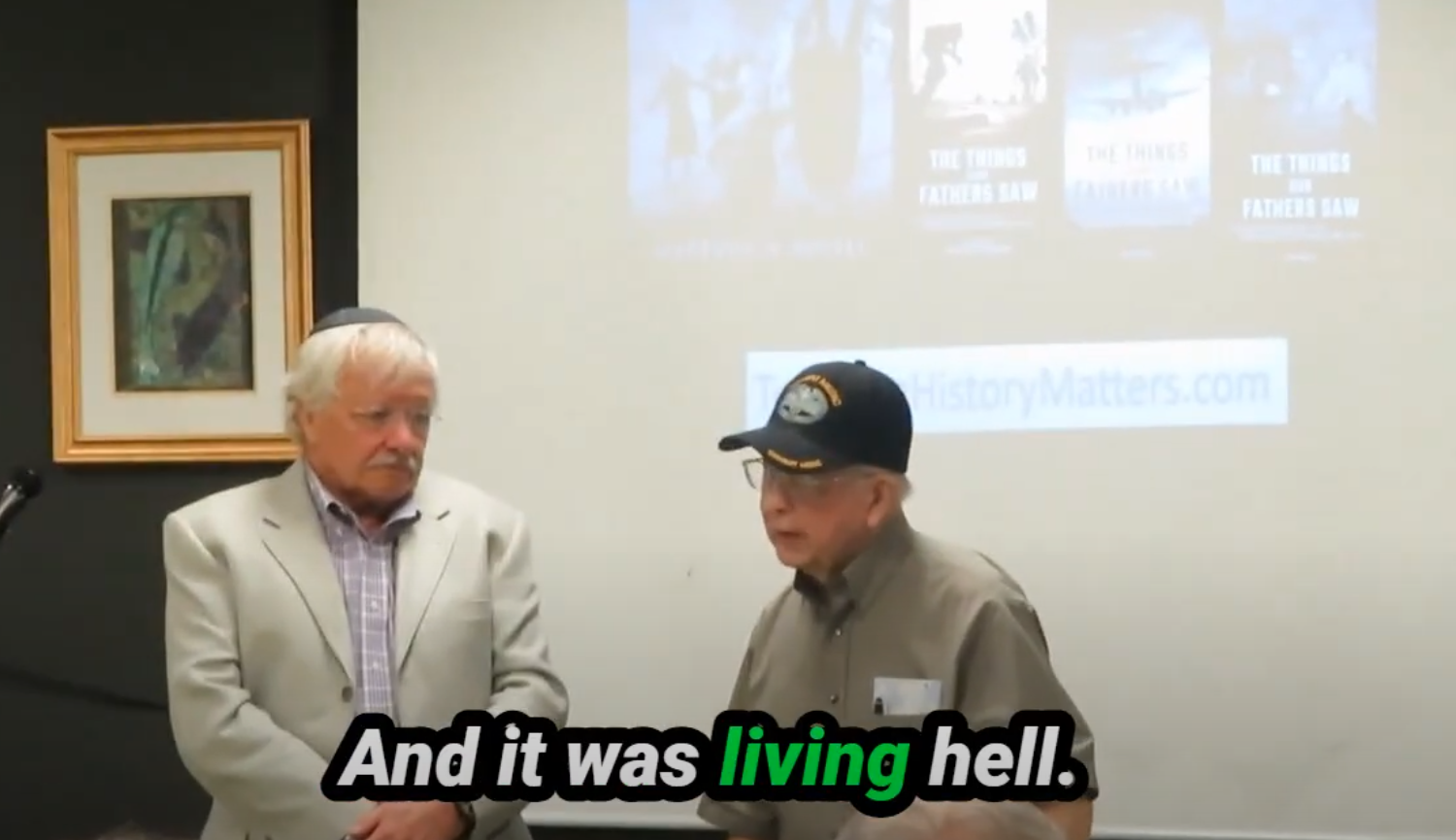
Screenshot of combat Medic Walter Gantz, and child survivor Oscar Schwartz, Warren County Community College, New Jersey, April 2019. Walter was 94 and would pass away before year’s end.

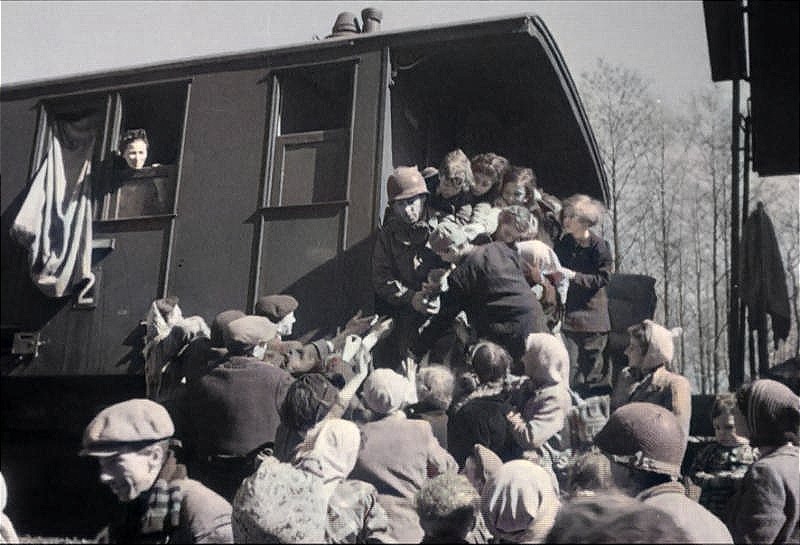
As we enter April 2025, the eightieth anniversary of liberation, more and more posts are rightly being generated on social media regarding it. Yad Vashem, World Holocaust Center, Jerusalem, earlier in the week posted a liberation photo on Facebook titled, “French soldiers meeting Jewish people who survived near Vaihingen, Germany, April 1945.” Their description:


“In the final months of the war, concentration camps were gradually liberated one after another. For the liberating forces, it was a glorious moment of triumph. But for the survivors — those who endured the horrors — the relief at war’s end was overshadowed by immeasurable pain and loss.
Freedom had arrived — but for many, it came too late.”

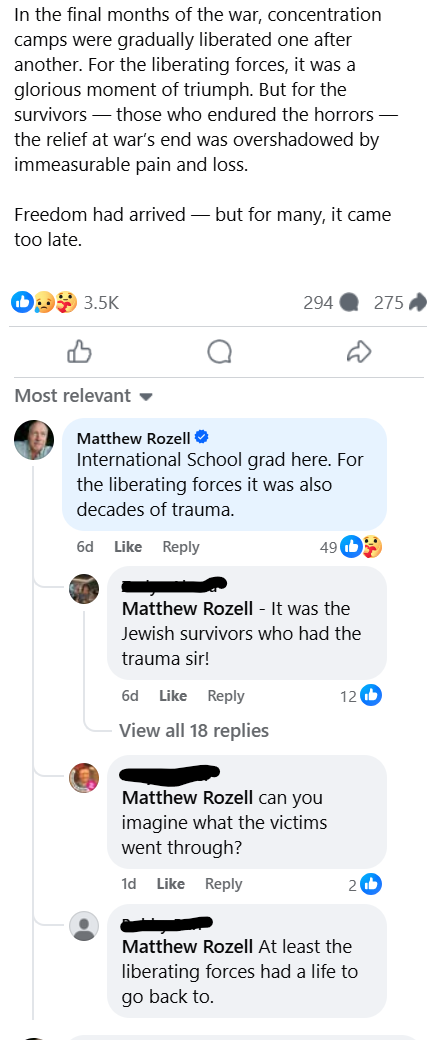
I shared it on my Facebook page, with my own take on their description.

Well, some decided they had to take me to task in the comments, the gist of which was that in pointing out the traumatic effects on liberating soldiers, I was disrespecting the experiences of the people they saved.

I recognize the trauma—I have been honored to know literally dozens of Holocaust survivors—and I have studied for nineteen days at their International School in Jerusalem, as well as experienced several weeks of touring the authentic sites of mass murder and suffering in this greatest crime in the history of the world with top notch scholars and historians and fellow teachers. Also, having been a USHMM Teacher Fellow, I felt pretty well informed enough to add my comment there, just that for the liberating forces, far from being a glorious moment of triumph, it was decades of trauma as well.

I don’t dispute any of their comments, but I think they were making assumptions, so I clarified, “Just as liberation was not the ‘happy end of the story’ for Jewish survivors, it did not end for the soldiers either. And no one is here to ‘compare pain’.”

And that is one of the tenets of Holocaust education. No one can suppose they know what the Holocaust survivors went through, except them, and that is why memoirs are so important. But to talk to the liberating forces, decades later, was also important. Walter Gantz told me, “Matt, for forty years, when our group (95th Medical Gas Battalion) met at reunions, we NEVER talked of Hillersleben. And my parents never knew I cried myself to sleep at night, when I got back.”

I found this video I took at a college in New Jersey where Walter got to meet one of the children he helped to save for the first time, and his take on his visit to Bergen Belsen. The trauma was still apparent after almost 75 years.

That’s all I was trying to say. So now I’ll let Walter tell you. It’s a 3 minute clip. [Only 8 people in the world have watched it thus far. I hope you can, in his memory.]

And I will end with the closing of my book, A Train Near Magdeburg:

A schoolkid once asked a survivor I know if anything good came out of the Holocaust. The survivor thought a minute, because it was an important question, and replied, ‘Yes. My rescuers.’
And here is where the story of the ‘Train Near Magdeburg’ will end, for now.


When we talk about the Holocaust, the sheer magnitude of it, there is no happy ending. For every single one of the approximately two-thousand five-hundred persons on the train who was set free, another two-thousand five-hundred persons perished in the Holocaust, most long before the Americans set foot upon the continent. And yet, at the end of the day, if we can say that somehow the soldiers and survivors in this book taught us something, perhaps the meaning is echoed in that three-word response.

I have found that in some educational circles the role of the American liberator is presented almost as an afterthought, and I would have to agree that when one is drawn into the unfathomable study of the Holocaust, liberation perhaps figures as a literal nano-episode.


They were not rescuers, in the formal sense of the word—that title is reserved for those without weapons, who risked their lives and usually the lives of their families by hiding Jews or some such noble action—but the nobility of the would-be rescuers who had weapons, the ones still fighting and being killed, the ones wholly unprepared for the catastrophes that played out before them on an hourly basis in April 1945 deserves a larger place in our national examination of the essence of what, indeed, ‘greatness’ is all about.

And here, I hope that the lesson is also one of humility; as they themselves stated in this book, it’s not about hero worship, or glorifying the liberator as some kind of savior. Many of the liberating soldiers would resist this, to the point of rejecting the term ‘liberator’— “It all sounds so exalted, so glamorous,” said one. But they will all accept the term ‘eyewitness.’

Eyewitnesses to the greatest crime in the history of the world; young men who ‘kept the faith’ of their fallen comrades, their country, and to humanity; witnesses who did something about what they saw.


Read Full Post »

Welcome to 2025, a momentous year for World War II remembrance and history. So glad that you can join us for these updates, the ‘octogintennial’ anniversary of the end of the war, and of the greatest crime in the history of the world, the Holocaust.Today is special for several reasons, two of which I will outline below.

Road to St. Vith, January 24, 1945. National Archives.

On December 16, 1944, the Battle of the Bulge began as Hitler’s last ditch effort to drive a wedge between the advancing American and British forces with a quarter million man German counteroffensive following D-Day and the Normandy breakouts of the summer and fall. Today, January 25, eighty years ago, all German forces had been pushed back to their original starting points; while the fight was not over for a long shot, today marked a turning point in the war in Europe.  Nineteen thousand American boys were killed in the bloodiest US battle of WWII, over the course of six weeks, in the coldest winter in European memory. Average age, 19. 80 years?  Was it really that long ago?


USHMM via Reuters.

Also on this day in 1945, the German SS dynamited the building of gas chamber and crematorium V in Auschwitz-Birkenau to destroy the evidence of their crimes as the Red Army approached from the east. The liberation of Auschwitz, the most notorious killing center of World War II, was at hand, the eightieth anniversary of which will be commemorated on Monday, January 27; one of my good Holocaust educator friends is co-leading a delegation of 50 or so survivors for this occasion. Talli and I were there together in an emotional journey I wrote about in my book, A Train Near Magdeburg.

This gas chamber operated from April 1943 to January 1945; Zyklon B was dumped in through openings after people were inside. 1.1 million people were murdered here, in a VERY short amount of time.

So what does it all mean, eighty years on? Time marches on, but as you may have read in my books, it’s not so much ‘how soon we forget’, as it is, ‘did we take the time to listen‘ the first time around, to our teachers, to our veterans? Do we as Americans even know our history? You know, in my books, I let the veterans and survivors speak for themselves, and for their friends and family who were killed or murdered. [I’m preaching to the choir now, and that’s the last thing I want to do-but hopefully we don’t move on until we pause and say their names.] 

And I’ll leave you with an upbeat note- I went into the classroom again in December to talk about Pearl Harbor and a local kid who died there, as I discussed in my first book, The Things Our Fathers Saw, Vol. 1, Voices of the Pacific. First time since retirement, and I’m happy to report the old man still has it, and the teenagers were HUNGRY for this knowledge, just like they were when I taught them at this high school in upstate NY. I left them all with free copies of that book with 19 year old Randy Holmes remembered in it. I’ll leave you with some books mentioned in this email below for further reading, and report back soon with some updates as 2025 moves on, with the anniversaries, and with our upcoming mini-series.Exciting!

~Matthew Rozell, Author/Educator

Read Full Post »

Liberation site, 13 April 2024. Photo by Daniel Keweloh. Note the visitation remembrance stones on the memorial.

April, 1945. Testimony of 17 year old Hungarian survivor Irene Bleier.

“In front of the cattle car, we could see German civilians from the two nearby towns running in opposite directions on the main road, trying to escape from the approaching US forces. With dulled sense, we glimpsed towards them. Several SS guards stayed with us. Some of them asked for—and received—civilian clothes from our people.

The next morning we dug up recently planted potatoes we found, made a fire, and cooked them. They tasted delicious. I again started walking towards the small pond, but then Jolan excitedly hollered to me: ‘Hey you, come back fast, the US Army has arrived!’

As much as my faint condition would allow me, I hurried to the scene of the miracle to welcome them, this being the big moment we so yearned for. Two angel-like American soldiers stood there beside their magic jeep. My sister and I looked on enchanted as they took captive the several SS cowards who stayed in their shameful and disgraceful uniforms. The SS henchmen held up their hands while one of the Americans stood opposite them with a pointed weapon. Then, the second US soldier searched their pockets.

Standing there and looking up at our liberators, I waited to sense some kind of emotion on this miraculous occasion—but no. Reality did not penetrate my consciousness. My senses were incapable of experiencing any signs of emotion; I had no tears of joy that appeared, nor even the slightest smile. My senses were left stiff, in the aftermath of extended suffering. We are liberated, but only outwardly. Our mind still remained under great pressure, as heavy, dark clouds obscured our world of comprehension. It will take a good many years to be free completely. When that time comes, if ever, we will be able to feel wholly liberated and shake off the shackles of bondage and imperceptible suffering. The majority of our group was so feeble that they stayed inside the crowded cattle cars. Some ventured to the nearby small towns for provisions. The following day, early in the afternoon, the US Army arrived with a big army truck. They brought us a delicious hot meal, potato goulash with veal meat. Never before in my life, or after, did I eat as tasty a meal as this. I just looked on as those US soldiers of valor took care of our group of two thousand, going from cattle car to cattle car so patiently. After suffering so long from inhuman treatment, I felt a great distinction to be treated with human kindness by those American soldiers. It was like being born again.

With their kind devotion toward us they sowed back into our souls the sparks and seeds of human hopes and feelings. By Sunday morning, my sister Jolan and I plucked up some courage and crawled out of the cattle cars to look around at the nearby town of Farsleben. We were pleasantly surprised to discover that US soldiers were already patrolling the locality. Some of our fellow Jews were also around and about. The local population either locked themselves in their homes or escaped. None of them ventured to welcome the new liberators.”


April 13.

Another year has gone by, since 1945, and since 2001 when I sat down with an 80 year old veteran, who would up telling me a story.

Today I am thinking of all my survivor families and friends, including those of the soldiers, who have now all pretty much left us. Last April on this day, I spoke to cadets at the USMA at West Point, officers in training about to go out into the world, about the actions of their forebearers across the generations at a place called Farsleben, Germany, honored to be there with the commanding general at my table.

Mike, Laura, Lee, and I then flew to Israel for a multi-day tour, interviewing a dozen or so survivors of the train and their families, thanks to our friend Varda W.

In June, the film crew made it up to Hudson Falls and the homestead to get more interviews.

In July, we discovered the lost footage of the train liberation shot on April 14, 1945 by the US Signal Corps. The discovery went ‘viral’ and has been viewed hundreds of thousands, if not millions of times.

In October, we toured the United States Holocaust Memorial Museum and interviewed historians and archivists who watched the story unfold, and gave their input for the film. We also talked to the United States’ Special Envoy for Holocaust Issues at the State Department. We know they appreciated this story, and we appreciate their interest and commitment, as it to no less than 60 communications to navigate and set up our interview.

Leaving Washington the afternoon of October 7, it became clear over the next few weeks that things had changed. The sheer horror and scale of the massacre and violence was dumbfounding as its scope became clear, on an unprecedented scale, since the Holocaust. The calculated evil that rolled through that morning and almost immediately elicited support in some cities in the west remains profoundly disturbing.

But today, as the world goes about its destructive business, a quiet ceremony took place at the liberation site in Farsleben, Germany, with committed locals and 2nd Gen survivors. My friend from Hillersleben Daniel K. took some photos. A beautiful April day, liberation day and today.

I spoke to attentive 10th graders this week, bringing them the message of what the soldiers did. We remember.

We hope to return next year for the 80th anniversary with the completed film, for more people to learn from, when the liberation anniversary appropriately falls on Passover.

Deliver us from evil.

Read Full Post »

Newly discovered US Army footage of the Train Near Magdeburg surfaces after 78 years.

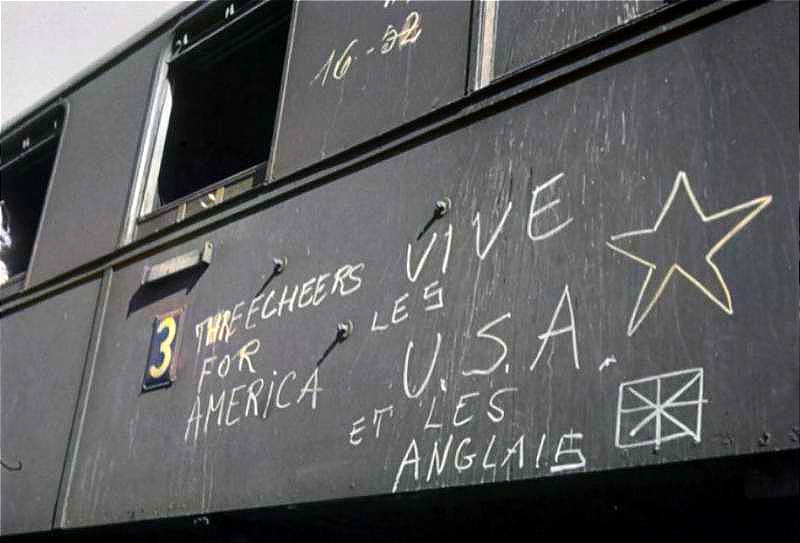
‘Three Cheers For America.’ Note numbers on car, Car #16 out of 52. Colorized still from newly discovered film.
American soldier handing out food, backing up as starving people swarm him. Colorized still from newly discovered film.

If you are coming to this website cold, as a public high school history teacher, 22 summers ago I sat down with an 80 year old WWII veteran, initially reluctant to tell his story, and almost forgetting to tell this part of it, but eventually, the following came out.

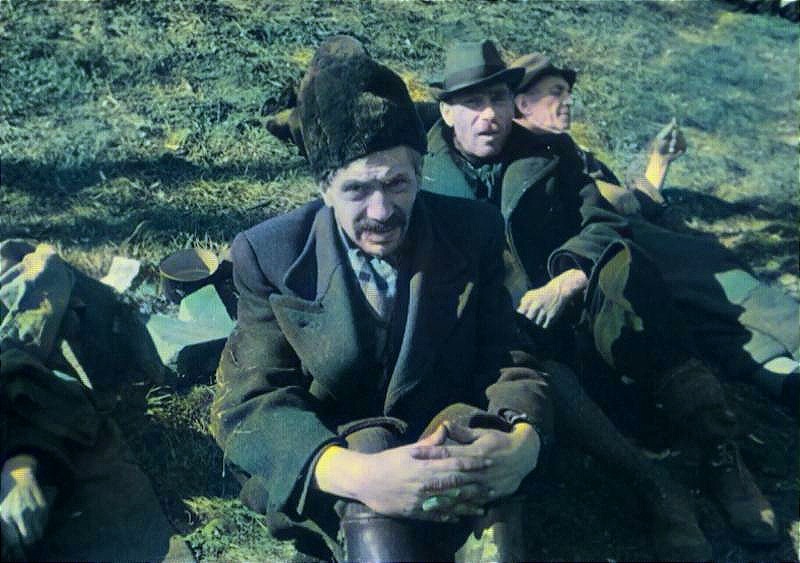
In the closing days of the war, fighting across central Germany, he and another tank commander came across a train stalled by the tracks with desperate people milling about. They were 2500 Holocaust victims from Bergen-Belsen. And they needed immediate help. Their major and one of the tank commanders had a camera. After my interviews with them, they gave me permission to place the photos on the school website.

Farsleben train, moment of liberation, Friday the 13th of April,1945. Two American tank commanders and their major in a jeep liberate the train. Major Benjamin snaps the photo.

Four years ticked by. Then I heard from a grandmother in Australia who had been a seven-year old girl on the train. Others followed. I was able to re-unite the liberators with the people and the families they saved as young men. Over eleven reunions on three continents took place. So now, twenty-two years after our initial interview, this footage of the event appears in my life.


Another miracle in a story of miracles. And this one is HUGE.

 A contact in Germany, Susanne at the museum in Wolmirstedt near the Farsleben, Germany liberation site outside of the city of Magdeburg on the Elbe River, recently emailed to say that she had seen part of a German documentary that included footage of people milling about a long train transport, and US Army soldiers helping, dispensing food and the like. She wondered if it was our train. Having been to the liberation site in person, and studying this story for decades, I was sure from the five seconds or so of a liberated train I watched that it was indeed our train.

Our team led by Mike Edwards inquired at the National Archives and just four weeks later, they sent the following footage to us. Of course, it had been filmed by the US Army Signal Corps in the aftermath of the Friday the 13th of April 1945 liberation, when our tankers of the 743rd came upon the train.

Newly discovered US Army footage of Farsleben train, April 1945. National Archives, public domain.
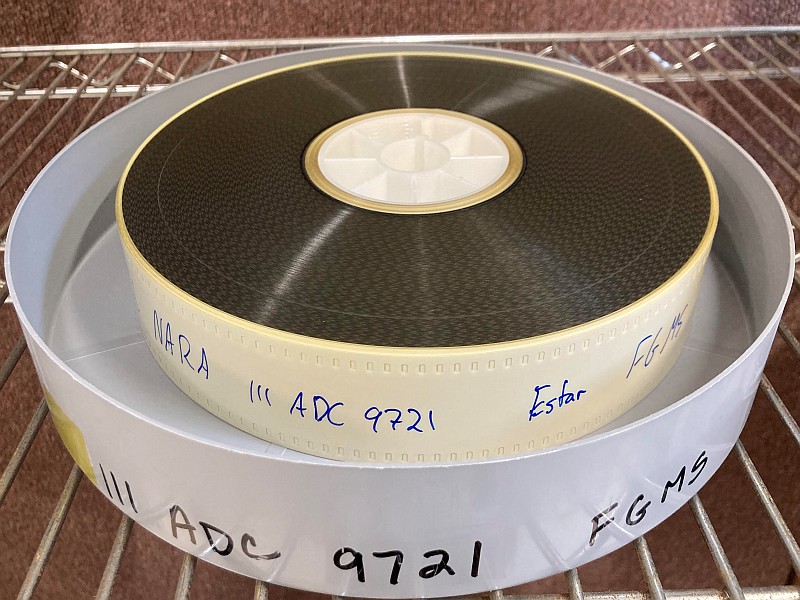
NARA photo of film reel can.

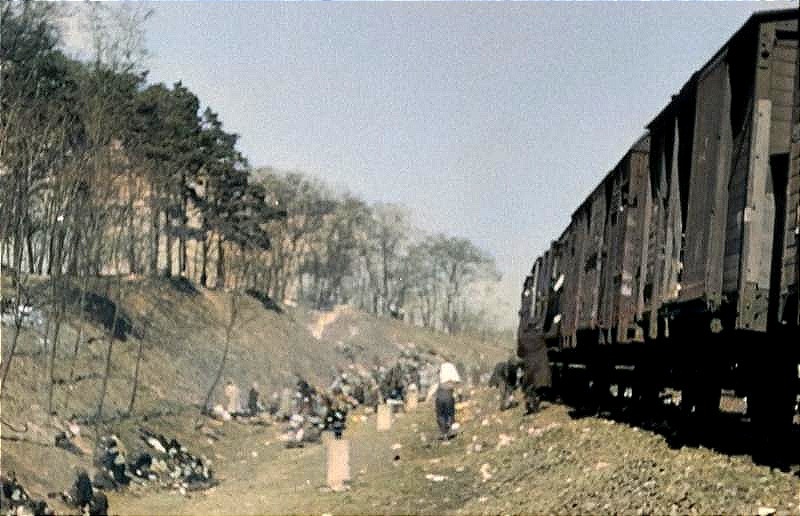
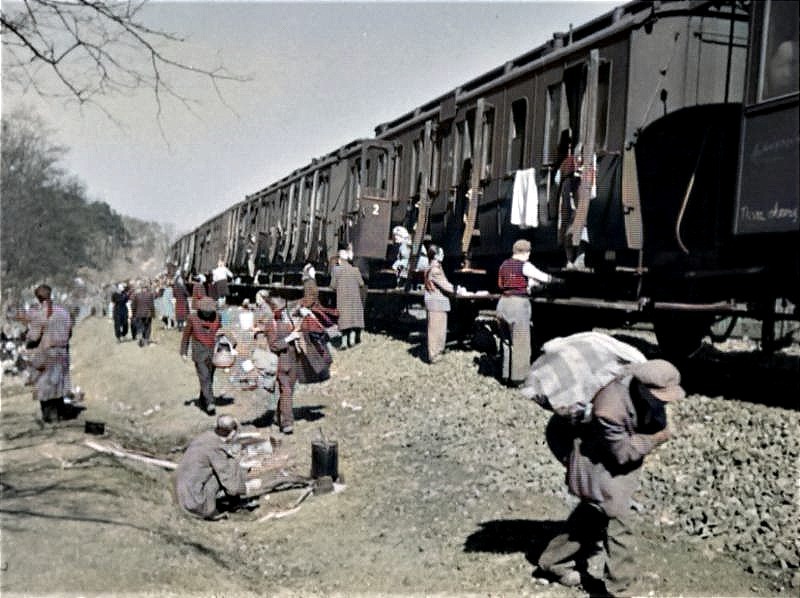
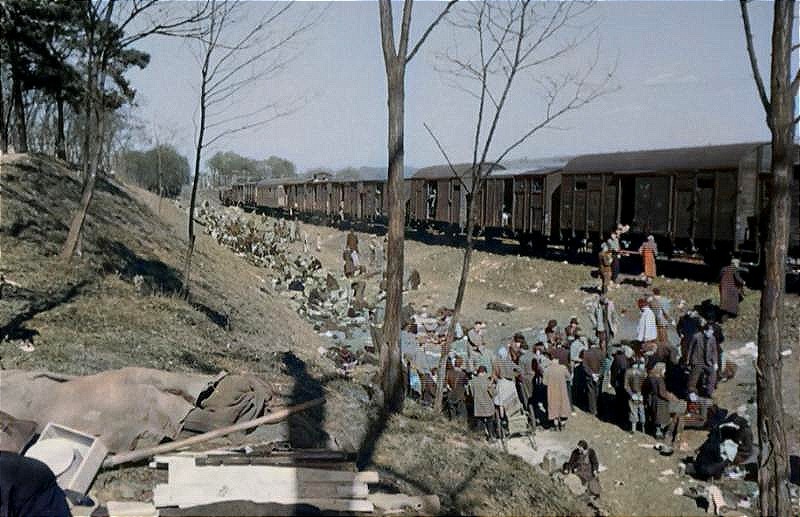
US SIGNAL CORPS footage reel dated 4.17.1945, in the immediate aftermath of the train’s liberation by the 743 Tank Battalion and 30th Infantry Division. No sound. From NARA: “Summary: Numerous scenes, freed Jewish prisoners in groups along railroad tracks. Their expressions furnish a clue to the suffering they endured. Individual shots: Men, women, and children, some of them in various stages of emaciation. Flashes of US soldiers distributing food. The group surrounding the soldiers push forward to receive meager bits of food. LS, village being shelled by German artillery from across the Elbe River.”

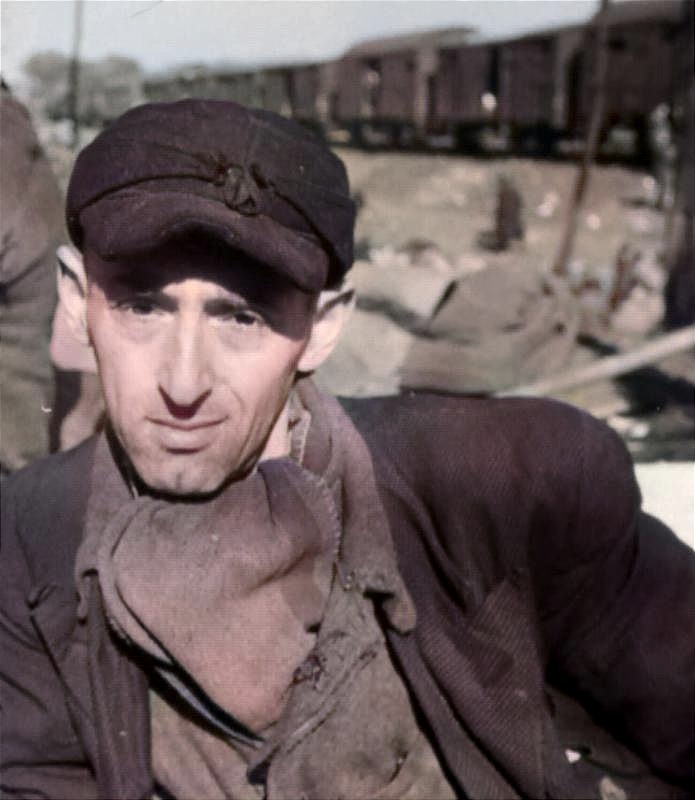
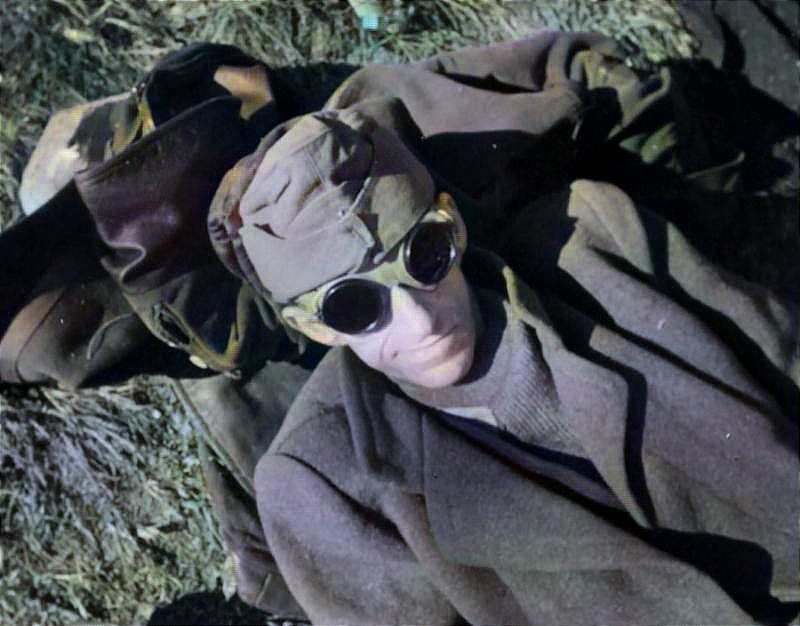
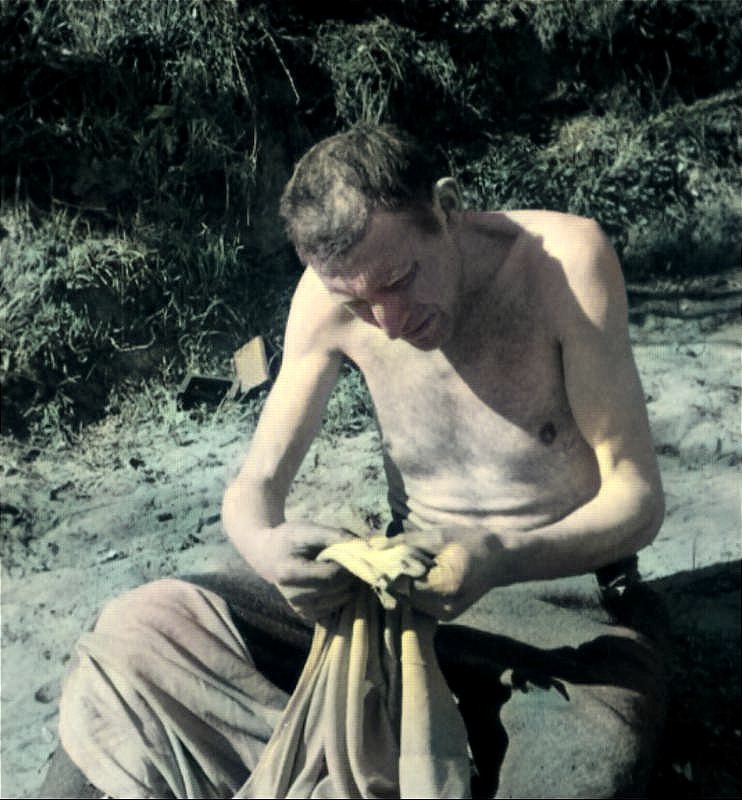
My best guess is that it was taken on Saturday 4.14.45, given the other US Signal Corps photographs from that day. What is fantastic is that this footage gives us a better perspective on liberation and its aftermath. Poignant and moving scenes: men crushing lice in their clothing. Families sprawled out, resting in the mid-April sunshine. Crowds swarming a soldier distributing food, bring to mind the Chuck Kincaid letter dated April 17, in which he expresses shock and horror at what he was seeing. A father holding his young daughter up so she can witness, and also put her hand out with the others. People in obvious distress, some likely very sick, some so exhausted they can hardly make an expression for the cameraman. The unsmiling little boy in hat, looking into the camera. The European script writing, numbering the cars, 52 of them, on the side of one of the cars; my guess is that it was done at Bergen-Belsen as they loaded the cars. And, of course, the beautiful American soldiers, trying to distribute food. Just who are they?

Red Walsh and George Gross and their tanks had departed for the final battle by the time of the Signal Corps arrival. Frank Towers was there, in and out that day, and medic Walter Gantz remembered being there that day.


I have been asked how I feel about this, surfacing 22 years to the day of my original interview with Red Walsh. With many of the stills, we have an entirely new portfolio of pictures to go through. We have already made one positive identification: the family of poet Yaakov Barzilai writes to confirm that he is visible in the footage, along with Yaakov’s mother and sister.

Top to bottom, in circle: Yaakov Barzilai, his sister Yehudit, his mother Iren, seated.
Yaakov and author this spring in Israel.

So if you are a person who follows my blog from the early days, you know that not just is this an astounding development, but also one that confirms again that the past still has secrets to reveal, that in contextualizing the photos and film into the story of the Train Near Magdeburg, more healing is already taking place in our mission to ‘repair the world’. [And if you can see yourself, your family, or recognize any of the people, reach out to me here in the comments, or drop a line to matthew@matthewrozellbooks.com.]


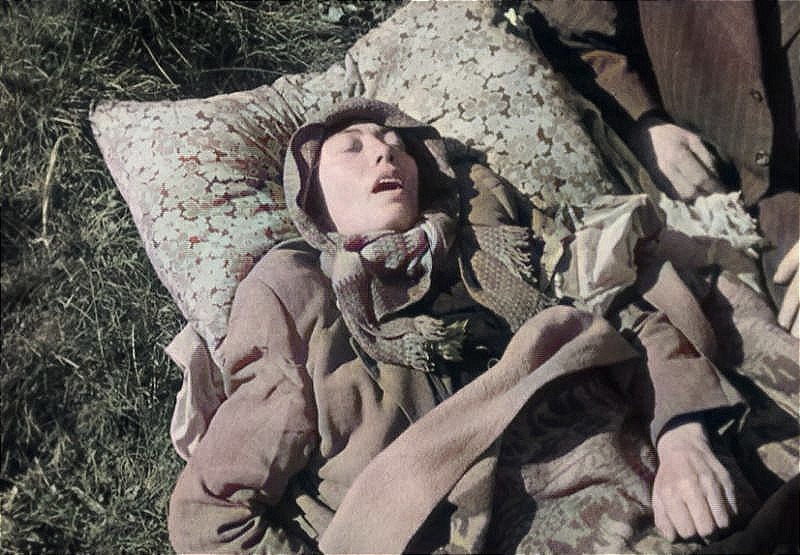
A boy after liberation.

So, how does this make me FEEL? Frankly, it is immensely gratifying, though even without this footage, this is an incredible story. But to actually see the newly discovered film is another nail in the coffin of Holocaust denial. The soldiers didn’t lie. They WITNESSED it with their own eyes, and suffered the consequences themselves.

I cannot say that I am entirely shocked or stunned at this amazing development, because, as I told my wife, this is larger than any of us. We are part of a cosmic, maybe holy process, a process of the unfolding of the ‘so many miracles’ of this story. I’m sad that my four soldier friends mentioned above and all my survivor friends who have also now passed, are not with us to see it, to comment on it, to share in it with me and the living survivors and their families. But I am grateful to be able to live it now, and I am proud that those twenty-two years ago I had the audacity to want to have a conversation with a reluctant World War II veteran, and the curiosity to pause and take note of what he revealed upon his daughter’s prompting, to begin what would become this never-ending journey to help heal the world, and now with a team dedicated to telling this story to the world on film. It is with an undying sense of Wonder that we get to witness yet again the Power of LOVE transcending Time and Space. Of the GOOD countering the evil.

Seventy-eight years vanishes in an instant. This project is a portal, evidenced many times over. So I’m proud of it, but also humbled by it. And I’m humbled by all the people all over the world who have also come believe in it, and champion the message, and healing the world with their own love and compassion. This is larger than all of us.

Below you will find a gallery of stills of the train and the people captured on that film 78 years ago, which I derived/created this weekend from the public domain film, and also added some color to, to highlight the scenes. [Tap the thumbnails for the information icon with my labels/captions; please write for permission if you wish to use any of them.] And don’t forget to write or comment below if you recognize someone!


The rest of the US Army Signal Corps film can be viewed here, including the famed ‘meeting at the Elbe’ on April 25 and 26 at Torgau.

Read Full Post »

Today marks a watershed moment in the history of the Holocaust, one I knew little about until my advanced studies.

Over 33,000 people were murdered, by hand, at close range, at the edge of a ravine.

In two days.

Did you learn about this in school? Why was it not widely known? The killers came from all over Germany, ‘ordinary men’, the bulk of whom went on to live out their days unaccountable for their crimes. Perhaps some are still walking among us.

So I’ll share these two posts that came up in my social media feed this morning. The first is from the organization. ‘Yahad – In Unum is the leading research organization investigating the mass executions of more than 2 million Jews and tens of thousands Roma/Gypsy people in Eastern Europe between 1941 and 1944.’ Important, literally groundbreaking work. Check Father out.

The second is from Yad Vashem in Jerusalem (where I studied for three incredible weeks!), Israel’s Holocaust Martyrs’ and Heroes’ Remembrance Authority and World Holocaust Remembrance Center, ‘the ultimate source for Holocaust education, remembrance, documentation, and research. From the Mount of Remembrance in Jerusalem, Yad Vashem’s approach incorporates meaningful educational initiatives, groundbreaking research, and inspirational exhibits,’ one of which is in the link.

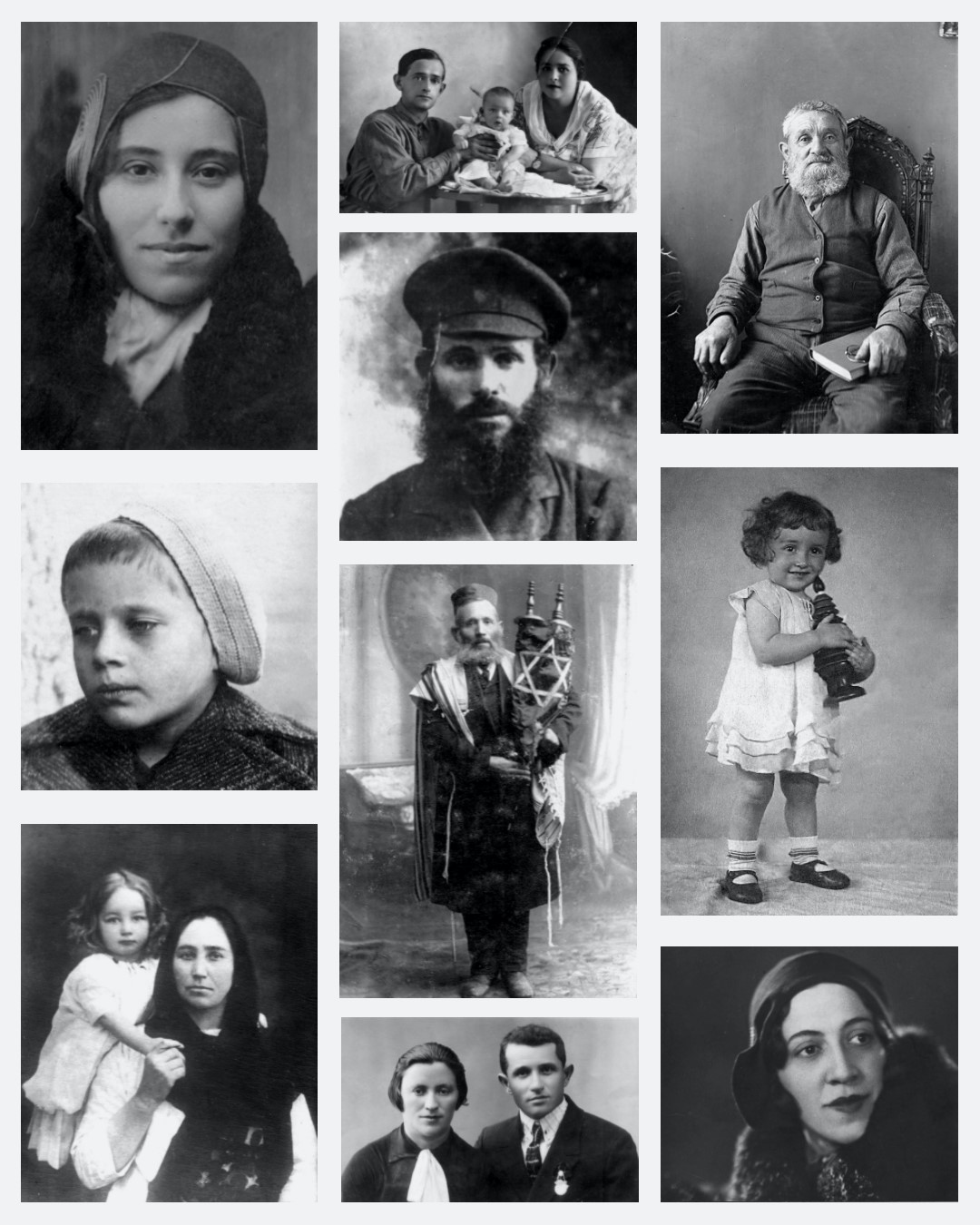
Study the faces. Never forget.


80 long years have passed since the 29th and 30th September 1941. Commemorating the Babi Yar massacre is not about remembering a number, however great it may be.
It is about remembering that more than 30,000 women, children, men, grandparents were taken from their homes, were forced to move to an unknown destination, a destination that would become their Babi Yar grave, simply because they were born Jewish.

The Ravine at Babi-Yar. September, 1941.


They were shot by German gunmen from all over Germany. And then thousands of neighbors watched, most of them passive, as their Jewish neighbors left the building forever.
80 years have passed. The memory was suppressed during the Soviet era, the bodies were burned by the Germans to erase forever the evidence of the crimes committed.
Finally, a memorial is being built after so many years of absence. It will probably be the first large memorial located near a mass grave.
Mass graves do not usually serve as memorials. The victims are killed, the pits are filled and silence falls.
This memorial is an act of justice for these women, children, adults shot because they were Jews. One by one we find the sacred names of each of them.
Today, over 150 German criminals at Babi Yar have been identified. Tens of thousands of Jewish victims are being identified.
A man-made mass crime machine is made up of human beings. Every German, every Ukrainian is fully responsible for having taken part in the Nazi criminal machine.
Babi Yar also represents a reminder that other mass murders have been perpetrated, by ISIS in broad daylight in Syria, in Iraq, by Boko Haram in Nigeria, by others in the Mail, in Niger.
Babi Yar is also a signal: sooner or later, where you kill, throw bodies into pits, we will come back. The names of the victims will be found and sanctified. The names of the perpetrators will not be drowned in silence.

-Father Patrick Desbois, Yahad – In Unum


Marking 80 years to the Murder of the Jews at Babi Yar >> https://bit.ly/3kGVRSh

On 29-30 September 1941, approximately 33,771 Jewish men, women and children from Kiev and the surrounding areas were murdered at Babi Yar by Einsatzgruppe C soldiers with the assistance of local collaborators. Jews who managed to escape the massacre in September but were discovered in the ensuing months, were also brought to Babi Yar and murdered.

80 photos and stories of the Jews murdered at Babi Yar are now online in a special exhibit just launched on the Yad Vashem website.

The photos were submitted to Yad Vashem together with Pages of Testimony containing the names and brief biographical information of the victims. Each Page is a mute testament to the persecution of an entire Jewish community: Rabbis, teachers and pupils, traders and artisans, philosophers and scientists- and in many cases entire families.

In this moving exhibit we can see the faces and explore the stories of 80 of the Jewish men, women and children who were murdered 80 years ago at a ravine called Babi Yar. Explore the exhibit here >> https://bit.ly/3kGVRSh

Read Full Post »

Holocaust survivor Ariela Rojek, right, was 11 years old in 1945 when she and 2,500 other concentration camp prisoners aboard a train near Magdeburg, Germany, were liberated by American forces including 1st Lt. Frank Towers, left with his son Frank Towers Jr., center. “You gave me my second life,” Rojek told Towers Wednesday, Sept. 21, 2011, at Hudson Falls High School during an event reuniting soldiers and survivors. Jason McKibben Glens Falls Post Star

It was 12 years ago years ago this evening, we shared a meal on the eve of Shabbat, after watching ourselves on a national broadcast that reached millions. Why does it seem, so long ago?

Maybe because it all seems so unbelievable- that out of the darkness of the past, on a day when the sun dawned clearly and was warming the Earth in its mid-April morning ascent, a low rumble was heard by  hushed and huddled groupings of tormented humanity as they strained to hope for friends amidst their lurking murderers. As the metallic clanking grew louder, over the horizon broke the earthly angels, two Sherman light tanks and an American Jeep with the emblem of the white star. A cry broke out. They realized they were saved, and the American major snapped a photograph at the exact moment the overjoyed survivors realized it.

And out of the past on a warm September day, we brought them all together again. Who would have believed that 62 years later, a high school in a quiet, rural part of the world would  bring the soldier-liberators and the rescued survivors together from the US, Canada, Israel and elsewhere? All because I couldn’t let go of a good narrative history, and pursued the story behind the photographs that proved it really happened?

And think about the risk you run, inviting hundreds of octogenarians to come to a high school for half a week to mingle with thousands of high school and middle schoolers? Talk about sweating bullets. What if they are uncomfortable? Cranky? Complaining? What if the kids I can’t control are rude? And what if one of these “old” folks, who I don’t even know, dies on our watch? I would lie awake at night wondering if I was out of my mind.

But the miracle came to be-for the two dozen or so elders who could come, tears flowed, wine spilled, and our “new grandparents” danced with young teenagers who adored them, but only after the risk was accepted, with the enthusiastic help of Mary Murray, Tara Winchell-Sano, and Lisa Hogan, Rene Roberge and others. Have a look at the videos, and feel the love. We created ripples, and tripped the wires of the cosmos, and the reverberations are still echoing. To date, with Varda Weisskopf’s and Frank Towers’ help, the list is at 275 survivors whom we have found. And how many generations has it effected?

This is the subject of my second book, A TRAIN NEAR MAGDEBURG, the PBS film of which is due out in 2022. In the meantime, I am working on a shorter work of what I have learned in teaching the lessons of the Holocaust. So take a look at the videos, and remember the words of the liberator:

“Here we are! We have arrived!”

Read Full Post »

April 30 1945 Headlines. Hangs in my classroom.

April 30 1945 Headlines, on display in my classroom.

A few days ago, it was the anniversary of the liberation of Dachau, 76 years on. This is a post I have shared in the past. I think it is important.

Today, if the anniversary is brought up at all, some of us might respond with a vacant stare. More might shrug and turn away. I suppose that is to be expected. But you know me. I just think that as a nation, sometimes we allow things to slip from memory at our peril.

It was real, and it happened. And it was American GIs who overran this camp and many others in the closing days of World War II.

The men of the 42nd and 45th Infantry Division arrived independently of each other, here, in southern Germany, at Dachau, on this day. A concentration camp, they were told. Their noses gave them a hint of what they were about to uncover, miles before the camp appeared in sight.

Read the headlines, above. Note the subarticle:

Boxcars of Dead at Dachau. 32,000 captives freed.

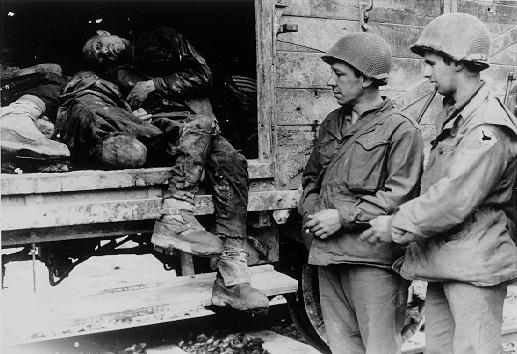
American soldiers view the bodies in one of the open railcars of the Dachau death train. USHMM

American soldiers view the bodies in one of the open railcars of the Dachau death train. USHMM

And so after some resistance, into the camp they entered. Life changing events were about to unfold for the American soldier.

***

For me, it’s not about hero worship, or glorifying the liberator or any World War II soldier by placing him on a pedestal. Our time with them is now limited, but many of the liberating soldiers I know push back at this, to the point of rejecting the term, “liberator”- “It all sounds so exalted, so glamorous” said one. But they will all accept the term, “eyewitness”.

Witnesses to the greatest crime in the history of the world.

So instead I think it is about honoring their experiences, their shock, the horror, the puking and the crying, the rage-and then, the American GIs recognizing that something had to be done. And they did suffer for it, for trying to do the right thing. Many tried to help by offering food to starving prisoners who just were not ready to handle it, only to see them drop dead. Or having to manhandle these emaciated victims who were tearing away at each other as food was being offered.

Some guys never got over it. How could you?

I have learned so much over the past few years from these guys, just through the way that they carried themselves and tried to cope with what they witnessed. In my World War II studies and Holocaust class, we discuss these issues at length. I’m so lucky to be able to teach it.

A few years back, I was privileged to teach a lesson to my high school seniors for NBC Learn, which was shared with other districts across the nation. Later, I stumbled upon this piece by the late author Tony Hays, who writes about his liberator father and his own encounter with the past. Thanks to the Get It Write folks; the original link is at the bottom.

***

Dachau Will Always Be With Us

by Tony Hays

This is not so much a post about writing as one about a writer’s education, about one of those experiences that molds us, shapes us into storytellers. I read yesterday the story of Joseph Corbsie, whose father, a World War II veteran, left him with a special legacy from the war, from the hideous Nazi concentration camp at Dachau. I feel a particular kinship with Mr. Corbsie.

My father, Robert Hays, was the son of an alcoholic tenant farmer in rural west Tennessee. If the appellation “dirt poor” fit anyone, it fit my grandfather’s family. Daddy served in the Civilian Conservation Corps during the 30s. He and my mother, who was in the woman’s equivalent of the CCC, working as a nurse’s aide at Western State Mental Hospital in Bolivar, Tennessee, met on a blind date in early 1940 and married in September of that year.

But just over a year later, Pearl Harbor happened. America was in the war. My father was among the first of those drafted in 1942. I won’t bore you with the details, but he participated in the North African, Salerno, Anzio, and southern France invasions, saved by the luck of the draw from Normandy. But they slogged through France and on to Germany. On April 29, 1945, Allied troops liberated the Dachau concentration camp. I don’t know whether he entered Dachau that day or the next, but that he was there within hours of the liberation is beyond dispute. A few months later, after more than three years overseas, he came home.

In later years, he would talk occasionally about the war, providing anecdotes that showed the chaos and random chance of battle. He spoke of driving through Kasserine Pass in North Africa just hours before the Germans killed thousands of Allied troops in a stunning attack. He spoke of a friend, defending his position from a foxhole, who was thought dead after an artillery shell landed right next to him. When the dust cleared, the friend was buried up to his neck in dirt, but did not have a scratch on him. He spoke often of Anzio, where he was wounded, and of the massive German air assaults on those soldiers clinging to that tiny sliver of beach along the Italian coast.

But he never spoke of Dachau.

The bodies of former prisoners are piled in the crematorium mortuary in the newly liberated Dachau concentration camp. Dachau, Germany, April 29, 1945.

The bodies of former prisoners are piled in the crematorium mortuary in the newly liberated Dachau concentration camp. Dachau, Germany, April 29, 1945. USHMM.

Ever.

When he died in 1981, we found a photo in his wallet. An old sepia-toned shot like others he had taken during the war, pictures that he kept in an old brown bag. But this one was different.

It showed a pile of naked bodies. Well, really more skeletons than not, with their skin stretched pitifully over their bones. On the back, as had been his habit, was typed simply “Dachau.”

I was confused. Why would he keep this one photo in his wallet all of those years? Especially a photo of a place and event that he never spoke about. It obviously had some deeper meaning for him than the other photographs. If it had been a shot of the building he was in when he was wounded (hit by an artillery shell), I could have seen that. A reminder of his closest brush with death. Yeah, I could buy that. But this macabre photo? That, I couldn’t see.

So, for the next fifteen years, I remained puzzled.

Until the fall of 1996. I was working in Poland, and I had some time off. I took an overnight bus from Katowice, Poland to Munich. It was an interesting trip all in itself. We sat in a line of buses at midnight on the Polish/German border, waiting for our turn to cross, next to a cemetery, as if in some Cold War spy movie. I remember passing Nuremburg and thinking that my father had been there at the end of the war. And then there was Munich.

I spent a day or two wandering through the streets, drinking beer in the Marienplatz. I’m a historical novelist, so the short trip out to Dachau was a no-brainer. Of course it was as much my father’s connection with it as anything else that spurred the visit. But I’m not sure that I was completely aware of that at the time.

Dachau literally sits just on the outskirts of the Munich metropolitan area. I looked at the sign on the train station with a sadness, wondering for how many people that had been one of the last things they saw. It was only later that I discovered there had been another depot for those passengers.

The Dachau Memorial is a place of deep emotion. In the camp proper, mostly all that are left are the foundations of the barracks. One has been reconstructed to give an idea of how horrible life must have been. The camp was originally intended to hold 6,000 inmates; when the Allies liberated Dachau in 1945, they found 30,000. The museum and exhibits are primarily in the old maintenance building. I looked with awe at life size photos of prisoners machine gunned, their hands torn to ribbons from the barbed wire they had tried to climb in a futile attempt at escape.

I followed the visitors (I can’t call them tourists) north to where you crossed over into the crematorium area. It was there that the full brunt of what had taken place at Dachau really hit me. A simple brick complex, it seemed so peaceful on the fall day that I stood before it. But as I read the plaques and consulted my guidebook, as I stepped through the door and actually saw the “shower” rooms where the prisoners were gassed, as I stared into the open doors of the ovens, I felt a rage unlike any I had ever known consume me.[i]

That night, I went to the famous Hofbrauhaus in Munich, to wash the images of the ovens away with some beer. I hadn’t been there long when an elderly American couple sat at the table. They were from Florida, a pleasant couple. He had been a young lieutenant in the American army on the push into Munich. In fact, it had been his pleasure to liberate the Hofbrauhaus from the Germans.

Of course, I asked the question. “Were you at Dachau?”

He didn’t answer for several seconds, tears glistening in the corners of his eyes as his wife’s hand covered his and squeezed. Finally, he nodded, reached into a back pocket and pulled out his wallet.

With a flick of his wrist, a photo, just as wrinkled, just as bent, as the one my father had carried landed on the table. It wasn’t the same scene, but one just like it.

Here was my chance, the opportunity to ask the question I had never been able to ask my father. I pulled the photo from my own wallet and lay it next to his. “Why? Why have you carried it so long? To remind you of the horror of Dachau, of what had been done here?”

His face carried the faintest of smiles as he shook his head. “No, son, to remind us of the horrors that we are capable of, to remind us not to go down that road again.”

The difference was subtle, but in that moment, I learned two lessons invaluable to a writer, subtle differences are important, and when you want to know the truth, go to the source.

As I sit here now and look at that same photograph, I realize that it was my father’s legacy to me, of Dachau. Joe Corbsie’s father left him something more tangible, a reminder of the same thing for the same reason, but more forcefully stated — a tiny box of human ash from the ovens.

Dachau is still with us, and I hope the legacy left by our fathers always will be.

The late Tony Hays.

[i] Where the prisoners were gassed- “In 1942, the crematorium area was constructed next to the main camp. It included the old crematorium and the new crematorium (Barrack X) with a gas chamber. There is no credible evidence that the gas chamber in Barrack X was used to murder human beings. Instead, prisoners underwent “selection”; those who were judged too sick or weak to continue working were sent to the Hartheim “euthanasia” killing center near Linz, Austria. Several thousand Dachau prisoners were murdered at Hartheim. Further, the SS used the firing range and the gallows in the crematoria area as killing sites for prisoners.” Source: United States Holocaust Memorial Museum. “Dachau” Holocaust Encyclopedia. https://encyclopedia.ushmm.org/content/en/article/dachau

Read Full Post »

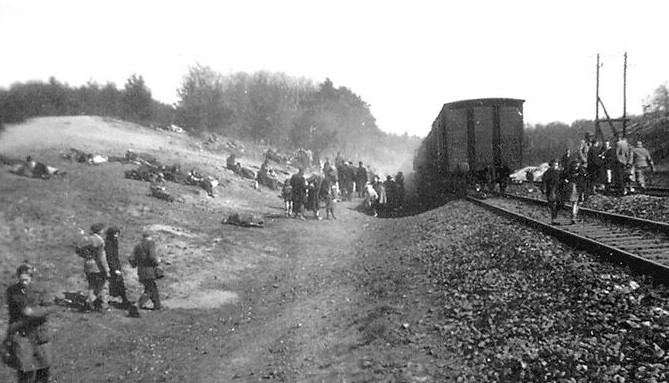
On this day the Train Near Magdeburg, pictured above in the 743rd Tank Battalion’s After Action Report following the 4-13-1945 liberation near the Elbe River, was just beginning its week-long final journey from the horrors of the Bergen-Belsen concentration camp.

I think back to nineteen summers ago, when I sat down to record the memories of an 80-year-old tank commander, Carrol Walsh, who had fought from Normandy, into Germany, back into Belgium for the Battle of the Bulge, and then back across Hitler’s Western Wall, who almost forgot to tell me the story of the train fifty-six years before. About his rejection of the mantle of “LIBERATOR”, but his acceptance of being a WITNESS, of being a symbol of the army that did something about what they saw.

I think today about George Gross, the other tank commander that day who had the camera and the photographs to prove that 2500 souls on their way to being murdered were in fact REAL, that the event DID happen, and that the Holocaust would never be forgotten. Of his years recounting the girls on that train, the children, and speaking to them and meeting the ones who could make the pilgrimage to meet him.

I think about Frank Towers, the lieutenant charged with getting these poor people out of harm’s way, as a new battle for the city of Magdeburg was about to unfold. The same Frank who excitedly beat a path to my door sixty-one years later to explain his role, and who went on with train survivor’s daughter Varda Weisskopf and I to track down over 275 survivors of that train all those years later, organizing over 11 reunions on 3 continents over 10 years.

I think today about the medic Walter Gantz, who suffered nightmares for decades after treating the victims on the train for six weeks after liberation, some literally dying on him, his trauma evident sixty-six years later in recalling carrying in his arms a sixty-pound fifteen-year-old girl’s body down the stairs in the middle of the night to a makeshift tent morgue. Of his call to my classroom to introduce himself, telling these thoughts to my high school seniors, and the salving of his scars in getting to speak to the former young people he saved so many decades later.

I think about all the beloved survivors and their families―such loving people who broke down, cried, laughed, danced with their liberators and fellow American WWII soldiers―so many whom I hold close in my heart forever.

I think about the words of one of them every year, an annual email that would arrive on this day from Leslie Meisels, recalling with his survivor “twins” the anniversary of their “re -birth”, their good fortune and gratitude for their liberating heroes, the miracles of survival and liberation, and the miracle of meeting them again.

And I wonder again why God put me on this path to bring a bit of healing to the world.

I have asked Him, ‘why me’, over and over.

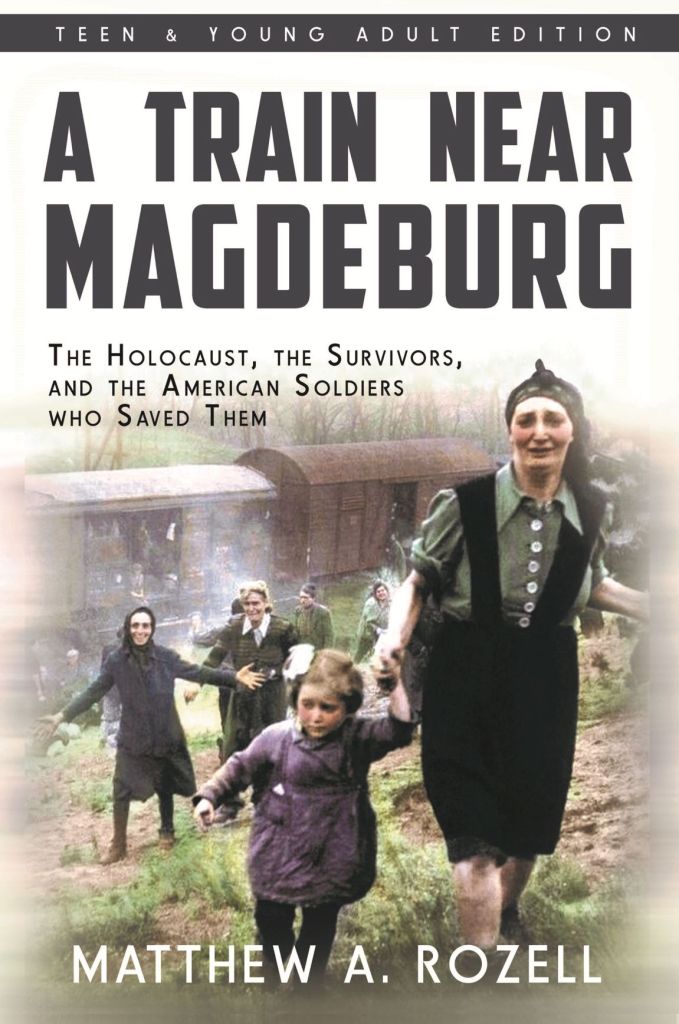
So we planned a trip to the proposed 75th anniversary of liberation ceremony with survivors, 2nd and 3rd Generation survivors and liberating soldiers’ families. Funds were raised and a monument created. The pandemic hit, the event was postponed, and in the meantime, several survivor friends have passed. One wonders what it all means, from time to time. But German high schoolers and their teacher and others have gotten involved in the project to honor the survivors, and have been fortunate enough to meet some very special ones. Our film project is back on track, the monument has been laid, and I have published a Young Adult version of the story.

But as I string these thoughts together, I’m reminded of the notes I got in my email inbox so early on the morning of the 75th anniversary from Germany at the liberation site, and again today on the 76th, so I think also about these German students so focused now on learning more about what transpired in their country, in their own backyard―not out of a sense of atonement for the deeds of generations past―no one can atone for those crimes, and frankly that is not their ‘job’―but simply out of LOVE.

LOVE. And HOPE. And maybe even FAITH.

And I still see these young adults as some sort of new symbol, the newest witnesses, at once comforting and profound and at once a source of light, of life, and yes maybe re-birth.

Last year I could not witness the planned re-unification of the saved and the saviors, the healing touches passing in the land where the crimes were perpetrated, but in reading these narratives and seeing these photographs I am renewed by witnessing a new generation arising out of the utter destruction, the evil, and the hatred of 75 plus years ago― in this form of a girl and her teenage friends planting new seeds, literally, at this site where people expired with the words “SALVATION” and “FREEDOM” on their lips, and I see from afar the honoring of the goodness that radiated from the deeds of those American soldiers, really not so long ago.


My name is Johanna, I am 19 years old and from Wolmirstedt near Farsleben. I have always taken a huge interest in history, but other than the important happenings and times you get taught at school, I would rather be told the unknown stories, the events that, in the grand scheme of things seemed so unimportant, but still impacted numerous people deeply, moved them enormously and, unfortunately, are forgotten about way too often.
When I first heard the story of the train, I thought to myself: “This cannot actually have happened so close to my home, otherwise we would have surely heard about it before. How could this remarkable story have been forgotten?”

1945 this day . The hill behind Johanna and the stone is visible. people were dead or dying there. George C Gross

So, I joined the project group of the story of the “Stranded Train”, and what started out as wanting to learn more  about what had actually happened on  April 13, 1945 and also seizing the opportunity to speak English more often, soon turned into this mission that I just could not let go… I suddenly found myself doing more and more research, about people who were a part of these events all those years ago and almost naturally , the stories of the survivors,  those who liberated them, and those who took them into their homes after this train had stopped right on their  doorstep, all became a part of my life.


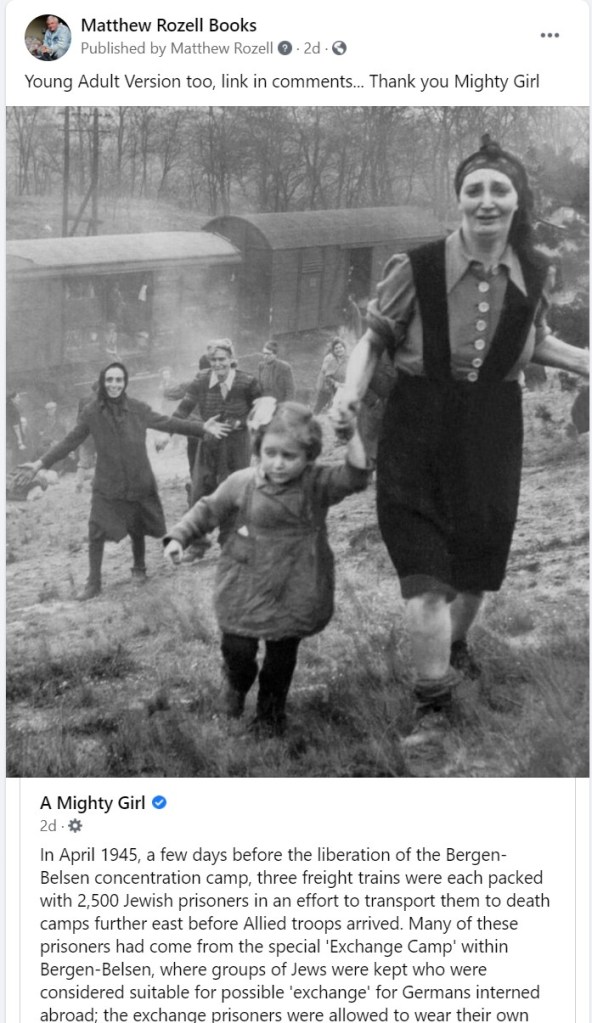
SCREENSHOT OF ‘A MIGHTY GIRL’ POST. CLICK TO READ ORIGINAL. [THEY ACTUALLY READ THE BOOK…]

RECENT UPDATES: A recent write-up on A Train Near Magdeburg was posted by “A Mighty Girl” on their FB page, with 2.5 M followers. I was impressed, they actually read the book, and continue to empower girls and young women, featured especially in the Young Adult version of the book.

Our film plans were sidelined, along with the rest of life, but now are back on track. Seeking sponsorship at all levels, especially corporate, for our PBS distributor-accepted film. Details on benefits and how to help are here (OPENS AS PDF). Thank you if you have given in the past, and be assured that it will happen!

The Young Adult version of our book is here, if you would like to check it out.

The Young Adult version is here.

Read Full Post »

April 30 1945 Headlines. Hangs in my classroom.

April 30 1945 Headlines, on display in my classroom.

Today, April 29th, is the anniversary of the liberation of Dachau, 75 years on.

Today, if it is brought up at all, some of us might respond with a vacant stare. More might shrug and turn away. I suppose that is to be expected. But you know me. I just think that as a nation, sometimes we allow things to slip from memory at our peril.

It was real, and it happened. And it was American GIs who overran this camp and many others in the closing days of World War II.

The men of the 42nd and 45th Infantry Division arrived independently of each other, here, in southern Germany, at Dachau, on this day. A concentration camp, they were told. Their noses gave them a hint of what they were about to uncover, miles before the camp appeared in sight.

Read the headlines, above. Note the subarticle:

Boxcars of Dead at Dachau. 32,000 captives freed.

American soldiers view the bodies in one of the open railcars of the Dachau death train. USHMM

American soldiers view the bodies in one of the open railcars of the Dachau death train. USHMM

And so after some resistance, into the camp they entered. Life changing events were about to unfold for the American soldier.

***

For me, it’s not about hero worship, or glorifying the liberator or any World War II soldier by placing him on a pedestal. Our time with them is now limited, but many of the liberating soldiers I know push back at this, to the point of rejecting the term, “liberator”- “It all sounds so exalted, so glamorous” said one. But they will all accept the term, “eyewitness”.

Witnesses to the greatest crime in the history of the world.

So instead I think it is about honoring their experiences, their shock, the horror, the puking and the crying, the rage-and then, the American GIs recognizing that something had to be done. And they did suffer for it, for trying to do the right thing. Many tried to help by offering food to starving prisoners who just were not ready to handle it, only to see them drop dead. Or having to manhandle these emaciated victims who were tearing away at each other as food was being offered.

Some guys never got over it. How could you?

I have learned so much over the past few years from these guys, just through the way that they carried themselves and tried to cope with what they witnessed. In my World War II studies and Holocaust class, we discuss these issues at length. I’m so lucky to be able to teach it.

A few years back, I was privileged to teach a lesson to my high school seniors for NBC Learn, which was shared with other districts across the nation. Later, I stumbled upon this piece by the late author Tony Hays, who writes about his liberator father and his own encounter with the past. Thanks to the Get It Write folks; the original link is at the bottom.

***

Dachau Will Always Be With Us

by Tony Hays

This is not so much a post about writing as one about a writer’s education, about one of those experiences that molds us, shapes us into storytellers. I read yesterday the story of Joseph Corbsie, whose father, a World War II veteran, left him with a special legacy from the war, from the hideous Nazi concentration camp at Dachau. I feel a particular kinship with Mr. Corbsie.

My father, Robert Hays, was the son of an alcoholic tenant farmer in rural west Tennessee. If the appellation “dirt poor” fit anyone, it fit my grandfather’s family. Daddy served in the Civilian Conservation Corps during the 30s. He and my mother, who was in the woman’s equivalent of the CCC, working as a nurse’s aide at Western State Mental Hospital in Bolivar, Tennessee, met on a blind date in early 1940 and married in September of that year.

But just over a year later, Pearl Harbor happened. America was in the war. My father was among the first of those drafted in 1942. I won’t bore you with the details, but he participated in the North African, Salerno, Anzio, and southern France invasions, saved by the luck of the draw from Normandy. But they slogged through France and on to Germany. On April 29, 1945, Allied troops liberated the Dachau concentration camp. I don’t know whether he entered Dachau that day or the next, but that he was there within hours of the liberation is beyond dispute. A few months later, after more than three years overseas, he came home.

In later years, he would talk occasionally about the war, providing anecdotes that showed the chaos and random chance of battle. He spoke of driving through Kasserine Pass in North Africa just hours before the Germans killed thousands of Allied troops in a stunning attack. He spoke of a friend, defending his position from a foxhole, who was thought dead after an artillery shell landed right next to him. When the dust cleared, the friend was buried up to his neck in dirt, but did not have a scratch on him. He spoke often of Anzio, where he was wounded, and of the massive German air assaults on those soldiers clinging to that tiny sliver of beach along the Italian coast.

But he never spoke of Dachau.

The bodies of former prisoners are piled in the crematorium mortuary in the newly liberated Dachau concentration camp. Dachau, Germany, April 29, 1945.

The bodies of former prisoners are piled in the crematorium mortuary in the newly liberated Dachau concentration camp. Dachau, Germany, April 29, 1945. USHMM.


Ever.

When he died in 1981, we found a photo in his wallet. An old sepia-toned shot like others he had taken during the war, pictures that he kept in an old brown bag. But this one was different.

It showed a pile of naked bodies. Well, really more skeletons than not, with their skin stretched pitifully over their bones. On the back, as had been his habit, was typed simply “Dachau.”

I was confused. Why would he keep this one photo in his wallet all of those years? Especially a photo of a place and event that he never spoke about. It obviously had some deeper meaning for him than the other photographs. If it had been a shot of the building he was in when he was wounded (hit by an artillery shell), I could have seen that. A reminder of his closest brush with death. Yeah, I could buy that. But this macabre photo? That, I couldn’t see.

So, for the next fifteen years, I remained puzzled.

Until the fall of 1996. I was working in Poland, and I had some time off. I took an overnight bus from Katowice, Poland to Munich. It was an interesting trip all in itself. We sat in a line of buses at midnight on the Polish/German border, waiting for our turn to cross, next to a cemetery, as if in some Cold War spy movie. I remember passing Nuremburg and thinking that my father had been there at the end of the war. And then there was Munich.

I spent a day or two wandering through the streets, drinking beer in the Marienplatz. I’m a historical novelist, so the short trip out to Dachau was a no-brainer. Of course it was as much my father’s connection with it as anything else that spurred the visit. But I’m not sure that I was completely aware of that at the time.

Dachau literally sits just on the outskirts of the Munich metropolitan area. I looked at the sign on the train station with a sadness, wondering for how many people that had been one of the last things they saw. It was only later that I discovered there had been another depot for those passengers.

The Dachau Memorial is a place of deep emotion. In the camp proper, mostly all that are left are the foundations of the barracks. One has been reconstructed to give an idea of how horrible life must have been. The camp was originally intended to hold 6,000 inmates; when the Allies liberated Dachau in 1945, they found 30,000. The museum and exhibits are primarily in the old maintenance building. I looked with awe at life size photos of prisoners machine gunned, their hands torn to ribbons from the barbed wire they had tried to climb in a futile attempt at escape.

I followed the visitors (I can’t call them tourists) north to where you crossed over into the crematorium area. It was there that the full brunt of what had taken place at Dachau really hit me. A simple brick complex, it seemed so peaceful on the fall day that I stood before it. But as I read the plaques and consulted my guidebook, as I stepped through the door and actually saw the “shower” rooms where the prisoners were gassed, as I stared into the open doors of the ovens, I felt a rage unlike any I had ever known consume me.[i]

That night, I went to the famous Hofbrauhaus in Munich, to wash the images of the ovens away with some beer. I hadn’t been there long when an elderly American couple sat at the table. They were from Florida, a pleasant couple. He had been a young lieutenant in the American army on the push into Munich. In fact, it had been his pleasure to liberate the Hofbrauhaus from the Germans.

Of course, I asked the question. “Were you at Dachau?”

He didn’t answer for several seconds, tears glistening in the corners of his eyes as his wife’s hand covered his and squeezed. Finally, he nodded, reached into a back pocket and pulled out his wallet.

With a flick of his wrist, a photo, just as wrinkled, just as bent, as the one my father had carried landed on the table. It wasn’t the same scene, but one just like it.

Here was my chance, the opportunity to ask the question I had never been able to ask my father. I pulled the photo from my own wallet and lay it next to his. “Why? Why have you carried it so long? To remind you of the horror of Dachau, of what had been done here?”

His face carried the faintest of smiles as he shook his head. “No, son, to remind us of the horrors that we are capable of, to remind us not to go down that road again.”

The difference was subtle, but in that moment, I learned two lessons invaluable to a writer, subtle differences are important, and when you want to know the truth, go to the source.

As I sit here now and look at that same photograph, I realize that it was my father’s legacy to me, of Dachau. Joe Corbsie’s father left him something more tangible, a reminder of the same thing for the same reason, but more forcefully stated — a tiny box of human ash from the ovens.

Dachau is still with us, and I hope the legacy left by our fathers always will be.

The late Tony Hays.

[i] Where the prisoners were gassed- “In 1942, the crematorium area was constructed next to the main camp. It included the old crematorium and the new crematorium (Barrack X) with a gas chamber. There is no credible evidence that the gas chamber in Barrack X was used to murder human beings. Instead, prisoners underwent “selection”; those who were judged too sick or weak to continue working were sent to the Hartheim “euthanasia” killing center near Linz, Austria. Several thousand Dachau prisoners were murdered at Hartheim. Further, the SS used the firing range and the gallows in the crematoria area as killing sites for prisoners.” Source: United States Holocaust Memorial Museum. “Dachau” Holocaust Encyclopedia. https://encyclopedia.ushmm.org/content/en/article/dachau

Read Full Post »

“To Mom and Dad, Babe” WW2 medic, Walter ‘Babe’ Gantz, left

The Old Coach is being buried today. As I write this, he is being eulogized by those who knew him and loved him best. Losing an old soldier is a heavy road I have been down many times, but it’s taken me a week to compose my thoughts on best serving his memory.

In a previous Army life, combat medic Walter Gantz of the 95th Medical Battalion was known as the ‘Sharpshooter’, not for killing people in wartime, but for his uncanny ability to sight in on impossible to find veins in skin-and-bones-bodies racked with disease, malnutrition, and dehydration with a life-giving needle. And he went on giving life after the war, leading by example and taking the needle himself, personally donating 27 gallons of blood to the American Red Cross and spearheading the collection of thousands more in his hometown.

I last talked to Babe, as he liked to sign off in his letters, a few months ago. It had crossed my mind to call him again on his 95th birthday this year, November 1st, but I guess I was busy or put it off to the weekend, figuring I still had time.

I wanted to ask him if he would like to return to Germany with us this coming April, to the site of the Holocaust train liberation of the Train Near Magdeburg and a monument unveiling for the 75th anniversary, in the presence of survivors and 2nd and 3rd generation descendants of survivors and other American liberators associated with the liberation of the train. And to meet the German schoolkids, one a 17-year-old who became a pen pal for a while, when I told her to write to him with her questions. Of course, he wrote back!

You see, Walter was a hero to a lot of people. Mike, the filmmaker for the documentary we are working on, remembers driving many hours to pull up at his house to meet him, to get an interview for our film—”I got out of my car, Walter took my hand and looked me straight in the eye and thanked me for coming to tell the story.”

Walter died on November 27th, in the morning, exactly a week ago. His son-in-law Ken reached out to me shortly afterwards, and I have been struggling to find the words ever since; it did not register at first because it just did not seem possible. When I met him in April—he was waiting for me in the lobby of the hotel. He had arrived an hour early, having driven himself to the hotel where we were staying.

I don’t have many heroes. But I met one in April. WW2 combat medic, Walter Gantz–and he squeezed my hands so hard…

Walter got emotional. The Old Coach in his red athletic hoodie grabbed my two hands with the grip of the 20-year-old he had been as a medic at Hillersleben, the captured German Luftwaffe base and weapons proving ground 74 years before. “Matt Rozell, God bless you!” Mike snapped a picture. “It’s a good thing I am as cool as a cucumber; otherwise I would be real nervous about all this!”

We talked for a while. He lived only three minutes away in the hills overlooking the city, the ‘Polish Alps’ as he calls it, where his parents had raised him, most of the community having emigrated from Poland in the early part of the previous century to work in the mines. He remembered attempts at conversations with the Polish survivors at Hillersleben, how he could pick up word and phrases, and he remembered child survivor Micha Tomkiewicz’s Polish mother distinctly, an educated woman who also had medical knowledge and training. He remembered Gina Rappaport, a survivor from the Krakow Ghetto who spoke seven languages and translated for the people on the train. And he was so sorry to have missed the reunions (11 in all) in the past, but I did not even know about him until he called my classroom in October 2011, shortly after our Sept. 2011 final school reunion.

We were in Scranton for a film shoot-re-introducing him to survivor Judah Samet of Pittsburgh, who came with his daughter for a meeting and lunch with Walter and his family. Walter cried.

As it happened, I was scheduled to give a talk in New Jersey the next week. Walter and his son-in-law Ken made the trip, and when a New York based train survivor learned about it, he and his family came to meet Walter in another emotional meeting. More tears were shed, and students got to witness it.

As he recalled,

“After 70 years, I still get emotional. I try to control my emotions, but it’s impossible. I know I keep repeating the word, ‘helpless.’ It’s a good way to describe this situation, really. Yet as medics we did everything humanly possible to help; I would say without a question we saved a lot of lives. We really did save a lot of lives. When you hear them saying ‘heroes,’ we medics weren’t considered heroes, but I guess we were the unsung heroes. It’s a long time ago, over 70 years. It’s a lifetime. Sadly, in time, your memories become dimmed—but there are certain events that will stay with a person all of their lifetime.

 The whole experience [of being reunited with survivors over 70 years later] has made me feel ten feet tall, and I have to use the word ‘mind-boggling’—I guess you’d have to put it in the category of a dream… all the survivors keep saying is, ‘Thank you, thank you, thank you.’”

Walter signed off on one of his letters to me.

Some of the boys couldn’t take this type of duty and had to be sent back to our headquarters… My parents never knew of Hillersleben; the 95th held more than 40 reunions and barely a word was mentioned concerning Hillersleben.

Matt, I wish you well in all your endeavors. God’s blessings to you and yours.


As ever,

Walter (Babe) Gantz

Member, 95th Medical Bn.


I think the best way to serve your memory, Walter, is to keep on keeping on in our ongoing endeavor, that you and your deeds are never forgotten, and generations of people will know and celebrate the goodness in humanity in recalling your life and the lives of all the soldiers and liberators through the book A Train Near Magdeburg, and our upcoming film of the same name. God bless YOU, my friend, and Godspeed.


Walter (Babe) Gantz Obituary

Walter (Babe) Gantz, 95, South Scranton, died peacefully Wednesday morning at Geisinger Community Medical Center surrounded by his family. His wife of 69 years, Charlotte Jean Kester Gantz, died in 2018.

Son of the late Frank and Rose Slangan Gantz, he spent his entire life in the South Side area. A graduate of Central High School and Keystone Junior College, he was a member of St. Stanislaus Polish National Catholic Cathedral.

During World War II, he served as a surgical technician with the 95th Medical Battalion. He was the recipient of the Combat Medical Badge, Bronze Star, Joint Service Commendation Medal, Army Commendation Medal, Meritorious Unit Citation and many other awards. He served in northern France, Rhineland, central Europe and Ardennes campaigns. During the Korean War, he was a member of the 79th Infantry Division.

In early 1944, he volunteered on a secret mission in the wetlands of southern Florida. It was a joint effort involving American, British, Canadian and French Armed Forces. Their task was to test clothing to be used in the event of chemical warfare. He was seriously burned by nitrogen mustard gas and was hospitalized at MacDill Air Force Base. His group was placed under 24-hour guard.

One of the greatest satisfactions of his lifetime was to reunite with the boys from his medical battalion after being separated for 18 years. He always referred to it as a “labor of love.” The first three reunions were held in Scranton and the 50th anniversary was also held locally. He remained as the only president of its association.

He was a great sports enthusiast throughout his lifetime, both as a player and coach. He was a member of the YMS of R team in the first-class Scranton association, the top amateur league. He also played with some of the best softball teams in the area. In 1945, while waiting to be transferred to the Pacific, his battalion’s softball team won the championship at the Arles staging area with a record of 35 wins and five losses. The staging area, located in northern France, consisted of more than 250,000 troops. In 1960, he formed the first slow-pitch league in NEPA. An outstanding distance runner, he continued to do so in his middle 70s. He was considered one of the top speed skaters in the area. While in the service, he was an assistant coach and member of the battalion boxing team. While in his 80s, Babe was a team adviser to the women’s softball team at Baptist Bible College. He continued in this role well into his 90s. He derived great satisfaction in hearing the players refer to him as Coach Walt. Most of the young generation referred to him as the “Old Coach.”

Babe was involved in community affairs throughout his lifetime. He was elected to a six-year term on the Scranton School Board in the 1970s. As the overseer of athletics, he was successful in introducing cross county in the district. He was noted for his objectivity while on the board. In the early 1980s, when the AIDS epidemic became known, he was a member of the initial committee to study its local impact.

As an AIDS instructor, he spoke at many of our high schools and colleges. Babe also served on the hemodialysis commission. As a combat medic, it was an easy decision for him to join our blood program in 1948. He served at the head of every volunteer office at the Scranton Chapter blood program and was its first representative to the NEPA Blood Center. He was the sole remaining member of the initial committee that organized the South Scranton Ecumenical Blood Council. The group collected more than 17,000 units of blood. Leading by example, he donated 27 gallons locally. In 2015, he retired from the program after 65 years. As the Americanism chairman for the American Legion Central District, he attended many services for those who made the supreme sacrifice during the Vietnam War.
Babe was an ardent believer in physical fitness. He would say to both young and old, “Keep those legs moving.”
Babe had a perpetual smile and when greeting you by your first name, he would always follow it with “God bless you.” It was easy for him to find the good in everyone. A spiritual individual, he tried his best to walk in the path of God.

He always said that he was truly blessed that he rubbed shoulders with so many individuals. In many instances he played the role of mentor, conveying any words of wisdom that he possessed.

He enjoyed music and said it was a source of strength during difficult times. His favorites were bluegrass, hymns, big band and the classics. In the evening, he spent many hours reading in his den. His topics ranged from Abraham Lincoln, World War II and those of a spiritual nature. For many years, he and Jeanie were seen at the area polka dances. Also for many years, the family enjoyed walking around Lake Scranton. He was an ardent fisherman and spent much time at his favorite pond, saying it was a great way to relax.

One of the most memorable events in his later years was having the honor and pleasure of meeting many Holocaust survivors at the Teen Symposium sponsored by the Holocaust Education Resource Center. For a number of years, he related his experience treating survivors from the Bergen-Belsen Concentration Camp. His medical battalion set up a hospital to meet their needs. They were victims of what was known as “The Death Train at Magdeburg.”

In 2010, Babe was the recipient of the Hero of Combat, Hero of Compassion award by our local group for his humane endeavors. He is also portrayed in the book called “A Train Near Magdeburg,” written by Matt Rozell, and will be featured in the upcoming documentary by the same name.

Although he was very devoted to his family, he credits his wife, Jeanie, for faithfully providing the everyday needs of their children while he was away or on assignment.

Surviving are three daughters, Debbie Gantz, Lake Winola; Linda Guarino and husband, James, Blakely; and Doreen Klinkel and husband, Kenneth, Dalton; grandson, Tony Guarino; great-grandson, Elijah Guarino; nieces and nephews; and a sister-in-law, Shirley Angelis, Lake Ariel.

He was preceded in death by a brother, Frank Gantz, and two infant brothers, Steven and Walter Gantz.

The funeral will be Wednesday at 9:30 a.m. from the Leon S. Gorgol Funeral Home, 1131 Pittston Ave., with Mass at 10 in St. Stanislaus Polish National Catholic Cathedral. Interment with military honors will be at Abington Hills Cemetery.

Published in Scranton Times on Dec. 1, 2019

Read Full Post »

Older Posts »