"for the sake of humanity"… A small town American high school history project changes lives worldwide. These are the observations of a veteran teacher- on the Power of Teaching, the importance of the study of History, and especially the lessons we must learn, and teach, on the Holocaust. Click on "Holocaust Survivors, Liberators Reunited" tab above to begin.
Violins of Hope. Train to Magdeburg tour of Israel, 2023.
We are in Jerusalem now, the City of God, after 22 hours of travel.
The last time I was here, I was studying at Yad Vashem, Israel’s Holocaust Martyrs and Heroes Remembrance Authority in the summer of 2016. That is when liberating soldier Frank Towers left us.
I am here with filmmaker Mike Edwards, crew Joe Hammers and Josh Fronduti, scriptwriter Lee Shackleford and his wife Karen and my wife Laura. Our mission is to interview a dozen Holocaust survivors of the train near Magdeburg. We landed on Shabbat, the sabbath day morning. Ben Gurion airport in Tel Aviv was very quiet.
Returning impression of Jerusalem. Growing upward, the city of cranes. Busy.
Hotel Agripas in Jerusalem, a central location found for us by our friend Ellen, a fifteen-minute stroll from the Old City. My wife and I walked down the first day, made it to the Church of the Holy Sepulcher. My third time, Laura’s first. She was moved to tears. Trapped in a procession of Eastern European pilgrims chanting prayers on the Via Dolorosa going the opposite direction. We wait for the Spirit to pass by, and we are back to our hotel for the transport to film at our first stop, the family behind the Violins of Hope project in Tel Aviv.
We arrive after an hour or so, greeted outside by nearly 84-year-old Amnon Weinstein at his ground level workshop. Joe and Josh set up the film shoot, as always, and we go across the street to meet his beautiful wife at an outdoor café. They are so happy to see us, Assi his wife is radiating goodness and love for the Americans who have come to tell a story of the Holocaust, passionate about history and life, the daughter of one of the famed Bielski partisans. She won’t let us pay or clear away the cups at the end.
We retire back at the shop, and Amnon begins to tell his story. The family emigrated to Palestine in 1938 from Poland, his father a violin maker, opening a shop right here in Tel Aviv when it was a brand new city, growing along the coast. As a boy, Amnon is puzzled one day in school when a teacher asks about families and grandparents; only one child in an elementary class of 35 has grandparents. He asks his mother; he remembers to this day the first shock of his life- when she wordlessly opens a book, directing the youngster’s attention to the graphic photos of the horrors of the Holocaust.
He became a master luthier, like his father, building and repairing violins for world class performers; he knows them all. Over time, though, survivors brought their violins, many German made fine specimens, and tell him that he must buy them, take them off their hands, or they will discard them. Many cannot bear to pick up the instrument that once brought them so much joy, after surviving the Holocaust, some even forced to play as train transports arrived at the camps, to add a false sense of comfort, for those about to be murdered. So he does acquire them-how can he not?-and others with a provenance of the Holocaust.
Mike asks how he feels when he plays, or sees others play these now restored instruments, the Violins of Hope. Amnon puts his hands on his shoulders. “I feel like I am carrying the weight, the music, telling in a way the stories of the six million. The violins are their voices speaking to us once more.” His son and third generation luthier Avi travels the world now showcasing the violins from the collection now numbers about 120.
Joe, Mike, Amnon setting up the shoot.
He moves to his workbench, sometimes using his ‘stick’, his cane. “I am nearly eight-four. This is all I do now; I no longer build from scratch. It is important, and I think I can get the collection up to 140 or so pieces before I ‘move on’. I do not welcome death, but I think it is a natural progression”, he gestures with a wave of the hand.
We record him working, picking up many of the same carving knives I see in my own woodworking shop at home. I ask him about the wood, the sharpening of his tools. “At the bench I am 21 years old again. I get lost in the work for hours.”
He has summoned one of his young clients from across town, and Tamir arrives, a natural 21-year-old prodigy, a future virtuoso in training. We move to Amnon’s office. Amnon goes to the vault and brings out one of the prized restored Violins of Hope. Young Tamir begins to play. Amnon watches him contentedly from his desk. Mike asks Tamir to play Hatikvah (The Hope), now Israel’s national anthem. The 140-year-old violin of a victim is playing the 21-year-old soon to be master. “The violin is playing me.”
Violin master luthier Amnon listens to the young prodigy Tamir.
Violin-Hatikva-Tamir Tavor and Amnon Weinstein at the shop. From the Train to Magdeburg tour of Israel, 2023.
Amnon will admit to being concerned about the state of the world, the terrible war in Ukraine, the state of political turmoil in his own land where he has virtually lived the history of the state of Israel since before its birth in 1948, but now to the point of losing sleep at night, to the point of impatience and frustration. When asked to comment on the famous Benjamin photograph of the liberation of the train in the spring of 1945, he simply says, “And why did it take so long?” In hindsight, liberator Carrol Walsh had reached the same conclusion years before. Film director Mike points out, and the title of this blog points out, that education is the key. We hope that our film helps in some small way to heal the world, as Amnon’s Violins of Hope travel the world with the same mission, to remember the millions, and to hopefully help the world refocus its energies away from hate, war, persecution, destruction.
Matthew Rozell and Amnon Weinstein at the bench.
Michael Edwards and Amnon Weinstein at the bench.
It has been a wonderful, emotionally draining day. We bid our new friends goodbye, and promise to carry on the mission.
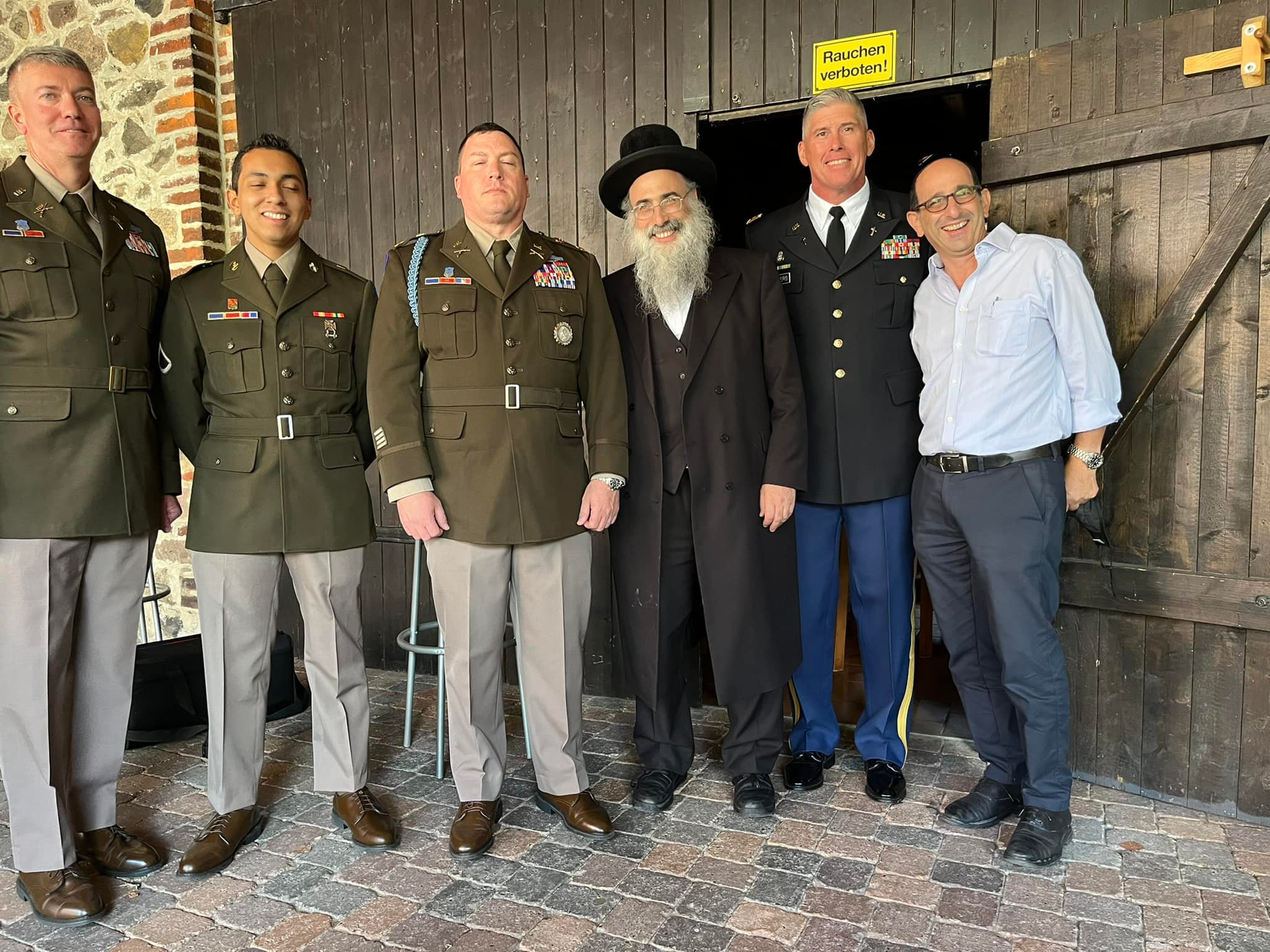
Yesterday I had the great honor of presenting to the senior leadership, faculty, and most importantly, the cadets at the United States Military Academy at West Point, in the scenic Hudson Highlands only a few hours south from my former high school at Hudson Falls.
It was a bright and beautiful summer-like day. The master sergeant and lieutenant colonel who were charged with planning and executing the commemoration of Holocaust Remembrance met us at the hotel on the base and we entered the beautiful room overlooking the Hudson where I was to speak to this group over lunch. As it turned out, I was addressing the soldiers at the exact time and date of the liberation of the train 78 years ago. My wife Laura and filmmaker Michael Edwards accompanied me.
Honored to be with Superintendent Lieutenant General Gilland.
To my surprise and immense gratification (see previous post), the Superintendent of the USMA at West Point, General Steven Gilland, and his wife, and other senior officers, the Commandant, Sergeant Major, were in attendance, seated right next to us. They took the time out of their busy workdays to commemorate and learn more about the the Holocaust; they spend their days preparing to protect and serve. They know that the unthinkable can happen. This is what they do, but this is a story they had not heard before, a message to humanity, of what ordinary soldiers did when thrust into the crisis of witnessing extreme suffering and distress of their fellow human beings.
I told the story, I educated, and I pointed out the ethical and moral choices our GIs made at that time, that day, 78 years ago to the moment of my address. I didn’t preach, I just offered up the story that, indeed, is their legacy. This may be the most important audience, our future young leaders, for the lessons I was presenting.
Some of our Jewish cadets and staff.
Senior cadet Matthew from West Texas.
Afterwards, I met some of the cadets, some of whom were eager to speak with me before heading back to class. To a person, my wife and I were impressed with the way that they conducted themselves, in that room and all over the base/campus. We took a late afternoon walk; every cadet jogging by said hello with a smile, and the diversity of the ‘kids’ and staff was impressive. West Point’s diversity credo is “to reflect the racial and ethnic composition of our enlisted force and our country. We believe a diverse student body results in a superior education for our cadets and in phenomenal leaders for our nation’s enlisted soldiers.”
And this is what our soldiers fought for. To paraphrase Dr. Yehuda Bauer, democratic forms of government are in reality new experiments, not perfect, but stand out from all others in their protection of minorities. These young men and women will protect and serve these ideals. What better lesson than the one I was sharing, 78 years to the day?
Later, I walked alone in the West Point cemetery overlooking the river, this same river where further upstream, in my youth, I wandered the banks on summer mornings in pursuit of adventure and wonder. Now, I was surrounded with the resting places of those who served and protected our nation from its earliest days to the present times. And in these seemingly troubled times, division and strife on our doorstep, laments over the state of our youth, today I am comforted by the young men and women I met, the heroes that surrounded me, the natural cadence of respect and goodness manifested everywhere we walked. I hope that when our film is out, more of these young people can become aware of the legacy of what these American soldiers did on a sunny early afternoon 78 years ago. But I feel good. I feel comforted.
I needed this.
Duty, Honor, Country. Those words mean something here. I hope that I helped reinforce those ideals; letting our present and future leaders know just what their GI predecessors did when they became witnesses to the greatest crime in the history of the world.
Off now to Israel to interview more survivors of the Train Near Magdeburg for our upcoming 2024 film.
*************
West Point Hosts Holocaust Author During Days Of Remembrance Observance
WEST POINT, NY, UNITED STATES
04.20.2023
Story by Eric Bartelt
United States Military AcademyatWest Point
In 1945, it did not yet have a name. American Soldiers heard vague rumors of it, but many dismissed it as propaganda put forth by higher command to get them into the right frame of mind to fight the enemy. But, today, its name is spoken as one of the biggest atrocities and despicable acts in recorded human history.
“The Holocaust. That name is not coined for this most horrific crime in the history of the world until the 1960s,” said Matthew Rozell. “Our GIs know nothing about what they’re about to stumble upon. They were certainly not trained for how to deal with this mass of humanity. Their mission is not to rescue, necessarily, but their mission is to capture and take the city of Magdeburg – their mission is to end the war.”
This is a prelude as part of a riveting speech made during the Days of Remembrance/Holocaust Remembrance Observance, hosted by the U.S. Military Academy’s Equal Opportunity Office, April 13 at the West Point Club. The observance of Days of Remembrance was established by the U.S. Congress as the nation’s annual commemoration of the Holocaust. Public Law 96-388 established the U.S. Holocaust Memorial Council and authorizes the actions of the council. Each year, the President of the United States also issues a Presidential Proclamation for the observance.
The event’s guest speaker, Rozell, is a retired high school History teacher from Hudson Falls, New York, who authored the book, “A Train Near Magdeburg,” and the 10-volume book series called, “The Things Our Fathers Saw,” during which he interviewed many Holocaust survivors.
Through his books, and specifically “A Train Near Magdeburg,” Rozell has helped reunite more than 275 Holocaust survivors with their American Soldier liberators. The Jewish prisoners, mostly women and children, were liberated when they were enroute to a concentration camp and Allied Soldiers intercepted it and set them all free.
Rozell began his teaching career in 1987 after he joined the faculty of his alma mater at Hudson Falls High School and taught World History. Rozell also specialized in teaching the Holocaust, but the narrative he told the audience at the remembrance ceremony is something that, “has been a major part of the second half of my life, and obviously, it brought me here to West Point today to meet you and to tell a story.”
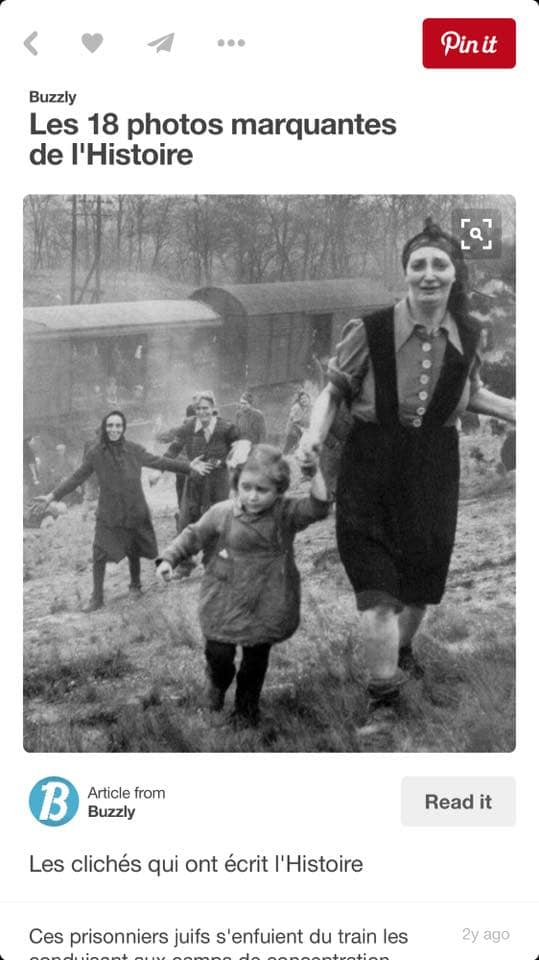
At the beginning of his speech, he jumped right in talking about his book, “A Train Near Magdeburg,” which came out in 2017. However, the photograph on the book’s cover has grown a life of its own within the last month.
“I don’t know if you’ve ever seen this photograph before, but it is one of the most powerful historical photos on the Internet (and social media) now,” Rozell said.
The photo depicts an emotional woman with a young child in the foreground walking up a small hill from railroad cars, which are seen in the background among other people, and it was posted by someone on Twitter a month ago and within two days had 2.3 million views.
“The thing about it is people are very curious about the photograph because it is very dramatic,” Rozell said. “It shows a train full of Jews, in the foreground looks like a mother with a young girl, maybe her child, stumbling up from this railroad car, which is an iconic image of the Holocaust with what railroad cars meant … but what is different about this one is these railroad cars actually brought these people to life.”
Rozell spoke in reference to the line from the tweet, “Allied Soldiers intercepted it and set them all free,” to his audience of mostly USMA cadets and young officers.
“The thing about it is they weren’t just Allied Soldiers, but it was young American Soldiers, about your age right now, who stumbled upon this train and really had no idea of what they were about to encounter,” Rozell said. “They had to make a decision in the field. The mission was to take the city of Magdeburg … but they had to do something with these sick and emaciated people who were going from one concentration camp and being transported to another one.
“This photograph probably wouldn’t have seen the light of day, even today, if I had not sat down with a World War II veteran and got him to tell me his story,” he added.
Rozell prefaced this venture he embarked on from the perspective of a high school History teacher who was responsible for teaching 8,000 years of world history to students in 300 class periods over two years per student. So, he asked the question, “How much time do you have to teach World War II, D-Day or the Holocaust?” The answer was not much.
He then asked a question of his students in the late ‘80s and ‘90s, “How many know a World War II veteran?”
“Every kid in the classroom, both hands went up because it was their grandparents’ generation who fought World War II, their aunts or uncles and, in some cases, even their parents,” Rozell said. “So, I devised a survey to take home with my students … and I got so many surveys back.”
Rozell illustrated one of the surveys on the projection slide to the audience by a man named Joseph N. Leary. The survey from 1998 by Leary, who was 75 years old then, mentioned him being a survivor of the Battle of the Bulge.
However, in this instance, what Rozell remembered most about Leary’s survey paper was his answer on the back of the document to the question, “What words do you have for the younger generation today about your World War II experience?”
“He wrote back, ‘I don’t know how anybody who wasn’t there could make a person understand what it was to survive a nightmare like a World War II,’” Rozell said. “I then took that as a challenge and we began to invite these veterans into the classroom, and my students ate it up.
“They were wrapped in attention listening to these older gentlemen telling their stories because, in many cases, they realized if they didn’t tell their stories, their friends who they lost overseas were going to be forgotten,” he added. “Their names were going to be forgotten and they wanted to get it off their chest. And we heard some pretty incredible stories.”
The 743rd Tank Battalion stumbles upon a rendezvous with destiny
During Rozell’s guest speaking appearance, he showed a clip from a documentary, projected to be called similar to his book, “A Train Near Magdeburg,” that he has been working on with filmmaker, Michael Edwards, for the past eight years and will debut on streaming platforms in 2024.
In a scene that was viewed by the audience, a male Holocaust survivor said, “We were lower than animals. We (did not have) names. We were not (allowed) to be human beings … we were treated like creatures whose destiny (was to) be dead.”
Those are chilling words of what could have been his fate and the fate of the other 2,500 Jews who inhabited the train that was headed to a concentration camp, which Rozell said there were 54,000 documented concentration camps of the Third Reich, Nazi Germany throughout Europe but mostly concentrated in Germany.
“It was worth it (doing the documentary),” Edwards said. “The reason why we did it is to educate people on the Holocaust.”
Fortunately, destiny had different plans for this group of people whose journey started at the Bergen-Belsen Concentration Camp. To put into perspective about Bergen-Belsen, like other well-known concentration camps in Dachau and Auschwitz-Birkenau, a German historian who keeps and reconstructed records of people who passed through there said 120,000 human beings passed through or died there during the war.
Rozell said the day the British’s 11th Armoured Division entered the gates and liberated the camp on April 15, 1945, “There were 60,000 emaciated people in various states of dying, typhus and starvation – there were mass graves everywhere. Belsen was a horror show.”
Historically, Bergen-Belsen is where Anne Frank, her mother and sister were shipped to in November 1944. Rozell said they died the following spring about three or four weeks before the liberation of the camp.
“The reason there is nothing there today is the British burnt the camp to the ground because of typhus, but today it is a memorial site,” said Rozell, who toured there with other teachers 10 years ago and then again with Edwards last year.
On April 12, 1945, three days before the Bergen-Belsen liberation, top American generals (Gens. Dwight D. Eisenhower, George Patton and Omar Bradley) walked into a concentration camp, and Eisenhower uttered the words, “We are told the American Soldier does not know what he is fighting for. Now, at least he knows what he is fighting against.”
Rozell said on their visit to a subcamp of Buchenwald, there is a photograph, which can be viewed at the U.S. Holocaust Memorial Museum in Washington D.C., of the three West Point graduates walking through the camp with a shot of them with railroad tracks behind them and an area where Germans incinerated the bodies with outdoor open fires in the foreground. Each of them ducked behind a shed to throw up, Rozell said.
However, it was the next day on April 13, 1945, where the train liberation story begins, which happened to be 78 years ago to the day of the remembrance observance.
Rozell said at about noon, two American tank commanders with their major in a jeep were the lead company of the 743rd Tank Battalion, attached to the 30th Infantry Division, on their way to fight the final battle for the city of Magdeburg, which would happen two days later. But, as Rozell said, “(They) went to find out what and why these thousands of people were doing milling about a train near the Elbe River.”
“From your studies of history, the Russians, or Soviet Red Army, were approaching from another direction (east) and the Americans were closing in from another direction (southwest) and they stumbled upon this train and the major (Maj. Clarence Benjamin) stopped and took this photograph (of the woman with a child),” Rozell said. “It appears in the After-Action Report, but it was buried in the National Archives until an interview I did with one of the tank commanders who was there that day.”
The interviews, the photograph, the liberators, the survivors and a story of a lifetime
From the U.S. Holocaust Memorial Museum website, the Holocaust started when Adolf Hitler came into power in 1933. It is defined as the “systematic, bureaucratic, state-sponsored persecution and murder of six million Jews by the Nazi regime and its collaborators.”
Rozell mentioned that about two-thirds of European Jews were murdered, and when he talked about the liberation of Jews, “They just didn’t go and live happily ever after.”
One of the guys who was interviewed for the documentary film was named Frank Towers, who was a first lieutenant who was a liaison between the 743rd Tank Battalion and the 30th Infantry Division. Towers’ job was to get the people out of harm’s way the next morning, which was Saturday, April 14.
“The survivors that I know … they celebrate (April 13) as if it were a birthday,” Rozell said. “The people Michael (Edwards), my film director, and I have been able to talk to, they cried tears of joy when they recalled this story of their rebirth to us.”
However, the photograph, the corresponding story and eventual book and film would have been lost to history until a happenstance meeting with an 80-year-old man named Carrol Walsh during the summer of 2001. Walsh, a retired New York State Supreme Court Justice, was the grandparent of one of Rozell’s students.
As Rozell explains, Walsh rocked back and forth in his rocking chair sharing his story of becoming a proficient tank commander during World War II. He landed in France in July 1944, following D-Day, and participated in 10 months of combat across northern Europe. His tank unit battled in France as it crossed into Aachen in October 1944, the first German city to fall.
Then his unit moved into Belgium and was involved in the German counter punch, the Battle of the Bulge, and he survived that. By March 25, 1945, his unit crossed the Rhine River as the tank company was moving 18 hours a day until April 12, which also was the day President Franklin D. Roosevelt died.
They got word their commander in chief was dead and the war was not over yet, and then they got word they had to go down and check out what was going on with this train.
“As I alluded with all they went through with 10 months of combat and how exhausted they were, he said to Matt, ‘We’re the fugitives of the law of averages, I don’t know how I survived it,’ as he didn’t get a scratch,” Rozell said of Walsh’s recollection.
Conversely, the train itself was never mentioned during the initial two-hour interview he had planned with Walsh. His daughter, Sharon Walsh Salluzzo, [actually Daughter Elizabeth Connolly] happened to say to her dad at the very end, “Did you tell Mr. Rozell about that train?” as he was ready to leave after the two-hour conversation. He said, “No, I didn’t.” So, it was at that point he started talking about that, “beautiful, fateful day 78 years ago today near the Elbe River,” Rozell said.
While Rozell began speaking about this experience with Walsh, he was projecting a picture of Walsh and the other tank commander, George Gross, and Walsh spoke highly of his good friend.
“(Walsh) said, ‘I was only there for an hour, but George Gross saved this train after they liberated it for the next 24 hours,’ and he had a camera,” said Rozell, who mentioned Gross became a professor at San Diego State University and wrote a narrative about the liberation.
“(Walsh and Gross) gave me this information and we started a website at the Hudson Falls High School World War II Living History project,” said Rozell, who stated the information was taken down after he retired in 2017. “But I do have a blog called, ‘Teaching History Matters,’ that documents all this stuff.”
The two tank commanders with their major investigated the train transport that curiously halted on the railroad tracks, deep in the heart of Nazi Germany.
“As they cautiously maneuvered forward in their Sherman tanks affixed with the white star on the side, they were stunned at what they were encountering,” Rozell said.
This train was part of three transports that left Bergen-Belsen at the end of the war in Europe. The first train, Rozell explained, was liberated at Farsleben, which was “our” train liberated by the Americans. The second train made it to the concentration camp at Theresisnstedt right at the end of the war. The third one was liberated by the Russians across the Elbe River.
“The three transports were Jews who had certificates that showed other countries who might have an interest in their well-being,” Rozell said. “But, these people, don’t get me wrong, were being starved to death when they were on this transport and were liberated.”
The school’s website sat there for four years before Rozell received an email from a grandmother in Australia who had been a 7-year-old Dutch girl on the train.
“She said she saw the photographs on the day of her liberation on our website, and she fell out of her chair,” Rozell said.
She contacted Gross in California from Australia and basically started crying when asking if he had anything to do with the liberation of the train near Magdeburg, Germany, and “that’s how they met.”
“So, Lexie (Keston) was the first person who found the photographs on our website,” Rozell said. “In 2007, myself and ‘Red’ Walsh, which was his nickname as he was Irish, met with three other survivors, one from Brooklyn and one from New Jersey – we got lucky and got them all together.
“Then, over the next 10 years, we heard from over 275 other children who were on the train. There were at least 500 kids on this train,” Rozell added. “We had three reunions at the high school, and that was the first one. There were 11 reunions overall on three continents, including Israel. It took me 10 years to write this book, and Michael (Edwards) is working on a film for the book.”
Rozell said he and Edwards were traveling to Israel the next day, April 14, to speak with 13 more children who were on the train.
From Rozell’s perspective, why is it important to listen to these people? What happens when they are no longer here to tell their stories?
“Once we have absorbed the stories that are in the book and the film – listen to the survivors’ testimony and the Soldiers’ testimony,” Rozell said. “You become a witness. You now have to take these lessons and act on your own. It is especially important to talk to young, future leaders like yourselves because this is your moral, ethical (compass), you’re a leader and people look to you. This is what our Soldiers had to do (in World War II).”
During an excerpt of the upcoming film shown to the audience, the group learned that Towers met with 55 survivors while in Israel. They met a man named Luca Furnari, who lives in the Bronx, who was a child who survived the train. They learned Walsh became friends with many of the survivors and wrote a letter to one of them in response to being called a liberator, he said, “No, I’m not a hero, I was just doing what had to be done. Nobody can repay you for what it has taken from you.” And, that letter currently resides at the U.S. Holocaust Memorial Museum.
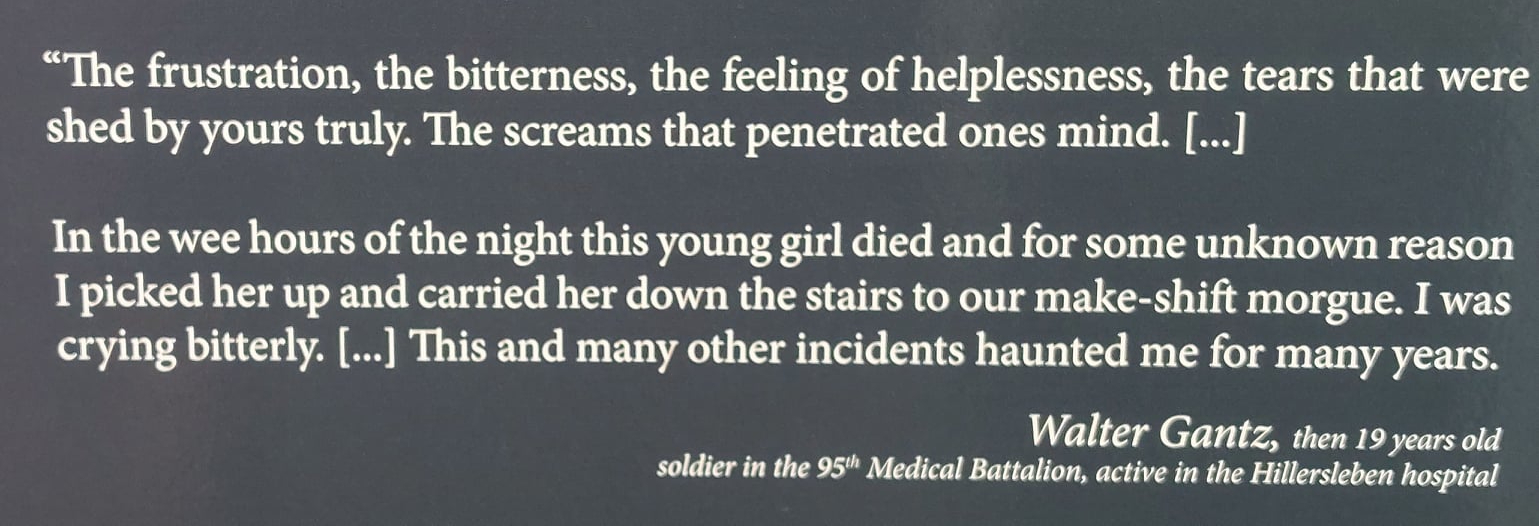
The audience also learned about Walter Gantz, who was a medic who took care of the Holocaust survivors for weeks afterward.
“There are certain events that will stay with a person throughout their lifetime,” Gantz said. He added “My parents couldn’t understand why I couldn’t sleep at times,” as he fought back the tears of the scars that still haunted him 65 years later.
Walsh’s daughter, Sharon Walsh Salluzzo, also made an appearance in the film excerpt discussing the photos Gross and Benjamin had taken, and that her father kept copies of them in his top dresser drawer from the time of the war until the end of his life.
“I look back on that now and I think, ‘how unusual,’ because everything else about the war was put away,” Walsh Salluzzo said. “He didn’t talk about the war very much, and yet, those pictures were something that must have touched him very deeply.”
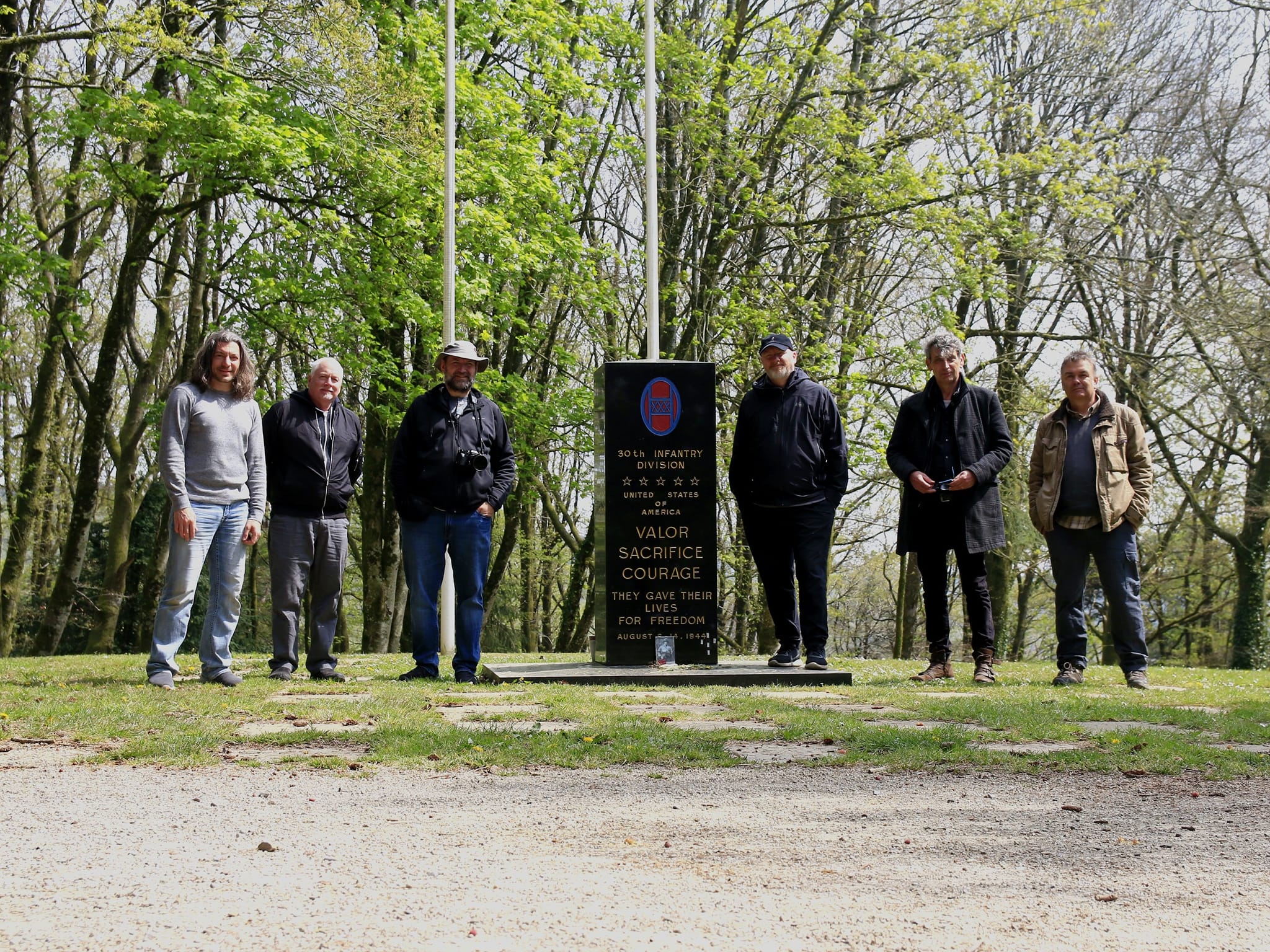
Rozell and Edwards went to Farsleben, Germany, last year to the site of the liberation and took photos of the spot where a monument now sits to the 30th Infantry Division, which has the division’s logo and the word “freedom” written in German and Hebrew on the marbled, squared tribute.
At the commemoration of the monument, Holocaust survivors and their families were present with current members of the 30th Infantry Division, which is now the 30th Armored Brigade Combat Team, and German townspeople and their children.
“The German townspeople have really taken on this project, especially the German school kids, and made it their own because they don’t want this history to be forgotten,” Rozell said. “And, believe me, it was that close to being forgotten.”
Rozell said it is a story that continues, and he is going to continue to set up more interviews with survivors, and many are in their 90s now. He is also continuing to write his world history series from the interviews that his students and Rozell collected over the years before he retired from teaching.
“Many of these interviews reside in the New York State Military Museum, which is based in Saratoga Springs,” Rozell said.
And as he closed his speech, he reiterated the main reason he spoke at the remembrance ceremony was to share this story with those in attendance.
“It is to remind and show you, the future and current leaders of the U.S. military, what your heritage is and this little-known story leads to a much wider audience,” Rozell said. “When I talk about meeting second and third generation Holocaust survivors who now know more about their own American liberators – think about meeting the actual person who saved you 78 years ago and that is what these people had the opportunity to do.
“But as the Soldiers would have told you themselves, the message they would want to leave for posterity is ‘What you do matters.’ We had no idea. We didn’t want to be heroes because we’re not heroes, we were thrusted into this situation,” Rozell said from the Soldiers’ perspective. “They had to make these decisions on the spot and because of that, there are tens of thousands of people who are alive today, and the cool thing about it is they got to learn their actions 78 years ago today led to these future generations being born. That is an important fact – it’s about the story of humanity.
“I’m not Jewish. Michael is not Jewish, but this is a story that every person in the world needs to hear, especially you who represents the United States military because this is what you did,” Rozell concluded. “This is your legacy, so thank you.”
A cadet’s thoughts on the Holocaust and his grandparents surviving World War II
After Rozell, who was named a U.S. Holocaust Memorial Museum Teacher Fellow and is a graduate of the International School of Yad Vashem in Jerusalem, Israel’s Holocaust Martyrs, Heroes Remembrance Authority among many accolades, spoke at the Days of Remembrance Observance, he met with a number of Jewish cadets and had a chance to speak to a couple of them. One of those cadets was Class of 2025 Cadet Justin Rogers.
Rogers spent a few minutes discussing with Rozell some of what his grandfather and grandmother went through during World War II to eventually find their way to America.
His grandfather, Salo Katz, who has been deceased since November 2001, was about 15 years old when World War II started.
“Once the Nazi occupation reached Hungary, he joined an underground resistance movement known as the ‘Betar Movement,’ which helped smuggle Jews out of Europe and to present day Israel,” Rogers said. “He was arrested during the war and was put into a concentration camp but was fortunately able to escape amidst an Allied Forces attack of the area, which part of the prison was damaged by artillery and bombs – allowing him to escape during the attack.”
Rogers said once he escaped, he located his father, half-brother and stepmother, and once together, they all immigrated to the United States through Ellis Island in 1951. Once they reached Ellis Island, his grandfather changed his name to Alex Kelton, for fear of anti-semetism against his Jewish background.
As for his grandmother, Erika Falusy, she was born in 1945. However, during the Russian advance through Austria, Rogers’ grandmother, her two older sisters and her mother were displaced by the Russian Army, who had quartered their estate and forced them to live in foxholes just outside their property, surviving on nothing but a mattress laid in a foxhole and whatever food their mother could afford or scavenge.
“Her father was drafted into the war and was never heard from again,” Rogers said. “In 1955, my grandmother and her sisters immigrated to the United States, paid for via bond, to stay with family already living in the United States. Once here, she began taking night classes to learn English while apprenticing as a hair stylist.”
Rogers said years later his grandfather and grandmother met and had two children (Rogers’ mother and uncle) and would eventually settle down in Manchester, New Hampshire.
“My grandmother is still alive and still owns the same house in New Hampshire, but also resides in Naples, Florida, in retirement,” Rogers said.
For Rogers, what did it mean to him to hear Rozell’s speech during the remembrance ceremony?
“I thought Mr. Rozell’s speech during the observance was powerful and made me grateful for people, who aren’t necessarily Jewish, for trying to recreate history for the newer generations and ensure that the stories of Jewish survivors and non-survivors throughout the war are remembered and not lost,” Rogers said. “From this, I was able to take away that although almost 80 years ago, the grueling history of World War II will not be forgotten, and that the lessons learned will help prevent anything like that from happening ever again.”
And what did Rogers believe that not only himself, but his fellow cadets learned about the Holocaust at the observance?
“I think it is important for myself and other cadets to understand and continue to learn about this part of history because it truly serves as a great lesson and example of both the capabilities of humanity to create evil,” Rogers concluded. “And, also to step up to counter evil.”
I recently returned from speaking engagements to mark International Holocaust Remembrance Day. A good friend and her dedicated staff hosted my talk at the Holocaust Center for Hope and Humanity in Orlando. Liberator son Frank Towers Jr. was in attendance and even was invited to light one of the six candles in our International Holocaust Remembrance Day ceremony with honored survivors and guests. It was quite a meaningful day, with a lot of thought and dedication put into its planning.
The next day I was at a local high school. The kids, for the most part, were great. I held their attention for 80 minutes. Been a while since I did that.
Now, the first new thing for me in the ‘school talk circuit world’ was that the administration, through my original hosts, asked to see my presentation in advance, in the expectation of flagging any Florida defined partial ‘woke’ or triggering content that might upset the young adults I would be speaking to. (I’m speaking about the Holocaust, people. Everyone should be disturbed about it, but I bring a message of hope for humanity, too.)
Turns out they were ok with 99% of it. They didn’t care for some of the WWII soldier-slang lingo I had used in previously recorded presentations for adult audiences, but I wasn’t going to use that anyway.
SIDEBAR: In this ‘hot news cycle’, the local NPR affiliate was excited to do a telephone interview with me, I guess mainly to show support for teachers besieged with this new state legislation that is terrifying many of them in the classroom. (You can look it up, if you are not familiar. ‘Missteps’, parent complaints, can cost you your job-or worse.) I spoke to the reporter for fifteen minutes about my project, my work, but she seemed to want to get to if I would like to comment on the new legislation. In her rush she got some of my important background facts wrong, and my twenty second comment on my take on the legislation was the only focus she included in her soundbite.
Paraphrasing, I said I just wasn’t all that familiar with the laws but that I also thought I might be getting into ‘trouble’ if I was a teacher in that state. She took that comment for her agenda, so I gave my Florida Holocaust education outreach sponsors a head’s up, after the reporter sent me the link to her story; I didn’t want to embarrass their efforts to reach out to their local educators. When they asked me if I wanted to do it, they had thought the interview was supposed to be about honoring the victims of the Holocaust-instead the word of my appearance was reduced to somehow another soundbite in the culture wars of the day.
For sure, I have no problem with supporting my fellow educators. Our host liaison Stephen did a fantastic job of arranging the speaking engagement with the coordinating Advanced Placement and IB instructor. The auditorium filled with maybe 600 advanced high schoolers, aged grade 10 through 12. I think it went well; I asked a lot of questions, as many as I ‘answered’, and I got some good questions back, and ‘knuckles’, high fives from kids near the front row. The technologist and the booking teacher were impressed and just wonderfully welcoming and later profuse in their thanks. They saw it all. My education liaison Stephen was also very happy with the talk. I appeared to have reached my target audience, which after all was the students, and that felt good. I still ‘got it’, after five years away from daily student contact. And I am grateful for the opportunity to engage with them.
What didn’t feel so good, though, was the lack of response, or even overt presence, of my fellow educators and/or the administration that granted permission for the talk in the first place. There were maybe a handful of adults in the back of the auditorium, and I don’t even have any idea who they were. I didn’t notice any teachers sitting with their students. I was the one who had to gently remind the less mature kids to put the cellphones away. Not one teacher came up to meet me afterwards, to greet me or chat or offer feedback, outside of the gracious host teacher and tech guy.
Later, I mentioned that for me, this was seemingly a more-often-than-not pattern to a new acquaintance/colleague with similar school performance experience. He commented, “Without fail – absolutely 100% of the time – the teachers used the performances as a break. They never attended, not once.” I’m not saying teachers did not attend the presentation, but darned if I could pick them out.
Okay, so I didn’t write this to knock the teaching profession. I’m a champion of you, was one of you for thirty-plus years. I get the part where teachers resent having instructional time pulled, being told once again they have to attend an out of classroom happening not of their own making or choice. But come on. You’re supposed to be setting an example here. At least make the effort to sit though it with your kids. Attentive. Especially given the topic.
And what to make of no-show administrators? Since I’ve retired, with the exception of my own former school district and university, “without fail”, I can’t recall any administrator greeting my appearance with a show of ‘welcome to our school’ or taking the time to introduce me at the podium.
Not one.
What are we supposed to be teaching to our students? It’s ironic because I added this slide specifically for that target audience.
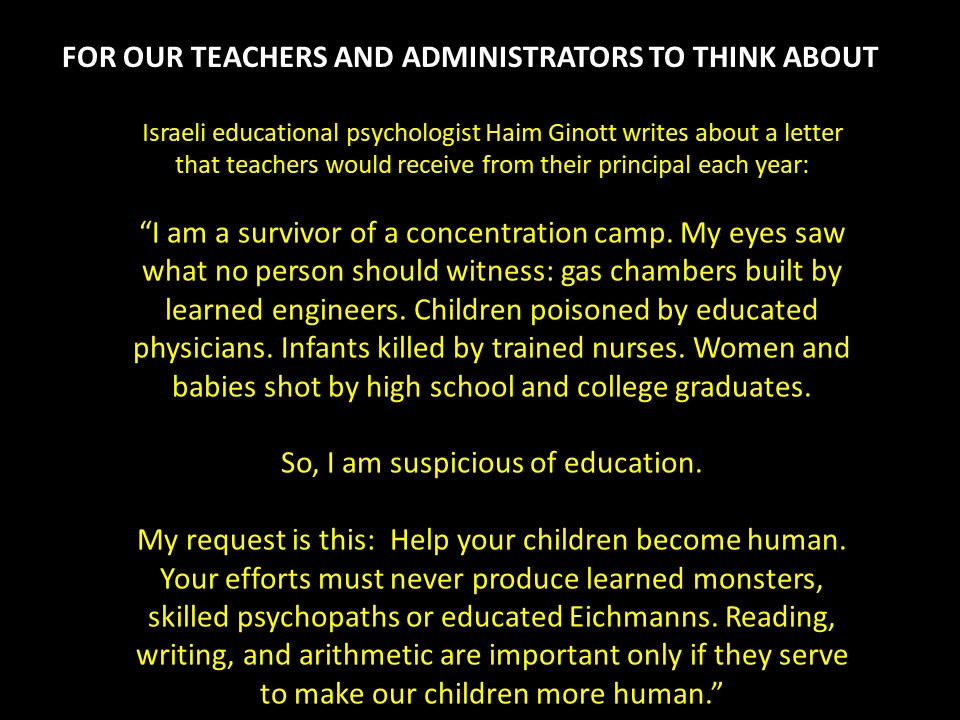
Maybe it’s my ego, or I’m overreacting, but it seems to me if you’re going to have a speaker or performer at your school to inspire young minds, maybe remember that your kids look to you to set the example. Dignify the subject and the message you vetted out of your concern with job security with the respect it deserves.
We’re all busy. But maybe just show up for the next person who takes hours out of their life to bring an important message to your kids, a warning to humanity, but also of hope. Introduce yourself. Stay for a while.
Today we mark the 78th anniversary of the liberation of Auschwitz, the most notorious of the murderous camps of the Third Reich and its supporters. I’ve been there. I’ve seen it with my own eyes. And Majdanek, Belzec, Treblinka, many others. I wrote about my journey in 2016, and continue to learn, lecture, and try to keep the memory alive.
As you probably know, I’ve talked to soldier-liberators and many, many, survivors. This weekend I will be presenting in Orlando Florida; below are the details.
Thanks for remembering with me. Maybe you can join us.
I did a local talk last week to about 150 local veterans. I spoke about my latest book on the Pacific, the sacrifices, the fact that it was a war that many Americans did not, and do not, know much about, outside of Pearl Harbor and Hiroshima.
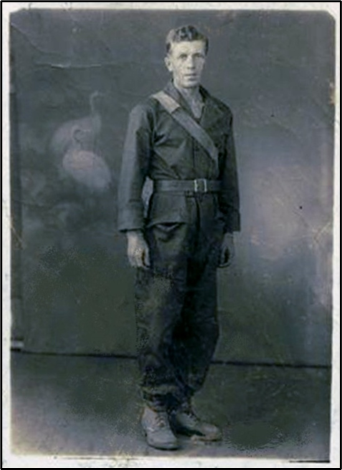
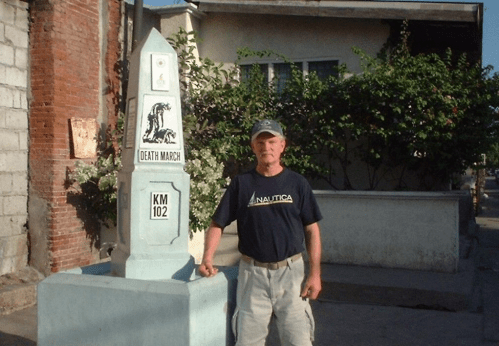
My friend Ron took out a full page ad on Veterans Day to honor his father, a World War II veteran and survivor of the Bataan Death March. It was a reprint of a 1946 local newspaper article. John is in my first book, which was also on the Pacific.
THE POST-STAR, GLENS FALLS, N.Y. WEDNESDAY, JANUARY 30, 1946 John Parsons, Local GI, Recounts Jap Tortures Left for Year’s Hitch; Ended in Manchuria With Gen. Wainwright
By BURR PATTEN
“Just a year’s hitch in Uncle Sam’s army.”
That was the outlook March 24, 1941, when John E. Parsons, 22 Everetts Avenue, local hero, left Glens Falls with a quota of 17 draftees. But it was a far cry from just the year’s hitch. Instead, it included nearly three and one-half years as a prisoner under the Imperial Japanese Army, sharing with General Wainwright the rigors and tortures of Jap prison camps. For Parsons it was just Army routine up until Dec. 8, 1941, when on a Sunday morning at Clark Field in the Philippines he sat on the steps of a barracks with some fellow soldiers watching an approaching flight of 56 planes which a passing officer described as a “Navy formation.” In a few minutes a thunderous crash of bombs began a nightmare of horror for Parsons which was to run from Japanese barbarism in the “Death March” through prison camps in an itinerary though Formosa, the Japanese homeland, Korea and into Manchuria. On Christmas day in 1941 it became necessary to evacuate Clark field, and parsons, who was with the 803rd Aviation Engineers, tells of wasted energy put forth in the building of two airstrips in the retreat toward the tip of Bataan in the blind hope that American planes would someday come. Up until March the men who were building and trying to keep strip in repair in the day were doing guard duty on beach at night. By early April they were being used as infantry replacements in the line and soon went to line for full duty where they remained until the surrender. Rations as such did not exist after the middle of February, even the Calvary horses having been eaten. A rice mill was being operated behind the lines and the food consisted almost entirely of plain boiled rice, small portions twice a day. Whole kernels of dried corn were sometimes boiled, but they were so hard as to be almost inedible. Finally malaria, dysentery and fatigue took their toll of troops running out of ammunition in the face of a foe growing stronger daily, and Bataan fell.
The “Death March” Of the “Death March” Parsons says, “It just can’t be imagined.” The march was a distance of about 75 miles which was covered in around six days. For healthy troops that would not be exceptional, but for the sick and weak, as nearly all were, it was a cruel ordeal. It was not a continuous march, parade fashion, but rather continued over a period of about a week with groups of 500 being sent out each day. Parsons says they were forbidden to help anyone in any manner, even if he fell. To do so was to invite a rifle butt in the back. He saw three men bayoneted in the back at a rest period when they walked a few feet from their group and knelt over a puddle splashing water on their faces. The Japanese way of feeding the prisoners, on those days when they did, was to place a bag of about 150 pounds of cooked rice at the head of the column and let them scramble for it. Those at the rear usually got nothing. More food was always promised “tomorrow.” The termination of the march was at Camp O’Donnell where the most sadistic practices were routine. Prisoners were put in groups of ten, a policy which was in effect from then on, and in the event anyone man attempted to escape or made any move which might be construed as such, the other nine were put to death with him. When this did happen the ten condemned were made to dig their own graves the afternoon prior to their deaths. Then four stakes were driven around the pit and the man was tied hand and foot spread-eagle over the hole so he was forced to stare at his own grave all night. In the morning the entire camp was turned out to witness the executions and the condemned were offered a cigarette and a blindfold, the latter of which was usually refused. A standing rule of the camp was that all prisoners bow to the guards. The guards would amuse themselves by hiding and jumping out unexpectedly when a prisoner came near. He would then be called to attention and slapped for not bowing. In the three years and five months that he was a prisoner Parsons does not know how many times he had been slapped or beaten but he states “30 would be a light guess.”
In a few days Parsons was transferred from Camp McDonnell to Bilibid Prison in Manila as part of a 12 man detail to work on the docks unloading ships. By this time his weight was down to 116 pounds from a normal of around 175 and his joints had begun to swell and sores were breaking out on him. After he was found too weak to carry even small cases he was he was allowed to report to American medical officers who though under close supervision, had a fairly free hand supervision at the prison. The fact that most of the prisoners there were used as laborers, explain this fairly decent treatment, Parsons reasons. A combination of medical care and a diet supplanted by smuggled purchases from Filipinos did much toward restoring his health and he was considerably stronger when on Sept. 23 he was shipped to Formosa in a group made up largest of high ranking American, British, Australian and Dutch officers. At Formosa, or Taiwan as the Japanese called it, he was sent to a Camp Korenko where he spent the next nine months. It was here that he met General Jonathan Wainwright and they remained in the same group until just prior to V-J Day. The Japanese wanted General Wainwright to sign a statement to the effect that they had volunteered to work for their captors. The general refused and forbid anyone else to sign such a statement. As a result the food ration was cut from a bowl of rice twice a day with an occasional bowl of seaweed soup. It was here that their shoes were taken away from them, including General Wainwright. The fact that they refused to sign up for work did not mean that they were not worked. At this camp and Camp Shara Kowa, also on Formosa where the group spent 16 months, duties consisted of working in rice fields, growing sweet potatoes and making rope.
Before going out of work and before returning to the camp formations were held at the Americans were made to count off in Japanese, usually in groups of ten. To hesitate when it came time to see who would have charge of the groups present was more complicated and thus easier muff. In order to supplement the meager diet whenever possible, PW’s stole food. One day Parsons hid some sweet potatoes with the intention of taking them back to camp. A guard observed him and told him not to touch them. At the end of the day when he thought no one was watching him he again tried to pick them up. The same guard appeared from seemingly nowhere, and parsons today carries the scar of the bayonet wound in his right arm as a reminder of this incident. The Japanese believed that Formosa would be invaded by our force so on Oct. 9, 1944 the group that Parsons was with was put aboard the Oyruko Maru, which was sunk in the Philippines on a later “voyage” 1600 American PWs. Only a few survived. The Oyruko Maru had considerable difficulty getting out of the Formosa harbor, in fact made three attempts but was driven back twice. Even before the first attempt, the harbor was bombed on Oct. 13, 14, and 15 by American planes with a result that it was about a week before any attempt was made to leave. When the bombing raids came the prisoners were locked in their compartment and timbers were wedged against the door, the hatches were all closed and the ventilation was shut off. One bomb struck so close that it killed 17 Jap soldiers on deck. The 286 men in the compartment had a double row of bare boards to sleep on as bunks which afforded everyone a place to lie down, though they would be shoulder to shoulder. The first attempt to leave the harbor terminated when the Japs apparently detected a submarine the first night out and turned back laying over in the harbor for five more days. On the second attempt the PWs heard a terrific explosion which they later learned was caused by a torpedo missing the ship and exploding on the shoreline to which they were sailing parallel. The third and successful attempt was made with an escort of two destroyers. The Japanese took a work detail on deck to wash dishes so these men kept the others in the hold informed of events. There was also a talkative interpreter from whom some information could be gained.
The ship successfully reached the seaport of Moji, on Kyushu, southernmost of the Japanese home islands. By this time the Japanese seemed to see the handwriting on the wall and treatment was generally better. At one time they were quartered for a time in a hotel where hot baths were available daily, something unheard of before. After a comparatively short stay in the Japanese homeland they were transported to Korea where they went by rail to a camp North of Mukden in Manchuria. Later they were moved back to Mukden where they were when the war ended. The first inkling they had that the war was over was when they saw a B-29 flying low near the prison camp and saw 10 objects parachute out. Later they learned that there were four men and six bundles of supplies dropped. The four Americans were given a rough reception, according to Parsons, and thrown in the prison camp. The following day, August 16, they were liberated by the Russians who had arrived in the vicinity the previous day but because of some technicality had not liberated them.
Free At Last
Parson says that there was not a great deal of demonstrating when they at last learned that they were free. One of the first things they did was to put the japs personnel, from colonel down to guards in the stockade and soon a reversal of procedure took place. Despite his experiences, if Parson had a burring hatred for the Japanese, he conceals it well. He shows a bitterness towards those of the enemy who participated in the “Death March” and for those responsible for one of the practices at a Formosa camp. That was when on rainy days, the camp would be called out and made to sit in a group on the wet ground facing mounted machine guns. They were told that in the event of an allied invasion 0f Formosa, this would be their fate. This took place about once a week, and having no source of news they never knew if it was the real thing or another rehearsal. For some of his guards he has a good word. Some of them he says even stuck their necks out to help the prisoners. Oddly enough, the Jap who bayoneted him is one of these. He says, “After that, he acted as if he couldn’t do enough for me.” But, he adds, “For every good one, there were 20 that weren’t.”
Wainwright “Great Guy” Parsons describes General Wainwright as “a great old guy.” He says that he kept up the morale of the men by talking to them. He told Parsons that he was familiar with the Glens Falls area, having at one time been a colonel at Plattsburg Barracks. Asked if the reports were true about the general having been slapped once by guards, Parsons smiles and answers, “Once?” One time the general was said to have cut his hand on a dish, at least that is what he reported when he sought medical aid. But the story got around camp that a guard had pointed a bayonet at him and the spunky general had pushed it aside with his bare hand. General Sharp, the adjutant under General MacArthur in the Philippines who was also a prisoner, gave John a card in Formosa reading: “My thanks and regards to you Parsons- William F. Sharp, Major General.” Brigadier General Carl H. Seals wrote a letter to Parson’s mother last September from Walter Reid General Hospital reading in part, “For the past three years I have been a `prison mate’ of your son, John. We left the Philippines together on a Jap ship in September, 1942, and have been together in various prison camps ever since. Throughout prison life he has been a big help to me, doing chores that I was little able to do. In fact, he was always most kind and considerate of my wants, which I shall always appreciate.”
Parsons is the son of Mrs. Edward Parsons, 22 Everetts Avenue, is married, and lives with his wife and two children, a daughter, Gail, and a son, Royal, at that address. He held the rank of staff sergeant at the time of his discharge and is entitled to wear the American Defense Service Medal, American Service Medal, Asiatic-Pacific Medal, Distinguished Unit Badge, with two clusters, Good Conduct Medal, Philippine Liberation Medal, World War II Victory Medal. He was discharged at Fort Dix, N.J., last month after having been a patient at Rhoads General Hospital in Utica for a few weeks.
EPILOGUE
Here is more information from Mr. Parsons’ son. 3-1-2015 “The article from the Post Star’s interview of my dad is 100% true. Few of the men received purple hearts, medals for heroism, and had no medical records. It came back to haunt us years later when dad was denied VA benefits time after time. Even if money were offered us it is a poor substitute. There was no fishing or camping with dad. My mom and I took care of him, he didn’t provide for us. He was destroyed because of it. There was no honor for him because his country abandoned him when he needed it.”
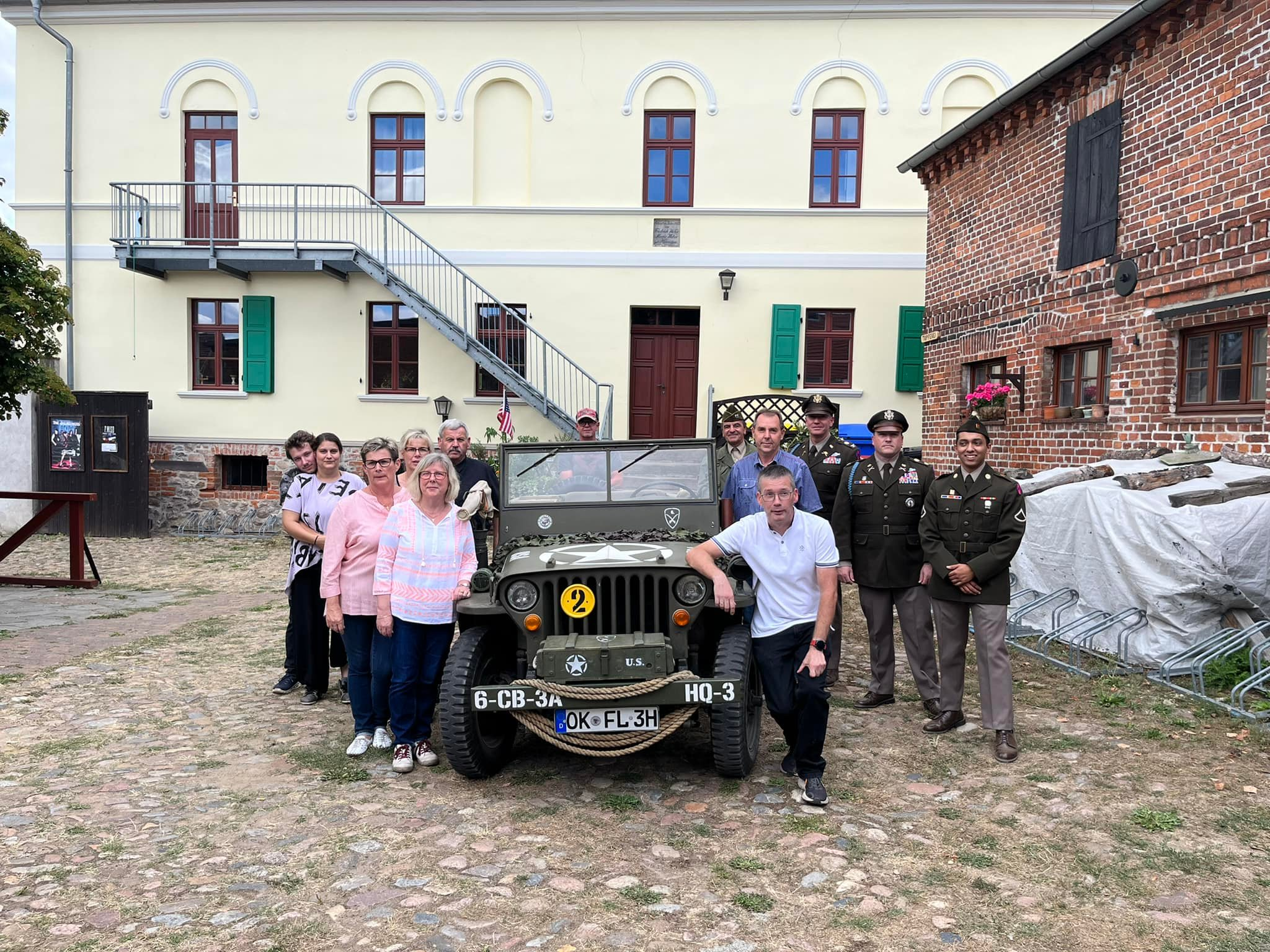
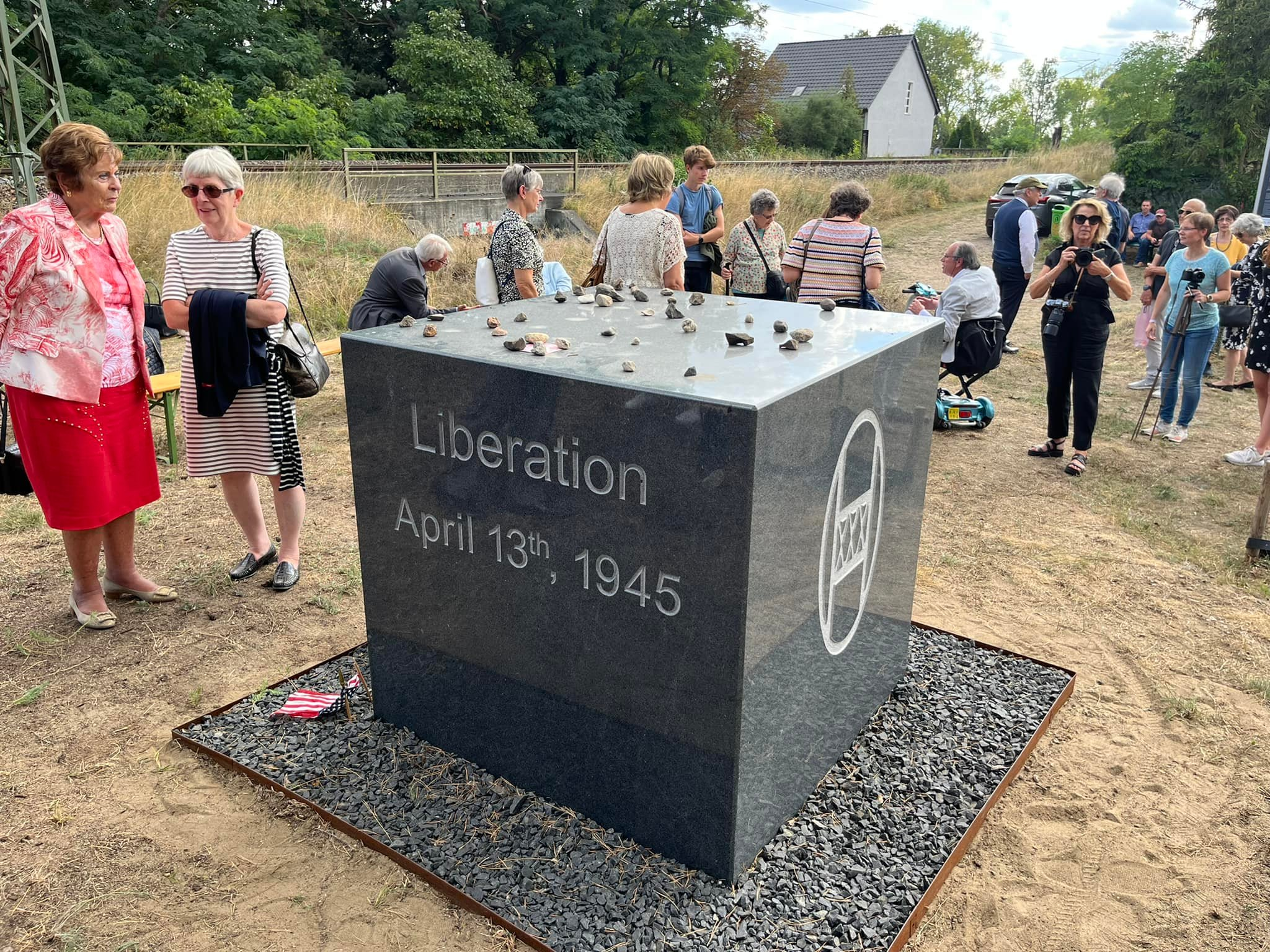
On August 30, 2022, first and second generation survivors and liberating families met to re-dedicate the monument at Farsleben which we visited and filmed at in April on the 77th anniversary, joined by the American successors the liberating soldiers, the 30th Armored Brigade Combat Team. They were welcomed by German and Dutch citizens responsible for the monument.
This article appeared in Israel yesterday; this all started when I interviewed Red Walsh in July 2001. Twenty one years ago. His daughters Elizabeth and Sharon attended; and I think Elizabeth is quoted in the article.
“We thought we were going to die”: the survivors who were freed from the death train returned to [Farsleben]
Nearly eight decades after they were released, a group of Holocaust survivors returned to Germany, to the same point where the death train stopped and they were set free. The survivors met the descendants of the American soldiers who freed them: “Near the monument and the railroad tracks, we felt the victory over the Nazis.” On the memorial erected at the site, the word “liberation” was written in Hebrew.
Itamar Eichner, Ynet News, Israel
10 Sept. 2022
“Near the memorial and the train tracks, I felt the victory of us, the survivors, over the Nazis. With every child born to me, every grandchild and every great-grandson, I said – ‘From you, Hitler, may your name perish, there is nothing left'”: these words are told excitedly by Miriam Muller, a Holocaust survivor 81. She and six other survivors returned for the first time to the German town of [Farsleben], where they were liberated by American soldiers 77 years ago.
2,500 Jews were then on a train liberated by the American 30th Division. They were taken from the Bergen-Belsen camp towards Theresienstadt, a few days before the end of World War II. Recently, the survivors returned to inaugurate a memorial that was placed near the railroad tracks, and on which was written the word “liberation” in Hebrew.
Since all the fighters who freed the train are no longer alive, at the memorial dedication ceremony the survivors met representatives of the 30th Division of the US Army, as well as the children of some of the liberators who came especially. The meeting between the survivors and the representatives of the division and the children of the liberators was emotional and full of tears .
One of the soldiers shouted in Yiddish: “I’m Jewish too”
The day of the train’s release was April 13, 1945. The Germans on the train received an order that if they could not take the train to the Theresienstadt concentration camp, they must blow it up over the Elbe River – for all 2,500 of its passengers. After six days of travel, the train stopped near the village of [Farsleben] in Germany, near the city of Magdeburg.
The exciting meeting with the representatives of the 30th Division of the United States Army. “We owe our lives to the American military”
Around four in the afternoon, an American patrol vehicle accompanied by a US Army tank arrived from the hill. These were soldiers from the 30th Division. The Nazis noticed the American tanks, and fled leaving behind 2,500 Jews, a third of them children, who thought they were being taken to their deaths.
While the Nazis were fleeing, some of the Jews – mainly women, girls and children – rose up and charged the American soldiers with shouts of joy. Only then did the soldiers notice the terrible sight of the passengers. George Gross, the American tank commander, told about the encounter: “Every one of them looked like a skeleton. They were hungry, sick on their faces. And there was something else: when they saw us they started laughing with joy, if you can call it laughter. It was More of an outburst of pure, almost hysterical relief.”
Those freed from the train near [Farsleben] in 1945. “We thought we were going to death”
The survivors said that when they saw the Americans they hugged them and cried with happiness. One of the American soldiers, Avraham Cohen, yelled at the terrified prisoners: “Ich bin ochut a-yed” (“I am also a Jew” in Yiddish), and showed them the Star of David that was hanging around his neck.
Miriam Muller, one of the freed – then a 4-year-old girl – was on the train with her family members. “These American soldiers were our angels,” she says. “When they opened the train doors, the Jewish prisoners fell out of the cars like sardines from a can. We knew we were not going to freedom. Why would the Germans send us to freedom?”
The release of the train on April 13, 1945, after the Nazis had fled
“We didn’t know where we were going, whether to Auschwitz or Dachau. They didn’t tell us anything,” she says. “We were pushed like animals, with dogs barking all around. We thought we were going to death. I was on that train with my father, mother, grandfather, grandmother and uncle. I’m the last one left alive.”
“The survivors were the real heroes”
At the ceremony, Mueller tearfully hugged American officers who represented the 30th Division. She even met the two children of the American tank commander, Carol Walsh, who rescued them. Of the 2,500 survivors of the train, only a few remained alive, mainly those who were small children at the time of liberation. Carol Walsh’s daughter said: “My father always said that they were just doing their job and were not heroes. The survivors were the real heroes.”
The new monument with the word “liberation”
Ron [Chaulet], an American-[Dutch] businessman, initiated the construction of the monument on the site. “We owe our lives to the American army,” said the survivors at the ceremony. “We are grateful that the US military saved us from a horrible death.”
Varda Weiskopf, whose father was a 15-year-old boy on the train, helped organize the ceremony. “Among the survivors of the train, few remain alive today, and it is important that this story be remembered forever,” she said. “We are happy about the initiative to erect a monument at the place of liberation, which will remind future generations of the incredible human heroism of the American army. My father passed away in December 2016, and I am sad that he did not get to see this monument.”
The representatives of the 30th division at the event
Additional photos below posted by 30th Armored Brigade Combat Team. “On August 30, a group of 30th Citizen Soldiers led by Hickory 6 attended a dedication ceremony near Farsleben, Germany to commemorate the liberation of over 2500 Holocaust Survivors by elements of the 30th on April 13, 1945- they joined survivors, their families, descendants of the liberators and the local community who made this monument a reality along with other German and Dutch Citizens.”
At the end of July, I was the featured speaker at the 30th Infantry Division Association reunion. There I met Sarah ‘Hardman’ Giachino, whose father was in the 30th, and she had this encounter to share. -MR
This weekend was meaningful beyond words. I met a special Gold Star family-the daughter of PVT Edward J. Conelly, 30 DIV 117 INF, who served with my dad. Peggy Conelly Remington and her family attended their first 30 INF DIV Association Reunion to honor her father.
Sarah ‘Hardman’ Giachino, Peggy Conelly Remington and her family, July 2022.
PVT Conelly was killed on July 10, 1944 and recently, I discovered this memory and quote, written in my dad’s notes:
“PVT Conelly was a replacement I selected as my runner since my last one was a casualty. I took a real liking to him and after I explained his duties, he never failed to be by my side. He said something to me I”ll never forget, but indicated that he was the type of man I could depend on, ‘Lieutenant, I’ll go anywhere you go, but please be careful where you go.’
One sunny day in Normandy, we were attacking across an open field between hedgerows when about halfway across he took a bullet in the midsection. I was unhurt.”
Dad goes on to say that he administered all the morphine and bandages from both of their kits. Conelly knew he was dying and was calling for his mother. The medics soon came in, and my dad found out the next day that he died. He concludes in his notes, “You can’t imagine awful this experience was for me, especially when he was calling for his mother. The cost of war is beyond belief.”
Dad was haunted by this, and I remember him telling us about this incident all of my life. He couldn’t shake off hearing him call for his mother. Dad felt that he easily could have been hit and Connelly happen to be running with him across the field in when he was in the line of fire and they fell into each other.
I thought this was very important information and wondered, it’s been 78 years, could I possibly find PVT Conelly’s family?
I posted this information on a 30th INF DIV Facebook page. Thanks to Vincent Heggen in Belgium and Rene Bonatti in France, maps showing the location in Normandy, a Morning Report of July 10, location of his grave in Coal City PA, was sent to me. But still I had no information on his family until Shawn McGreevy, a genealogist and friend, found his daughter Peggy and granddaughter Shellie.
Through social media, we arranged a phone call and during a very meaningful and emotional conversation, Peggy said she was a baby when her father deployed. “He was over there for only a couple of days. Her mother and aunt never talked about her father’s death.” She added, “We tried to find out what happened but couldn’t find out anything.”
Private Edward J. Conelly took the hit that spared my dad’s life, and meeting his daughter and her family was an indescribable moment.
I spoke yesterday to the 30th Infantry Division Association at the invitation of Col. Wes Morrison, after a two year pandemic delay. It was wonderful to meet with the veterans, active duty soldiers, and their families and other invited guests, including a Gold Star family who just learned of their father’s association with the 30th, which, as you know, went on to save the train with their attached armored battalions.
I love the graphic above, designed for this 76th annual gathering. Yesterday they learned more about their legacy, and I’m sure it will inspire.
THE SEVENTY-EIGHTH ANNIVERSARY OF D-DAY is upon us.
Thirty-eight years ago, I watched as the American president honored the fallen, and the living, at the Normandy American Cemetery for the fortieth anniversary. Just out of college, something stirred inside me. Something was awoken.
Those thirty-eight years have passed. I began by writing letters to the newspaper. Veterans of the war saw my interest; several reached out to me, and I began to interview D-Day veterans and others. I began to collect stories—not relics, prizes, or artifacts. I really had little interest in captured Nazi flags or samurai swords.
Monument to the boys from Bedford, Va.
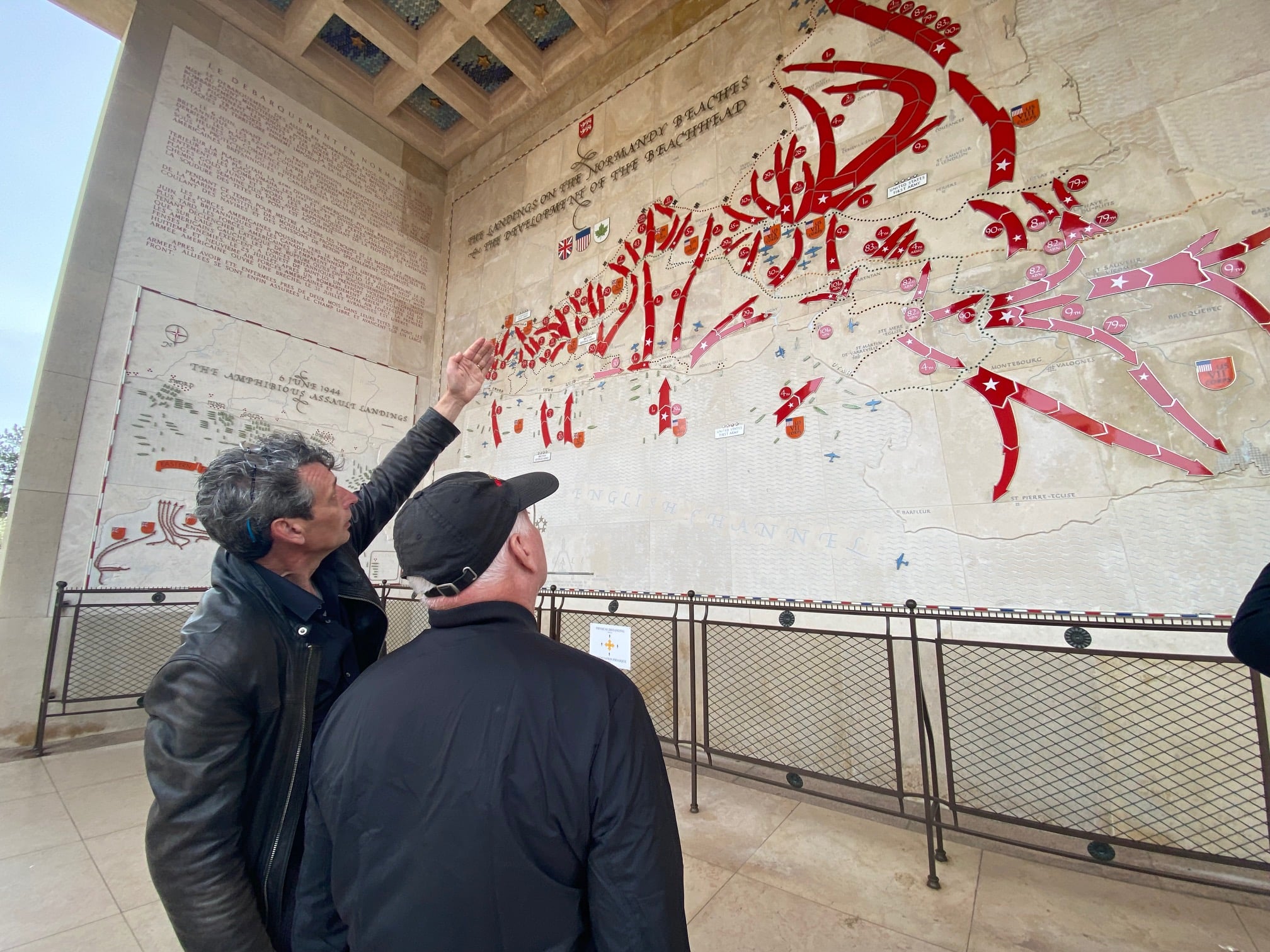
I wanted to talk to the men who were there. That path that lead to a rewarding teaching career also resulted in one of the largest high school collections of World War II oral history in the state, now housed at the New York State Military Museum. It led to my book series. It led to the discovery of the story of the train. But the men are nearly all gone now. And I had never been to Normandy until a month ago, until the final leg of our European trip to make the documentary about my book A Train to Magdeburg: the events and aftermath took us from Germany to Normandy, France — to Omaha Beach and to the Normandy American Cemetery and Memorial in France, located in Colleville-sur-Mer.
We were there to document the beaches I had been studying, teaching and writing about for those past 40 years — the place where the liberators I wrote about in A Train to Magdeburg came ashore, some on D-Day and some later.
Ten months after holding off desperate German counterattacks meant to push them back into the sea, our then-battle-hardened soldiers, rescuing a train of would-be Holocaust victims, would be shocked by the reality of industrial scale genocide; indeed, they would realize what they were fighting for.
Most impactful was our visit to the American Cemetery at Colleville-sur-Mer.
Mike Edwards photos.
Marble headstones at Normandy
Just two days after the beginning of the D-Day invasion, the first American dead were laid to rest in a makeshift cemetery just off the beach.
A few years later, the bluffs overlooking Omaha Beach would become the American Cemetery at Colleville-sur-Mer.
Today, nearly 9,400 Americans lay at rest on more than 170 acres of sanctified ground meticulously maintained by the American Battle Monuments Commission, watched over by the 22-foot-tall bronze statue, ‘Spirit of American Youth Rising from the Waves.’
We had called ahead to secure permission to film. I was stunned at the serene beauty and peacefulness of the site, and the dedication of the staff who gave us the white glove treatment, allowing us to enter roped-off sections, past row after row of marble headstones.
I tried to touch the top of each one.
Small crowds of tourists gathered and craned in curiosity as I was shown photographs and told personal stories of the young soldiers by ABMC staff: A student here. A schoolteacher there. Lawyer. Farmboy. Mechanic. Shopkeeper. Playboy. Young father. Brother. Son.
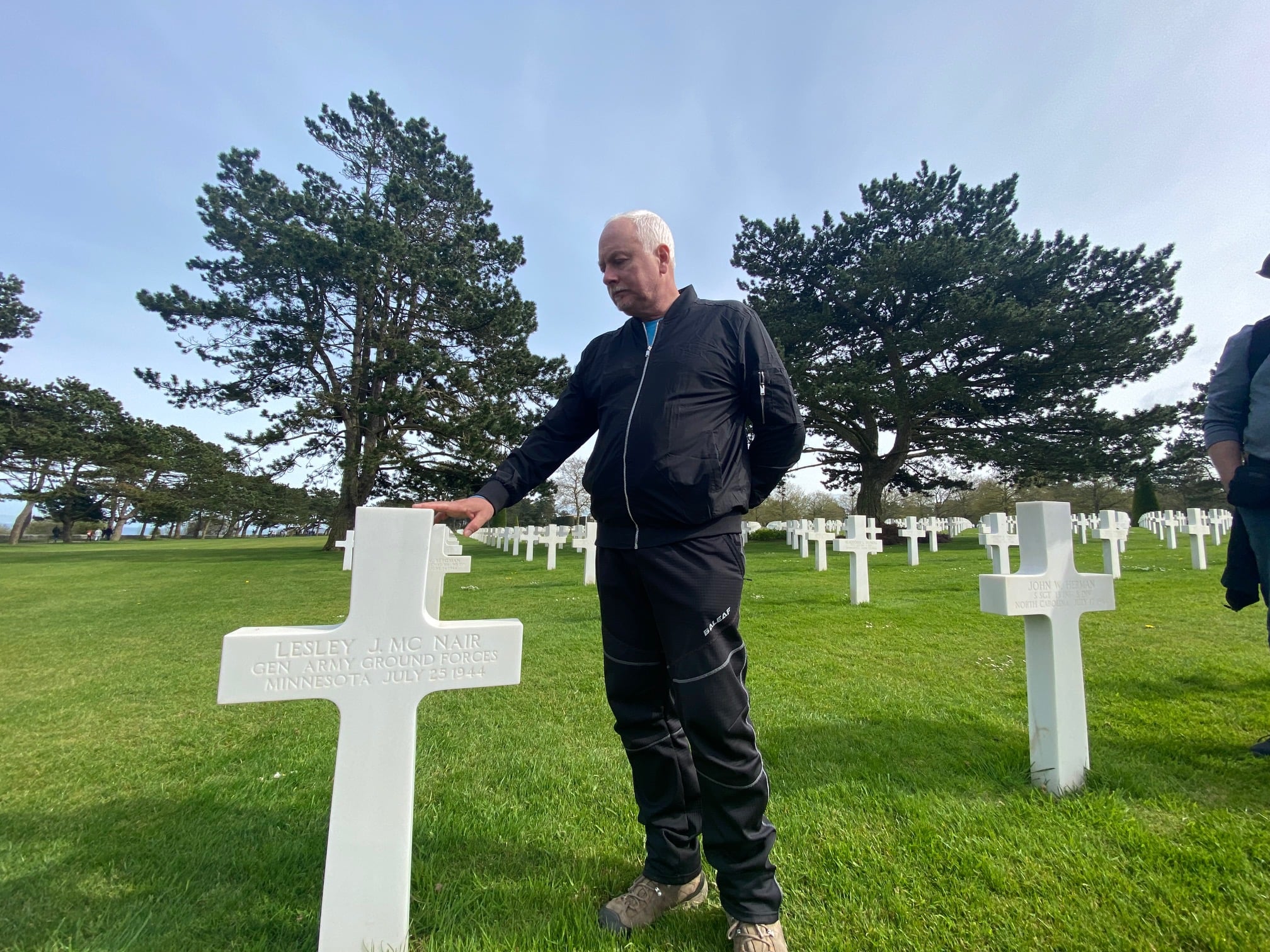
I also paused at General McNair’s grave. At 62 he was the oldest person buried here, as well as at the resting place of General Theodore Roosevelt, Jr. — the highest-ranking officer to come ashore at Utah Beach on D-Day, who was felled by a heart attack six days later.
It’s a moving place.
Remembering their efforts
About a third of the World War II families with loved ones killed overseas opted not to repatriate their remains after the war, knowing they will be cared for and rest perpetually with their fallen comrades in arms.
Our day ended with us being allowed to film the flag lowering ceremony at 5 p.m.
Back at the hotel, a teenage American student sat with us in the sitting room, listening in as we debriefed ourselves on our trip.
We talked about what following in the footsteps of the American soldier-liberators and the Holocaust survivors they rescued meant to us. For me, it added an almost spiritual dimension to this story of World War II that reveals mankind at its absolute worst, but also at its shining best.
We can’t risk forgetting how the murder of six million began with words, with neighbors and friends turning away.
We hope our film will offer up what happens when “ordinary” people put themselves in harm’s way to exemplify the greatness that human beings are capable of.
Humbled at Omaha Beach
We had told our expert guides, two British expats living in France, we wanted to see the exact locations of the landing of elements of the 743 Tank Battalion on June 6, 1944, 10 minutes before H-Hour on D-Day.
Of the five Allied beachheads established that day along 35 miles of the Normandy coastline, Omaha Beach was the bloodiest. Our guide Nigel wanted us to get there early, when the tides would be similar to what Allied planners were hoping to encounter.
It was a cool overcast morning, not unlike in 1944, when Nigel led us down to this westernmost section of Omaha Beach where the soldiers had struggled ashore.
The tide was rushing in fast, rising 12 feet in a matter of minutes. It would have hidden beach obstacles and pole mounted mines quickly. Many soldiers, weighted down, drowned.
After filming a while, we lost sight of our cameramen Josh for an hour.
The water was rushing in so fast that I was actively scanning the surf, worried that he, in walking backward while looking down into the camera lens, may have lost his footing. He turned up just as we considered sounding the alarm, having walked midway down the five-mile-long Omaha Beach.
Nigel told us more stories of the men, the heroism, the tragedy of that day. Just before where we were standing, 100 men out of a company of 150 were killed.
It was humbling to be here.
Omaha BeachNigel and Mike near where the 743 came ashore early on D-Day morning.Cameraman Josh.D-1 draw where the parts of the 743 finally exited the beach near nightfall, June 6, 1944.
A small airfield
Later, deeper into the countryside, we found the small airfield where filmmaker Mike Edward’s grandfather served in the summer of 1944, supporting fighter planes that followed the troops.
These hundreds of makeshift grass airstrips throughout northern France. had typically reverted to agricultural use immediately after the battles.
It was an emotional moment for Mike, to be in the spot where his grampa had served.
‘Liberated the heck out of it’
I asked our other guide, Sean, to see where Operation Cobra was launched, a planned breakout, where men of our tank battalion in support of the 30th Infantry Division and others would race in to encircle German forces. As planned, heavy bombers of the Eighth Air Force flying out of England would pound the enemy.
Unfortunately, many dropped their bomb loads early, on US troops, resulting in hundreds of casualties from friendly fire, including General McNair, the top American general killed in the European Theater, who was observing the action with the 30th Infantry Division.
Today, the approximate site of his demise is recently plowed farm fields. With my archaeological training it was easy to spot metal fragments littering the area.
Stopping quickly to visit the 800-year-old reconstructed cathedral in the City of Saint-Lô, we saw a shell still protruding from the wall and recalled the lore: How one dumfounded GI said, as troops entered the destroyed town: “We sure liberated the hell out of this place!”
At Hill 314, an emotional visit
At Mortain, we visited the site of a climactic week-long battle where the men of the 30th held the high ground against overwhelming forces, and saved the Allied breakout — but fewer than half the 700 survived.
We did more interviews and filmed up on this ancient hilltop, with glimpses of the famous cathedral Mont Saint-Michel shimmering in the distance.
The hill known for a thousand years as Mont Joie is now remembered by the US Army appellation ‘Hill 314’ in Normandy.
Hill 314, Mortain, France.15th c. stork sanctuary. Temporary post as 30th advanced through the hedgerow country.The Chapel. Hill 314, Mortain, France.Hill 314, Mortain, France. Crew: Josh, Joe, me, Mike, guides Nigel and Sean. Nigel Stewart photo.
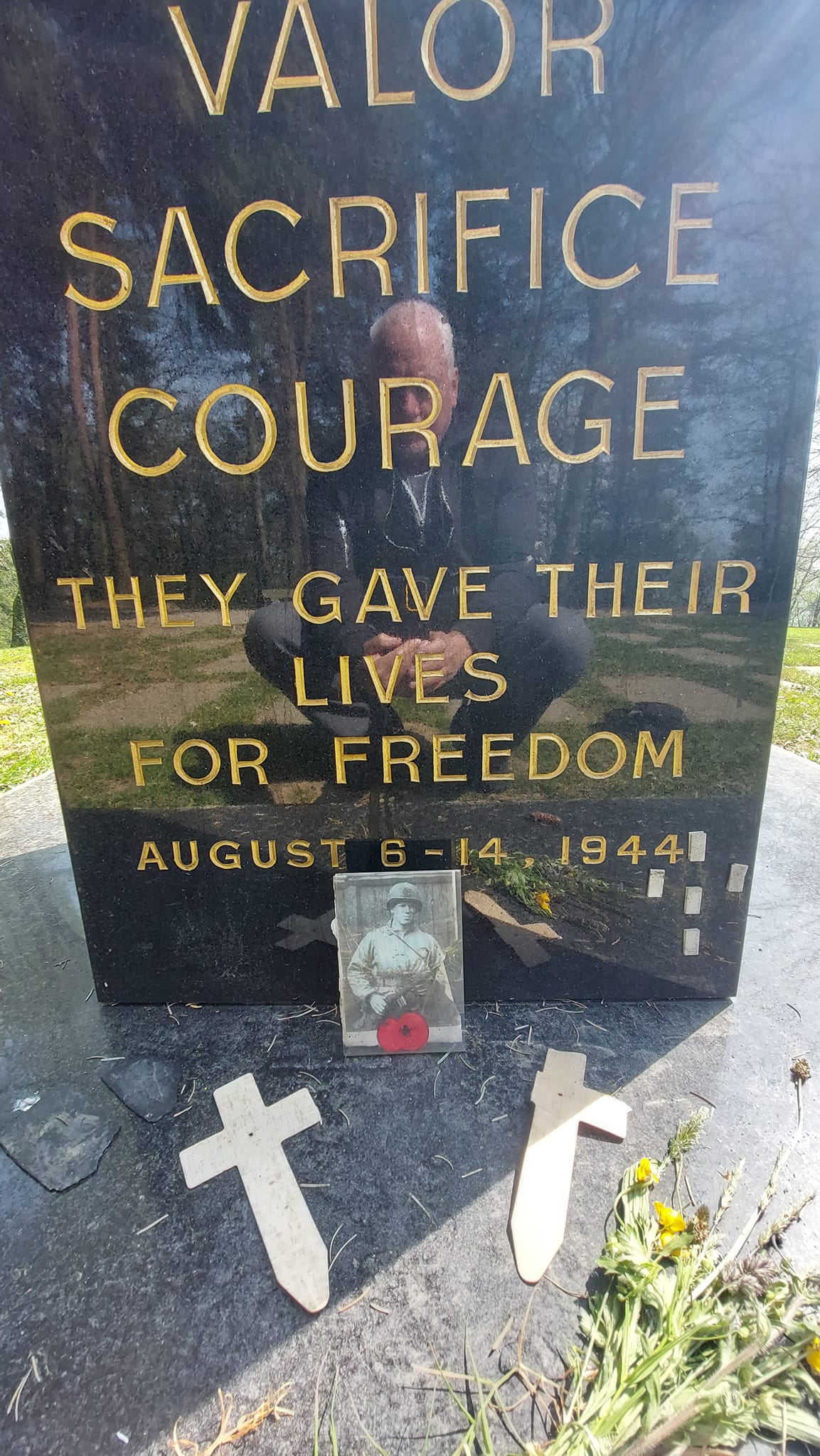
Between takes, in the spring sun I closed my eyes. The breeze rose and murmured through the pines, where I later learned bodies had been laid — after being searched desperately for food or weapons — while their vastly outnumbered brothers staved off a siege of evil in August 1944.
An elderly couple walking a dog spoke to me when they noticed the cameras.
I told them what we were doing, and the man’s eyes welled as he gripped my arm and thanked me for caring. It seems he takes care of the local memorials to the American fallen.
What they did mattered
In 2020, the 30th Infantry Division finally received the Presidential Unit Citation in honor of its heroism here.
What they did mattered, and their actions are lessons that will make us better if we remember, and teach the world what they did.
Some of our local news outlets have shown interest in this story. One ran today. We hope to have the film ready by Quarter 4 next year. I’ve edited a couple sentences/ photos for clarity on my part, but I think Ms. Hochsprung nailed it.Next up, Toronto in June to visit with Ariela!
After two-year delay, author Matthew Rozell visits Magdeburg, Germany
by Gretta Hochsprung, Glens Falls Post Star
May 24, 2022
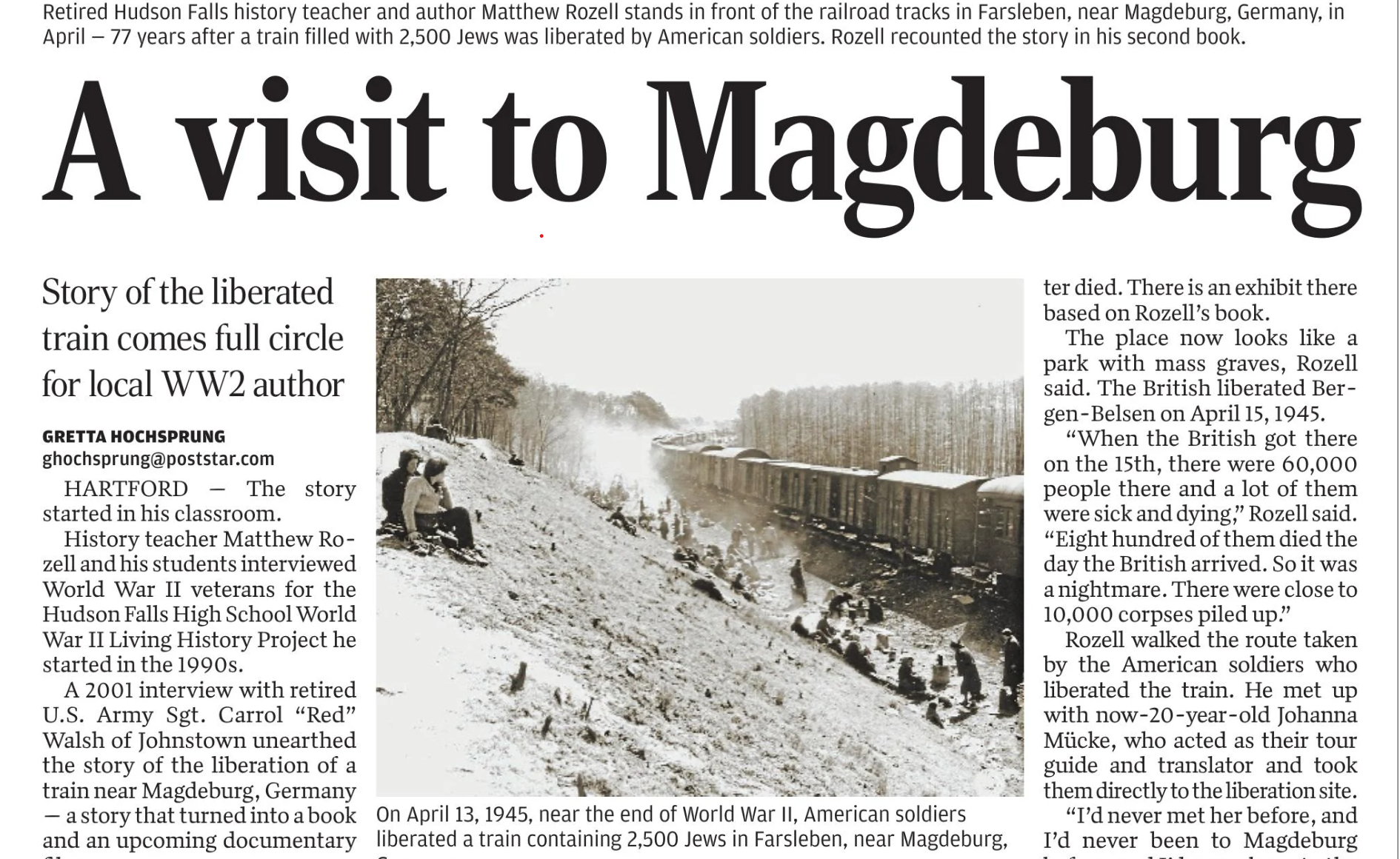
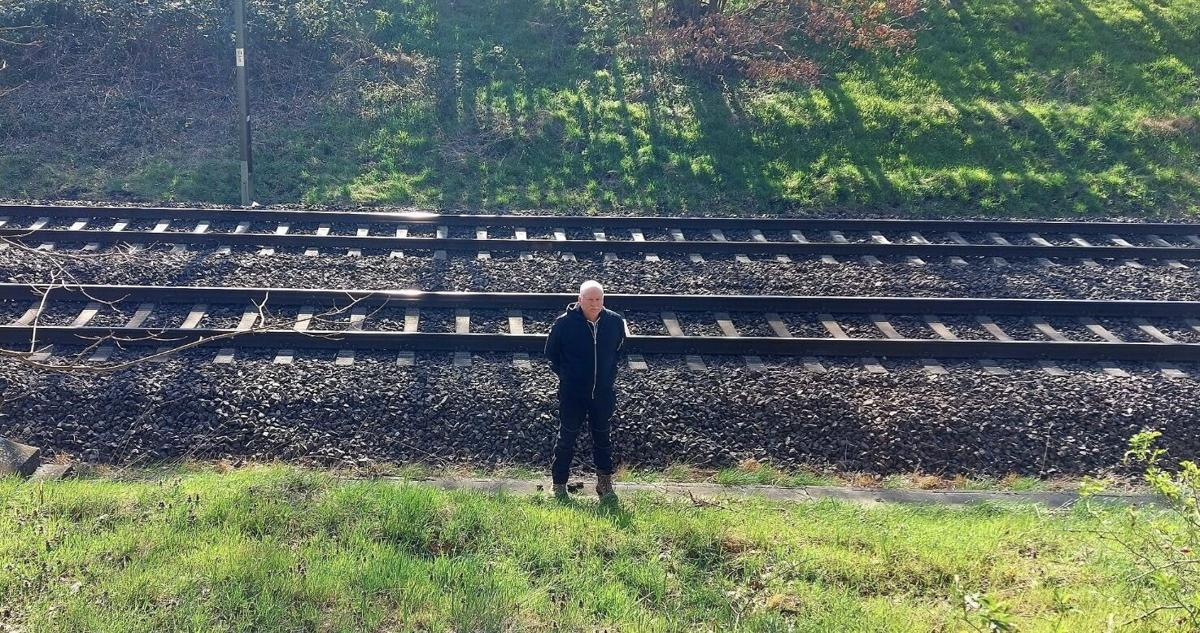
Retired Hudson Falls history teacher and author Matthew Rozell stands in front of the railroad tracks in Farsleben, near Magdeburg, Germany, in April — 77 years after a train filled with 2,500 Jews was liberated by American soldiers. Rozell recounted the story in his second book.
HARTFORD, NEW YORK — The story started in his classroom.
History teacher Matthew Rozell and his students interviewed World War II veterans for the Hudson Falls High School World War II Living History Project he started in the 1990s.
A 2001 interview with retired U.S. Army Sgt. Carrol “Red” Walsh of Johnstown unearthed the story of the liberation of a train near Magdeburg, Germany — a story that turned into a book and an upcoming documentary film.
On April 13, 1945, near the end of World War II, Army Sgt. George Gross and Walsh were deep in the heart of Nazi Germany, part of the U.S. 30th Infantry Division and the 743rd Tank Battalion, when they spotted a train sitting on the tracks.
On April 13, 1945, near the end of World War II, American soldiers liberated a train containing 2,500 Jews in Farsleben, near Magdeburg, Germany.
Liberation photo has gone viral many times over. Social media post, France.
The train contained 2,500 Jews being taken from Bergen-Belsen concentration camp to the Theresienstadt Ghetto, a Nazi concentration camp in the Czech Republic. The American soldiers found the train deserted on the tracks and liberated the Jewish prisoners, saving them from extermination.
Rozell shared photos of the liberation on the school’s website and eventually turned the story into his second book, “A Train Near Magdeburg — The Holocaust, the survivors, and the American soldiers who saved them.”
A dedicated Dutch-American organizer, a passionate local historian, the town’s museum coordinator, and, importantly, the local school’s world history teacher and her group of high school students near Magdeburg found Rozell’s photographs and started the “Stranded Train Committee” to raise money to build a monument to remember the day of the liberation, a subject the German students formally didn’t learn much about.
History teacher Matt Rozell, right, stands with filmmaker Mike Edwards near the railroad tracks in Farsleben, near Magdeburg, Germany, in April.
Rozell and filmmaker Mike Edwards were planning to capture the monument dedication ceremony to mark the 75th anniversary of the liberation in Germany in 2020.
But the event was canceled due to the COVID-19 pandemic. Instead, a lone red-headed high school student named Johanna Mücke placed a bouquet of flowers at the site.
Over Easter, Rozell finally made the long-awaited trip to Magdeburg, a central German city on the Elbe River, to commemorate the 77th anniversary of the liberation — two years later than expected. He brought along a film crew to conduct interviews and film the dedication ceremony.
“After that first gig got canceled, we kind of decided we didn’t need to film all the hoopla,” Rozell said, “we wanted to go and interview people. Unfortunately in the last two years, I lost like four or five survivors that we never got on film.”
Rozell and the film crew shot scenes at Bergen-Belsen, which is where Anne Frank and her sister died. There is an exhibit there based on Rozell’s book.
The place now looks like a park with mass graves, Rozell said. The British liberated Bergen-Belsen on April 15, 1945.
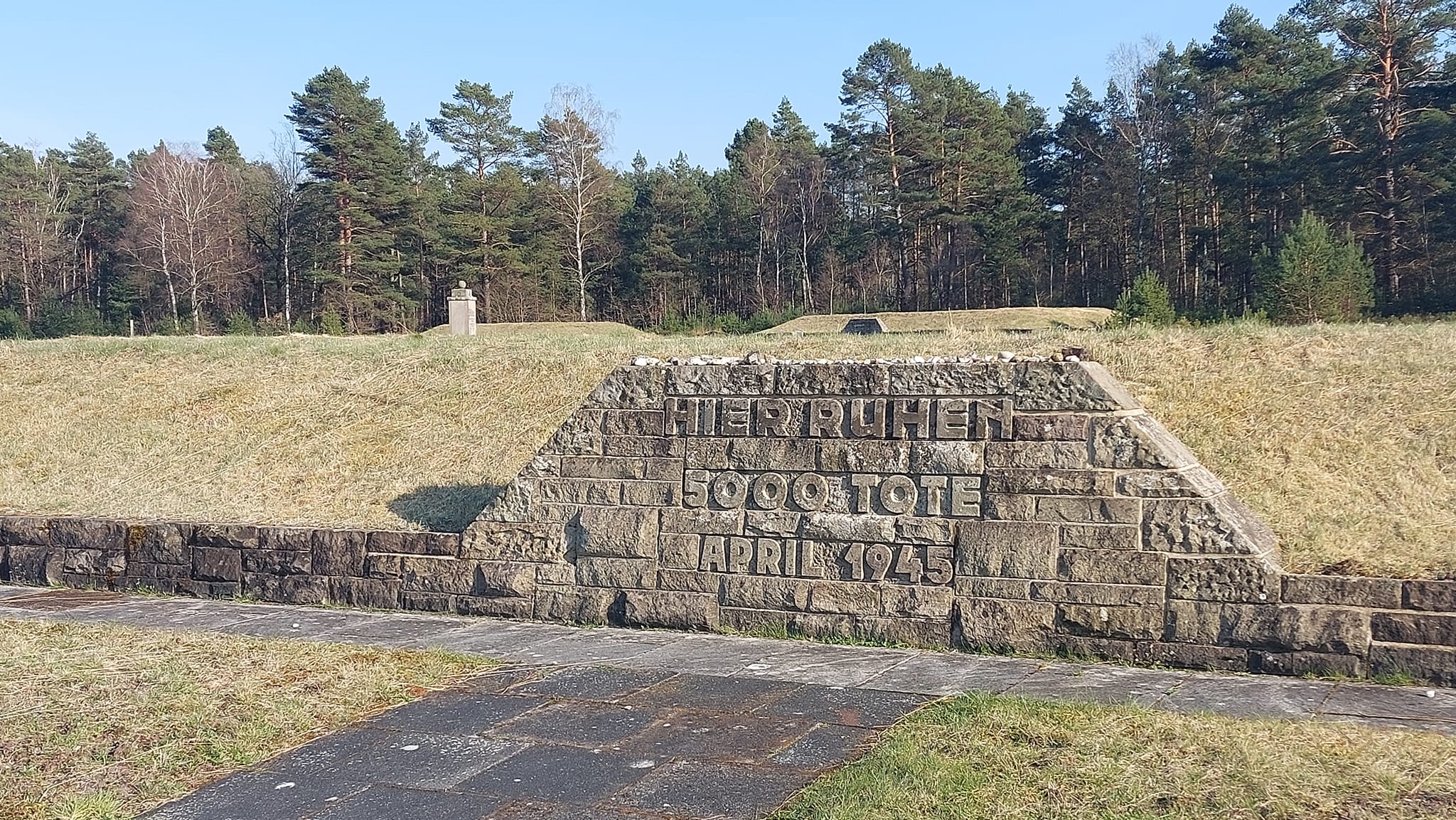
Bergen-Belsen. “Here Rest 5000 dead”.
“When the British got there on the 15th, there were 60,000 people there and a lot of them were sick and dying,” Rozell said. “Eight hundred of them died the day the British arrived. So it was a nightmare. There were close to 10,000 corpses piled up.”
Rozell walked the route taken by the American soldiers who liberated the train. He met up with now-20-year-old Johanna Mücke, who acted as their tour guide and translator and took them directly to the liberation site.
“I’d never met her before, and I’d never been to Magdeburg before, and I’d never been to the liberation site before,” Rozell said. “This is what I’ve been doing with my life for the past 20 years.”
Rozell and a cameraman hiked down a ravine to the railroad tracks where the famous liberation picture was taken in 1945. When he arrived at the tracks — still a very active train route — a train rushed by, giving Rozell chills.
Seventy-seven years to the day, on a beautiful spring day, Walsh and Gross liberated that train.
Rozell is most impressed with the German students who have asked questions and learned about a past that many Germans want to forget. Many of the students had never met a Jewish person. They hadn’t learned much about the Holocaust in school.
“Nobody knew, even though it was in their backyard, about this story,” Rozell said.
Rozell took home rocks to remember his travels. He picked up a rock at the train site.
“It’s actually a piece of that place that’s with me forever,” said Rozell, who remarked upon the details of a trip 20 years in the making.
The story has come full circle, he said, but the chapters are not yet complete.
“Just when you think it’s over, the phone rings or the email chimes and there’s a new survivor — quote unquote new — somebody who had never known the story before,” Rozell said, “and the book and the film is helping these people heal.”
“Stranded Train Committee” Monument dedication. Due to fluctuating Covid conditions, a smaller dedication ceremony went ahead on the 77th anniversary at the liberation site. Johanna Mücke, German legislator, Anette Pilz, Ron Chaulet, Matthew Rozell, 2nd Gen survivors from Israel spoke.
Johanna Mücke and her German classmates were part of the team that formed “Stranded Train Committee” and raised money to erect a monument in memory of the liberation of the train near Magdeburg. Ron Chaulet of the Netherlands (pictured above) was instrumental in setting up the foundation.
Local father and son historians Daniel and Klaus-Peter Keweloh of Hillersleben were instrumental in educating people near the liberation site about the train. (Magdeburg was formerly behind the Iron Curtain in E. Germany). It was Daniel who had written to me in 2008 from the German town of Hillersleben, some 15 or so km from the liberation site. He now conducts informal tours where the hospital was located and the Jewish cemetery for 136 souls rest (after passing following their liberation), in his ‘backyard’. He stated that growing up, he learned little about the Holocaust; all of the rhetoric was placed on the sacrifices of the Soviet Union in World War II, almost nothing of the horrors of the industrial scale genocide perpetrated on the Jewish people. He is passionate about educating his fellow Germans and bringing Jewish families to this resting place.
“It’s bringing together the new generations with the ones that are leaving us,” Rozell continued. “It’s bringing together former enemies, these dedicated German historians, who now dedicate their lives to helping these Jewish families get a sense of closure. So the whole experience has been one of healing, and it’s healing for the soldiers and the families of the guys who fought in combat.”