Feeds:
Posts
Comments

Archive for the ‘Uncategorized’ Category

{As part of the conclusion to my USHMM Teacher Fellowship project, I  am posting the unfolding nature of the discovery of the camps as Allied troops closed in from the East and the West, sixty-five years to the day that the discovery/event occurred.}

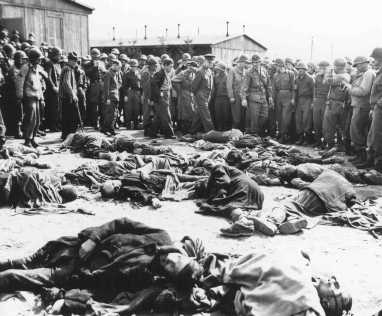
American troops inspect the site of the Gardelegen atrocity. In the background, German civilians exhume corpses who were buried in a mass grave by the SS. Germany, April 18, 1945. — Courtesy of John Irving Malachowski; United States Holocaust Memorial Museum

April 13, 1945: Death marchers from the small labor camp of Rottleberode, a subcamp of Dora-Mittelbau, are driven to the outskirts of Gardelegen, Germany, which they had reached two days before. The just over 1000 prisoners are herded by SS guards and members of the local militia into a barn, which has been prepared as an execution site. As the last prisoners are pushed into the barn, the SS guards throw torches onto the gasoline-soaked straw and lock the doors. Those prisoners who are not killed by the smoke and fire are shot by the SS as they try to escape. Only a few of the prisoners survive.


April 9, 1945: The concentration camp at Dora-Mittelbau, Germany, is liberated by the U.S. Army. Very few inmates remain alive.

April 10, 1945: SS functionary Adolf Eichmann visits the Theresienstadt, Czechoslovakia, camp/ghetto to gloat over the many Jews who have perished there.

April 11, 1945: American troops liberate the concentration camp at Buchenwald, Germany; 21,000 inmates are still alive. In the Pathology Block (Block 2), GIs discover tanned and tattooed human skin.

April 11, 1945: The U.S. Infantry and 3rd Armored divisions liberate the concentration/slave-labor camp at Nordhausen, Germany.

April 11, 1945: Inmates at the Aschersleben, Germany, camp are evacuated by the SS to Theresienstadt, Czechoslovakia.

April 12, 1945: U.S. Generals Dwight Eisenhower, George Patton, and Omar Bradley visit the camp at Ohrdruf, Germany, and view corpses and other evidence of Nazi atrocities.

April 12, 1945: U.S. President Franklin Roosevelt dies. Vice-president Harry S. Truman becomes president.

April 13, 1945: Soviet troops enter Vienna.

Weber, Louis. The Holocaust Chronicle. Publications International Ltd., 2007. http://www.holocaustchronicle.org

Read Full Post »

Hilde Huppert’s Hand in Hand with Tommy is one of the earliest factual accounts of the Holocaust, written in autumn 1945. Huppert describes with piercing objectivity her harrowing experiences as a mother with her little son in prison, in the Rzeszow Ghetto, and in the concentration camp Bergen-Belsen. Twenty editions of the book have been published, in German, Czech, Dutch, Hebrew, and Arabic.

April 7, 2010

Dear dear Matthew, Thank you for all what you do for us. If before I was ashamed to be included in the group of survivors now I happy to belong, because I realized that it takes a great deal to go through hell and come out of it as a normal functioning person. I am proud now to belong because we are all living proof to a greatness of the human spirit, in spite the evil and cruelty of some. I am speechless to stand in front people like you all, who get out from their everyday life to bring light and hope to people who they never met, and remind the world that evil is exist but cannot be tolerated, and can not be forgotten, they will be always someone there to remind it. I myself was thinking all these years in terms of, better not to talk about it, better take it with you. I know now that I was wrong. Yes I want to remember, I want to remember to my last day the women that I don’t remember their faces, but they were there,and  in the most horrific circumstances they took care for a baby from the age of two to the age of five and kept her alive. I want to remember the woman – Hilde Hupert, who took from the train all the way to Palestine together with group of Children that she have organized, and that is another story. And the biggest realization is that we are never alone in the world and yes, there is a goodness. I would like very much to commemorate and put up the names of my parents Lidia and Jan Kazimierski and all the rest of the family which been killed and vanished from the face of the earth. I didn’t know them I don’t know how many of them were exist, but I feel that they have to be mentioned somewhere. Please if you can do it for me I will be very grateful.

Bless you Matthew Rozell

Lily

MORE FROM MY FRIEND LILY


Read Full Post »

{As part of the conclusion to my USHMM Teacher Fellowship project, I  am posting the unfolding nature of the discovery of the camps as Allied troops closed in from the East and the West, sixty-five years to the day that the discovery/event occurred.}

General Dwight D. Eisenhower (center), Supreme Allied Commander, views the corpses of inmates who perished at the Ohrdruf camp. Ohrdruf, Germany, April 12, 1945. — National Archives and Records Administration, College Park, Md. USHMM

We are told the American soldier does not know what he is fighting for. Now, at least he knows what he is fighting against.

— General Dwight D. Eisenhower, on visiting a subcamp of Buchenwald, April 12, 1945

April 4, 1945: The U.S. 4th Armored Division liberates the concentration camp at Ohrdruf, Germany, a subcamp of Buchenwald, the site of more than 4000 deaths during the previous three months. Victims were Jews, Poles, and Soviet POWs. Hundreds shot just before liberation had been working to build an enormous underground radio and telephone communications center. Very few inmates remain alive at liberation.

April, 1945: U.S. Generals Dwight Eisenhower, George Patton, and Omar Bradley visit the camp at Ohrdruf, Germany, and view corpses and other evidence of Nazi atrocities.

In late March 1945, the camp had a prisoner population of some 11,700, but in early April the SS evacuated almost all the prisoners on death marches to Buchenwald. The SS guards killed many of the remaining prisoners who were too ill to walk to the railcars.

When the soldiers of the 4th Armored Division entered the camp, they discovered piles of bodies, some covered with lime, and others partially incinerated on pyres. The ghastly nature of their discovery led General Dwight D. Eisenhower, Supreme Commander of the Allied Forces in Europe, to visit the camp on April 12, with Generals George S. Patton and Omar Bradley. After his visit, Eisenhower cabled General George C. Marshall, the head of the Joint Chiefs of Staff in Washington, describing his trip to Ohrdruf:

. . .the most interesting–although horrible–sight that I encountered during the trip was a visit to a German internment camp near Gotha. The things I saw beggar description. While I was touring the camp I encountered three men who had been inmates and by one ruse or another had made their escape. I interviewed them through an interpreter. The visual evidence and the verbal testimony of starvation, cruelty and bestiality were so overpowering as to leave me a bit sick. In one room, where they were piled up twenty or thirty naked men, killed by starvation, George Patton would not even enter. He said that he would get sick if he did so. I made the visit deliberately, in order to be in a position to give first-hand evidence of these things if ever, in the future, there develops a tendency to charge these allegations merely to “propaganda.”

Seeing the Nazi crimes committed at Ohrdruf made a powerful impact on Eisenhower, and he wanted the world to know what happened in the concentration camps. On April 19, 1945, he again cabled Marshall with a request to bring members of Congress and journalists to the newly liberated camps so that they could bring the horrible truth about Nazi atrocities to the American public. He wrote:

We continue to uncover German concentration camps for political prisoners in which conditions of indescribable horror prevail. I have visited one of these myself and I assure you that whatever has been printed on them to date has been understatement. If you could see any advantage in asking about a dozen leaders of Congress and a dozen prominent editors to make a short visit to this theater in a couple of C-54’s, I will arrange to have them conducted to one of these places where the evidence of bestiality and cruelty is so overpowering as to leave no doubt in their minds about the normal practices of the Germans in these camps. I am hopeful that some British individuals in similar categories will visit the northern area to witness similar evidence of atrocity.

That same day, Marshall received permission from the Secretary of War, Henry Lewis Stimson, and President Harry S. Truman for these delegations to visit the liberated camps.

Ohrdruf made a powerful impression on General George S. Patton as well. He described it as “one of the most appalling sights that I have ever seen.” He recounted in his diary that

In a shed . . . was a pile of about 40 completely naked human bodies in the last stages of emaciation. These bodies were lightly sprinkled with lime, not for the purposes of destroying them, but for the purpose of removing the stench.

When the shed was full–I presume its capacity to be about 200, the bodies were taken to a pit a mile from the camp where they were buried. The inmates claimed that 3,000 men, who had been either shot in the head or who had died of starvation, had been so buried since the 1st of January.

When we began to approach with our troops, the Germans thought it expedient to remove the evidence of their crime. Therefore, they had some of the slaves exhume the bodies and place them on a mammoth griddle composed of 60-centimeter railway tracks laid on brick foundations. They poured pitch on the bodies and then built a fire of pinewood and coal under them. They were not very successful in their operations because there was a pile of human bones, skulls, charred torsos on or under the griddle which must have accounted for many hundreds.

Source(s):

Weber, Louis. The Holocaust Chronicle. Publications International Ltd., 2007. http://www.holocaustchronicle.org

The United States Holocaust Memorial Museum, 1945- The Year of Liberation. 1995.

http://www.ushmm.org/wlc/en/media_ph.php?ModuleId=10006131&MediaId=3711

http://www.ushmm.org/wlc/en/article.php?ModuleId=10006131

Read Full Post »

Days of Remembrance: Honoring Liberation

In commemoration of the 65th anniversary of the liberation of Nazi concentration camps, the Museum has designated Stories of Freedom: What You Do Matters as the theme for the 2010 observance. To honor their bravery as soldiers and their importance as eyewitnesses, the Museum will pay tribute to the U.S. soldiers who helped defeat Nazi Germany and liberate Holocaust survivors from years of suffering. Learn more about Days of Remembrance and what the liberators’ extraordinary stories of freedom mean for our world today.

Watch a story about how a teacher fellow from the Museum reunited Jewish prisoners with U.S. Army soldiers who liberated them from a train near Magdeburg, Germany, on April 13, 1945. Go to http://www.ushmm.org/remembrance/dor/years/2010/liberation/

Watch a story about how a teacher fellow from the Museum reunited Jewish prisoners with U.S. Army soldiers who liberated them from a train near Magdeburg, Germany, on April 13, 1945. Go to http://www.ushmm.org/remembrance/dor/years/2010/liberation

As an aside, we are now up to 141 survivors who were liberated on that train, most verified by original passenger manifest.

Transcript:

NARRATOR
They were men and women who came together from all across the United States, from Canada, and from as far away as Israel. For several, it was their first face-to-face meeting with each other in more than sixty years.

CARROL “RED” WALSH
How could a young guy like me be 88 years old! I’m not sure how many more reunions I’m going to go to. I never thought I would see anybody on that train again. It’s amazing. Just amazing.

NARRATOR
The occasion was to commemorate an event that occurred on April 13, 1945, as American armies rolled across Europe, liberating millions from the dominion of the Third Reich. On that day, the Army’s 743rd Tank Division came upon a sight near Magdeburg, Germany, they never expected to see. Freight train cars alone on a track, and filled wall to wall with over two thousand men, women, and children, all of them Jews.

CARROL “RED” WALSH, TANK COMMANDER, U.S. ARMY 743RD TANK BATTALION
I remember the moment I remembered seeing this long freight train, long string of boxcars, and I can remember pulling the tank to the right and driving along the side of the train and seeing all these people that were on these boxcars. It was totally unexpected and when I saw their condition I was overwhelmed, I can remember thinking “What are we going to do with all these people and for all these people?”

NARRATOR
This fateful wartime incident might have remained known only to those who were directly part of it, had it not been for a Web site created and managed by Matthew Rozell. A high school history teacher in Hudson Falls, New York, and a teacher fellow with the United States Holocaust Memorial Museum, Rozell conducted several interviews with men and women whose lives were directly caught up in the events of the Holocaust. It was during an interview with Carrol “Red” Walsh, a tank commander with the 743rd, that the story of the train car outside Magdeburg came to light.

MATTHEW ROZELL, HISTORY TEACHER, HUDSON FALLS HIGH SCHOOL
And at the tail end of a two hour discussion, taped conversations I had with him in his daughter’s living room, his daughter chimed in and said “Dad, did you tell Mr. Rozell about that train that stopped, that you had to go and investigate?” He said “Oh, that’s right, that train.” And he launched into about how it was a beautiful April day. He and another tank commander went down and investigated this train stopped by the side of the tracks. They found it full of Jewish refugees. The other tank commander, he told me, was still alive in California, and actually had photographs that he took of the liberation. And this Dr. Gross allowed me to place the photographs on the Internet. We put those on our school Web site, and they sat there, not a lot of Web traffic. But all of a sudden, I got an e-mail from a grandmother in Australia who had been a 7-year-old girl on that train. And she said that she clicked on the Web link, the photographs opened, and this was the day of her liberation in 1945. She said she fell out of her chair.

It was very organic the way it all unfolded. I would open up my e-mail inbox and there would be another message from a new survivor, somebody that I wasn’t aware of before. These people are coming to me individually. They’re not aware of each other for the most part before finding my Web site on the Internet, for example. So it’s just kind of unfolding.

RENE ROBERGE, DRAMA TEACHER, HUDSON FALLS HIGH SCHOOL
At this time, I would like to call to the stage the rest of our soldiers and survivors, beginning with Mr. Francis Currie. [Applause]

NARRATOR
The surviving veterans of the 743rd are modest about their accomplishments, but this did not prevent the audience of students, teachers, town residents, and Holocaust survivors from honoring them at a special reunion event held at Hudson Falls high school in September 2009.

WILLIAM GAST, U.S. ARMY 743RD TANK BATTALION
It’s a gratifying and emotional experience to reunite with some of the survivors, to meet them face to face, and to call them my friends.

LESLIE MEISELS, SURVIVOR, TRAIN AT MAGDEBURG
Those brave American soldiers, they were saying that they didn’t do anything heroic, they just did their job. But with that job, they gave us back our life, and for that I thank you from the bottom of my heart. [Applause]

NARRATOR
It was a heady four days for the guests of honor and their families, a time to reminisce and reconnect, a time to enjoy each other’s company, and reflect upon what brought them together.

BUSTER SIMMONS, CHAPLAIN, 30TH INFANTRY DIVISION
We were there. But it’s still tough to wrap your mind around the situation that presented itself when those people were liberated on that train.

ELIZABETH SEAMAN, SURVIVOR, TRAIN AT MAGDEBURG
None of them put themselves up as being something special, and they have a great sense of humility, and also a great sense of love. I feel that love just emanating from them to me and the others, and I think the sense of love that they have I think is also what has kept them going and giving all their lives.

DIANE SAWYER
“And so we choose history teacher Matt Rozell, the Holocaust survivors on that train, and those American soldiers who kept them and their story alive.” [Cheers, applause]

NARRATOR
Matt Rozell’s spotlight as ABC News Charles Gibson’s person of the week was a fitting conclusion to this special event. At the farewell banquet following the broadcast, Rene Roberge, the Hudson Falls high school teacher who served as the program’s master of ceremonies, told liberators and survivors alike what he had learned from them.

RENE ROBERGE
Share the truth. The moral responsibility you had as a liberator to free a people from harm at a moment’s notice, and, as a survivor, to save a generation from becoming complacent. You were heroes then. You are my heroes now.

MATTHEW ROZELL
I think we were in the right place at the right time, in the sense that we had people who are now at the stage in their life where they really wanted to send a message before they leave this earth. To see how it touched these students so deeply, that is where the real gratification is for me, and that’s what this whole week was all about. Don’t forget the past. You have to remember what happened. You can’t just be a bystander.

FRANK TOWERS, PRESIDENT, 30TH INFANTRY DIVISION VETERANS of WWII
You know, I bid those people goodbye and thought I’d never see them again. So now here we are 65 years later, to come this full 65 years and, we’re coming together, and it’s a rewarding experience.

Read Full Post »

{*As part of the conclusion to my USHMM Teacher Fellowship project, I  am posting the unfolding nature of the discovery of the camps as Allied troops closed in from the East and the West, sixty-five years to the day that the discovery/event occurred. This material was published elsewhere, as noted below; it is used with permission. This post also gets an inordinate amount of hits; please be sure to visit the “About” link for context.}

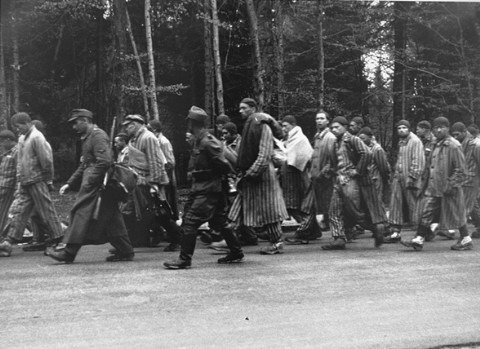
Prisoners on a death march from Dachau move towards the south along the Noerdliche Muenchner street in Gruenwald. German civilians secretly photographed several death marches from the Dachau concentration camp as the prisoners moved slowly through the Bavarian towns of Gruenwald, Wolfratshausen, and Herbertshausen. Few civilians gave aid to the prisoners on the death marches. Germany, April 29, 1945. — KZ Gedenkstaette Dachau. USHMM

Early April 1945

The SS evacuates thousands of Jews–mostly on foot–as Allied and Soviet forces press in from the east and west. Evacuees are taken to camps at Bergen-Belsen, Germany; Dachau, Germany; Ebensee, Austria; Leitmeritz, Czechoslovakia; and Theresienstadt, Czechoslovakia. The operation is rife with daily beatings and murders as well as deaths from starvation and typhus. Thirteen hundred Jews are evacuated on foot from Vienna; only 700 will reach their destination, the Gusen, Austria, camp, alive.

The evacuations of the concentration camps had three purposes:

(1) SS authorities did not want prisoners to fall into enemy hands alive to tell their stories to Allied and Soviet liberators

(2) the SS thought they needed prisoners to maintain production of armaments wherever possible

(3) some SS leaders, including Himmler, believed irrationally that they could use Jewish concentration camp prisoners as hostages to bargain for a separate peace in the west that would guarantee the survival of the Nazi regime.

The SS guards had strict orders to kill prisoners who could no longer walk or travel. As evacuations depended increasingly on forced marches and travel by open rail car or small craft in the Baltic Sea in the brutal winter of 1944-1945, the number who died of exhaustion and exposure along the routes increased dramatically. This encouraged an understandable perception among the prisoners that the Germans intended them all to die on the march. The term death march was probably coined by concentration camp prisoners.

During these death marches, the SS guards brutally mistreated the prisoners. Following their explicit orders, they shot hundreds of prisoners who collapsed or could not keep pace on the march, or who could no longer disembark from the trains or ships. Thousands of prisoners died of exposure, starvation, and exhaustion. Forced marches were especially common in late 1944 and 1945, as the SS evacuated prisoners to camps deeper within Germany. (USHMM)

April 1, 1945 – The Red Army liberates Sered labor camp in Slovakia. The first UNRRA (United Nations Relief and Rehabilitation Administration) teams enter Germany in the wake of the Allied armies to facilitate and assist in the relief of the displaced persons.

April 1, 1945: The SS initiates death marches to evacuate the concentration camps at Dora-Mittelbau and Kochendorf, Germany.

April 3, 1945: All 497 members of a slave-labor group at Bratislava, Slovakia, are shot and killed by their captors. The Nazis evacuate the concentration/slave-labor camp at Nordhausen, Germany.

Source(s):

Weber, Louis. The Holocaust Chronicle. Publications International Ltd., 2007. http://www.holocaustchronicle.org

The United States Holocaust Memorial Museum, 1945- The Year of Liberation. 1995.

http://www.ushmm.org/wlc/en/article.php?ModuleId=10005162

Read Full Post »

{As part of the conclusion to my USHMM Teacher Fellowship project, I  am posting the unfolding nature of the discovery of the camps as Allied troops closed in from the East and the West, sixty-five years to the day that the discovery/event occurred.}


March 21, 1945: Red Army troops enter the Pruszcz, Poland, camp near Stutthof. Only about 200 women prisoners, out of an original 1100, remain alive.

March 26, 1945 – American troops liberate the town of Hadamar, Germany.

March 29, 1945: The Red Army takes Danzig.

March 30, 1945: Jewish women being led to their deaths at the Ravensbrück, Germany, camp grapple with their SS guards. Nine of the women escape but are recaptured and murdered with the rest.

March 30, 1945: Soviet troops enter Austria.

Buses used to transport patients to Hadamar euthanasia center. The windows were painted to prevent people from seeing those inside. Germany, between May and September 1941. — Hessisches Hauptstaatsarchiv Wiesbaden

March 31, 1945 – Members of the US 2d Infantry Division investigate the facilities of the Hadamar euthanasia killing institution after local inhabitants report the murder of thousands of people. The Americans find 550 patients still alive. Several members of the staff are arrested.

March 31, 1945– One source mentions that Anne Frank died at the age of 15 in the Bergen Belsen concentration camp.

Source(s):

Weber, Louis. The Holocaust Chronicle. Publications International Ltd., 2007. http://www.holocaustchronicle.org

The United States Holocaust Memorial Museum, 1945- The Year of Liberation. 1995.

http://www.ushmm.org/wlc/en/media_ph.php?ModuleId=10005200&MediaId=881

Read Full Post »

{As part of the conclusion to my USHMM Teacher Fellowship project, I  am posting the unfolding nature of the discovery of the camps as Allied troops closed in from the East and the West, sixty-five years to the day that the discovery/event occurred.}

March 19, 1945:

Adolf Hitler issues the Nero-Befehl (Nero Order), a scorched-earth directive intended to leave only a ruined Germany for advancing troops.
March 19, 1945:

Two hundred survivors out of 1000 Jewish women who began a forced march from the Neusalz, Poland, slave-labor camp on January 26 are evacuated by train to the concentration camp at Bergen-Belsen, Germany; see this post.

Source(s): Weber, Louis. The Holocaust Chronicle. Publications International Ltd., 2007. http://www.holocaustchronicle.org

I recently received this email from the son of survivors:

Dear Mr. Rozell,

My mother was one of the 200 or so that survived that “death march”!  The survivors were transported to the camp at Bergen-Belsen, where my mother was ultimately liberated on April 15, 1945.

Many years ago, she did relate to me a wartime story of hers which I wrote up in 2006, and had published.

Here it is…

The Defining Moment

By Joseph H. Danziger

It happened more than sixty years ago- and not to me- but I cannot dislodge it from my mind’s eye.  My consciousness will not surrender the thought of what it must have been like for my mother, especially on one ominous day. I am a child of Holocaust survivors.

My parents, and thousands like the, each have personal stories of their incarceration in the various concentration camps that dotted Germany, Poland and neighboring countries during World War II.

My parents rarely shared with me their accounts of that desperate period of their lives. When prodded, they might offer an occasional vignette. Seeing the pain on their faces in talking of these experiences, however, I didn’t push for details. Those are memories they certainly preferred to have long forgotten.

Of the stories that were begrudgingly told to me, one shared by my mother will haunt me forever. The soul-searching decision with which she was confronted on that fateful day so long ago is unfathomable to me. As a result of the decision she made that say, I am here to tell the tale.

My mother spent the flower of her youth- ages 17 through 20- within the confines of a concentration camp in Neusalz, Poland. It was a women’s “slave-labor” camp where yarn was processed for the war effort. Although it was not one of the infamous “death” camps such as Auschwitz, Treblinka or Sobibor, the distinction between these titles is hardly significant. In a death camp the aim was to kill as many and as quickly humanly possible. In a slave-labor camp the goal was, in effect, to work the laborers to death, with an ever-replenishing supply of labor. The death tolls in each were mind-boggling. The human skeletons who managed to survive all looked the same and had similar stories of deprivation, torture, depravity and the wanton taking of life.

In the midst of this living hell, an opportunity presented itself to my mother. She saw a possible means of escape. Despite knowing that if she got caught she would face certain death, she took the chance. She escaped, although she never explained exactly how.

Clad only in rags, she trudged through unfamiliar territory until she came to a house. She knocked on the door. She related her circumstance to the master of the house and pleaded for food and a place to hide. Although sympathetic to her plight, he told her he could not jeopardize his family. If found to have secreted a Jew, especially one who escaped from a nearby camp, he and his whole family would most likely be killed as a lesson to the community.

Yet, seeing my mother’s emaciated condition and dire need- and against his better judgment- he took pity on her. He invited her into his home, let her eat, bathe and sleep the night. Before the break of dawn, however, he said she must be gone. She thanked him and availed herself on his family’s kindness. For one night during a span of three years she had a full stomach, clean clothes and a restful night’s sleep.

She left before dawn, as promised. But where would she go? Only then did the truly desperate nature of her circumstance become apparent. For one such as she there was nowhere to go.

My mother was confronted with an unimaginable predicament, a sort of Gordian knot. Should she hazard freedom in an unfamiliar countryside filled with anti-Semitism where peril and betrayal would be her constant companions? Or should she attempt the inconceivable- a stealth re-entry into the camp from which she had just risked her life to escape- hoping the guards had not noticed her absence? As least there she reasoned, she had the known quantity of a controlled environment offering minimal subsistence, albeit in a horrific setting and under subhuman conditions. She chose the latter. In her mind, that choice offered the best chance for survival. As remarkable as was her original escape, doubly remarkable was her ability to re-enter the camp, unnoticed, and return to her quarters before the morning roll call.

With the memory of nearly one full day of freedom, my mother persevered. Then, in January 1945, together with 1,000 other interned women, she was set on a one-and-a-half-month forced to march to the concentration camp at Flossenburg, Germany, some 200 miles to the southwest. This was one of many so-called “death marches” that occurred toward the end of the war, in a calculated maneuver by the Nazis to deceive the Allies about the vast network of fully functioning concentration camps in operation during the war years.

Along the way to Flossenburg, 800 women were beaten, shot or left to die when they collapsed in the harsh winter. Upon their arrival, the remaining 200 women were transported to the concentration camp in Bergen-Belsen. On April 15, 1945, the British and the Canadians liberated the scant number of those remaining. One of those was my mother. One year later, after surviving family members were reunited, she married my father.

I cannot imagine any other Holocaust survivor choosing a purposeful re-entry into a concentration camp after an earlier successful escape. The very idea is mind-numbing. But she chose wisely, for which her five children and six grandchildren are her testament. I will forever marvel at the immense resolve of this remarkable woman and her relentless insistence on survival.

My father passed away in 1981. My mother is now 82 and, other than having some memory troubles, is in good health and lives with one of my sisters in Virginia.

(Article first appeared in THE PHILADELPHIA LAWYER , SUMMER 2006. Retyped by student Jana Putzig. Used with permission.)

Contact the teacher, Matthew Rozell, at marozell@hfcsd.org

View Diane Sawyer’s Persons of the WeeK!

Read Full Post »

March 5, 1945: The U.S. Ninth Army reaches the Rhine River south of Düsseldorf, Germany.

By Travis Loller, Associated Press Writer NASHVILLE, Tenn. Posted 3/5/2010 7:50 PM ET

— Nearly 65 years ago a group of American soldiers advancing through Germany came upon a train loaded with 2,500 starving Jewish prisoners. For Frank Towers, who was serving as the liaison officer in the 30th Infantry Division, the day he organized a convoy to take those people to freedom was just another day in the war. But several years ago, some of the Holocaust survivors, who were only children at the time, began contacting their liberators through the Internet. That was the beginning of a new focus at the 30th Infantry Division’s annual reunion, with survivors joining the veterans and telling their stories. At this year’s reunion in Nashville, Towers is reuniting with four of the people he rescued from that train. “We had read in Stars and Stripes about Jewish slave labor camps, but this was the first group we encountered,” the 92-year-old said in an interview at the reunion on Friday. “It was really beyond our imagination that any sector of the human race could do to these people what had happened.” Micha Tomkiewicz is now 70 and a professor of Physics and Environmental Studies at Brooklyn College in New York City. He was only five on April 13, 1945, when he was liberated. His memories of the Bergen-Belsen concentration camp, where he had been held until the Nazis tried to evacuate him and the others to prevent their liberation, are few. One memory is of the rats, he said, and the time he woke up the whole barracks screaming that they were eating him. Although he knew he had been liberated by the American Army, he said, “throughout my life, they were always an abstract concept. Now suddenly they’ve got shape, voice, life.” “I just wanted to find the opportunity to really, really thank these guys,” he said. George Somjen, now 80 and a retired professor of Neurophysiology at Duke University, was 15 at the liberation, and remembers it better. “We were, of course, terribly happy,” he said, “but in that extremely emaciated state (I had lost 30 to 40 percent of my body weight), one has a very limited emotional scale. One doesn’t feel much except, ‘I am hungry.’ ‘I am thirsty.’ ‘I hurt.”‘ “For many years I never thought about this,” he said. Then, a few years ago he read a newspaper article that featured a fellow survivor and came to hear of the reunions. On Friday, while giving a presentation on his experiences, he recalled a 1997 trip to Germany where he revisited the town of Hillersleben, where the Americans first housed the survivors after they were taken from the train. His voice cracked as he told the group that his father, who had been with him on the train, died there, several days after the liberation. Tomkiewicz, Somjen and the other survivors would likely never have met their liberators if it hadn’t been for a high school history project. Several years ago, Hudson Falls (N.Y.) High School history teacher Matthew Rozell asked his students to collect the oral histories of local WWII veterans. Since those stories and pictures first went on the Internet, about 100 survivors who were on the train near Magdeburg and now live all over the world have contacted him and Towers. “It’s immensely satisfying to know that 65 years ago I had some part to play in the liberation … of these people and in setting them up on the road to a new life,” Towers said.

Read Full Post »

Wonderful Victory.

A note from liberator Frank Towers:

Hi Matt:  Attaching the latest revised list of our Holocaust Survivors.  It is almost unbelievable to learn that there are so many of them still surviving – most of course we do not know where.

By my calculation, there were about 425 children on that train. Statistically about half of them are deceased thru malnutrition, disease effects from their incarceration and normal attrition, bringing the total survivors to about 200+.  Would you believe that we now have “over 100 names” on this list now, and it continues to grow!!!

I have been in contact with Varda in Israel, and she has been working 24/7 looking for these people, and she has come up with a bunch of them, and most have been verified from my Farsleben Train List.

And a wonderful communication from Israel:

Hello, Matthew,
My name is Lily Cohen and I was a little girl who was on that train coming from Bergen-Belsen.  My name was Lili Kazimierski-Shein and I was an orphan, probably about 5 or 6 years old.  at that time.  I don’t know my birth day, or year.
I am so moved to find this research, as most of my early life appeared to be “erased” somehow by the Holocaust, and only now am I able to take small steps into what was my past to piece together fragments of memories.  I remember the train.  I remember the hill, I remember a German soldier running away, and I remember a woman who was trying to take care of me dying at my side.
I come to the US and would be very touched to come to a reunion.  My life has turned into a really wonderful victory over Hitler’s attempt to obliterate the Jewish race.  Tonight I made dinner for 10 people in my home in Tel Aviv – 6 of whom came from me!!!
I send gratitude to you,

Lily

How did I hear of you?  Varda  called me last evening, having found my name in a book by Hilda Hoopert called “Hand In Hand With Tommy.”  Since it only mentioned my first name and the kibbutz where I was raised, she called the kibbutz!  Amazing how things can come together when there are people dedicated to finding out “the rest of the story.” Thank you for your dedication.
Please feel free to quote me on your weblog.  It would be an honor, and might even lead me to more pieces of the mosaic of my early life.  It would be good to be contacted directly, so you can include my e-mail and even my phone number here in Israel if you like.
I would very much like to talk to the other girl whose story is so similar to mine.  You are so kind to consider the sensitive nature of our feelings.
I do so look forward to meeting you some day soon.
Shalom,
Lily

POSTSCRIPT:

Hi Matt,

Thank you again. Since last Tuesday when I got Varda’s call I am on a different time zone. on one hand I carry on with my life, on the other I can not wait to get on the computer to see if there is anything from you or Frank. For so many years I didn’t talk about my childhood even with my children, deep deep down I had the feeling that something was probably very wrong with me, something you should be ashamed of, if all this happened to me. I have open my mouth only ten years ago to tell my granddaughters.  You see, among all the amazing stories that you hear, my story is unbelievable. I don’t think that – at least- in Bergen Belzen it was a child from a very young age of two years old until the age of five or six that was completely alone without anybody from his family, all the other children were with parents, Mum, aunt. I, must thank all the anonymous women who took care of me all that horrible years. I don’t remember their faces but I know they were exist and saved my life.
You are really doing a holy work and I do hope to meet you some day.

Read Full Post »

Holiday Inn Opryland/Airport is the Place

March 4 – 7 is the Time

The Prez Sez:

As your  President and Editor, I hope that you have had a Very Merry Christmas or a Happy Hanukkah, with your families, and I hope that you all will have a Wonderful, Happy, Healthy and Fulfilling Year in the year 2010 to come. At this stage in the game, we all must count our blessings and be thankful for what we have.

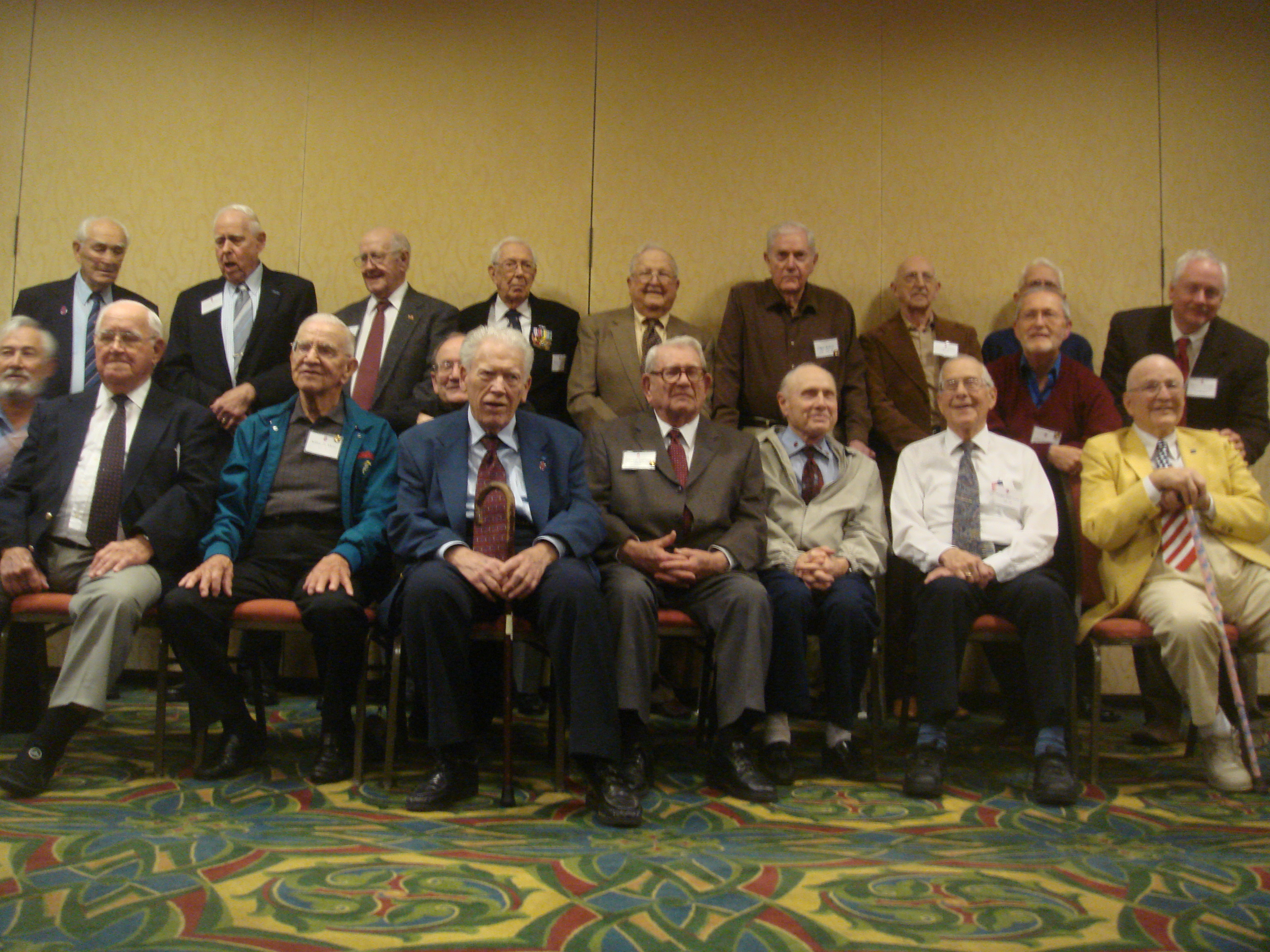
I am delighted to note that as of this writing, we have 52 persons registered for our next Reunion in March. This is very exciting to know that so many of our members are planning ahead and making plans to be together with us for this memorable event. Among our participants, we already have a commitment from 4 of our Holocaust Survivors, who plan to be with us to tell their stories and to become acquainted with their Liberators, and meeting others of their peers for the first time. I am sure that there will be others joining us as time goes on. If we can have 100 or more at this reunion, it will tell us that we surviving “Old Hickorymen” still have a lot of spirit within us, and determination to join with the crowd as often as the opportunity presents itself.

If you have not been to one of our Reunions, you just do not know what you are missing in the way of Friendship and Camaraderie, that we all knew way back 65 years ago. It has grown even better ! Don’t miss out on this one !!

Frank W. Towers, President

DRAFT COPY

(Subject to Change)

Program 2010

Holiday Inn Select, Opryland/Airport

4 March – 7 March 2010

Wednesday                              3 March

Early Registration                                         1:00 P.M.  –  5:00 P.M.

Hospitality                                                      1:00 P.M.  –  5:00 P.M.

Dinner on Own                                              5:00 P.M.  –  7:00 P.M.

Manager’s Reception (Free)             5:30 P.M.  –  6:30 P.M.

Hospitality                                                      7:00 P.M.  –         ??

Thursday                               4 March

Registration                                                   9:00 A.M. –  12:00 Noon

Lunch on Own                                            12:00 Noon –   1:00 P.M.

Registration                                                   1:00 P.M.  –    5:00 P.M.

Reception in Atrium                                     6:00 P.M.  –   7:30 P.M.

Hospitality                                                      7:30 P.M.  –  10;00 P.M.

Friday                                     5 March

Breakfast       (Whenever you wish)            6:30 A.M.  –    8:30 A. M.

Memorial Service                                          9:30 A.M.       10:30 A.M.

Open Time for Visiting / Interviews            10:30 A.M.     12:00 Noon

Lunch at Hotel                                               12:00 P.M   –     1:30 P.M.

Holocaust Survivors Presentation                  2:00 P.M.  –                 5:00 P.M.

Hospitality                                                         5:00P.M.  –    6:00 P.M.

Dinner                                                               6:00 P.M.  –    7:30 P.M.

Hospitality                                                         7:30 P.M.  –   10:00 P.M.

Saturday                                6 March

Breakfast       (Whenever you wish)               6:30 A.M.  –    8:30 A.M

General Meeting                                                9:00 A.M.     12:00 Noon

Lunch at Hotel                                                  12:30 P.M.       1:30 P.M.

Hospitality                                                          1:30 P.M.         6:00 P.M

Holocaust Survivors Presentation Cont’d       1:30 P.M.        5:00 P.M..

Banquet                                                                7:00 P.M.        9:00 P.M.

Hospitality                                                             9:00 P.M.      11.00 P.M.

Sunday                                   7 March

Breakfast  (Whenever you wish)                        6:30 A.M. – 8:30 A.M.

Departures :    Airport shuttle as scheduled . Be sure to schedule your departure with the Hotel Concierge on Friday or Saturday!!

Read Full Post »

« Newer Posts - Older Posts »