Feeds:
Posts
Comments

Archive for the ‘Uncategorized’ Category


Excerpt from the new book “The Things Our Fathers Saw” and Joe Minder’s prisoner of war dairy, dated 70 years ago this weekend, on the day he tasted freedom.

[In mid-August] On the radio the Japanese Emperor Hirohito spoke to his people and said, ‘The time has come when we must bear the unbearable.’ It was the first time they had heard his voice. Shaken prison camp commandants awaited word of whether or not to carry out the “kill-all” order within their camps.

Joe Minder recorded his observations as the prisoners dared to hope that their redemption was near.


Joseph Minder 1941.

Joseph Minder 1941.


Upcoming events page: http://matthewrozell.com/author-appearances/

Order the signed book directly: http://matthewrozell.com/order-the-things-our-fathers-saw/

Order paperback or ebook from Amazon:

******


Read Full Post »

I’m not sure what this is. It leaves some things out, I think. Read the book and decide for yourself.


Statement by Prime Minister Shinzo Abe

Cabinet Decision

On the 70th anniversary of the end of the war, we must calmly reflect upon the road to war, the path we have taken since it ended, and the era of the 20th century. We must learn from the lessons of history the wisdom for our future.

More than one hundred years ago, vast colonies possessed mainly by the Western powers stretched out across the world. With their overwhelming supremacy in technology, waves of colonial rule surged toward Asia in the 19th century. There is no doubt that the resultant sense of crisis drove Japan forward to achieve modernization. Japan built a constitutional government earlier than any other nation in Asia. The country preserved its independence throughout. The Japan-Russia War gave encouragement to many people under colonial rule from Asia to Africa.

After World War I, which embroiled the world, the movement for self-determination gained momentum and put brakes on colonization that had been underway. It was a horrible war that claimed as many as ten million lives. With a strong desire for peacestirred in them, people founded the League of Nations and brought forth the General Treaty for Renunciation of War. There emerged in the international community a new tide of outlawing war itself.

At the beginning, Japan, too, kept steps with other nations. However, with the Great Depression setting in and the Western countries launching economic blocs by involving colonial economies, Japan’s economy suffered a major blow. In such circumstances, Japan’s sense of isolation deepened and it attempted to overcome its diplomatic and economic deadlock through the use of force. Its domestic political system could not serve as a brake to stop such attempts. In this way, Japan lost sight of the overall trends in the world.

With the Manchurian Incident, followed by the withdrawal from the League of Nations, Japan gradually transformed itself into a challenger to the new international order that the international community sought to establish after tremendous sacrifices. Japan took the wrong course and advanced along the road to war.

And, seventy years ago, Japan was defeated.

On the 70th anniversary of the end of the war, I bow my head deeply before the souls of all those who perished both at home and abroad. I express my feelings of profound grief and my eternal, sincere condolences.

More than three million of our compatriots lost their lives during the war: on the battlefields worrying about the future of their homeland and wishing for the happiness of their families; in remote foreign countries after the war, in extreme cold or heat, suffering from starvation and disease. The atomic bombings of Hiroshima and Nagasaki, the air raids on Tokyo and other cities, and the ground battles in Okinawa, among others, took a heavy toll among ordinary citizens without mercy.

Also in countries that fought against Japan, countless lives were lost among young people with promising futures. In China, Southeast Asia, the Pacific islands and elsewhere that became the battlefields, numerous innocent citizens suffered and fell victim to battles as well as hardships such as severe deprivation of food. We must never forget that there were women behind the battlefields whose honour and dignity were severely injured.

Upon the innocent people did our country inflict immeasurable damage and suffering. History is harsh. What is done cannot be undone. Each and every one of them had his or her life, dream, and beloved family. When I squarely contemplate this obvious fact, even now, I find myself speechless and my heart is rent with the utmost grief.

The peace we enjoy today exists only upon such precious sacrifices. And therein lies the origin of postwar Japan.

We must never again repeat the devastation of war.

Incident, aggression, war — we shall never again resort to any form of the threat or use of force as a means of settling international disputes. We shall abandon colonial rule forever and respect the right of self-determination of all peoples throughout the world.

With deep repentance for the war, Japan made that pledge. Upon it, we have created a free and democratic country, abided by the rule of law, and consistently upheld that pledge never to wage a war again. While taking silent pride in the path we have walked as a peace-loving nation for as long as seventy years, we remain determined never to deviate from this steadfast course.

Japan has repeatedly expressed the feelings of deep remorse and heartfelt apology for its actions during the war. In order to manifest such feelings through concrete actions, we have engraved in our hearts the histories of suffering of the people in Asia as our neighbours: those in Southeast Asian countries such as Indonesia and the Philippines, and Taiwan, the Republic of Korea and China, among others; and we have consistently devoted ourselves to the peace and prosperity of the region since the end of the war.

Such position articulated by the previous cabinets will remain unshakable into the future.

However, no matter what kind of efforts we may make, the sorrows of those who lost their family members and the painful memories of those who underwent immense sufferings by the destruction of war will never be healed.

Thus, we must take to heart the following.

The fact that more than six million Japanese repatriates managed to come home safely after the war from various parts of the Asia-Pacific and became the driving force behind Japan’s postwar reconstruction; the fact that nearly three thousand Japanese children left behind in China were able to grow up there and set foot on the soil of their homeland again; and the fact that former POWs of the United States, the United Kingdom, the Netherlands, Australia and other nations have visited Japan for many years to continue praying for the souls of the war dead on both sides.

How much emotional struggle must have existed and what great efforts must have been necessary for the Chinese people who underwent all the sufferings of the war and for the former POWs who experienced unbearable sufferings caused by the Japanese military in order for them to be so tolerant nevertheless?

That is what we must turn our thoughts to reflect upon.

Thanks to such manifestation of tolerance, Japan was able to return to the international community in the postwar era. Taking this opportunity of the 70th anniversary of the end of the war, Japan would like to express its heartfelt gratitude to all the nations and all the people who made every effort for reconciliation.

In Japan, the postwar generations now exceed eighty per cent of its population. We must not let our children, grandchildren, and even further generations to come, who have nothing to do with that war, be predestined to apologize. Still, even so, we Japanese, across generations, must squarely face the history of the past. We have the responsibility to inherit the past, in all humbleness, and pass it on to the future.

Our parents’ and grandparents’ generations were able to survive in a devastated land in sheer poverty after the war. The future they brought about is the one our current generation inherited and the one we will hand down to the next generation. Together with the tireless efforts of our predecessors, this has only been possible through the goodwill and assistance extended to us that transcended hatred by a truly large number of countries, such as the United States, Australia, and European nations, which Japan had fiercely fought against as enemies.

We must pass this down from generation to generation into the future. We have the great responsibility to take the lessons of history deeply into our hearts, to carve out a better future, and to make all possible efforts for the peace and prosperity of Asia and the world.

We will engrave in our hearts the past, when Japan attempted to break its deadlock with force. Upon this reflection, Japan will continue to firmly uphold the principle that any disputes must be settled peacefully and diplomatically based on the respect for the rule of law and not through the use of force, and to reach out to other countries in the world to do the same. As the only country to have ever suffered the devastation of atomic bombings during war, Japan will fulfill its responsibility in the international community, aiming at the non-proliferation and ultimate abolition of nuclear weapons.

We will engrave in our hearts the past, when the dignity and honour of many women were severely injured during wars in the 20th century. Upon this reflection, Japan wishes to be a country always at the side of such women’s injured hearts. Japan will lead the world in making the 21st century an era in which women’s human rights are not infringed upon.

We will engrave in our hearts the past, when forming economic blocs made the seeds of conflict thrive. Upon this reflection, Japan will continue to develop a free, fair and open international economic system that will not be influenced by the arbitrary intentions of any nation. We will strengthen assistance for developing countries, and lead the world toward further prosperity. Prosperity is the very foundation for peace. Japan will make even greater efforts to fight against poverty, which also serves as a hotbed of violence, and to provide opportunities for medical services, education, and self-reliance to all the people in the world.

We will engrave in our hearts the past, when Japan ended up becoming a challenger to the international order. Upon this reflection, Japan will firmly uphold basic values such as freedom, democracy, and human rights as unyielding values and, by working hand in hand with countries that share such values, hoist the flag of “Proactive Contribution to Peace,” and contribute to the peace and prosperity of the world more than ever before.

Heading toward the 80th, the 90th and the centennial anniversary of the end of the war, we are determined to create such a Japan together with the Japanese people.

August 14, 2015
Shinzo Abe, Prime Minister of Japan

Read Full Post »

001

Mr. Peachman and author, at debut book signing, Aug. 8, 2015. Mary Rozell photo.

As the book  ‘The Things Our Fathers Saw ‘ went to press, I was contacted by the Japan’s largest news wire service, “with over 50 million subscribers worldwide, publishing articles in Japanese, English, Chinese and in Korean…” They wanted a veteran’s “reflections as we approach the 70th anniversary of the double bombings of Hiroshima and Nagasaki” (which he offers in the book, Chapter 13, ‘The Kamikazes’). So, seventy years after the war, Mr. Peachman got to address the Japanese people. The story is below. I called him to ask him how it went.

Mr. Peachman: “It was very nice, the reporter was happy to speak to me. I told her, ‘I hope you have an hour or two.’ We had many things in common- I had traveled to Japan several times after the war, and we knew of the same places. I told her, you can’t say that you feel the same as you did, 70 years later. During World War II, the Japanese would fight to the death. I honestly felt that the bomb was necessary to end the war, though I feel that President Roosevelt made a mistake by demanding unconditional surrender. And I have questions about how and when the bomb was used. But make no mistake, the coming land invasion of Japan would have been a bloodbath.”

Mr. Peachman and author, at debut book signing, Aug. 8, 2015. Article in Japanese in foreground. Mary Rozell photo.

Mr. Peachman and author, at debut book signing, Aug. 8, 2015. Article in Japanese in foreground. Mary Rozell photo.

NEXT LOCAL AUTHOR APPEARANCE/EVENT:
• BOOK SIGNING AND TALK-Sunday, August 23, 7:00 pm:
The Glen at Hiland Meadows, 39 Longview Drive, Queensbury, NY 12804

From the Kyodo Japanese News Service :
Thank you so very much for all of your help and for putting us in touch with Mr. Peachman. As I explained to you both it was part of a series of short interviews conducted with people from around the world on the subject of views on the atomic bomb.
In addition to Mr. Peachman, whose comments we wrote about, we also spoke with a third generation Japanese American in LA, a former factory worker in Beijing, a female university student in Seoul, a high school teacher in Hong Kong who was involved in the protest movements, a former office worker in Germany, a Professor Emeritus from Israel, a young Iranian whose parent was a writer and a former preacher from Scotland.
We are so appreciative of our conversation with Mr. Peachman and because of the importance of what he said, he was mentioned at the top. Please see the Japanese article with the mark indicating the part where he spoke.
In Summary: we simply explained that many in the U.S. believe that the atomic bomb was necessary to help save lives and that Mr. Peachman was aboard a ship off Okinawa when it was attacked by Kamikaze planes. He lost some of his crew mates and upon hearing the news that the bomb was dropped was relieved because he did not think that he would have survived another encounter with the Japanese. Although he is saddened by the deaths that occurred in Hiroshima he did believe that it did save lives.
I hope this is helpful to you and please pass along our appreciation to Mr. Peachman and we also thank you so much for putting us in touch with him.
Please see the attached file.
Best regards,
S. M.

*************************************************************

Matthew Rozell’s career as a history teacher is now spanning four decades. Over the course of the past 20 years, he and his students conducted hundreds of interviews with the World War II generation. One such interview led to the reuniting of a train transport of Holocaust survivors with their American liberators, over 60 years later. He is currently working on a trilogy of narrative histories based on these interviews.

His first book, a narrative of World War II in the Pacific as told through the previously unpublished recollections of over 30 veterans, was released in August. It is available here.  His second book, in progress, is on the power of  teaching, remembering the Holocaust, and the real story behind the  iconic photo of the “Train Near Magdeburg’. He can be reached at his Facebook page at Author Matthew Rozell or by commenting below.

Read Full Post »
How my 93 yr. old history teacher, who survived a deadly kamikaze attack in the spring of 1945, got to address the Japanese people on the eve of the 70th anniversary of the end of WW II.

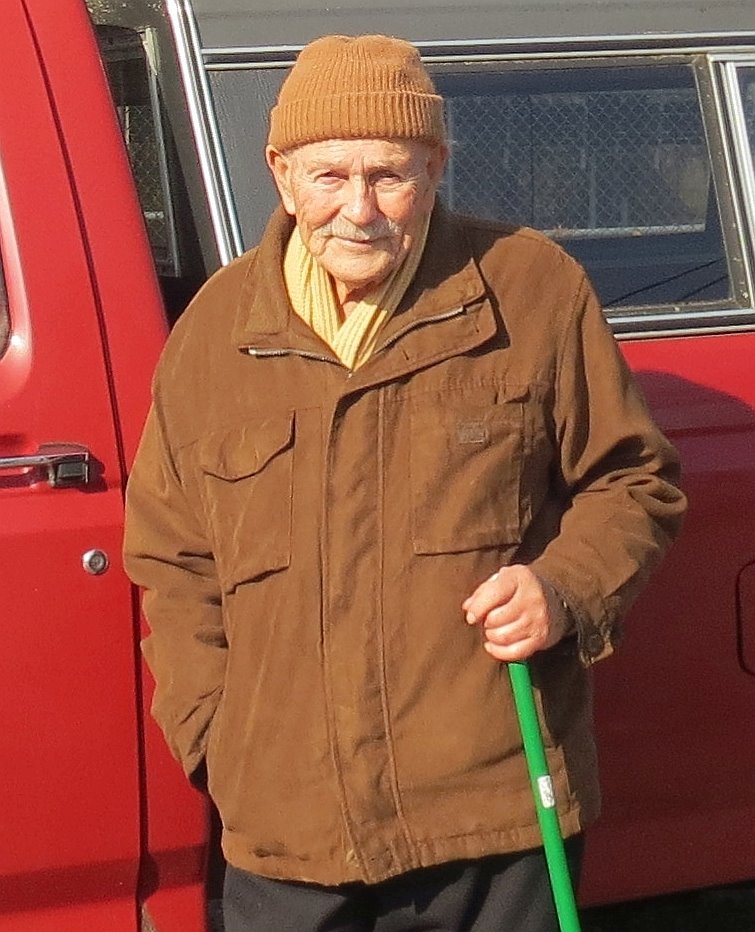
Mr. Alvin Peachman, Nov. 2014, out for his daily walk. Photo by Mike Nicholson, HFHS Class of 1979.

Mr. Alvin Peachman, Nov. 2014, out for his daily walk. Photo by Mike Nicholson, HFHS Class of 1979.

Be sure to come out and see us at the first author event- yes, Mr. Peachman will be there, too. He has TWO chapters in the book.

August 8th, 1-4 pm
The Village Booksmith.
223 Main St, Hudson Falls, NY 12839
(518) 747-3261

As the book  ‘The Things Our Fathers Saw ‘ went to press, I was contacted by the Japan’s largest news wire service, “with over 50 million subscribers worldwide, publishing articles in Japanese, English, Chinese and in Korean…” They wanted a veteran’s “reflections as we approach the 70th anniversary of the double bombings of Hiroshima and Nagasaki” (which he offers in the book, Chapter 13, ‘The Kamikazes’). So, seventy years after the war, Mr. Peachman got to address the Japanese people. The story is not out yet, but I just called him to ask him how it went.

Mr. Peachman: “It was very nice, the reporter was happy to speak to me. I told her, ‘I hope you have an hour or two.’ We had many things in common- I had traveled to Japan several times after the war, and we knew of the same places. I told her, you can’t say that you feel the same as you did, 70 years later. During World War II, the Japanese would fight to the death. I honestly felt that the bomb was necessary to end the war, though I feel that President Roosevelt made a mistake by demanding unconditional surrender. And I have questions about how and when the bomb was used. But make no mistake, the coming land invasion of Japan would have been a bloodbath.”

From the book:

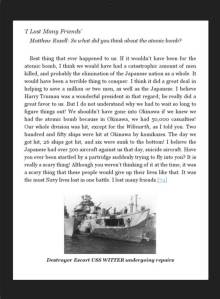
 ‘I Lost Many Friends’


Matthew Rozell: So what did you think about the atomic bomb?

Best thing that ever happened to us. If it wouldn’t have been for the atomic bomb, I think we would have had a catastrophic amount of men killed, and probably the elimination of the Japanese nation as a whole. It would have been a terrible thing to conquer. I think it did a great deal in helping to save a million or two men, as well as the Japanese. I believe Harry Truman was a wonderful president in that regard; he really did a great favor to us. But I do not understand why we had to wait so long to figure things out! We shouldn’t have gone into Okinawa if we knew we had the atomic bomb because in Okinawa, we had 50,000 casualties! Our whole division was hit, except for the Wilmarth, as I told you. Two hundred and fifty ships were hit at Okinawa by kamikazes. The day we got hit, 26 ships got hit, and six were sunk to the bottom! I believe the Japanese had over 500 aircraft against us that day, suicide aircraft. Have you ever been startled by a partridge suddenly trying to fly into you? It is really a scary thing! Although you weren’t thinking of it at the time, it was a scary thing that these people would give up their lives like that. It was the most Navy lives lost in one battle. I lost many friends.

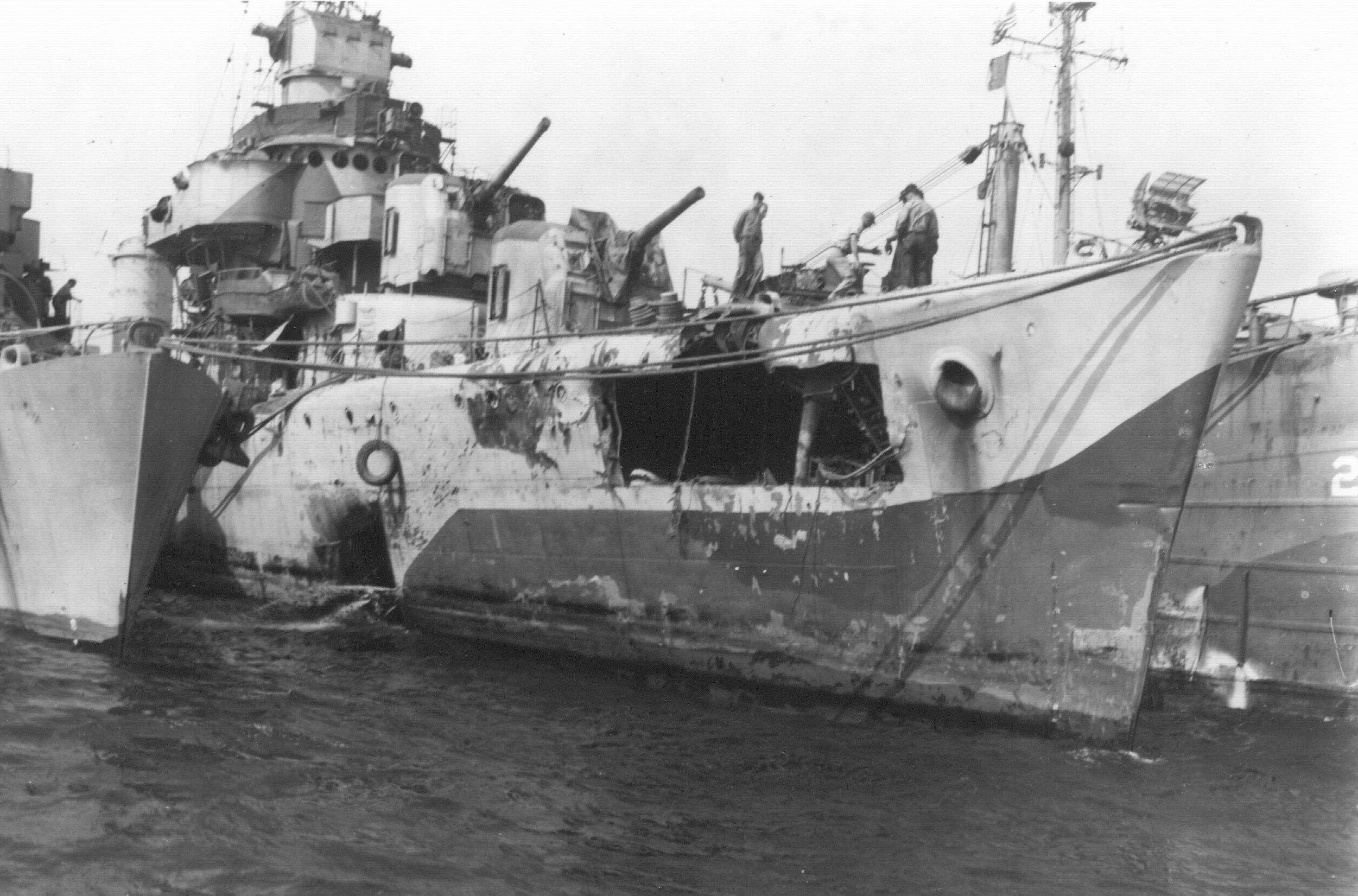
Destroyer Escort USS WITTER undergoing repairs following kamikaze attack. Alvin Peachman collection.

Destroyer Escort USS WITTER undergoing repairs
following kamikaze attack. Alvin Peachman collection.

As the land battle for Okinawa raged toward its crescendo with the fury of a storm, the kamikaze attacks would claim over 15,000 American casualties for the Navy alone.

Read Full Post »
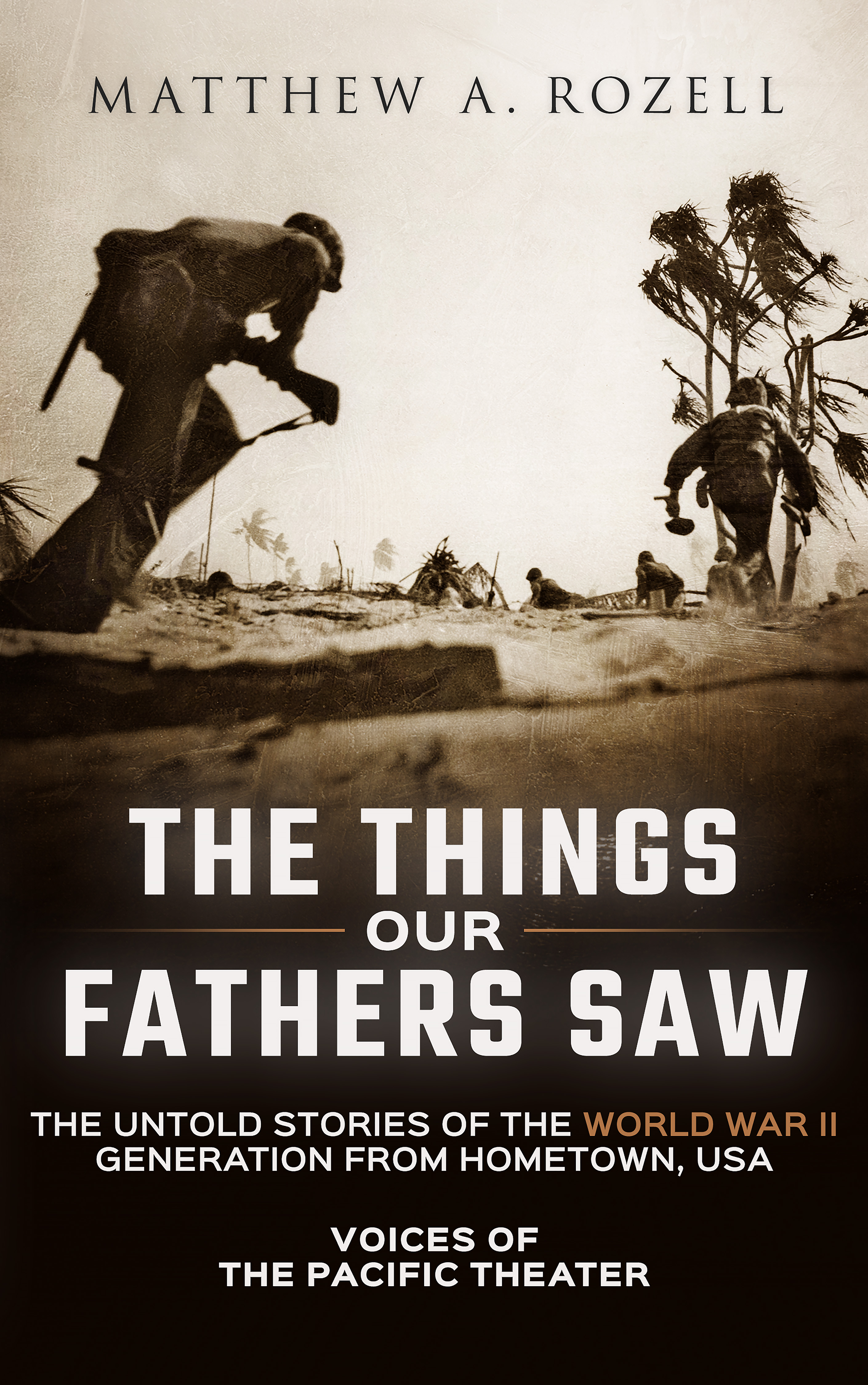
cover-shrunkThe paperback book is ready. It’s reasonably priced and it can be ordered at Amazon. The e-book is also there; below are some still shots/previews.

Thank you for all your support in keeping the memory alive.


 ORDER THE PAPERBACK BOOK  / E-BOOK HERE.

288 pages. 35 photographs, including never-before published portraits, and over a dozen maps/closeups by Susan Winchell-Sweeney.

Receive regular updates by ‘liking’ the Facebook page at the bottom of our HOME page or visiting it at  AuthorMatthewRozell

The first author appearance is scheduled in Hudson Falls, NY, one of the book’s settings,  for August 8th , 1-4pm, at the Village Booksmith.

Address: 223 Main St, Hudson Falls, NY 12839
Phone:(518) 747-3261

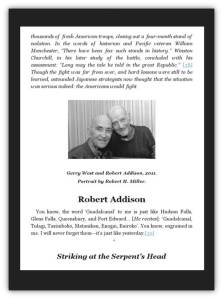
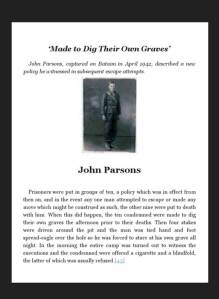
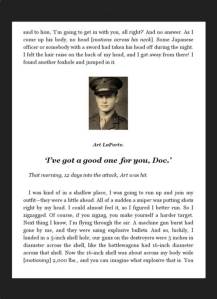
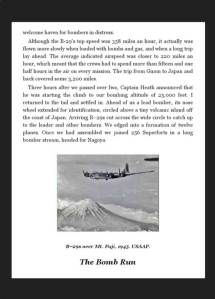
RANDOM PREVIEW IN E-BOOK I-PAD VIEW.


Read Full Post »
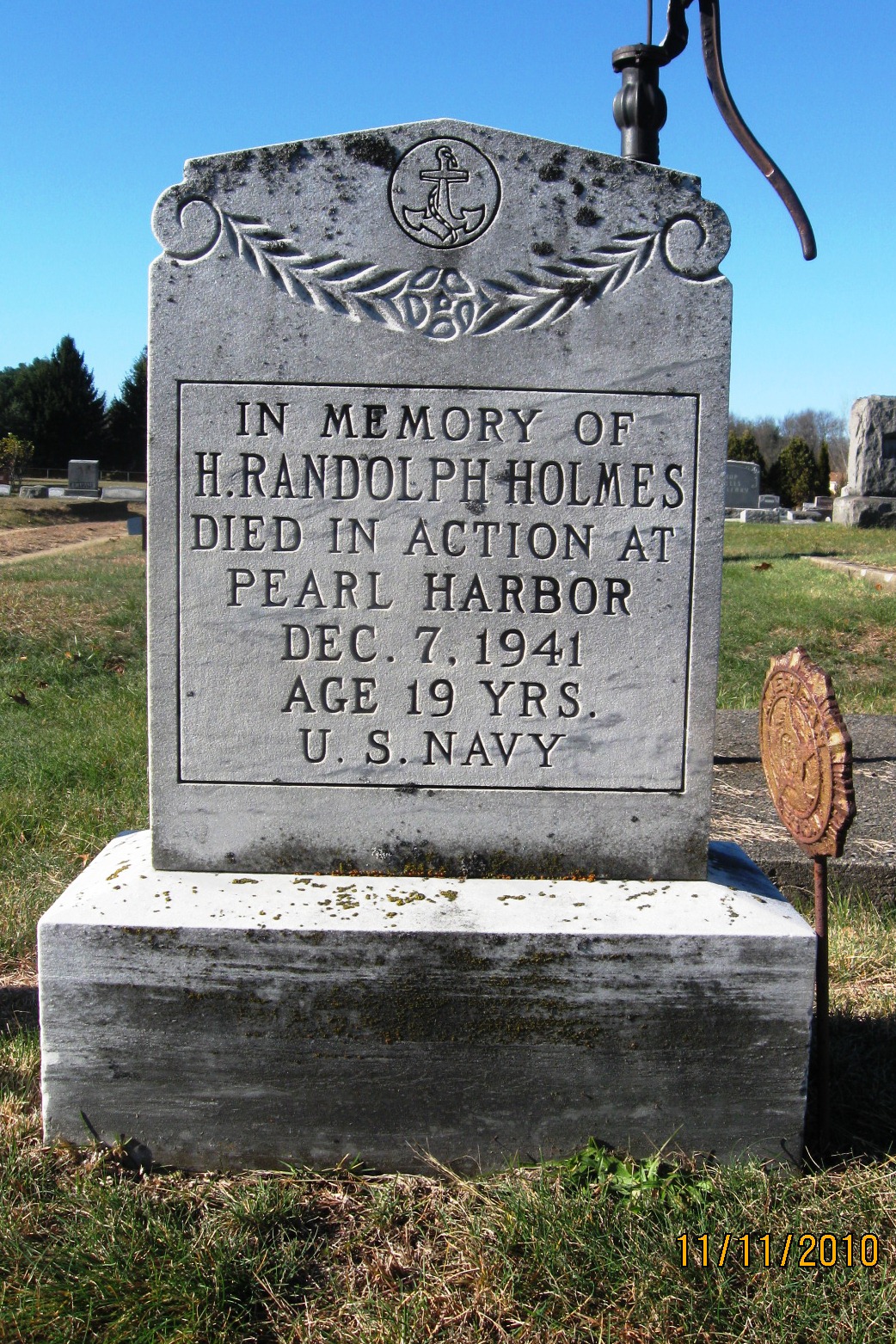
The Remains of Randy.

This is kind of a quiet big deal. There is a boy from Hudson Falls, New York, and he and 387 others are buried here in commingled settings at the National Memorial Cemetery of the Pacific in Hawaii. Exhumations began last week and are going on right now. He was 19 when he died, his remains were under water for 18 months, and he never came home. Definitely the first boy killed in World War II from our town, and county, maybe even the state. He left school at 17 and joined the Navy. A year later, he was declared missing, and he has never properly been identified.

Imagine what that did to his mother and father, and sister. He’s a big part of my upcoming book, which will be published this week.  Looks like I have to go back and add another endnote! But a good one.

Photo by Bruce and Debbie Almeida.

Photo by Bruce and Debbie Almeida.

From NPR: Pentagon To Exhume Remains Of Sailors From USS Oklahoma
APRIL 15, 201512:39 PM ET
KRISHNADEV CALAMUR

The Pentagon says it will exhume the remains of 388 sailors and Marines who died on Dec. 7, 1941, in the capsizing of the USS Oklahoma during the Japanese bombing of Pearl Harbor.

They are all currently buried as unknowns at the National Memorial Cemetery of the Pacific in Honolulu. In all, 429 sailors and Marines perished aboard the Oklahoma; 35 were identified in the years after the attack. The 388 personnel who remained unidentified were buried in 61 caskets at 45 grave sites at the memorial, locally dubbed the “Punchbowl.”

As recently as last year, the Navy told families of those aboard the ship that it opposed the exhumation, noting “a full DNA testing and accounting could take many years and likely leave many of the missing still unaccounted for.” But on Tuesday, the Pentagon reversed course.

Deputy Defense Secretary Robert Work, in a memorandum, said: “Recent advances in forensic science and technology, as well as family member assistance in providing genealogical information, have now made it possible to make individual identifications for many Service members long-buried in graves marked ‘unknown.’ ”

The memorandum states that the Defense Department “has contacted families, collected and analyzed DNA from 84 percent of applicable USS Oklahoma family members, and has collected 90 percent of antemortem medical and dental records from the ship’s crew.” Analysis of the evidence suggests that most of the Oklahoma’s crew members could be identified if the 61 caskets were disinterred — a process, the memo said, that should be completed within five years.

More broadly, Work established a broader policy that applies to all unidentified human remains from permanent U.S. military cemeteries from which remains are exhumed for identification. For commingled remains, there must be a 60 percent chance of identification; for individuals, 50 percent.

Moss St. Cemetery. Photo by Judith Yole Graham.

Moss St. Cemetery. Photo by Judith Yole Graham. He is not here.


source article: http://www.npr.org/sections/thetwo-way/2015/04/15/399825301/pentagon-to-exhume-remains-of-sailors-aboard-uss-oklahoma

Further reading, update: http://www.militarytimes.com/story/military/pentagon/2015/07/27/uss-oklahoma-remains-dug-up-for-identification/30750103/

Photo by Bruce and Debbie Almeida.

Photo by Bruce and Debbie Almeida.

Photo by Bruce and Debbie Almeida.

Photo by Bruce and Debbie Almeida.

Read Full Post »

Portrait by Rob Miller.

Portrait by Rob Miller.

We just launched the new website! Come on over and see. Find out more about the new book. Bonus material here for the book, also. Tons of photographs and artifacts, and my new photo blog. It’s launch time! E-book is out, Print to follow Aug. 1. Signed copies available.

HOME

Like us at Facebook AuthorMatthewRozell if you are so inclined, for more updates. Thanks for sharing this post!

Matt

Read Full Post »
We are about a week out from the launch of my first book, The Things Our Fathers Saw.  It clocks in at 286 print pages, and none of it is filler. Over 30 veteran stories are featured. The angle is new and unlike any other WW2 title out there. I am pretty excited. You get some butterflies, too; you are throwing yourself out to the world and you are going to be judged every time someone picks it up. So, why do it? I’d like to tell you what the experience of writing a first book has meant to me.

First off, I have been planning to write this book for well over a decade. Why?

The Things Our Fathers Saw - Front Cover

Besides the fact that it has been a major portion of my life’s work, I’ll offer up the other cliché that it is ‘a story that needs to be told’. Though I didn’t wake up one day and decide to write a book. The stories have bouncing around in my head for years.  I’ve shared them over and over again in my classes. The men and women who told them to me and to our young people are gone, or sadly won’t be with us forever. And I’m not taking the stories with me when it’s my turn to go. This is my legacy, this is their legacy, and more importantly, if you are an American, it is your legacy too.

And I don’t care how much you know about World War II, or the Pacific War. You WILL learn something new in this book. Not because I am a genius or an expert, but because I thought that I was pretty well-versed on this history, but I learned  A LOT myself in the research and writing of it. And if you are a bit hazy on the subject, or maybe were a wee bit disinterested in it when in school (if you were taught it in the first place), you are about to be blown away-by the writing, I hope, but especially the history.

*

Here is why I did NOT write the book. It was not about the money, and any author who writes for money, well, that is a book you probably do not want to read. I did not set forth to cash in, or write for “personal gain”. I think my brother said it best, simply, when he told me it is just something that you have to do.

That said, the book did not write itself. It has been in the works on a daily basis for nearly a year now. I’ve gotten up at 1:00 in the morning and worked to 4 or 5 AM, slipping back into the sack for a power nap before charging off again to school. Somedays, it killed me.

The past month, since school got out, I have been glued to this chair. The manuscript that I have been working on has been updated and revised 41 times since final exams wrapped up. I’ve gone back and forth with my beta editors and my mapmaker, Susan Winchell-Sweeney, on at least a weekly basis since April. I spent my school vacations studying, researching, editing and transposing a never-before-published prisoner of war diary, and cross-referencing and tracking down confirmations for the stories that appear in my book.

And I have found out that some super best-selling authors on similar topics should have done a little bit more of this type of homework.

So what you are going to get, is my best.

***

Some people looked at me curiously when I said I was going to publish independently-mostly people who are caught up in traditional publishing. ‘Self-publishing’ gets a bad rap, gets ‘poo-pooed’-and there is a LOT of dreck and drivel out there. But for me, and for my brothers who are also writers, we just don’t want to deal with the gatekeepers at this time (my brother lost the rights to his first book, watched it go out of print, and had to buy the rights back when the opportunity arose). This allows us the independence to produce the work that we have envisioned in our heads with total control. That is not to say that you don’t seek help in the form of editing, the title, the book layout and design (I even had a contest of sorts on Facebook to refine and select the final cover design, with feedback from hundreds). But I’m told that the first thing a traditional publisher is going to ask today is, ‘how will YOU (the author) market this book?’ What is your following, and where is your brand? Voilà. Woodchuck Hollow Press came into the world.

014

Final edits coming to you from the Woodchuck Hollow Studios.

Marketing? That is a whole other venture, the business side, I suppose. Personal gain did not figure into the motivation for doing this, but obviously I have incurred expense (that cover cost us a small fortune, but worth it, thanks to Damon Freeman at Damonza.com), and in investing so much of my time, I chose to forgo other opportunities to supplement the family income. I don’t know how to explain it, it is just something that I had to do (though that walk-in closet that I started for my wife last summer still is not done-but we are still married!). If a major publisher or bookseller shows interest, we can talk. But we are not going to lose sleep worrying over the numbers. The woodchucks will handle it.

Built-from-scratch cabinet doors for inside walk-in closet. By scratch means I cut the trees for it. Kinda like building a book. On to the next set.

Built-from-scratch cabinet doors for inside walk-in closet. ‘By scratch’ means I cut the trees for it. Kinda like building a book. On to the next set.

Stay tuned for more details. It will be available on Amazon in print and ebook format, and signed copies will be available via my website (http://matthewrozell.com/) or at local events I may be invited to do. Thanks for following this blog, and you can get more frequent updates if you are on Facebook by following/liking the AuthorMatthewRozell page.

Any others out there who want to share the experience of writing a book? Comments on my comments? Now if you will excuse me, I have to go out and deal with that pesky woodpecker who keeps hammering away at my house. Have a great day!

Read Full Post »

My friend Elaine wrote this. She just returned for the umteenth time taking dedicated Holocaust educators to learn from some very heavy authentic sites in Europe.

The daughter of survivors, Elaine is special person, known by many, who guided me to the places that she writes so hauntingly about. The day we went to Belzec, the men were grouped apart from the women for the first time, nearing the end of a very emotional trip. I remember being confused about it at the time, but Elaine needed to share with the beautiful girls on our trip. I get it now. A year later, I was still processing, and wrote a related post way below. It literally took that long. I still am processing, which is a part of her essay, below. Though I don’t pretend to equate my experience with any other human being’s, I think it is a universal truth that it’s never over.

Thank you Elaine. Matt

By Elaine Culbertson

In the winter my book club read a book called This Republic of Suffering by Drew Gilpin Faust. It’s about the aftermath of the Civil War, particularly about death and dying and the business and customs that sprung up as a result of so many deaths.

At the time I was reading it, I never made the connection that struck me today. Here it is: after the Civil War, a new industry of mourning developed. Families searched for their loved ones on battlefields and in mortuaries; they paid for bodies to be shipped across many state lines (hence the idea of refrigerating the body and more stringent embalming practices were instituted); they saved relics of loved ones including hair and made jewelry from it; they placed markers in places far away from their home burial plots; they placed notices in newspapers hoping to find information about missing combatants; they held ceremonies for people they could not find, establishing markers all over the then US to the Civil War dead. Both sides, North and South, were engaged in this, but the Northerners, being the victors, had the upper hand and could dishonor the dead bodies of the Southerners and claim that they were missing when in fact they had used mass graves, in some cases, to dispose of the dead. The book fascinated me for its scholarship, its directness, and its beautiful writing, but I did not know why it resonated as it did.

Humans need to remember and honor their dead. The mourning period has no defined end, especially when there is no closure. Those distraught family members who could not establish a real burial spot lived with the hope/dread that the dead might not really be gone or that the suffering was not over. Believing that they are dead but not knowing of their fate is an interminable condition of anxiety. Going to Auschwitz and Belzec, one day after another, was like the extended funeral I have been living my entire life. I never knew any of them them but they have loomed large in my life. To be named after them, to be told I look like them, to hear stories about them, and yet not to have the ability to end the mourning period, or perhaps abbreviate it and pack it away for a while, is the legacy of survivors and their offspring.

Even as I write this I find myself moved to tears thinking about those lonely places. While cemeteries are supposed to be peaceful, those places are restless and painful, hardly consoling. I don’t mean the bustling barracks at Auschwitz, but the quiet windy Birkenau where we were pelted with hail. I mean the scorched earth of Belzec where nothing can grow. No matter how many kaddishes are said there, it will never be enough. There aren’t enough stones to commemorate those who died in either place, and although I stood in front of my grandmother’s name, I don’t have a sense of being able to say a true goodbye. I can walk away, but I can never leave.

913

Elaine is a former high school English teacher and school administrator. She is the Chair of the Pennsylvania Holocaust Education Council, and the director of the The Holocaust and Jewish Resistance Teachers’ Program, an intensive three-week living and learning experience in Germany, Poland and Israel for U.S. secondary school teachers who are committed to teaching about the Holocaust and Jewish resistance. Visit their website at www.hajrtp.org, especially if you are a teacher interested growing in this life-changing experience.

***

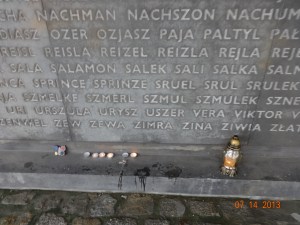
Matt’s 2013 Belzec experience the day Elaine took him and the group there.

And the cycle, the mystery, the life continues. Belzec.

Read Full Post »


The Things Our Fathers Saw: 

The Untold Stories of the World War II Generation from Hometown, USA –

Voices of the Pacific Theater

288 pages

27th Infantry Division. Saipan, July, 1944.  New York State Military Museum.

27th Infantry Division. Saipan, July, 1944.
New York State Military Museum.

‘I hope you’ll never have to tell a story like this, when you get to be 87.

I hope you’ll never have to do it.’

‑Marine veteran of the 1945 Battle of Iwo Jima, to his teenage interviewer

cover-shrunkAt the height of World War II, LOOK Magazine profiled a small upstate New York community for a series of articles portraying it as the wholesome, patriotic model of life on the home front. Seventy years later, a high school history teacher and his students track down over two dozen veterans residing around ‘Hometown, USA’ who fought the war in the Pacific, from Pearl Harbor to the surrender at Tokyo Bay. They rescue and resurrect firsthand accounts of combat and brotherhood, of captivity and redemption, and the aftermath of a war that left no American community unscathed. Here are the stories that the magazine could not tell, from a vanishing generation speaking to America today.

About the Author

Matthew Rozell’s teaching career is now spanning four decades. He has been recognized as an OAH Tachau History Teacher of the Year and as a recipient of the NSDAR National Founders’ Medal for History Education. Rozell is a United States Holocaust Memorial Museum Teacher Fellow, has had his lessons filmed for NBC Learn and the New York State United Teachers, and has even been selected as an ABC World News ‘Person of the Week’. He is also a recipient of several state and local awards for history education.

Receive regular updates by ‘liking’ the Facebook page at the bottom of our HOME page or visiting it at  AuthorMatthewRozell

The first author appearance is scheduled in Hudson Falls, NY, one of the book’s settings,  for August 8th , 1-4pm, at the Village Booksmith.

Address: 223 Main St, Hudson Falls, NY 12839
Phone:(518) 747-3261


Read Full Post »

« Newer Posts - Older Posts »