Feeds:
Posts
Comments

Archive for the ‘Uncategorized’ Category

During the first Nuremberg Trial, American guards maintain constant surveillance over the major Nazi war criminals in the prison attached to the Palace of Justice. Nuremberg, Germany, November 1945. NARA, public domain, via USHMM. I interviewed the third guard on the left side.

My wife and I went to see the 2025 film Nuremberg yesterday, starring, among others, Russell Crowe as Hermann Goering and Rami Malek as the psychiatrist assigned to him. Overall, while unfamiliar with the story of Lt. Col. Douglas Kelley, I felt the film was generally well done from the aspect of a Holocaust and World War II educator. I felt that, for the most part, the portrayal of chief prosecutor was well done, particularly from the angle of setting precedent for holding war criminals accountable for their individual actions. This was the first time in the history of the world that this had been attempted; leaders of a nation—military commanders, government officials, and propagandists—were held personally responsible for crimes against peace, war crimes, and crimes against humanity, destroying the defense of “I was only following orders.” It created the legal foundation for modern human rights.

The International Military Tribunals debuted in Nuremberg for a reason, which was well brought out in the film. It was the central rallying point for the massive Nazi displays of power in the early days of the Reich—see Leni Riefenstahl’s 1934-35 classic documentary, Triumph of the Will, which I would show to my seniors despite its almost two hour run time— and the sinister 1935 Nuremberg Laws that defined ‘Jewishness’ and codified antisemitism, beginning with stripping German Jews of their civil rights.

What a lot of folks who may be familiar with the Nuremberg trial portrayed here may not actually be aware of is that it was only the first of several trials. Prosecutor Robert H. Jackson set the tone early on.

Documenting the truth of Nazi crimes was the signature achievement. The trials produced an enormous body of evidence—captured documents, films, photographs, eyewitness testimony, and first-hand accounts from perpetrators. The authentic films of the camps upon liberation were included in this movie, and while hard to watch, just like in 1945-46, it showcased that the Holocaust one of the most documented crimes in world history, countering future denial with overwhelming proof.

The trials also set a moral example after a global catastrophe. Rather than executing Nazi leaders summarily—as some Allied leaders wanted—the Allies insisted on a lawful trial. This demonstrated that justice would not be simply vengeance, that the rule of law was stronger than dictatorship, and even the worst crimes deserved legal scrutiny.

To be sure, Hollywood took some liberties. The scenes portraying Jackson as being outwitted by Goering on the stand, and in which the psychiatrist Kelley hands over confidential notes to a gorgeous reporter in an intoxicated state were outright fabrications, to be sure. Others have criticized it for showing the humanity of the chief perpetrators, but I do not have much of a problem with that. For if we hold that they were all monsters, we are just letting humanity off the hook for the next time, as I have written about before, and while I speak for myself, many professionals in Holocaust education circles are in agreement.

But let’s not forget about the everyday GIs who found themselves at Nuremburg. In Volume 7, Across the Rhine, I introduce at least two of the guards to you, in their own words.


The Courtroom Sentinel

Leo DiPalma was the son of Italian immigrants who grew up in the western part of Massachusetts in the Great Depression. Like many young high schoolers at the time, he was shocked at the news of Pearl Harbor, and ready to serve when his number was called three years later at the age of eighteen. He gained combat experience as an infantryman with the 79th Division, crossing the Rhine in 1945 before being tasked with a new assignment in the 1st Division—standing guard, at the tender age of nineteen, over some of the most notorious war criminals of the 20th century.

I pulled guard duty in the cell block [at Nuremberg]. The cell block was sort of a center, like a star, and all these blocks went off this way [gestures several radial corridors with hand]. Well one of these blocks had the 21 bigwigs, Hermann Goering and Ribbentrop and Hess and all those guys. I was a staff sergeant at the time. I pulled guard on Albert Speer’s cell, and Rudolf Hess. Then after that I was there for a short while, I became sergeant of the guard. I took my regular duties every other day for 24 hours. Luckily, I was asked to go up into the courtroom. I pulled guard with the courtroom guard at one of the visitor doors. After that, I was asked to go up onto the witness stand. That was very interesting, because from where we stood, we weren’t too far from the interpreters. If they were speaking German, and you could pick out [the English translations], you know, so you could know what’s going on, that was very, very interesting. I actually had, at that time, the latter part of the 21 original prisoners, like von Schirach, and Raeder, and Donitz, and Sauckel, right around that area there. I was moving up real fast. I stayed there until July of ’46.

‘Goering and I, We Didn’t get Along’

I had a lot of contact [with these prisoners]. Goering, he was the highest-ranking German soldier there. He expected to be treated like he was a high-ranking officer. The rest of them, believe it or not, they used to bow down to him, let him go first and stuff like that. He and I didn’t get along when I took over sergeant of the guard.

One of my duties was, during a recess, when I opened the door, I stood at parade rest right in the docket where he was right in the corner. I’m sure you’ve seen pictures of it. He would turn to me, and he asked me for some water. ‘Vasser, bitte.’ Okay. I go down to the Lyster bag, which was chlorinated, and I’d get him a little cup of water, and I’d bring it up to him. And he’d take a sip and he’d go, ‘Bah, Americanich.’ You know? He’d hand it back to me. Now there was no way of getting rid of the water; I used to have to walk down to the men’s room on this side to get rid of the water and walk back up.

Mr. DiPalma later recalled that fed up with Goering’s antics, he once met Goering’s demands by replacing the contents of the cup with water from the toilet instead of the tap, which Goering found better than the chlorinated version. ‘I guess I felt it was my little contribution to the war effort,’ he added.

In the meantime, you know, I think he was just doing it on purpose, just getting rid of me. I think one of the things was that he didn’t want to do any talking, didn’t know if maybe I spoke German or stuff like that. I could understand a little bit. But what he didn’t know is, we had some German-speaking GIs right there, and they picked up some stuff on him anyway.

Another time, at night when court was over, one of my duties as the sergeant of the guard was to run the elevator. The elevator was located behind a docket in one of the panels. The elevator carried six people: three prisoners, two guards, and myself, made it [one guard to one prisoner], going up or going down. Well at night, we had to get out of there and run and get our trucks to get back to our billet. Everybody would step back, and there’s big confusion in the docket. [The Germans] let [Goering] go right through, you know. Well, one night, I grabbed ahold of Field Marshal Keitel, he was standing right there. I said, ‘Come on, get in, get in.’ And I dragged him in like that. He was indignant; he was going to let Goering get [in first]. I pulled somebody else in, and somebody else, and I left him, left Goering standing there, you know. I think that was one of the reasons why he would send me for water every day, he was getting back at me.

Another time everybody in the docket was stepping over one another, letting him get out first; they were going to lunch. He didn’t want to cross the hallway where spectators were, he wanted to walk right across—he didn’t want anybody to look at him. So this Captain Gilbert told us, ‘Put him last.’ Okay, so we put him last. Don’t let him stand inside of the doorway. He would wait until everybody went by so he [would have to] walk straight across. Well, I pushed him out there one time, we carried a club, poked him in the back, you know. He turned around and he swung at me, and he hit me on the arm, so I gave him an awful belt in the kidneys. He never said a word to me [after that]. He didn’t like me; I know he didn’t like me. I had a couple confrontations with him, but other than Goering, the rest of them were all pretty good.

Albert Speer, many of them spoke English. I never heard Goering speak English. Albert Speer, he was Hitler’s architect, if you remember correctly. I always felt sorry for him. He was the architect, but he kind of got, I think, using the right word here, sucked into being a Nazi, and he turned out to be a Nazi. Of course, this was all for glory, I guess, for himself. I think Hitler just used him. He was a very calm-speaking individual. Always spoke to the guards. He was quite an artist. He never did me, but some of the other guys that pulled guard on some of these cell blocks, on his cell, he used to draw pencil sketches of them, and they were good. Very, very good. Imagine something like that’s worth a buck today. I don’t have that.

Let’s see, Streicher, he was a pain in the neck, complained all the time. Terrible, terrible. Going back just a little bit, when I pulled guard on the cell block, imagine standing there for an hour and watching the guy sleep through a little hole in the door, you know, it’s awful monotonous. The guys used to talk to one another, and the other guys would get to laughing. Some of them [prisoners] didn’t get much sleep at night. You kind of had to keep it down; when I was sergeant of the guard, sometimes you used to hear hollering down there, so I had to go down there and tell the guys to knock it off. Have you ever seen the old German pfennig? It’s their penny. It’s about as big as our half dollar. Well, one of the things they used to do at night, this wing had a terrazzo floor. These guys would roll these pennies down the terrazzo floor, and it sounded like a freight train coming down through there! [Laughs] I’m surprised that a lot of the German prisoners could stay awake in the courtroom the next day.

Another night, I was in the guard office, and I had a cot there, I was laying there. I could hear some screaming. I said, ‘Oh my God!’ I went down there and the guard at Streicher’s door, out of monotony, had taken a piece of paper and folded it, and he had ripped a little man out of it, so that when you opened it up, it was a man with just legs and arms like that and the head. And from off his uniform somewhere, he had tied a piece of string [tied to the neck of the effigy]. You had the light on just outside of the cell, and he’s swinging the thing in front of the light, and it’s [silhouetting] on the wall, a man hanging. [Chuckles] Jeez. I really don’t blame him for trying to get through the hours, standing there.

Let’s see, von Schirach, I pulled guard on the witness stand with him. He was head of the Hitler Youth. One day, there was quite a confrontation between him and Chief Justice Jackson. Of course, we could understand him. And he spoke decent English now, but most of his replies were in German. But through the interpreter, we could hear what was going on. They were arguing back and forth about the duties of the Hitler Youth. Well, they called a recess shortly after that, and he turned to me. I was on his left side. He turned to me, and he said, ‘But the Hitler Youth is nothing more than your Boy Scouts.’

I said, ‘Really?’ He doesn’t realize that I was a frontline soldier.

I said, ‘I fought your Hitler Youth!’ He never said a word [after that]. We found Hitler Youth that could take apart our BAR, our M1s, or any of our equipment. So they weren’t Boy Scouts like he wanted to portray them.

The rest of them were all just no problems, really. No problems. Alfred Jodl, he was a signer of the surrender terms. He didn’t talk to anybody. Him and Keitel, they weren’t Nazis, but they originally were Wehrmacht soldiers, and they were good soldiers. But of course, they turned into Nazis afterwards, you know?

*

I came home in July, yeah, about three months before the trial ended. [I was not present when Goering committed suicide]; I think [he died] the beginning of October, as I recall.  Everybody was trying to get their autographs. In fact, I have their autographs. All but Hess. Every time you’d ask Hess for his autograph, he spoke good English, because he spent quite a bit of time in England, he said, ‘after the trials.’

Well, you know what our favorite saying was? ‘You won’t be here after the trials.’


Nuremberg’s message endures:
No one, no matter how powerful, is above the law—and the world will remember.

Read Full Post »

My mom passed away twenty years ago this morning.

She struggled with early onset Alzheimers for about twenty years. It was so hard to witness the decline, but I have to say that I think she was happy most of that time. She was beloved by the assisted living, and later the nursing home staff who cared for her at the end. She was gentle and sweet, and in her prime as the head school nurse teacher in her school district, no pushover when it came to advocating for her kids to those in power who stood in the way of affording them maximum attention and services. My sister and I sat with her in the wee hours after we learned she was no longer taking food. Exhausted, we headed home for a break around 2am that morning. We got the call about an hour later that she passed at 2:45, after we had left. I hardly remember her funeral, and it took years to get over it. A lot of anger to process. I’m not sure I’m over it yet, but there have been many signs and reminders that she is still with me.

Take this morning, for instance.

I woke up from a dream around 2:30 AM, and got up to walk to the bathroom. I noted the time, thinking of Mom. Actually I was doing some meta thinking—thinking about thinking of Mom—like, why did I wake up at this moment? The exact timing of her passing to the minutes twenty years on? Of course she’s been on my mind, but…

So I was walking by an antique low wattage lamp that remains on 24/7 near some stairs to light the path. Literally just as I passed it, behind my back, it started to flicker wildly, as some of these newfangled energy saving bulbs are apt to do when they are nearing the end, though it hasn’t ever done it before, and is not doing it now over 12 hours later. It sits on a desk my father built, alongside a bunch of my mom’s oversized art books. She loved the Impressionist painters. She loved to travel, frequently with my wife, who became her best friend and companion. I stopped in my tracks, and I thought, well, that’s weirdly appropriate.

It’s been quite a summer. First, the bedside clock at camp stopped at quarter to three. My father also died at that time, in the afternoon, 25 years ago this past August. Then the battery operated bedside clock here at home stopped at the same clock hour about a week later.

So when the exact moment rolled around again this morning, as I was returning to bed, just at the time Mom passed 20 years ago, I took this other pic. I kid you not, literally as I took it, the power to the whole house flickered, the bedside lamp, the night light, etc.

I am all alone in this big house. The kids have left the nest, and  Laura is traveling abroad, but I’m not creeped out. I’m comforted. If your parents were beloved and are no longer with us, I hope you are comforted by their presence yourself from time to time. For me, I am constantly reminded of my parents near me when I glance at a clock face and, ‘by chance’, it’s a quarter to three. It seems to be happening more frequently as I get on, but it’s all good.


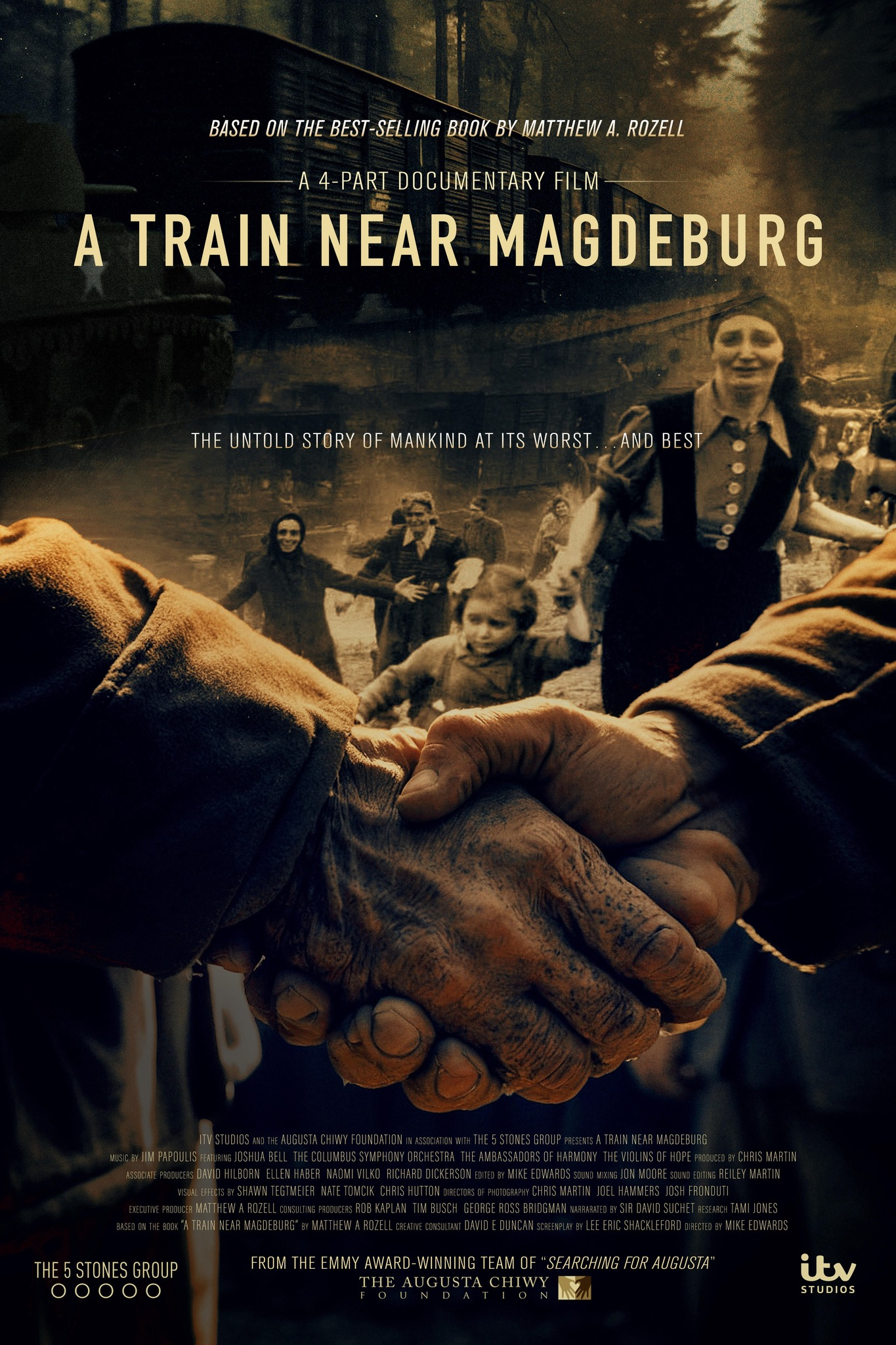
Anyway, I’m no stranger to the power of love transcending time and space. It’s all over my book, A Train Near Magdeburg. There are no coincidences, and I’ll share an experience I wrote about in a previous post that helps to illustrate that point, once again. The 2017 post was titled, “Hope To See You In California.” Thanks for reading.


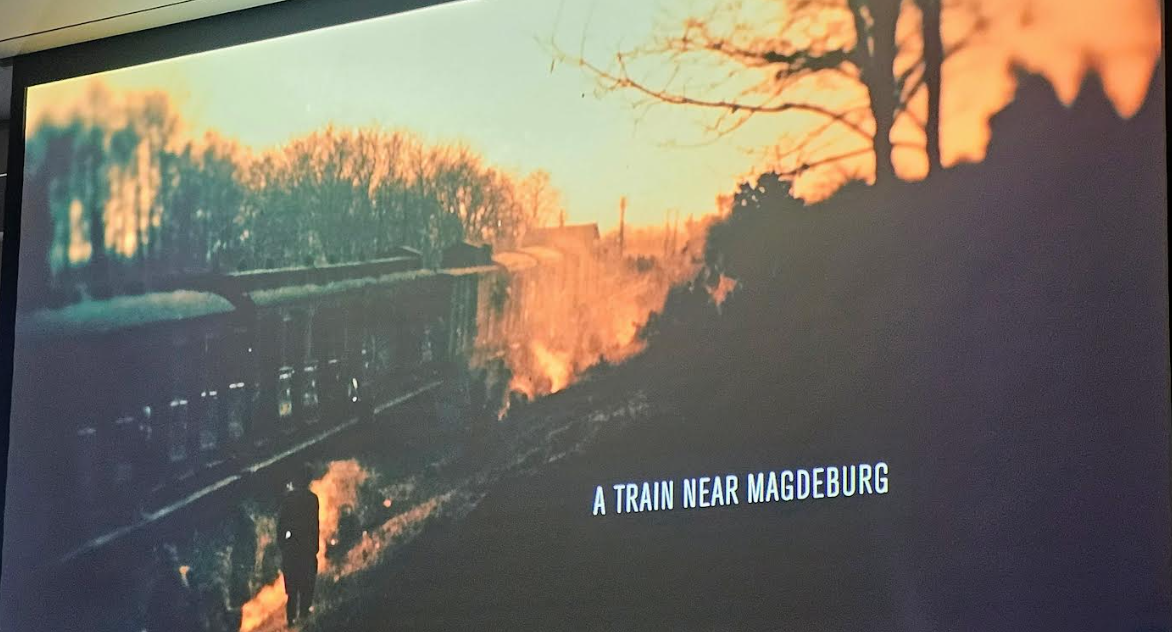
My second book, A Train Near Magdeburg, the one on the death train and my journey as a teacher in discovering and retracing the miracles in reuniting Holocaust survivors with their American soldier liberators, has had mostly positive reviews. Then recently someone posted how he found himself resenting that I had clumsily inserted my own experiences into an otherwise tremendous story. (Fair enough—but ‘resentment’?) That, coupled with a resurgence of antisemitism and the other stuff that bad dreams are made of sends a certain chill up this writer’s—this historian’s—spine.

Now if one really read, and ‘got’ the point of my second book, it’s about miracles and goodness and common human decency and humanity; about a triumph of the power of good and love over evil, against crazy odds; about the lessons and the values which we should hold firm to in a world filled with pain and destruction, deception and deceit. But some days it is hard to see the good, and the world lately frankly leaves me feeling rather adrift; I wonder if it all is pointless.

And then, out of the blue, comes the quiet reminder…

Later this week I got an email from a new fan in Salt Lake City, Utah. We have never met or heard of each other until he bought my books. He loved them, and then felt compelled to reach out to me (which I invite—it’s matthew@teachinghistorymatters.com). He wrote that as he neared the end of the book, he realized that his wife was from the area where I live and write about.
We went back and forth. Later on a whim he reached up on the bookshelf in his basement office and dusted off his wife’s high school yearbook. He opened it up, and sent me this:

mom-yrbk-1975

IT’S MY MOM.

Vintage 1975, autographing his wife’s graduating yearbook… turns out my mom was the school nurse teacher at his wife’s school, now nearly a continent away. Kim was heading out west after graduation, and my mother was going to head there to visit her brother and his family in California that summer. Neither I nor my siblings had ever seen this photo before; I can tell by her expression that Mom is laughing with the photographer and is insisting that he get the shot over with!

So now, on a dark day, my mother is speaking to me. She was taken from us in 2005, just before the Holocaust survivors I write about found me in 2006 and entered my life and the lives of the soldiers who freed them in such a profound way. My mother reaches out  to remind me that there is still good in the world.

Maybe that reviewer could care less, but my mom will always be a part of the story—MY story. Thanks, William, for sending it to me. And thanks Ma, for being there for me again.

Read Full Post »

A Night For Remembering.

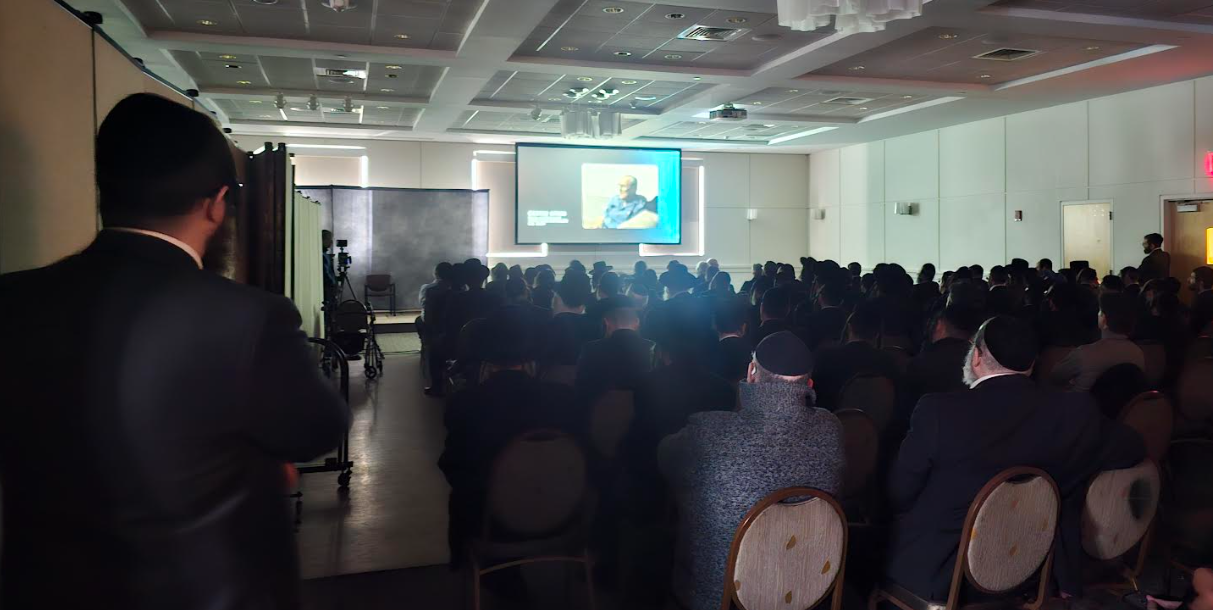
Fall is here, and two weeks ago, I was lucky enough to be on stage with the director of the film for A Train Near Magdeburg to preview a snippet of the film and be a part of a panel of folks who are in the film. So on the 24th anniversary of 9.11, we sat on the stage of a community center near Columbus, Ohio to participate in a panel discussion in an evening of remembrance on a little-known pivotal moment in history.
To my right was a German girl who wasn’t even born in 2001. To my left was a Holocaust survivor was was on the train as a bewildered six year-old boy, a friend who has lived within sight of the Twin Towers for decades. On his left was a daughter of the WWII tank commander who I interviewed that summer of 2001, before those towers came down and the world seemed to stop. On the far right sat the director, a good friend now who I have been working with for the past decade.

All that morning beforehand I spoke to students, younger than the German girl—born long after 9.11.2001 into a ‘new world’—about my experiences surrounding events that took place on April 13, 1945, sixteen years before I myself was born. As I reflect—and process, really—on that evening now, two weeks on, a few thoughts are crystalizing in that wake of our national remembrance of 9.11.2001 and the political assassination that unfolded the day before—and the resulting tide of outrage and finger pointing which was threatening to tear our nation asunder anew by the time we took the stage. Literally as the killing was unfolding a thousand miles across the country, we were working with those young Americans in those classrooms, cultivating a sense of beauty, wonder, love, honor, inspiration, and resilience in our young people.

NEW ALBANY SEPT 2025 orchestral workshop with students. Video by Matthew Rozell.
Oscar S. and Micha M., two survivors of the Train Near Magdeburg, meet for the first time at the Ohio governor’s mansion, 9.9.2025. Matthew Rozell photo.

But that evening, we were there to speak to a moment in history when young men were faced with a choice—soldiers headed into a battle in which many would be killed—and chose compassion and humanitarianism, at great personal cost that in many cases would haunt them for decades thereafter. We were there to talk about a story that will unite Americans in a time of national division—no magic bullet to heal our woes, certainly, but a story of healing regardless. And it’s all true, it really happened, the result of many miracles that has resulted in tens of thousands of people being alive today, as documented by filmmaker Mike Edwards, who was the moderator for the evening.

And now Mike himself is being drawn into the vortex of the cosmic power of love transcending time and space, having reached out and gotten a response from the first family on the 2500-name survivor passenger manifest list—two and a half times the size of Oscar Schindler’s list—living in the Netherlands, who had no idea about this story. Mike’s in Europe and has visited that family in Amsterdam on this latest trip he is on.

It never ends, as I stated in the discussion. And that is a good thing. We want to Heal the World, in our own way…

[A link to the panel discussion video is below, containing also a short trailer for the film. (Warning: I talk a lot!) Photos not credited above and and video below courtesy of the City of New Albany, Ohio.]


Read Full Post »

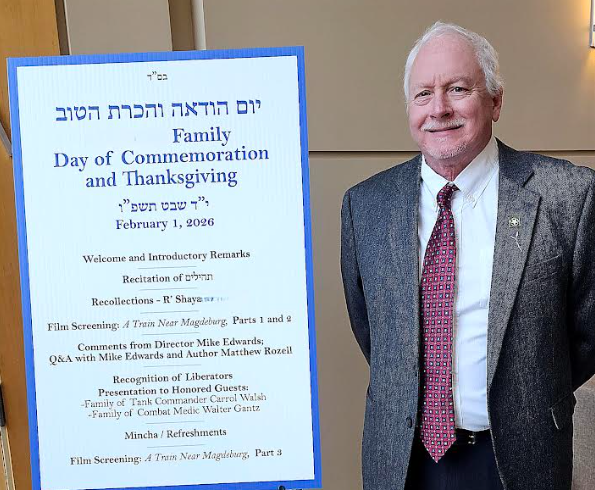
This is a notice for those of you who may be interested, especially Soldier/Survivor/2nd/3rd Gen families who may not have seen the social media posts and advance press releases. It takes place in Columbus, Ohio, where Mike Edwards the director, and the Augusta Chiwy Foundation, the organizational apparatus for steering the film to the light of day, are based. Some of you may also be previous donors to the foundation in the name of the film–this is also especially for you, with gratitude. The dates are below but the main kick off event is Thursday, September 11, 2025 in association with the New Albany, Ohio community and school system.

A Train Near Magdeburg Film Series- Events Kick Off Week, In Celebration of 80th Anniversary of Liberation and the Film Series Panel Discussion (Public, but seating limited, reserve below asap!) and also special Sneak Preview (Invitation Only, write to Matthew at matthew@matthewrozellbooksdot com for inquiries, especially if you are Soldier/Survivor/2nd/3rd Gen!]


September 11-14, 2025
Columbus, Ohio

Thursday September 11: 7pm-9:30pm-PUBLIC/SEATING LIMITED!/REGISTRATION REQUIRED! FREE! BUT ACT FAST!!!
Opening Program- Keynote Speech, Panel Discussion and The Violins of Hope, Abadi Holocaust Artwork
The McCoy Center: 100 E. Dublin Granville Road, New Albany, Ohio 43054
Registration and Tickets Link: https://newalbanyohio.org/programs-and-events/atrainnearmagdeburg/

Mark your calendars for an unforgettable evening in New Albany, Ohio on Thursday, September 11th at 7pm as we bring to life the extraordinary story of A Train Near Magdeburg that will leave you inspired and in awe. This is your chance to be part of history—and trust us, you won’t want to miss it! Tickets are FREE, but they’re disappearing fast, and seating is limited—secure yours NOW before it’s too late!

We’re thrilled to share that at least two survivors of the train will be in attendance, with one joining a powerful panel discussion to share their deeply moving story firsthand. This is a rare opportunity to hear directly from those who lived through a pivotal moment in history.

But that’s not all! The evening will feature a special appearance by Matthew Rozell, renowned educator and historian, alongside the daughter of one of the key liberators, sharing insights that will bring this incredible story to life. The evening will also include an appearance by former German high school student, Johanna Mücke, who experienced the power of this story firsthand in her own hometown, at the site of the liberation, and has dedicated her life to keeping the story alive for future generations.

And lastly, be prepare to be captivated by a breathtaking performance on the world-famous Violins of Hope, played by virtuoso musicians from the Columbus Symphony Orchestra, filling the air with music that resonates with hope and resilience.

This is more than an event—it’s a once-in-a-lifetime experience to connect with history, honor courage, and celebrate the human spirit. Grab your tickets now and join us for an evening that will stay with you forever!


Friday September 12: 11:30am-1:30pm-PUBLIC
Liberator Family Appreciation Luncheon and Keynote Address
National Veterans Memorial and Museum: 300 West Broad Street, Columbus, Ohio 43215
Keynote Speaker: Brigadier General Charles W. Morrison, Representing The 30th Infantry Division

REGISTER HERE FOR TIX: https://my.nationalvmm.org/25educationprograms/trainmagdeburg


Saturday September 13: 7pm-10pm
Social Gathering FOR Donors/Soldier/Survivor/2nd/3rd Gen families / Ohio State vs. Ohio Football Watch Party
Renaissance Hotel Columbus, 50 North Third Street, Columbus, Ohio 43215


Sunday September 14: 1pm-4pm
A Train Near Magdeburg Screening (Invitation Only, write to Matthew at matthew@matthewrozellbooksdot com for inquiries, especially if you are Donor/Soldier/Survivor/2nd/3rd Gen!]): Episodes 1-3 (of 4)
Location: To Be Determined


UPDATES ON THE FILM: https://magdeburgtrain.com/
Hotel Reservation Link: https://book.passkey.com/go/MagdeburgPremier

Read Full Post »

TEN YEARS AGO, my first book was published.

Eight years before that, my high schoolers and I sat down with Jim and Mary Butterfield for what would turn out to be the last time.

They are featured in that first book, The Things Our Fathers Saw, Vol. 1-Voices of the Pacific. And their story is one of my favorites.

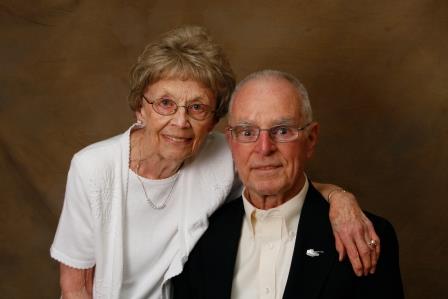
Mary and Jim Butterfield Jan. 2007

Jimmy used to come to my classroom with his bride of 65+ years, Mary. She would joke with him, and us, and call him by his high school nickname, “But”. Maybe it was “Butt”, I don’t know, but they had fun playing around with each other in front of 17 and 18 year olds.

The two of them, and Danny Lawler, another First Marine Division veteran of really hard fighting at Peleliu and Okinawa, came to my room for an afternoon. Later, I came home to an email from one of my senior girls, telling me how meaningful meeting Jimmy and Mary and Danny was to her and her classmates.

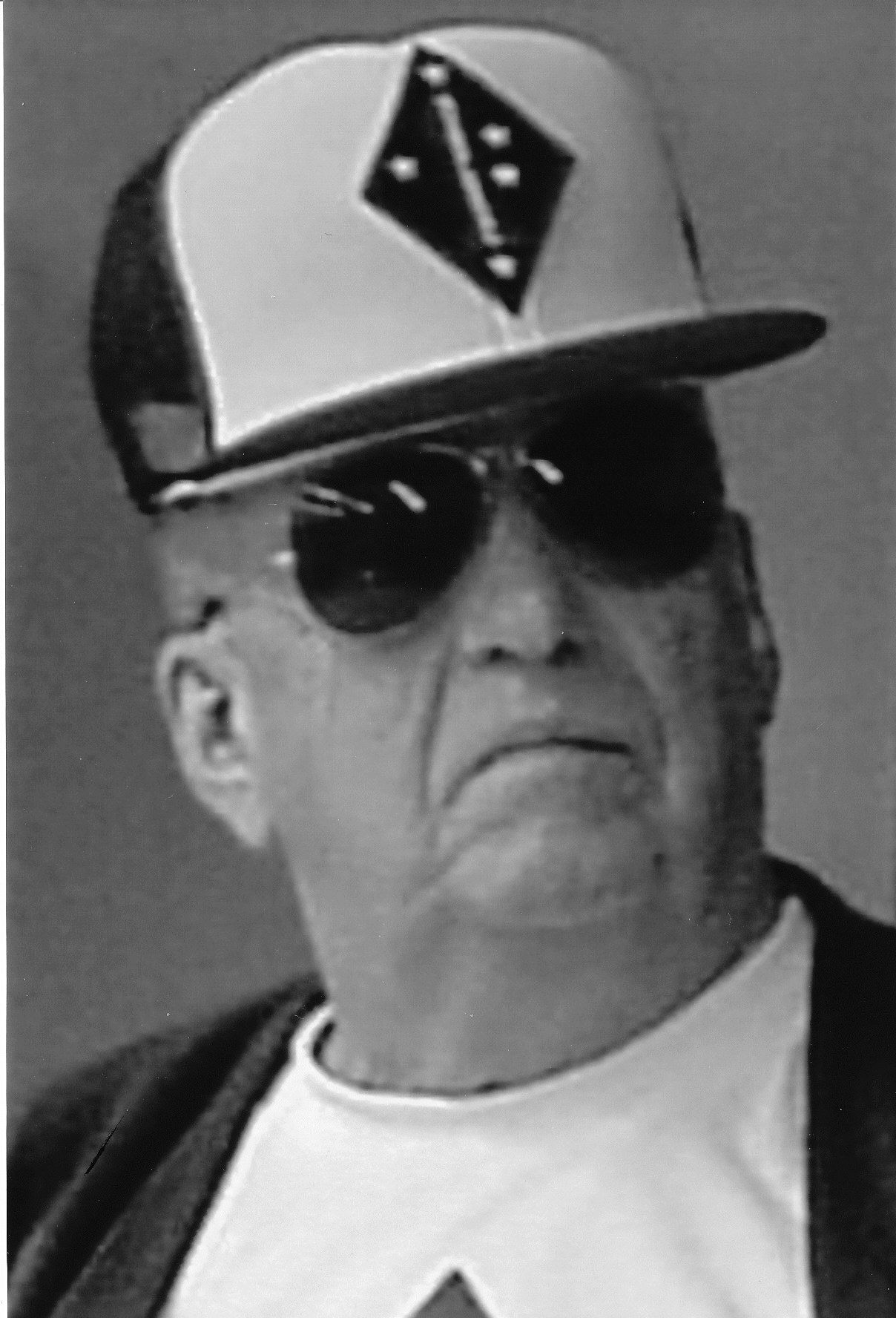
Jimmy, of course was blind and hard of hearing. Mary had to yell at him, he would crack a grin under the dark glasses and flirt with her. The high school girls loved it.

You see, Jimmy Butterfield got struck not once but twice in the head by enemy fire at Okinawa on May 19, 1945. He was evacuated first to Guam, then to Hawaii and later stateside for over 18 months and as many for reconstructive surgery. It was clear early on, though, that he would never see again.

To everyone but Jimmy.

When he eventually was ‘informed’, he told us that he instructed his high school sweetheart to leave him be. Not to get attached to him, a blind man.

Well, she told us what she thought of that. They ran a small mom and pop store back in Glens Falls together until they retired.

Mary passed in the fall of 2013. Jimmy died at home the following spring. What obstacles they overcame together. Below, from Vol. 1, they recount how Jimmy learned, weeks after the battle, that he would never see again.

Jimmy: I didn’t know, until they told me there [in the hospital in Hawaii].

So here’s the climax. Every morning there was inspection with the doctors. So the doctor came around that morning. He said, ‘How are you, Jim?’

I said, ‘Fine.’ He said, ‘You need anything?’ I said, ‘Nope, I’m doing fine.’ He says, ‘Well, are you used to the idea?’ I said, ‘Used to what idea?’

He said, ‘That you’re not going to see again.’


Well, you could hear a pin drop. I said, ‘I don’t think I heard you, Doc.’ He said, ‘You’re not going to see again.’ I said, ‘What?’ He said, ‘Didn’t they tell you in Guam?’


I said, ‘No! But it’s a good thing that [first] doctor isn’t here, because I’d kill him!’ I got so mad! I couldn’t really grab the idea. I’m not going to see again? … What the hell did I know about blindness? Nothing!


I said, ‘How about operations?’

He said, ‘You’ve got nothing to work with, Jimmy.’


So a pat on the shoulder, and he just walks away. The nurse comes over and says, ‘The doctor wants you to take this pill.’ I said, ‘You know what the doctor can do with that pill?’


Mary: Don’t say it.


Jim: I’m not going to, Mary.


So I had a hard… two months, I guess. I kept mostly to myself. I wouldn’t talk to people. I tried to figure out what the hell I was going to do when I got home. How was I going to tell my mother this? You know what I mean?


So they come around and said, ‘You’ve got a phone call.’ So I went in to where the phone was. They were calling me from home. They got the message, see…

This one here was on the phone [points to Mary].

I said, ‘Looks like things have changed, kiddo.’

She said, ‘No, we’ll discuss this when you get home.’ She was already bossing me around. [Laughter]
But that’s how I found out, and that’s how it happened. And after a while, I just started to live with it.


There are not days—even today—I go to bed and I wish I could see. So much I miss. I miss watching a nice girl walking down the street. I miss seeing my daughter, my wife. I even miss looking at Danny. [Laughter]


Mary: But you see, I’m only seventeen to you now. That’s a good thing.


Jim: Since we got in the conversation, when I dream, and I do dream, everything is real. Everything I knew before, I see it as it was then, not today. My wife and daughter would never get old in my eyes. When I dream of Mary, she’s still seventeen years old.


Mary: But you never saw your daughter.


Jim: I dream about my daughter. Mary’s caught me doing this. We lost our daughter a year and a half ago. But I sit right up in bed and I’m trying to push away that little cloud of fog in front of her, but I can’t quite make her out.


Mary says, ‘What are you doing?’ I say, ‘Just dreaming.’

Jim Butterfield was nineteen years old at the Battle of Okinawa.
In the final push at the Shuri Line that cost him his eyesight, the Marines lost over 3,000 men and the U. S. Army even more. When the island was declared secure near the end of June, in Lawler’s K/3/5, only 26 Peleliu veterans who had landed with the company had survived Okinawa. It had been the bloodiest campaign of the Pacific, with over 12,500 Americans killed or missing and nearly three times that number wounded. For the Japanese, no accurate counts are possible, but perhaps 110,000 were killed.

Read Full Post »

Below is a post by my friend and our project screenwriter Lee Shackleford announcing that Sir David Suchet has signed on to narrate our four part mini-series. I was a part of a Zoom call to meet him, from London, last December, a very humble and gracious man.  He concluded our meeting by saying, “I’m here and I’m with you all. And listen also, Matt, no more ‘Sir’. I’m just David. I’m part of the team. No hierarchy. It’s very nice to be a ‘Sir’ but I never expect [to be addressed so]… it doesn’t sit that easily on me. But I believe now that I am [with you and the team] I’m a member of a wonderful family!”

Here is to seeing it all come to fruition before next December rolls around!

Stay tuned for more announcements! You can also follow the mini-series announcements and previews and opportunities to support at https://magdeburgtrain.com/.

We are beyond elated to announce that one of the world’s finest and most widely-acclaimed actors has joined the adventure of A Train Near Magdeburg. Our narration will be performed by none other than Sir David Suchet, multiple-award-winning star of stage and screen.

Though he has been performing professionally since 1969 (!) he is best-known around the world for his portrayal of Agatha Christie’s eccentric detective Hercules Poirot in the long-running TV series Poirot.

While we were searching for exactly the right talent for our narrator, Sir David was looking for us — that is, for a way to add his talents to a significant story about Jews in the Holocaust. He is himself of Lithuanian-Jewish descent; his father was “Suchedowitz” in the old country. He told us he has recently learned more about the fate of his Lithuanian relatives during the Holocaust and has since been eager to honor their legacy with a project like ours. 

Sir David has recently completed an extraordinary tour of the world following the path once taken by Agatha Christie, with whom he naturally feels a strong personal bond. That entire adventure can be seen in the outstanding documentary series Travels with Agatha Christie & Sir David Suchet.

Read Full Post »

June 6, 1944
Amsterdam
 
‘This is D-Day,’ the BBC announced at 12 o’clock. This is the day. The invasion has begun!
Is this really the beginning of the long-awaited liberation? The liberation we’ve all talked so much about, which still seems too good, too much of a fairy tale ever to come true?…
The best part of the invasion is that I have the feeling that friends are on the way. Those terrible Germans have oppressed and threatened us for so long that the thought of friends and salvation means everything to us!
 
― Anne Frank, diary entry,
six days before her 15th birthday


Forty-one years ago today, I tuned in to a small black and white TV in a ramshackle white clapboard farmhouse I shared with three or four other guys my age. I was 23, a recent college graduate with a seemingly useless history degree, working in the back of a kitchen of a high end restaurant in my college town. I wasn’t sure still what my direction was, but I had a knack for churning out long history papers running forty or fifty pages in length, and a passion for World War II, especially D-Day. Well, I reluctantly turned to teaching—I had student loans to pay—but I grew into another passion, sharing my love of history, and engaging veterans with students, creating an oral history project which has now reached ten books and counting, as well as an upcoming film series.

But today, June 6, 2024, it is now the 80th anniversary, and my mind is focused on how my life has turned out. I realize that I am the age of many of the veterans were when forty years ago, I watched as the American president honored the fallen, and the living, at the cemetery for the fortieth anniversary. Just out of college, something stirred inside me. Something was awoken.

Those forty years have passed. I began by writing letters to the newspaper. I began to interview D-Day veterans and others. I began to collect stories—not relics, prizes, or artifacts. I really had little interest in captured Nazi flags or samurai swords.

I wanted to talk to the men who were there.

The fiftieth anniversary came next with great pomp and more reflection. It graced the covers of the major newsweeklies. ‘Saving Private Ryan’ would soon stir the consciousness of a new generation, and the reflections of the old. And I learned so much more of the war beyond the beachhead. That there were so many beachheads.

The sixtieth anniversary came around. Students on their annual trips to France would bring me back their photographs and the requisite grains of white sand from Omaha Beach. Teenagers had their emotions a bit tempered, I think. I would go on to introduce them to so many who were there, when they themselves were teenagers.

Normandy American Cemetery, Spring 2022. Photo by Mike Edwards.

While filming for our 2025 documentary series A Train Near Magdeburg, two years ago I finally had the chance to set foot on Omaha Beach with an excellent guide who was insistent that we arrive early in the morning to catch the tide as it began to roll in. It was an astounding thing, to witness the 10 to 12 foot rise in the course of only a few hours. Imagine the men struggling to find their footing, pinned down by murderous fire. The 743rd Tank Battalion, liberators of the Train Near Magdeburg ten months later in the heart of Nazi Germany, was one of five tank battalions that took part in those initial landings, planned for H-Hour in support of the 29th Infantry Division in specially outfitted duplex drive ‘swimming’ amphibious Sherman tanks, powered by propellers in water and tracks on land and equipped with inflatable canvas flotation screens.

Bill Gast awarded the Silver Star.

Bill Gast was one of those tank drivers. I first met Bill at a reunion of 30th Infantry Division and 743rd Tank Battalion soldiers at a reunion in March 2008, in which I was present with several Holocaust survivors who were meeting their liberating soldiers for the first time. Later, Bill came to my high school to speak to students. I think the experience of sharing, and meeting the Holocaust survivors whom the 743rd came upon and liberated, affected him deeply. It was really the first time that he opened up, several hundred students as his primary witnesses. Unlike many who were physically able, Bill had no intention of going back to the sands of Omaha for any anniversary. As he explained to our students in 2009,

“I’m listed [in the event program] as a liberator- however, I am also a survivor of World War II, having landed on Omaha Beach in Normandy, France on D-day and fighting through to the end when the Germans surrendered, May the 7th, 1945.”

“Pictures.

Video games.

Movies.

Words.

They simply do not covey the feeling of fear.

The shock.

The stench.

The noise.

The horror, and the tragedy.

The injured.

The suffering.

The dying, and the dead…

Freedom is not free; there is a high price tag attached.”

Video tribute by Mike Edwards, Director, A Train Near Magdeburg.

Bill left us in 2018 at the age of 94. Against many odds, today nearly 200 surviving D-Day veterans gather, most probably for the last time, to honor the fallen from the nations engaged in storming ‘Fortress Europe’.

Today, the ocean laps at the lateral thirty-five-mile advance of sand littered with relics of a different time, the hulking remnants of the tide of battle. The surf rolls in and kisses the beach as the last participants mix on the hallowed bluff above with the politicians who have gathered from all over the world. In 1984, President Reagan asked, “Why? Why did you do it? What impelled you to put aside the instinct for self-preservation and risk your lives to take these cliffs? What inspired all the men of the armies that met here?

He continued: “These are the champions who helped free a continent. These are the heroes who helped end a war…We look at you, and somehow, we know the answer. It was faith and belief; it was loyalty and love.”[1]


Wayne Robinson, the chronicler of the 743rd’s travails and exploits during the war, wrote this in 1945 at war’s end:

“The story of D-Day is the story of all who. were there—jeep drivers, truckdrivers, halftrack crews, supply and communications men as well as the tankers. Many—too many—of the stories were posthumous.

The Presidential Unit Citation was awarded the Battalion for the day’s fighting. There were the D.S.C.s won, and a galaxy of Silver Stars and Bronze Stars. But the Battalion was not thinking of glory as it fought its way through Exit D-1 toward Vierville-Sur-Mer. Glory is a tainted angel to tankers who have just had to run their steel treads over the bodies of fallen Gls because there was no other way to advance over sand cluttered with American dead and wounded. ‘If there was any sign of life at all, I tried to avoid them’, one tank driver said. ‘But buttoned up, looking through the scope, it was hard to see. You just had to run over them.’

In war there is no easy way. The grinding tracks of the Battalion’s tanks trailed blood through the ·sand, rolling inland off the beach. The whole war in France, Belgium, Holland and Germany was ahead of them.”[2]

And for the men of the 743rd’s Dog Company, ahead there would be this train, a long shabby string of boxcars and shabby passenger cars, spectral creatures milling about, listless, sick, and fearful…


D-Day: the view from a tank on Omaha Beach

By Mathieu Rabechault May 23, 2014 6:46 AM

Washington (AFP) – From inside his tank, the young soldier could see “practically nothing” on Omaha Beach.

Seventy years later, William Gast still wonders whether he rolled over his comrades sheltering from German gunfire that day.

Gast was 19 years old the morning of June 6, 1944. “We came in at H-10, that was 10 minutes before the designated hour.”

He cannot recall why he and his fellow soldiers arrived early, but he has other memories that have never left him.

As part of Company A, 743rd Tank Battalion, 1st Army, Gast remembers the training beforehand in Britain, when he rehearsed driving the Sherman tank onto the landing craft. And then floating in the English Channel.

“Another night we went out and we didn’t come back. That was it.”

Gast got to know the captain of the landing craft that would ferry his tank to the beaches of Normandy.

The skipper promised he would get them close enough that they would not be submerged in water, like so many tanks were that day.

He kept his word.

Another tank unit at Omaha Beach was less fortunate, with 27 of 32 tanks launched at sea five kilometers (three miles) from the coast sinking before they could reach land, despite being outfitted with a flotation screens.

“The order was given to go, we started our engines up, they lowered the ramp,” said Gast.

Amid German shrapnel and sea spray, he “could feel the tracks spinning.”

At last, the tank tracks took hold on the sandy sea bottom and he drove up the beach.

– Like throwing marbles at a car –

Down below in the driver’s seat, Gast tried to steer the tank with the aid of a small, manual periscope.

“You can imagine how much we could see, practically nothing,” he said.

The radios inside the tank were so unreliable that his commander would tell Gast which way to turn by kicking him on the left or right shoulder.

The difficulty in seeing the way ahead has left Gast with a gnawing sense that he may have run over the bodies of American soldiers on the beach.

“The saddest part about the whole thing is, not being able to see, I may have run over some of my own people.

“And if I did, I don’t even know it. I can’t ever get that out of my mind, you know?”

Corporal Gast heard machine gun bullets hitting the side of the tank, “like throwing marbles at a car — that’s what it sounded like.”

“And there were shells that exploded right beside me. You could feel the tank shake.”

For Gast, it was a day of fear and terror, and following orders without reflection.

“I can’t tell much about what happened, I was scared to death to start with,” he said.

“It was just like putting it on automatic, you just did what you had to do, did what you were told to do.”

By noon, close to 19,000 American soldiers who landed at Omaha were still pinned down on the beach.

– High school sweetheart –

Carefully laid plans had unraveled as the beach became a killing zone, with troops mowed down under a fusillade of German machine gun, artillery and mortar fire.

Small teams of US troops eventually managed to break through on the bluffs between German positions, with the help of combat engineers blowing up obstacles.

The losses were staggering: more than 2,000 dead, wounded and missing on Omaha beach. The exact toll is still unknown. Of the 15 tanks in Gast’s Company A, only five survived without damage.

Gast, from Lancaster, Pennsylvania, earned the Silver Star and the Purple Heart during his combat tour, and went on to marry his high school sweetheart.

Mr. & Mrs. Gast, Holocaust Survivors-American Soldiers reunion, 2009.

Mr. & Mrs. Gast, Holocaust Survivors-American Soldiers reunion, 2009.

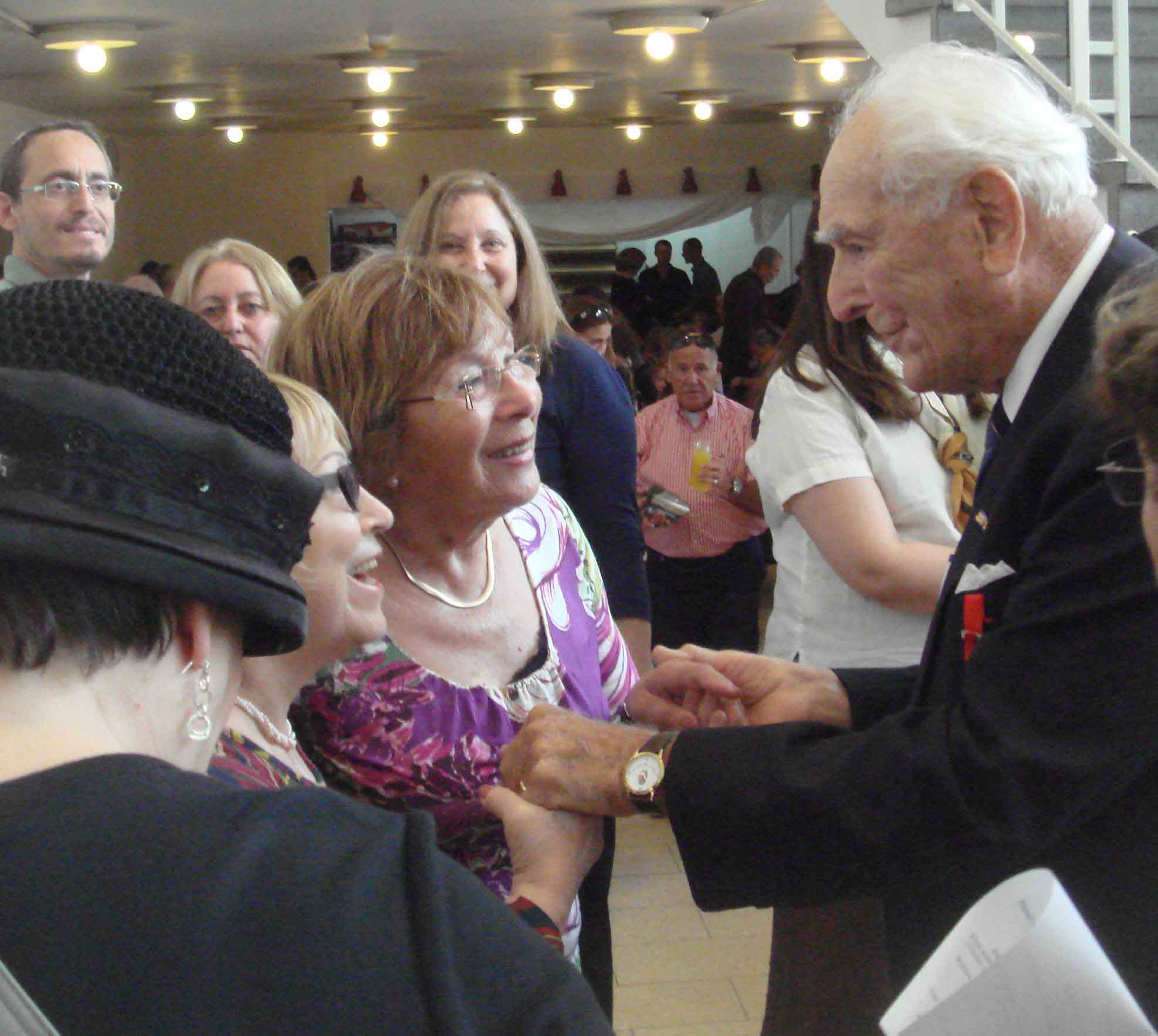
Now 89 years old, he recently was awarded France’s Legion d’Honneur at a small ceremony for World War II veterans at the French embassy in Washington.

The short, soft spoken man stood up to receive the medal and shook hands with a French diplomat. But he has no plans to return to Normandy for the 70th anniversary of the D-Day landings.

His son, Bill, said his father did not want to relive that day: “It’s important we don’t forget but you try to hide things somewhere.”

news.yahoo.com/d-day-view-tank-omaha-beach-104656852.html


[1] Why did you do it?-President Ronald Reagan, June 6, 1984, Omaha Beach, Normandy, France. http://www.historyplace.com/speeches/reagan-d-day.htm

[2] Robinson, Wayne; and Hamilton, Norman E., Move Out, Verify: The Combat Story of the 743rd Tank Battalion. 1945. World War Regimental Histories. United States Army.

Read Full Post »

I went up to my camp alone in the Adirondack mountains last night. Part of me needed to get away from the machinations of daily life, but I think I needed to be there to reflect by myself on a momentous anniversary.

Passover in 2025 has begun, a fitting setting to recall the significance of the eightieth anniversary of the liberation of the Train Near Magdeburg. Passover of course is the commemoration of the exodus of the Jewish people from slavery in ancient Egypt.

By the spring of 1945, the evil that had engulfed the world had led to the destruction of two-thirds of Europe’s Jews. Yet by some miracle, a handful of Jewish families were sent out of Bergen Belsen to walk to railcars headed towards an unknown destination as Passover 1945 drew to a close.

Seven days of shuttling on the tracks later, cramped and suffering, this train transport stopped in a slight ravine in a forest, hiding for cover from Allied planes but also awaiting instructions on how to proceed from German commanders as American forces approached from the west, and the Red Army appeared near the Elbe River a few kilometers away near the ancient German city of Magdeburg, which was not surrendering without a fight.

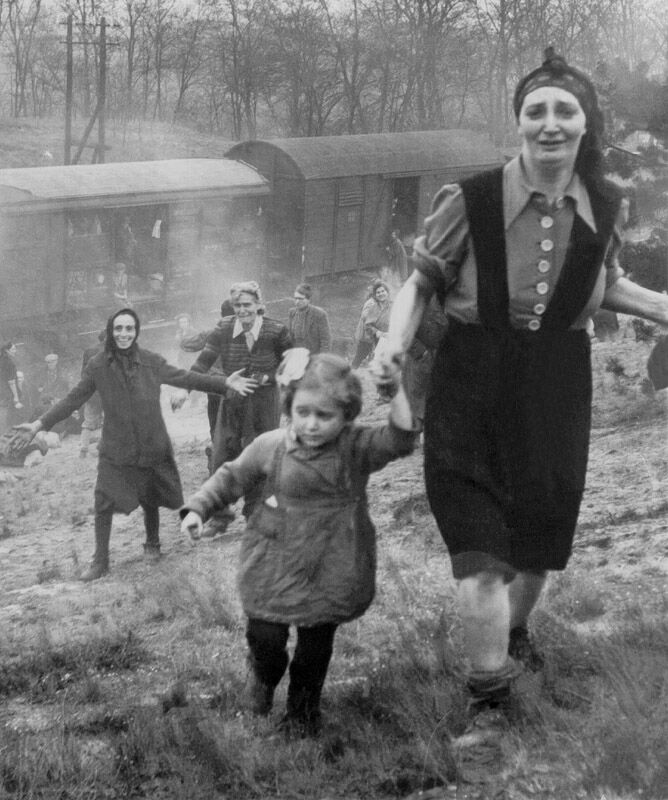
On the morning of the 13th, war weary and grieving solders in two tanks and a command jeep approached the ‘stranded train’, the U.S. soldiers just having learned that morning of the death of their commander in chief, Franklin Delano Roosevelt. They pulled up to the train. Major Clarence Benjamin of the 743 Tank Battalion stood and snapped the now famous photograph of the moment of liberation.

Over half a century later, I began to piece together this story that was forgotten by all except those who lived it—the survivors, and the liberating soldiers themselves. Some of the accounts that I gathered appear in my book, A Train Near Magdeburg (and in the mini-series of which is approaching completion, but no, I can’t tell you where to tune in yet, so stay tuned!). The memory below is from my friend Steve Barry, who passed 13 years ago, but who as a 21-year-old survivor on this day in 1945, remembered this:

There were two tanks. I still get tears in my eyes; that’s what it was. Right now, I have tears in my eyes and I always will when I think about it. That [was the moment that] we knew we were safe.

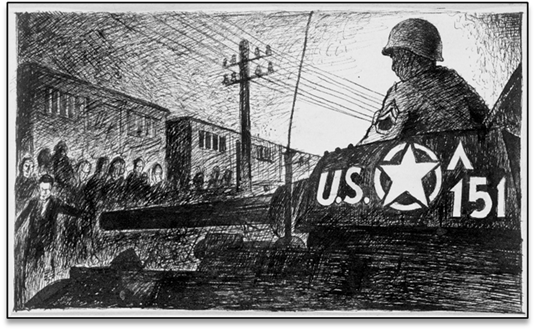
1945 Ink drawing by Hungarian survivor Ervin Abadi, Credit: USHMM, courtesy of George Bozoki.

We found some matches in those German soldiers’ [rail]cars. We had this tiny little fire going and we were sitting next to it, and I was sitting there with this great big SS overcoat on. One GI walked down the embankment, came over to the fire, sat next to me, took out his pen knife, and he cut off the SS insignia from my coat, and slowly dropped it into the fire. [Gets emotional] If my voice breaks up right now, it always does when I say that, because it’s a moment that just can never be forgotten. I don’t know who the GI was, but it just signaled something to me that maybe I’m safe and maybe the war ended and the Germans, or the Nazis, were defeated. It was an unbelievable symbol to me. And all I can tell you is, it still touches me very deeply, and probably always will.

In this season of liberation, I pause this weekend to reflect on Steven and all the survivors and liberators and their families who have touched my life.


A friend of mine and fellow [non-Jewish] Holocaust educator, Stephen Poynor, posted this morning the words that I will close with here, ones that closely follow the message I have adopted since first sitting down with one of those tank commanders for an interview 24 summers ago, the stories preserved in my book, and in the upcoming film series. Like the soldiers and the survivors who confronted this evil, let us not forget as we continue forward to ‘heal the world’, because that is what good people are called to do.

In a world swollen with division and sorrow, where the weight of injustice falls unevenly and history is too often forgotten or denied, the story of Passover reminds us that liberation is not a moment—it is a journey. Ongoing. Fragile. Worth telling and retelling with trembling hands and hopeful hearts.

We carry these stories not as burdens but as lanterns. We light them for others to see, to feel, to understand. This week, may those lanterns burn a little brighter. May your table be full, your memory deep, and your hope unshakable.

Freedom.

“Hope was keeping me alive.” -17-year-old train survivor Leslie Meisels

Read Full Post »

Screenshot of combat Medic Walter Gantz, and child survivor Oscar Schwartz, Warren County Community College, New Jersey, April 2019. Walter was 94 and would pass away before year’s end.

As we enter April 2025, the eightieth anniversary of liberation, more and more posts are rightly being generated on social media regarding it. Yad Vashem, World Holocaust Center, Jerusalem, earlier in the week posted a liberation photo on Facebook titled, “French soldiers meeting Jewish people who survived near Vaihingen, Germany, April 1945.” Their description:


“In the final months of the war, concentration camps were gradually liberated one after another. For the liberating forces, it was a glorious moment of triumph. But for the survivors — those who endured the horrors — the relief at war’s end was overshadowed by immeasurable pain and loss.
Freedom had arrived — but for many, it came too late.”

I shared it on my Facebook page, with my own take on their description.

Well, some decided they had to take me to task in the comments, the gist of which was that in pointing out the traumatic effects on liberating soldiers, I was disrespecting the experiences of the people they saved.

I recognize the trauma—I have been honored to know literally dozens of Holocaust survivors—and I have studied for nineteen days at their International School in Jerusalem, as well as experienced several weeks of touring the authentic sites of mass murder and suffering in this greatest crime in the history of the world with top notch scholars and historians and fellow teachers. Also, having been a USHMM Teacher Fellow, I felt pretty well informed enough to add my comment there, just that for the liberating forces, far from being a glorious moment of triumph, it was decades of trauma as well.

I don’t dispute any of their comments, but I think they were making assumptions, so I clarified, “Just as liberation was not the ‘happy end of the story’ for Jewish survivors, it did not end for the soldiers either. And no one is here to ‘compare pain’.”

And that is one of the tenets of Holocaust education. No one can suppose they know what the Holocaust survivors went through, except them, and that is why memoirs are so important. But to talk to the liberating forces, decades later, was also important. Walter Gantz told me, “Matt, for forty years, when our group (95th Medical Gas Battalion) met at reunions, we NEVER talked of Hillersleben. And my parents never knew I cried myself to sleep at night, when I got back.”

I found this video I took at a college in New Jersey where Walter got to meet one of the children he helped to save for the first time, and his take on his visit to Bergen Belsen. The trauma was still apparent after almost 75 years.

That’s all I was trying to say. So now I’ll let Walter tell you. It’s a 3 minute clip. [Only 8 people in the world have watched it thus far. I hope you can, in his memory.]

And I will end with the closing of my book, A Train Near Magdeburg:

A schoolkid once asked a survivor I know if anything good came out of the Holocaust. The survivor thought a minute, because it was an important question, and replied, ‘Yes. My rescuers.’
And here is where the story of the ‘Train Near Magdeburg’ will end, for now.


When we talk about the Holocaust, the sheer magnitude of it, there is no happy ending. For every single one of the approximately two-thousand five-hundred persons on the train who was set free, another two-thousand five-hundred persons perished in the Holocaust, most long before the Americans set foot upon the continent. And yet, at the end of the day, if we can say that somehow the soldiers and survivors in this book taught us something, perhaps the meaning is echoed in that three-word response.

I have found that in some educational circles the role of the American liberator is presented almost as an afterthought, and I would have to agree that when one is drawn into the unfathomable study of the Holocaust, liberation perhaps figures as a literal nano-episode.


They were not rescuers, in the formal sense of the word—that title is reserved for those without weapons, who risked their lives and usually the lives of their families by hiding Jews or some such noble action—but the nobility of the would-be rescuers who had weapons, the ones still fighting and being killed, the ones wholly unprepared for the catastrophes that played out before them on an hourly basis in April 1945 deserves a larger place in our national examination of the essence of what, indeed, ‘greatness’ is all about.

And here, I hope that the lesson is also one of humility; as they themselves stated in this book, it’s not about hero worship, or glorifying the liberator as some kind of savior. Many of the liberating soldiers would resist this, to the point of rejecting the term ‘liberator’— “It all sounds so exalted, so glamorous,” said one. But they will all accept the term ‘eyewitness.’

Eyewitnesses to the greatest crime in the history of the world; young men who ‘kept the faith’ of their fallen comrades, their country, and to humanity; witnesses who did something about what they saw.


Read Full Post »

Welcome to 2025, a momentous year for World War II remembrance and history. So glad that you can join us for these updates, the ‘octogintennial’ anniversary of the end of the war, and of the greatest crime in the history of the world, the Holocaust. 
A father buries his son on Okinawa.
As we reflect on the events of April 1945, the final months of World War II, we cannot help but be struck by the deep significance of two momentous moments that unfolded on opposite sides of the globe: the Battle for Okinawa and the liberation of the first concentration camps in Germany. Both are pivotal moments in history, shaping the course of the war and leaving lasting impressions on the men and women who lived through them.The Battle for Okinawa, which began on Easter Sunday, April 1, 1945 and would last until June 22, was one of the bloodiest and most brutal campaigns in the Pacific theater.

For the American forces, it was a grueling and relentless fight to secure the island from the Japanese army, a battle that cost thousands of lives and saw immense casualties on both sides. It was not only a strategic victory for the Allies but a foreshadowing of the price that would be paid in the Pacific as the Allies moved toward the final assault on Japan.

In the photo taken above, Colonel (later Brigadier General) Francis I. Fenton learned his younger son Private First Class Michael J. Fenton had been killed by a sniper. He went to the site and knelt before Michael’s body to pray. When he rose, he said of the other Marine dead, ‘Those poor souls. They didn’t have their fathers here.’


Eisenhower and top brass inspect a subcamp of Buchenwald, Germany, April, 1945.

At the same time, across the Atlantic in Europe, April 1945 marked the liberation of the first Nazi concentration camps, including Buchenwald and Dachau. The horrors uncovered by Allied soldiers began to reveal the shocking tip of the iceberg of the industrial scale mass murder genocide that had taken place.

General Dwight D. Eisenhower, witnessing the aftermath of these atrocities, requested Congressional and press visitations: “The things I saw beggar description… the visual evidence and the verbal testimony of starvation, cruelty, and bestiality were so overwhelming that I became sick and utterly unable to make any sense out of the facts.” 

He was prescient in recognizing that someday, there would be those who would minimize the magnitude of the Holocaust, or outright deny that it ever took place. Along these lines, he encouraged American and other Allied soldiers in Germany to visit the camps: 

“We are told the American soldier does not know what he is fighting for. Now, at least, we know what he is fighting against.”

While the battles of Okinawa and the liberation of the camps might seem like disparate events, they are linked by the shared theme of human sacrifice and the undeniable cost of war. The soldiers who fought at Okinawa faced fierce resistance and unimaginable challenges, much like the liberators of the concentration camps, who encountered the full scale of humanity’s cruelty. In both cases, they were tasked with missions of unimaginable significance—many just barely out of high school—but perhaps sensing that the world would never be the same after their efforts.

The heroes of these stories, those who fought in the Pacific and those who liberated Europe, lived through experiences that forever changed them—and most would reject the mantle of ‘hero’.As we reflect on their stories, it’s important to remember their sacrifices, their courage, and their commitment to justice; otherwise, I believe, we run the real risk of losing our identity as Americans.

I hope we are worthy of what they did about what they saw.

And as we continue to explore these critical moments in history through the Things Our Fathers Saw series, we are reminded of the power of storytelling. The voices of these veterans and survivors are an invaluable testament to their experiences—stories that need to be told and heard for generations to come.

Read Full Post »

Older Posts »