Feeds:
Posts
Comments

Archive for April, 2025

I went up to my camp alone in the Adirondack mountains last night. Part of me needed to get away from the machinations of daily life, but I think I needed to be there to reflect by myself on a momentous anniversary.

Passover in 2025 has begun, a fitting setting to recall the significance of the eightieth anniversary of the liberation of the Train Near Magdeburg. Passover of course is the commemoration of the exodus of the Jewish people from slavery in ancient Egypt.

By the spring of 1945, the evil that had engulfed the world had led to the destruction of two-thirds of Europe’s Jews. Yet by some miracle, a handful of Jewish families were sent out of Bergen Belsen to walk to railcars headed towards an unknown destination as Passover 1945 drew to a close.

Seven days of shuttling on the tracks later, cramped and suffering, this train transport stopped in a slight ravine in a forest, hiding for cover from Allied planes but also awaiting instructions on how to proceed from German commanders as American forces approached from the west, and the Red Army appeared near the Elbe River a few kilometers away near the ancient German city of Magdeburg, which was not surrendering without a fight.
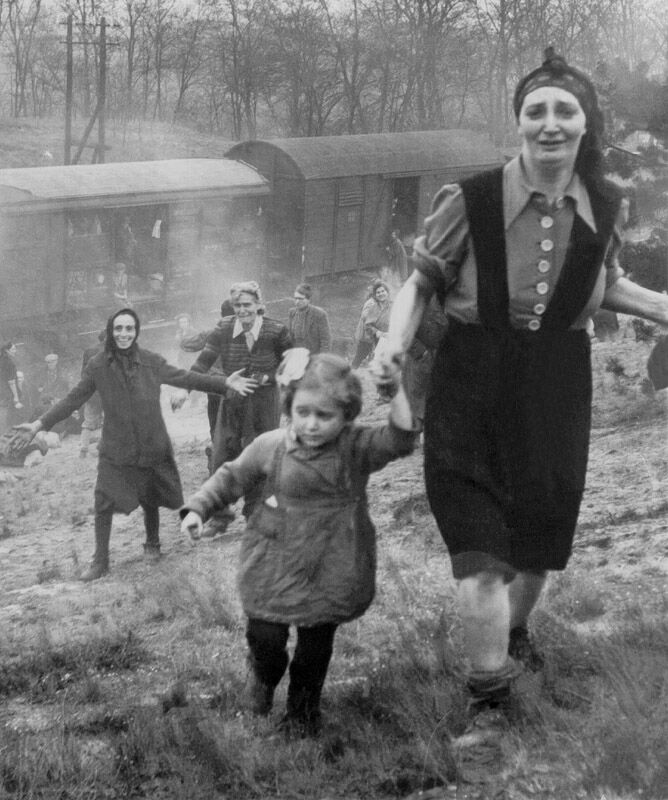
On the morning of the 13th, war weary and grieving solders in two tanks and a command jeep approached the ‘stranded train’, the U.S. soldiers just having learned that morning of the death of their commander in chief, Franklin Delano Roosevelt. They pulled up to the train. Major Clarence Benjamin of the 743 Tank Battalion stood and snapped the now famous photograph of the moment of liberation.

Over half a century later, I began to piece together this story that was forgotten by all except those who lived it—the survivors, and the liberating soldiers themselves. Some of the accounts that I gathered appear in my book, A Train Near Magdeburg (and in the mini-series of which is approaching completion, but no, I can’t tell you where to tune in yet, so stay tuned!). The memory below is from my friend Steve Barry, who passed 13 years ago, but who as a 21-year-old survivor on this day in 1945, remembered this:

There were two tanks. I still get tears in my eyes; that’s what it was. Right now, I have tears in my eyes and I always will when I think about it. That [was the moment that] we knew we were safe.
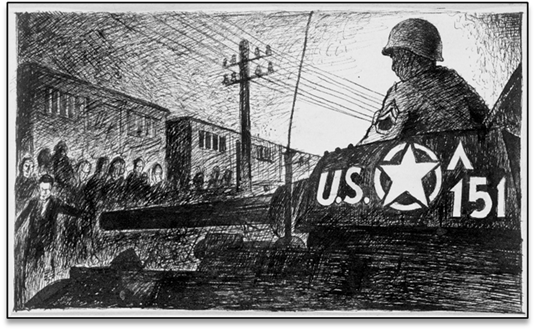
1945 Ink drawing by Hungarian survivor Ervin Abadi, Credit: USHMM, courtesy of George Bozoki.

We found some matches in those German soldiers’ [rail]cars. We had this tiny little fire going and we were sitting next to it, and I was sitting there with this great big SS overcoat on. One GI walked down the embankment, came over to the fire, sat next to me, took out his pen knife, and he cut off the SS insignia from my coat, and slowly dropped it into the fire. [Gets emotional] If my voice breaks up right now, it always does when I say that, because it’s a moment that just can never be forgotten. I don’t know who the GI was, but it just signaled something to me that maybe I’m safe and maybe the war ended and the Germans, or the Nazis, were defeated. It was an unbelievable symbol to me. And all I can tell you is, it still touches me very deeply, and probably always will.

In this season of liberation, I pause this weekend to reflect on Steven and all the survivors and liberators and their families who have touched my life.


A friend of mine and fellow [non-Jewish] Holocaust educator, Stephen Poynor, posted this morning the words that I will close with here, ones that closely follow the message I have adopted since first sitting down with one of those tank commanders for an interview 24 summers ago, the stories preserved in my book, and in the upcoming film series. Like the soldiers and the survivors who confronted this evil, let us not forget as we continue forward to ‘heal the world’, because that is what good people are called to do.

In a world swollen with division and sorrow, where the weight of injustice falls unevenly and history is too often forgotten or denied, the story of Passover reminds us that liberation is not a moment—it is a journey. Ongoing. Fragile. Worth telling and retelling with trembling hands and hopeful hearts.

We carry these stories not as burdens but as lanterns. We light them for others to see, to feel, to understand. This week, may those lanterns burn a little brighter. May your table be full, your memory deep, and your hope unshakable.
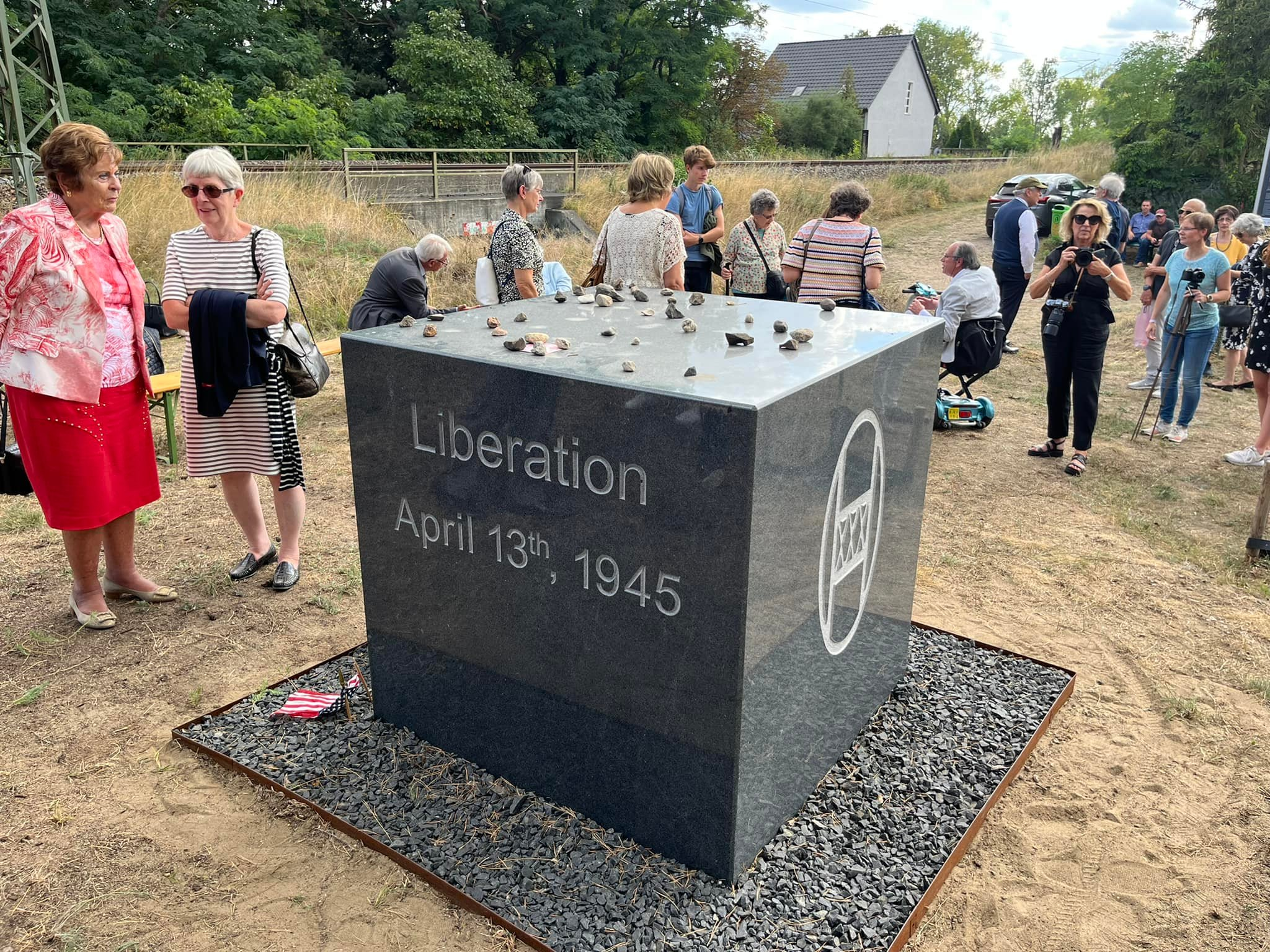
Freedom.

“Hope was keeping me alive.” -17-year-old train survivor Leslie Meisels
Read Full Post »

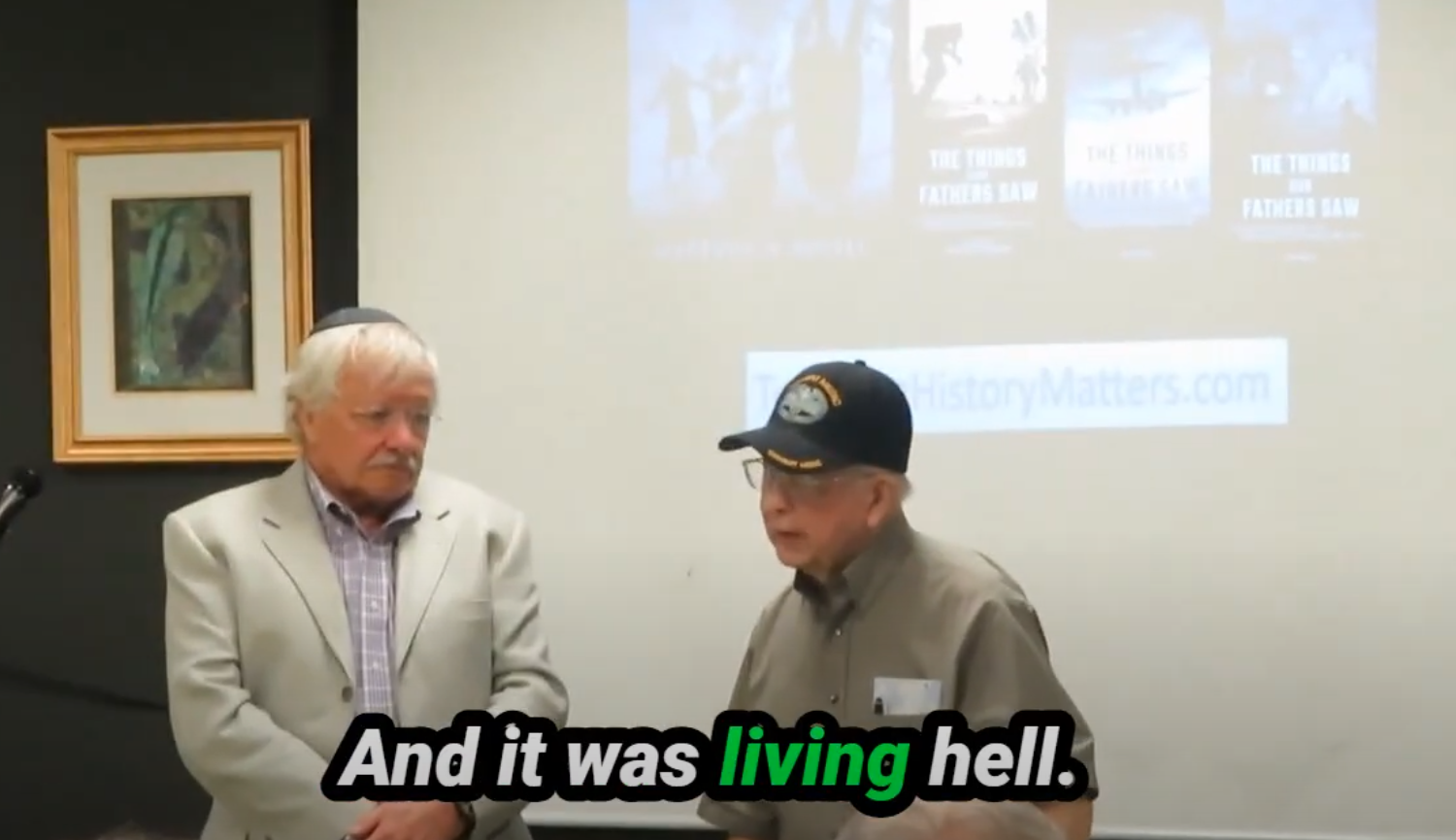
Screenshot of combat Medic Walter Gantz, and child survivor Oscar Schwartz, Warren County Community College, New Jersey, April 2019. Walter was 94 and would pass away before year’s end.

As we enter April 2025, the eightieth anniversary of liberation, more and more posts are rightly being generated on social media regarding it. Yad Vashem, World Holocaust Center, Jerusalem, earlier in the week posted a liberation photo on Facebook titled, “French soldiers meeting Jewish people who survived near Vaihingen, Germany, April 1945.” Their description:


“In the final months of the war, concentration camps were gradually liberated one after another. For the liberating forces, it was a glorious moment of triumph. But for the survivors — those who endured the horrors — the relief at war’s end was overshadowed by immeasurable pain and loss.
Freedom had arrived — but for many, it came too late.”

I shared it on my Facebook page, with my own take on their description.

Well, some decided they had to take me to task in the comments, the gist of which was that in pointing out the traumatic effects on liberating soldiers, I was disrespecting the experiences of the people they saved.

I recognize the trauma—I have been honored to know literally dozens of Holocaust survivors—and I have studied for nineteen days at their International School in Jerusalem, as well as experienced several weeks of touring the authentic sites of mass murder and suffering in this greatest crime in the history of the world with top notch scholars and historians and fellow teachers. Also, having been a USHMM Teacher Fellow, I felt pretty well informed enough to add my comment there, just that for the liberating forces, far from being a glorious moment of triumph, it was decades of trauma as well.

I don’t dispute any of their comments, but I think they were making assumptions, so I clarified, “Just as liberation was not the ‘happy end of the story’ for Jewish survivors, it did not end for the soldiers either. And no one is here to ‘compare pain’.”

And that is one of the tenets of Holocaust education. No one can suppose they know what the Holocaust survivors went through, except them, and that is why memoirs are so important. But to talk to the liberating forces, decades later, was also important. Walter Gantz told me, “Matt, for forty years, when our group (95th Medical Gas Battalion) met at reunions, we NEVER talked of Hillersleben. And my parents never knew I cried myself to sleep at night, when I got back.”

I found this video I took at a college in New Jersey where Walter got to meet one of the children he helped to save for the first time, and his take on his visit to Bergen Belsen. The trauma was still apparent after almost 75 years.

That’s all I was trying to say. So now I’ll let Walter tell you. It’s a 3 minute clip. [Only 8 people in the world have watched it thus far. I hope you can, in his memory.]

And I will end with the closing of my book, A Train Near Magdeburg:

A schoolkid once asked a survivor I know if anything good came out of the Holocaust. The survivor thought a minute, because it was an important question, and replied, ‘Yes. My rescuers.’
And here is where the story of the ‘Train Near Magdeburg’ will end, for now.


When we talk about the Holocaust, the sheer magnitude of it, there is no happy ending. For every single one of the approximately two-thousand five-hundred persons on the train who was set free, another two-thousand five-hundred persons perished in the Holocaust, most long before the Americans set foot upon the continent. And yet, at the end of the day, if we can say that somehow the soldiers and survivors in this book taught us something, perhaps the meaning is echoed in that three-word response.

I have found that in some educational circles the role of the American liberator is presented almost as an afterthought, and I would have to agree that when one is drawn into the unfathomable study of the Holocaust, liberation perhaps figures as a literal nano-episode.


They were not rescuers, in the formal sense of the word—that title is reserved for those without weapons, who risked their lives and usually the lives of their families by hiding Jews or some such noble action—but the nobility of the would-be rescuers who had weapons, the ones still fighting and being killed, the ones wholly unprepared for the catastrophes that played out before them on an hourly basis in April 1945 deserves a larger place in our national examination of the essence of what, indeed, ‘greatness’ is all about.

And here, I hope that the lesson is also one of humility; as they themselves stated in this book, it’s not about hero worship, or glorifying the liberator as some kind of savior. Many of the liberating soldiers would resist this, to the point of rejecting the term ‘liberator’— “It all sounds so exalted, so glamorous,” said one. But they will all accept the term ‘eyewitness.’

Eyewitnesses to the greatest crime in the history of the world; young men who ‘kept the faith’ of their fallen comrades, their country, and to humanity; witnesses who did something about what they saw.


Read Full Post »

Welcome to 2025, a momentous year for World War II remembrance and history. So glad that you can join us for these updates, the ‘octogintennial’ anniversary of the end of the war, and of the greatest crime in the history of the world, the Holocaust. 
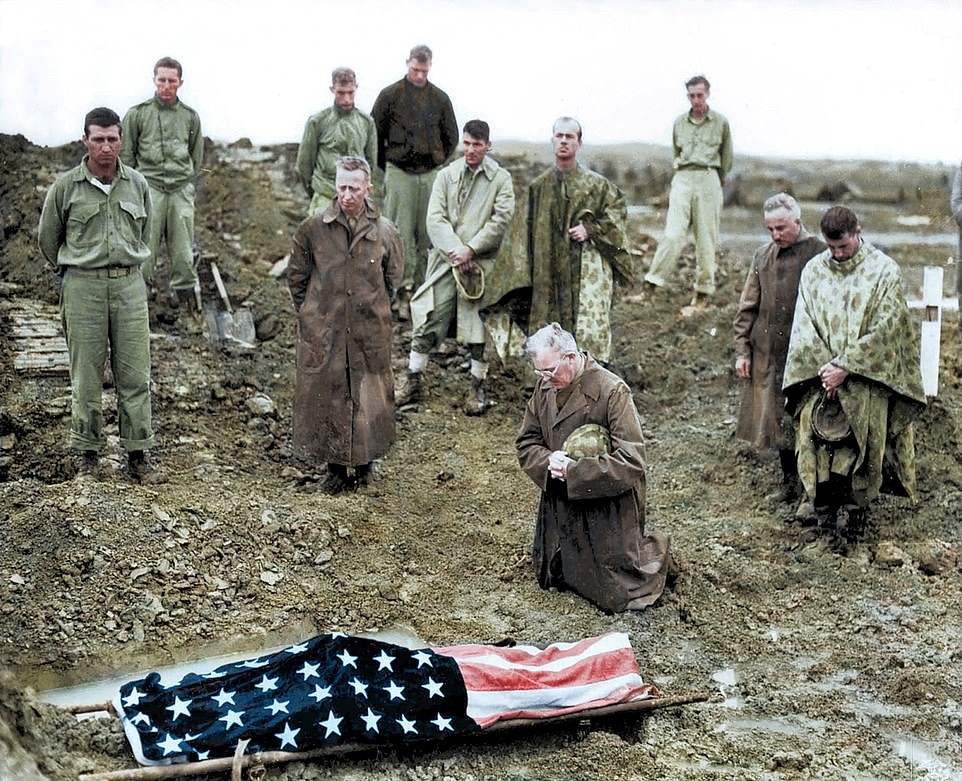
A father buries his son on Okinawa.
As we reflect on the events of April 1945, the final months of World War II, we cannot help but be struck by the deep significance of two momentous moments that unfolded on opposite sides of the globe: the Battle for Okinawa and the liberation of the first concentration camps in Germany. Both are pivotal moments in history, shaping the course of the war and leaving lasting impressions on the men and women who lived through them.The Battle for Okinawa, which began on Easter Sunday, April 1, 1945 and would last until June 22, was one of the bloodiest and most brutal campaigns in the Pacific theater.

For the American forces, it was a grueling and relentless fight to secure the island from the Japanese army, a battle that cost thousands of lives and saw immense casualties on both sides. It was not only a strategic victory for the Allies but a foreshadowing of the price that would be paid in the Pacific as the Allies moved toward the final assault on Japan.

In the photo taken above, Colonel (later Brigadier General) Francis I. Fenton learned his younger son Private First Class Michael J. Fenton had been killed by a sniper. He went to the site and knelt before Michael’s body to pray. When he rose, he said of the other Marine dead, ‘Those poor souls. They didn’t have their fathers here.’


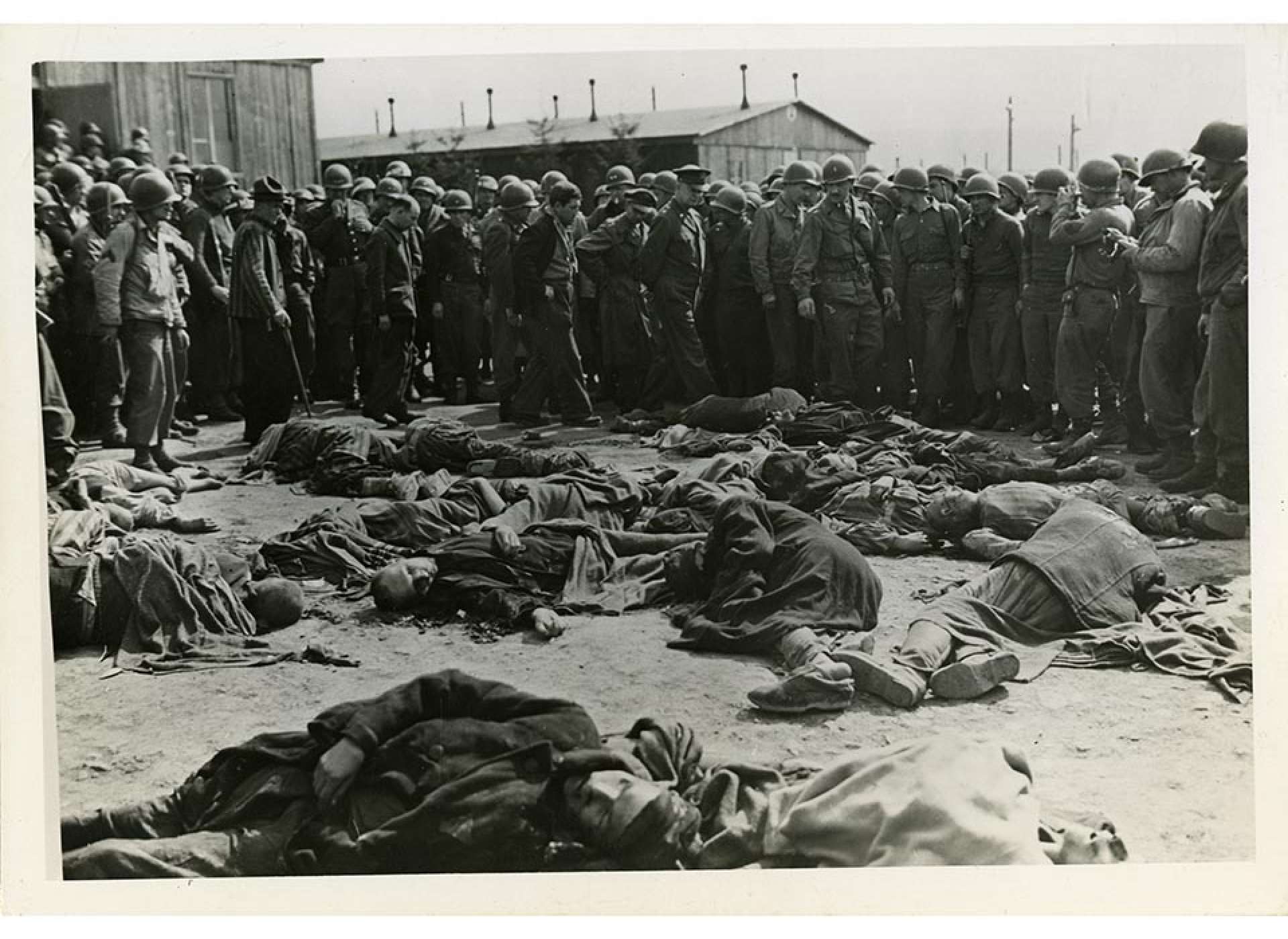
Eisenhower and top brass inspect a subcamp of Buchenwald, Germany, April, 1945.

At the same time, across the Atlantic in Europe, April 1945 marked the liberation of the first Nazi concentration camps, including Buchenwald and Dachau. The horrors uncovered by Allied soldiers began to reveal the shocking tip of the iceberg of the industrial scale mass murder genocide that had taken place.

General Dwight D. Eisenhower, witnessing the aftermath of these atrocities, requested Congressional and press visitations: “The things I saw beggar description… the visual evidence and the verbal testimony of starvation, cruelty, and bestiality were so overwhelming that I became sick and utterly unable to make any sense out of the facts.” 

He was prescient in recognizing that someday, there would be those who would minimize the magnitude of the Holocaust, or outright deny that it ever took place. Along these lines, he encouraged American and other Allied soldiers in Germany to visit the camps: 

“We are told the American soldier does not know what he is fighting for. Now, at least, we know what he is fighting against.”

While the battles of Okinawa and the liberation of the camps might seem like disparate events, they are linked by the shared theme of human sacrifice and the undeniable cost of war. The soldiers who fought at Okinawa faced fierce resistance and unimaginable challenges, much like the liberators of the concentration camps, who encountered the full scale of humanity’s cruelty. In both cases, they were tasked with missions of unimaginable significance—many just barely out of high school—but perhaps sensing that the world would never be the same after their efforts.

The heroes of these stories, those who fought in the Pacific and those who liberated Europe, lived through experiences that forever changed them—and most would reject the mantle of ‘hero’.As we reflect on their stories, it’s important to remember their sacrifices, their courage, and their commitment to justice; otherwise, I believe, we run the real risk of losing our identity as Americans.

I hope we are worthy of what they did about what they saw.

And as we continue to explore these critical moments in history through the Things Our Fathers Saw series, we are reminded of the power of storytelling. The voices of these veterans and survivors are an invaluable testament to their experiences—stories that need to be told and heard for generations to come.

Read Full Post »

Rehearsals and recording of the musical score and the soundtrack to our mini-series, A Train Near Magdeburg. Featuring Joshua Bell, violinist, Jim Papoulis, Composer and Conductor, with the Columbus Symphony Orchestra.

Half the episodes for the film series A Train Near Magdeburg have been completed and recording was finished in Columbus Ohio in early March. My wife and I were invited to attend the recording sessions that featured the Columbus Symphony Orchestra conducted by composer extraordinaire Jim Papoulis and featuring top shelf violinist Joshua Bell [‘m told he’s probably the greatest living violinist in the world (my aunt Kathleen at lunch the other day, a classical music guru)]. House was pretty much to ourselves: Ohio Theater, Columbus Ohio. Great to have them onboard… and all the talented musicians are a part of it now.

Read Full Post »