TeachingHistoryMatters.com · Matthew Rozell · Remembering Those Who Came Before
World War II · 351st Bomb Group · B-17 · July 29, 1944
The Ripples Go Forth: A Message Across Eighty Years
By Matthew Rozell
March 30, 2026
It started, as so many things do now, with a Facebook message out of the blue. A stranger’s name in my inbox, but then a few lines that stopped me cold.
Her name was Eileen Kaynan. She had been searching for her uncle online — the way people do today, typing a name into a search bar, half-expecting nothing — when the internet handed her something extraordinary. A photograph.
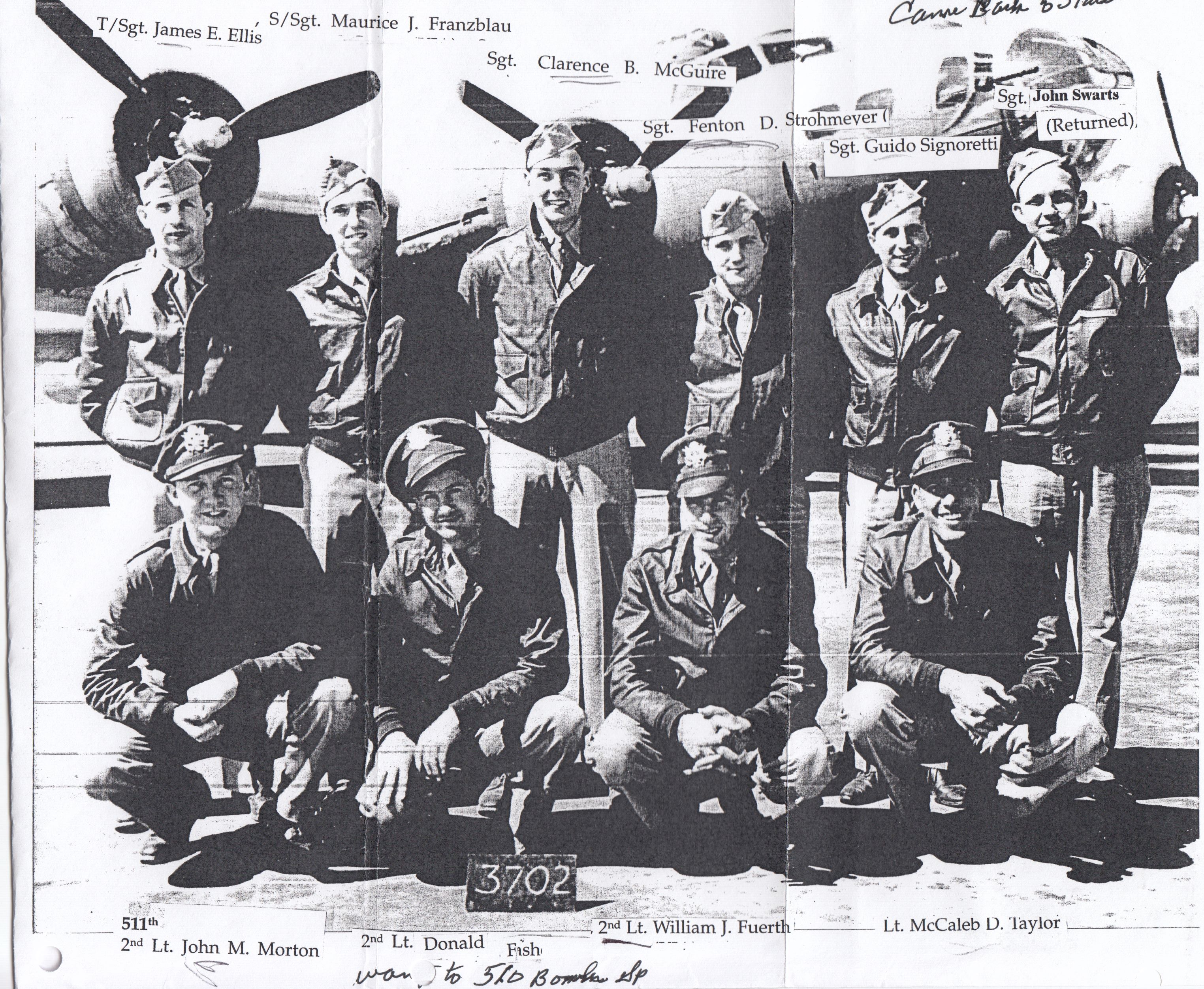
The same photograph that had hung in her grandmother’s living room for as long as she could remember. Ten young men in front of a B-17 Flying Fortress. And there, labeled now in someone else’s handwriting, was her uncle: Sgt. Guido Signoretti.
I just recently bought the book The Things Our Fathers Saw, Vol. 2. I became aware of it when I did a Google Search of my Uncle's name. He was one of the aircrew that Clarence McGuire and John Swarts were part of. His name was Guido Signoretti. Imagine my surprise to see the same photo of the aircrew that hung in my Grandmother's living room all the while I was growing up.
My Mother — Guido's sister — is 91 and I shared the information with her. We had been contacted by the Army a few years ago to provide DNA to aid in their search to identify remains.
His story is one of the reasons I served in the United States Navy. We should never forget them.
— Eileen Kaynan, March 19, 2026
Read that again. Ninety-one years old. The Army, still searching, still trying to identify remains. And a niece who joined the Navy — eighty years later — partly because of a young man she never met, whose photograph watched over the family home like a quiet vigil.
I had to sit with that for a while.
The Photo That Haunted Two Houses
When I wrote the introduction to The Things Our Fathers Saw, Volume II, I described the crew photo that had followed me through childhood. It hung somewhere in the background of memory — ten men, young, smiling, someone’s hand having placed a small cross over the head of one of them, Clarence McGuire, my father’s cousin. Dead at twenty, on his sixth mission over Germany, July 29, 1944. Clarence’s grieving mother probably drew that cross, in our household picture, that I stared at in wonderment as a young boy and teen. Just look at the smile on him, the tallest one in the back row.
What I never knew — what I couldn’t have known — was that the very same photograph was hanging in another home, in New Jersey, watched over by another grieving mother. Guido Signoretti’s mother. Standing near in the back row to Clarence in that picture. Friends, it turns out. Close ones. And look at the smile on him!
Two families. Two homes. One photograph, reproduced and carried and kept. And for more than eight decades, no connection between them.
Until Eileen typed her uncle’s name into a search bar.
Who Was Guido Signoretti?
Born December 18, 1921, in Leonia, New Jersey. The family later moved to Dumont, NJ, around 1939. His sister — Eileen’s mother, now 91 — was born when their mother was 40 years old, meaning she was only about nine years old when Guido was killed. She has outlived all of her siblings. She is the last one left who remembers him from those years.
Eileen told me she has digitized letters Guido sent home during his training stateside, before he shipped out to England. Letters from a young man who didn’t yet know what was coming. Letters that a family kept, carefully, for eighty years.
The Army contacted the family in recent years requesting DNA — still working, still trying to bring people home.
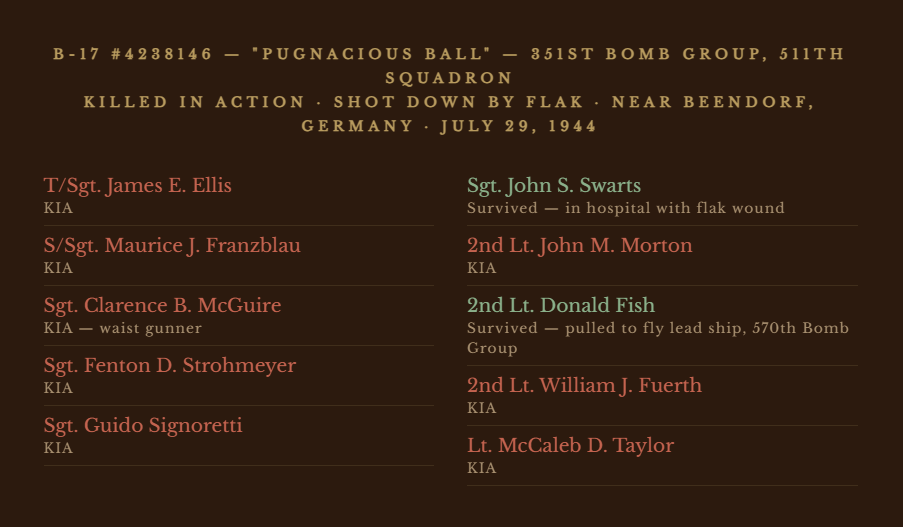
John Swarts Remembered Him, Too
When I finally tracked down John Swarts — the tail gunner, the one who survived because flak had burned his eyelid two days before and put him in the hospital — he sent me photographs and scrapbook pages. Among them was a picture of five young men, standing together, candid and grinning. On the back, John had written in his own hand: “My Best 4 Friends of our crew, all killed in action but me.”
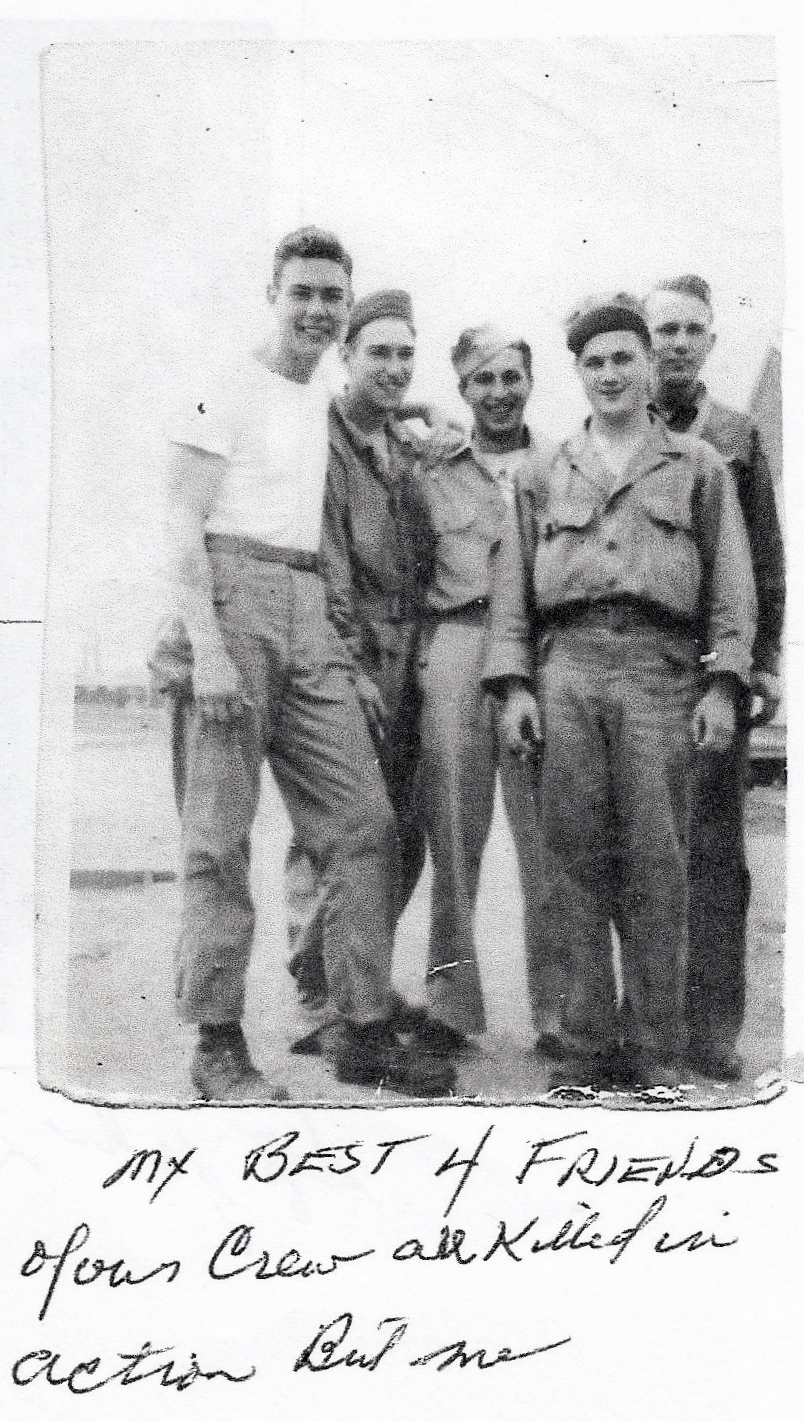
Guido is there, right in the middle of John’s best friends. He is in the photo that opens the book. He is named, placed, remembered — by a man who by then had lived ninety-three years and still called July 29, 1944 the worst day of his life.
When Eileen’s message arrived and I told her about John’s photograph, the caption, the handwriting — all killed in action but me — she had no idea until she opened the first page of my book. She had never seen that image in her life, and neither had his little sister. A photo of her uncle, captioned by a grieving friend, sitting in a scrapbook in Missouri, now Florida, for eighty years. She was seeing it for the first time.
Does It Bring Closure?
I’ve been turning this question over since her message arrived.
I don’t think history works that way — not cleanly, not finally. Eileen’s 91-year-old mother studied the labeled crew photograph “pretty hard,” Eileen told me. She was nine years old when her brother died. She has spent a lifetime with a fragment of that story, knowing only what a child could piece together from siblings and letters and a photograph on a wall.
To learn, now, that her brother was one of John Swarts’ best friends, that he stood in the middle of a picture captioned with grief and love, that a historian’s cousin and her brother were crewmates, perhaps friends, killed on the same mission on the same plane — that the photograph that watched over one family’s living room was the same one that haunted another family’s memory — I don’t know that “closure” is the right word for what that does.
Maybe it’s more like: recognition. The feeling that someone’s life, however brief, left marks that lasted. That the people who loved him were not alone in remembering, that across eight decades and two family lines who never knew each other — that the weight of that July morning in 1944 was being carried by more people than anyone realized.
✦ ✦ ✦
I wrote in the epilogue to that book: The ripples go forth. But they also come back. I meant it about John Swarts calling me out of the blue in 2017. About my students leaving memorial pebbles at a grave, about the way history, if you let it, keeps moving through time and finding new people to touch.
I didn’t know then that the ripples were still traveling. That a woman in New Jersey would type her uncle’s name into a search bar seventy-three years after the plane came down, and find her way to a book, and find her way to me, and that I would find my way back to her — and that together we would find Guido Signoretti standing in the middle of a photograph, surrounded by friends, remembered.
Eileen wrote to me: We should never forget them.
She is right. And the extraordinary thing — the thing that still moves me, sitting here at this keyboard — is that forgetting has proven harder than anyone might have feared. These men keep finding ways to be remembered. Through books. Through search engines. Through families that kept photographs on walls. Through a daughter who joined the Navy because of an uncle she never met.

“I get a little emotional. I’m almost 93;
I hope to see them all again in heaven.”
— John S. Swarts, tail gunner, B-17 “Pugnacious Ball”
John Stanley Lee Swarts, passed away at the age of 97, March 27, 2022, at his home in Summerfield, Florida. (Is it a coincidence that I wrote this remembrance on the anniversary of the weekend of his passing? I think not.) The last of the crew, plagued with guilt for years, standing on the tarmac July 29, 1944, waiting for his plane and his friends to return. But the ripples return. The wonders don’t stop. They just keep going.The story is not finished.
Eileen Kaynan has generously offered to share letters and photographs of her uncle Guido Signoretti, which I hope to present here in a future post. If you have any connection to the 351st Bomb Group, 511th Squadron, or to any of the crew of B-17 #4238146, please reach out. I have tagged them all by name in this post.
© 2026 TeachingHistoryMatters.com · Matthew Rozell · All Rights Reserved
Author of The Things Our Fathers Saw series ·


 Teaching History Matters