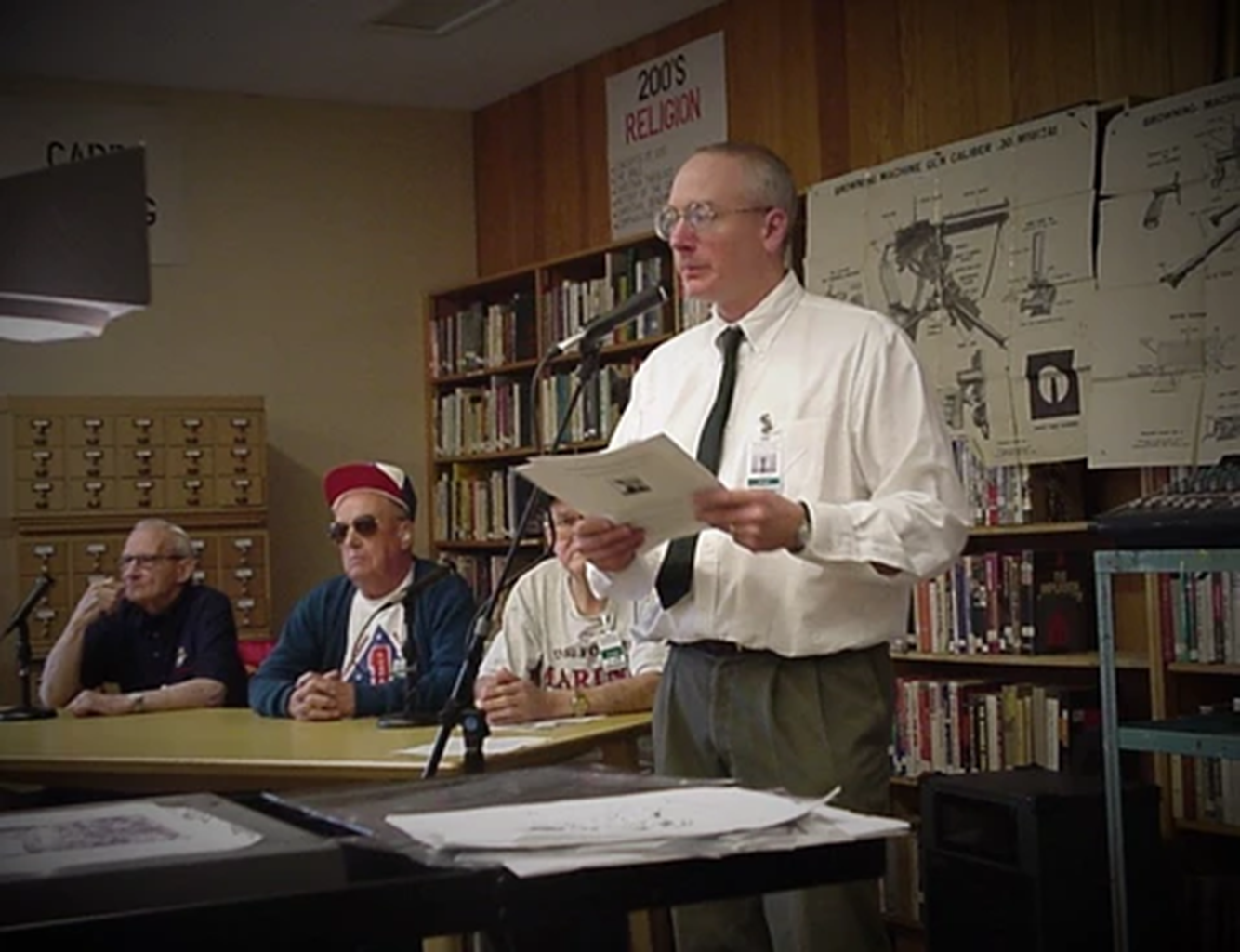
My oral history project at Hudson Falls High School began early in my teaching career as soon as I got settled in the classroom, and it began almost by accident. I was tasked with teaching 8000 years of world history, with a NYS Regents exam looming over our heads at the end of tenth grade. The fiftieth anniversary of World War II was upon us, but frankly, that left only a few class periods to introduce these most cataclysmic events of the history of the world, and the commission of the greatest crime in history, the Holocaust. And being a good student of WWII, I didn’t think that was quite right. I found myself spending a good chunk of time each spring lecturing enthusiastically about World War II, and it was contagious. I will also admit to being curious about the community’s ties to the war, so one day I asked for a show of hands as I introduced the topic—and just about all the students would raise a hand when I would call out for examples of grandparents or other relatives who had served in the war—frequently two hands would go up in the air. Maybe I was on to something here.
Building on that blossoming interest, I created a simple survey for students to interview family members. I had hit upon something that every teacher searches for—a tool to motivate and encourage students to want to learn more, for the sake of just learning it.
Then, we began to invite the subjects into the classroom, to tell their stories. The kids and I were riveted. I bought a video camera, and with the veterans’ permission, began to record and transcribe their stories for inclusion on a project website I created, with the school’s blessing; here after all was a teacher who was using the new educationally trending buzz, ‘technology in the classroom’. And what is the sense of collecting the stories if they cannot be shared, and learned from? My students now had a hand in not only studying history, but in creating it! And it went further than anyone expected.
In the link(s) below you can find materials I created for the course I eventually was allowed to teach, including rationales, sample course handouts and how-to’s, practical advice for teachers and budding student historians. You can adapt them if you wish for your own purposes. For further information or questions, email me below, subject line: Oral History in the Classroom.
~Matthew Rozell
Matthew@MatthewRozellBooks.com
My Model Course Materials (opens as PDF)
Sample In-House Course Rationale
Sample Course Final Project Requirements/Layout/Scoring Guide [Note: If you follow a model such as this, you may wish to pre-screen your potential students. It’s a bit of work, but can be one of the most meaningful things they did in high school. And you need to introduce the final project in pieces, or many may run to drop your class after the first session!]
Sample Interview Checklist [Note: I never sent students to interview subjects’ house alone. Pairs; one to operate the camera, one to conduct the interview. Obviously with district sanction and parent permission.]
Sample Course Survey/Release Forms [Note: get administrative/school board okay for your drafts; I’m not a lawyer!]
Sample Course Completed Final Project [Note Project Requirements above!]


 Teaching History Matters