June 6, 1944
Amsterdam
‘This is D-Day,’ the BBC announced at 12 o’clock. This is the day. The invasion has begun!
Is this really the beginning of the long-awaited liberation? The liberation we’ve all talked so much about, which still seems too good, too much of a fairy tale ever to come true?…
The best part of the invasion is that I have the feeling that friends are on the way. Those terrible Germans have oppressed and threatened us for so long that the thought of friends and salvation means everything to us!
― Anne Frank, diary entry,
six days before her 15th birthday
Forty-one years ago today, I tuned in to a small black and white TV in a ramshackle white clapboard farmhouse I shared with three or four other guys my age. I was 23, a recent college graduate with a seemingly useless history degree, working in the back of a kitchen of a high end restaurant in my college town. I wasn’t sure still what my direction was, but I had a knack for churning out long history papers running forty or fifty pages in length, and a passion for World War II, especially D-Day. Well, I reluctantly turned to teaching—I had student loans to pay—but I grew into another passion, sharing my love of history, and engaging veterans with students, creating an oral history project which has now reached ten books and counting, as well as an upcoming film series.
But today, June 6, 2024, it is now the 80th anniversary, and my mind is focused on how my life has turned out. I realize that I am the age of many of the veterans were when forty years ago, I watched as the American president honored the fallen, and the living, at the cemetery for the fortieth anniversary. Just out of college, something stirred inside me. Something was awoken.
Those forty years have passed. I began by writing letters to the newspaper. I began to interview D-Day veterans and others. I began to collect stories—not relics, prizes, or artifacts. I really had little interest in captured Nazi flags or samurai swords.
I wanted to talk to the men who were there.
The fiftieth anniversary came next with great pomp and more reflection. It graced the covers of the major newsweeklies. ‘Saving Private Ryan’ would soon stir the consciousness of a new generation, and the reflections of the old. And I learned so much more of the war beyond the beachhead. That there were so many beachheads.
The sixtieth anniversary came around. Students on their annual trips to France would bring me back their photographs and the requisite grains of white sand from Omaha Beach. Teenagers had their emotions a bit tempered, I think. I would go on to introduce them to so many who were there, when they themselves were teenagers.

While filming for our 2025 documentary series A Train Near Magdeburg, two years ago I finally had the chance to set foot on Omaha Beach with an excellent guide who was insistent that we arrive early in the morning to catch the tide as it began to roll in. It was an astounding thing, to witness the 10 to 12 foot rise in the course of only a few hours. Imagine the men struggling to find their footing, pinned down by murderous fire. The 743rd Tank Battalion, liberators of the Train Near Magdeburg ten months later in the heart of Nazi Germany, was one of five tank battalions that took part in those initial landings, planned for H-Hour in support of the 29th Infantry Division in specially outfitted duplex drive ‘swimming’ amphibious Sherman tanks, powered by propellers in water and tracks on land and equipped with inflatable canvas flotation screens.

Bill Gast was one of those tank drivers. I first met Bill at a reunion of 30th Infantry Division and 743rd Tank Battalion soldiers at a reunion in March 2008, in which I was present with several Holocaust survivors who were meeting their liberating soldiers for the first time. Later, Bill came to my high school to speak to students. I think the experience of sharing, and meeting the Holocaust survivors whom the 743rd came upon and liberated, affected him deeply. It was really the first time that he opened up, several hundred students as his primary witnesses. Unlike many who were physically able, Bill had no intention of going back to the sands of Omaha for any anniversary. As he explained to our students in 2009,
“I’m listed [in the event program] as a liberator- however, I am also a survivor of World War II, having landed on Omaha Beach in Normandy, France on D-day and fighting through to the end when the Germans surrendered, May the 7th, 1945.”
“Pictures.
Video games.
Movies.
Words.
They simply do not covey the feeling of fear.
The shock.
The stench.
The noise.
The horror, and the tragedy.
The injured.
The suffering.
The dying, and the dead…
Freedom is not free; there is a high price tag attached.”
Bill left us in 2018 at the age of 94. Against many odds, today nearly 200 surviving D-Day veterans gather, most probably for the last time, to honor the fallen from the nations engaged in storming ‘Fortress Europe’.
Today, the ocean laps at the lateral thirty-five-mile advance of sand littered with relics of a different time, the hulking remnants of the tide of battle. The surf rolls in and kisses the beach as the last participants mix on the hallowed bluff above with the politicians who have gathered from all over the world. In 1984, President Reagan asked, “Why? Why did you do it? What impelled you to put aside the instinct for self-preservation and risk your lives to take these cliffs? What inspired all the men of the armies that met here?
He continued: “These are the champions who helped free a continent. These are the heroes who helped end a war…We look at you, and somehow, we know the answer. It was faith and belief; it was loyalty and love.”[1]
Wayne Robinson, the chronicler of the 743rd’s travails and exploits during the war, wrote this in 1945 at war’s end:
“The story of D-Day is the story of all who. were there—jeep drivers, truckdrivers, halftrack crews, supply and communications men as well as the tankers. Many—too many—of the stories were posthumous.
The Presidential Unit Citation was awarded the Battalion for the day’s fighting. There were the D.S.C.s won, and a galaxy of Silver Stars and Bronze Stars. But the Battalion was not thinking of glory as it fought its way through Exit D-1 toward Vierville-Sur-Mer. Glory is a tainted angel to tankers who have just had to run their steel treads over the bodies of fallen Gls because there was no other way to advance over sand cluttered with American dead and wounded. ‘If there was any sign of life at all, I tried to avoid them’, one tank driver said. ‘But buttoned up, looking through the scope, it was hard to see. You just had to run over them.’
In war there is no easy way. The grinding tracks of the Battalion’s tanks trailed blood through the ·sand, rolling inland off the beach. The whole war in France, Belgium, Holland and Germany was ahead of them.”[2]
And for the men of the 743rd’s Dog Company, ahead there would be this train, a long shabby string of boxcars and shabby passenger cars, spectral creatures milling about, listless, sick, and fearful…
D-Day: the view from a tank on Omaha Beach
By Mathieu Rabechault May 23, 2014 6:46 AM
Washington (AFP) – From inside his tank, the young soldier could see “practically nothing” on Omaha Beach.
Seventy years later, William Gast still wonders whether he rolled over his comrades sheltering from German gunfire that day.
Gast was 19 years old the morning of June 6, 1944. “We came in at H-10, that was 10 minutes before the designated hour.”
He cannot recall why he and his fellow soldiers arrived early, but he has other memories that have never left him.
As part of Company A, 743rd Tank Battalion, 1st Army, Gast remembers the training beforehand in Britain, when he rehearsed driving the Sherman tank onto the landing craft. And then floating in the English Channel.
“Another night we went out and we didn’t come back. That was it.”
Gast got to know the captain of the landing craft that would ferry his tank to the beaches of Normandy.
The skipper promised he would get them close enough that they would not be submerged in water, like so many tanks were that day.
He kept his word.
Another tank unit at Omaha Beach was less fortunate, with 27 of 32 tanks launched at sea five kilometers (three miles) from the coast sinking before they could reach land, despite being outfitted with a flotation screens.
“The order was given to go, we started our engines up, they lowered the ramp,” said Gast.
Amid German shrapnel and sea spray, he “could feel the tracks spinning.”
At last, the tank tracks took hold on the sandy sea bottom and he drove up the beach.
– Like throwing marbles at a car –
Down below in the driver’s seat, Gast tried to steer the tank with the aid of a small, manual periscope.
“You can imagine how much we could see, practically nothing,” he said.
The radios inside the tank were so unreliable that his commander would tell Gast which way to turn by kicking him on the left or right shoulder.
The difficulty in seeing the way ahead has left Gast with a gnawing sense that he may have run over the bodies of American soldiers on the beach.
“The saddest part about the whole thing is, not being able to see, I may have run over some of my own people.
“And if I did, I don’t even know it. I can’t ever get that out of my mind, you know?”
Corporal Gast heard machine gun bullets hitting the side of the tank, “like throwing marbles at a car — that’s what it sounded like.”
“And there were shells that exploded right beside me. You could feel the tank shake.”
For Gast, it was a day of fear and terror, and following orders without reflection.
“I can’t tell much about what happened, I was scared to death to start with,” he said.
“It was just like putting it on automatic, you just did what you had to do, did what you were told to do.”
By noon, close to 19,000 American soldiers who landed at Omaha were still pinned down on the beach.
– High school sweetheart –
Carefully laid plans had unraveled as the beach became a killing zone, with troops mowed down under a fusillade of German machine gun, artillery and mortar fire.
Small teams of US troops eventually managed to break through on the bluffs between German positions, with the help of combat engineers blowing up obstacles.
The losses were staggering: more than 2,000 dead, wounded and missing on Omaha beach. The exact toll is still unknown. Of the 15 tanks in Gast’s Company A, only five survived without damage.
Gast, from Lancaster, Pennsylvania, earned the Silver Star and the Purple Heart during his combat tour, and went on to marry his high school sweetheart.
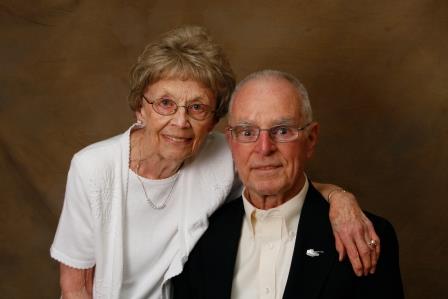
Mr. & Mrs. Gast, Holocaust Survivors-American Soldiers reunion, 2009.
Now 89 years old, he recently was awarded France’s Legion d’Honneur at a small ceremony for World War II veterans at the French embassy in Washington.
The short, soft spoken man stood up to receive the medal and shook hands with a French diplomat. But he has no plans to return to Normandy for the 70th anniversary of the D-Day landings.
His son, Bill, said his father did not want to relive that day: “It’s important we don’t forget but you try to hide things somewhere.”
news.yahoo.com/d-day-view-tank-omaha-beach-104656852.html
[1] Why did you do it?-President Ronald Reagan, June 6, 1984, Omaha Beach, Normandy, France. http://www.historyplace.com/speeches/reagan-d-day.htm
[2] Robinson, Wayne; and Hamilton, Norman E., Move Out, Verify: The Combat Story of the 743rd Tank Battalion. 1945. World War Regimental Histories. United States Army.


 Teaching History Matters