This post is an update, two years on, on the occasion of the recording for the soundtrack to our film. In it, we use eight of master luthier and restorer Amnon Weinstein’s Violins of Hope, rescued from the destruction and oblivion of the Holocaust.
On March 4, 2024, Amnon Weinstein passed at the age of 84. Exactly one year to the day of his passing, eight of his violins were in the hands of the Columbus Symphony Orchestra, to record the soundtrack to our mini-series, A Train Near Magdeburg, under the direction of Jim Papoulis, Composer and Conductor, with the Columbus [Ohio] Symphony Orchestra. Please watch the clip to see Amnon’s violins brought to life again, and read the article for more about his life. Director Mike Edwards reads the biographies of the violin’s original owners to the musicians who will play them.
Violins of Hope. Train to Magdeburg tour of Israel, 2023.
We are in Jerusalem now, the City of God, after 22 hours of travel.
The last time I was here, I was studying at Yad Vashem, Israel’s Holocaust Martyrs and Heroes Remembrance Authority in the summer of 2016. That is when liberating soldier Frank Towers left us.
I am here with filmmaker Mike Edwards, crew Joe Hammers and Josh Fronduti, scriptwriter Lee Shackleford and his wife Karen and my wife Laura. Our mission is to interview a dozen Holocaust survivors of the train near Magdeburg. We landed on Shabbat, the sabbath day morning. Ben Gurion airport in Tel Aviv was very quiet.
Returning impression of Jerusalem. Growing upward, the city of cranes. Busy.
Hotel Agripas in Jerusalem, a central location found for us by our friend Ellen, a fifteen-minute stroll from the Old City. My wife and I walked down the first day, made it to the Church of the Holy Sepulcher. My third time, Laura’s first. She was moved to tears. Trapped in a procession of Eastern European pilgrims chanting prayers on the Via Dolorosa going the opposite direction. We wait for the Spirit to pass by, and we are back to our hotel for the transport to film at our first stop, the family behind the Violins of Hope project in Tel Aviv.
We arrive after an hour or so, greeted outside by nearly 84-year-old Amnon Weinstein at his ground level workshop. Joe and Josh set up the film shoot, as always, and we go across the street to meet his beautiful wife at an outdoor café. They are so happy to see us, Assi his wife is radiating goodness and love for the Americans who have come to tell a story of the Holocaust, passionate about history and life, the daughter of one of the famed Bielski partisans. She won’t let us pay or clear away the cups at the end.

We retire back at the shop, and Amnon begins to tell his story. The family emigrated to Palestine in 1938 from Poland, his father a violin maker, opening a shop right here in Tel Aviv when it was a brand new city, growing along the coast. As a boy, Amnon is puzzled one day in school when a teacher asks about families and grandparents; only one child in an elementary class of 35 has grandparents. He asks his mother; he remembers to this day the first shock of his life- when she wordlessly opens a book, directing the youngster’s attention to the graphic photos of the horrors of the Holocaust.
He became a master luthier, like his father, building and repairing violins for world class performers; he knows them all. Over time, though, survivors brought their violins, many German made fine specimens, and tell him that he must buy them, take them off their hands, or they will discard them. Many cannot bear to pick up the instrument that once brought them so much joy, after surviving the Holocaust, some even forced to play as train transports arrived at the camps, to add a false sense of comfort, for those about to be murdered. So he does acquire them-how can he not?-and others with a provenance of the Holocaust.

Mike asks how he feels when he plays, or sees others play these now restored instruments, the Violins of Hope. Amnon puts his hands on his shoulders. “I feel like I am carrying the weight, the music, telling in a way the stories of the six million. The violins are their voices speaking to us once more.” His son and third generation luthier Avi travels the world now showcasing the violins from the collection now numbers about 120.
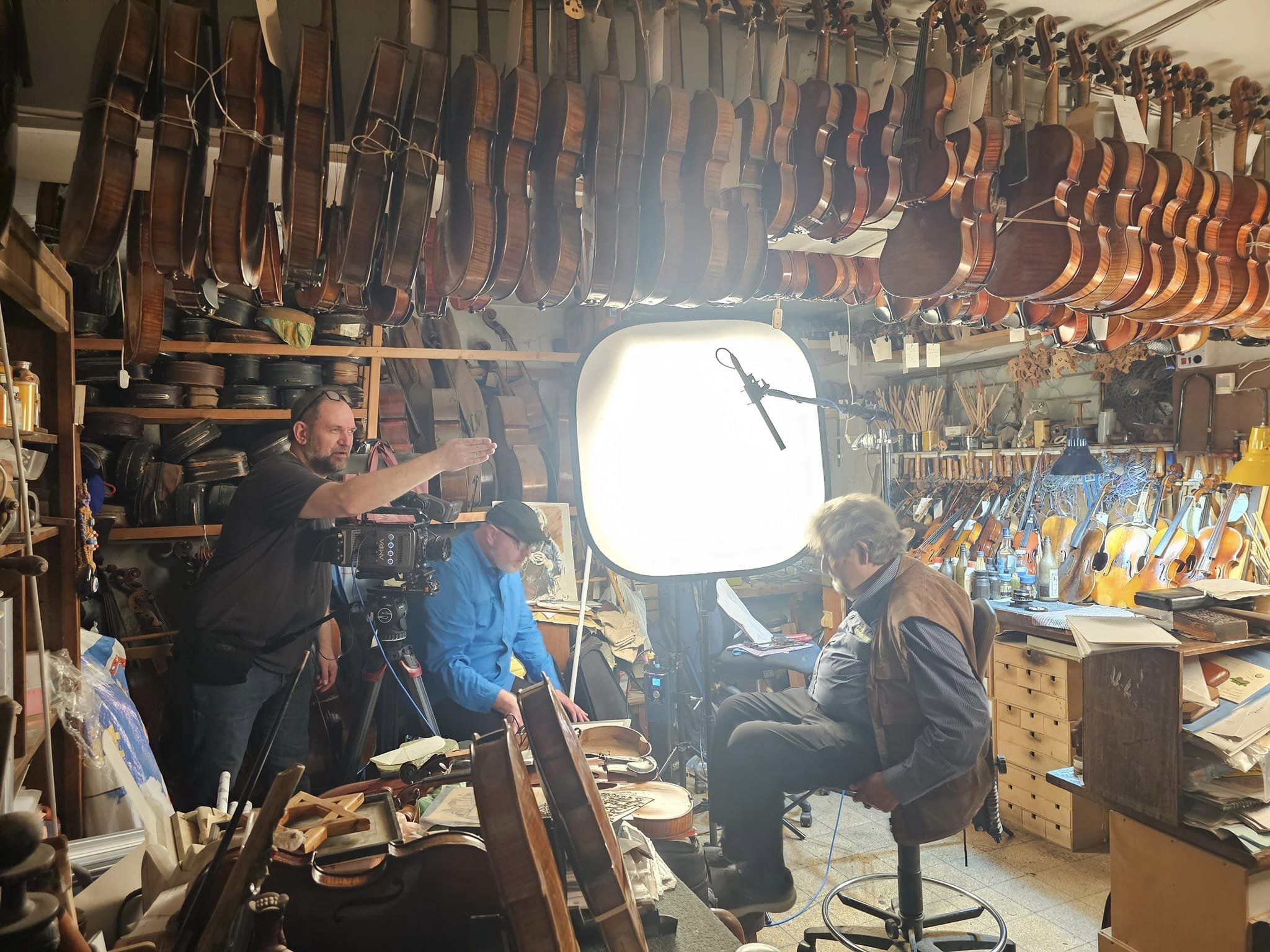
He moves to his workbench, sometimes using his ‘stick’, his cane. “I am nearly eight-four. This is all I do now; I no longer build from scratch. It is important, and I think I can get the collection up to 140 or so pieces before I ‘move on’. I do not welcome death, but I think it is a natural progression”, he gestures with a wave of the hand.
We record him working, picking up many of the same carving knives I see in my own woodworking shop at home. I ask him about the wood, the sharpening of his tools. “At the bench I am 21 years old again. I get lost in the work for hours.”
He has summoned one of his young clients from across town, and Tamir arrives, a natural 21-year-old prodigy, a future virtuoso in training. We move to Amnon’s office. Amnon goes to the vault and brings out one of the prized restored Violins of Hope. Young Tamir begins to play. Amnon watches him contentedly from his desk. Mike asks Tamir to play Hatikvah (The Hope), now Israel’s national anthem. The 140-year-old violin of a victim is playing the 21-year-old soon to be master. “The violin is playing me.”

Amnon will admit to being concerned about the state of the world, the terrible war in Ukraine, the state of political turmoil in his own land where he has virtually lived the history of the state of Israel since before its birth in 1948, but now to the point of losing sleep at night, to the point of impatience and frustration. When asked to comment on the famous Benjamin photograph of the liberation of the train in the spring of 1945, he simply says, “And why did it take so long?” In hindsight, liberator Carrol Walsh had reached the same conclusion years before. Film director Mike points out, and the title of this blog points out, that education is the key. We hope that our film helps in some small way to heal the world, as Amnon’s Violins of Hope travel the world with the same mission, to remember the millions, and to hopefully help the world refocus its energies away from hate, war, persecution, destruction.


It has been a wonderful, emotionally draining day. We bid our new friends goodbye, and promise to carry on the mission.
We sit down with our first survivor tomorrow.
Amnon Weinstein, Who Restored Violins From the Holocaust, Dies at 84
Many were left behind by victims of the gas chambers. He let the instruments be heard again in musical tributes through his organization, Violins of Hope.
By Michael S. Rosenwald, The New York Times
Published March 21, 2024
Amnon Weinstein, an Israeli luthier who restored violins belonging to Jews during the Holocaust so that musicians around the world could play them in hopeful, melodic tributes to those silenced in Nazi death camps, died on March 4 in Tel Aviv. He was 84.
His death, at a hospital, was confirmed by his son Avshalom Weinstein.
Mr. Weinstein was the founder of Violins of Hope, an organization that provides the violins he restored to orchestras for concerts and educational programs commemorating the Holocaust. The instruments have been played in dozens of cities worldwide, including Berlin, at an event marking the liberation of the Auschwitz concentration camp.
“Violins of Hope, it’s like a huge forest of sounds,” he said in a 2016 PBS documentary. “Each sound is standing for a boy, a girl and men and women that will never talk again. But the violins, when they are played on, will speak for them.”
There are more than 60 Holocaust-era violins in his collection.
Some belonged to Jews who carried them in suitcases to concentration camps, and who were then forced to play them in orchestras as prisoners marched to the gas chambers. Others were played to pass the time in Jewish ghettos. One was tossed from a train to a railway worker by a man who knew his fate.
“In the place where I now go, I don’t need a violin,” the man told the worker, in Mr. Weinstein’s telling. “Here, take my violin so it may live.”
Mr. Weinstein hunched over his desk over a violin that he is in the middle of repairing. He wears the same outfit as in the last photo, as well as glasses and a large wristwatch. A row of violins hang from the ceiling behind him.
The son of a violin repairman, Mr. Weinstein worked in a cramped and dusty workshop in the basement of an apartment building on King Solomon Street in Tel Aviv.
“Walking in there was like stepping in time,” James A. Grymes, a University of North Carolina-Charlotte music professor who wrote a book about Violins of Hope, said in an interview. “It really felt like you were in Stradivarius’s workshop — the smells of varnish, there’s parts of violins everywhere. It’s like he was the Willy Wonka of the violin.”
One afternoon in the 1980s, a man with a prisoner identification tattoo on his arm arrived with a beaten-up violin that had, like him, survived Auschwitz.
“The top of the violin was damaged from having been played in the rain and snow,” Mr. Grymes wrote in “Violins of Hope: Violins of the Holocaust — Instruments of Hope and Liberation in Mankind’s Darkest Hour” (2014). “When Amnon took the instrument apart, he discovered ashes inside that he could only assume to be fallout from the crematoria at Auschwitz.”
Mr. Weinstein, who had lost hundreds of members of his extended family in the Holocaust, nearly turned the man away; working on such an instrument seemed too emotionally fraught. But he ultimately repaired the violin, and the man gave it to his grandson to play.
Mr. Weinstein didn’t reflect much about working on Holocaust-era violins again until the late 1990s, when he was training his son to become a luthier. The experience made him reflect on the role of violins in Jewish culture, from the shtetls of Eastern Europe to klezmer bands to Itzhak Perlman’s soaring concertos.
“It was kind of a must for the young generation to learn to play the violin,” he said in the PBS documentary. “And when you have a violin, Friday or Saturday evening, always somebody was taking it and playing on it.”
During a radio interview, he asked listeners to bring him instruments connected to the Holocaust. Soon, families began showing up at his workshop with violins that had been stored away in attics and cellars, each with its own haunting story.
Mr. Weinstein was especially shaken by those recovered from concentration camps after the Allied invasion of Germany in 1945.
“This was the last human sound that all of those people heard, the violin,” he said in a 2016 radio interview on WKSU in Ohio. “You cannot use the name beauty. But this was the beauty of this time, these violins.”
Mr. Weinstein holding the body of a violin with a swastika and other symbols etched into it. Behind him are various instruments hanging on the walls as well as portraits of people holding their violins.
Three old violins on display, each with Jewish symbols etched into them.
Amnon Weinstein was born on July 21, 1939, in Mandatory Palestine and grew up in Tel Aviv. His father, Moshe Weinstein, was a musician and violin repairman. His mother, Golda (Yevirovitz) Weinstein, was a pianist and a secretary in her husband’s workshop. They had immigrated from Lithuania in 1938, just as the persecution of Jews was escalating in Germany.
Mr. Weinstein grew up helping in his father’s violin shop. In his early 20s, he moved to Cremona, Italy — a city long known for its master luthiers — to study violin making. He continued his training in Paris under Étienne Vatelot, one of the world’s most renowned luthiers. In 1975, he married Assaela Bielski Gershoni, whose father was a Jewish resistance fighter during World War II who was made famous in the 2008 film “Defiance.”
After his father’s death in 1986, Mr. Weinstein took over the family violin shop; he started Violins of Hope a decade later. The first concerts with the violins in the collection took place in Turkey and Israel in 2008. Others followed in Switzerland, Spain and Mexico, as well as in Ohio, North Carolina and Virginia.
“Each concert is a victory,” he would often say.
A man in a black T-shirt stands while playing a violin that is tucked beneath his chin. Behind him are other musicians, seated in front of music stands and holding their own instruments.
Musicians, especially Jewish ones, have described playing violins from the collection as a soul-stirring experience.
“It’s emotional for me because I’m not there to play this violin, I’m there to let it speak,” Niv Ashkenazi, a violinist who recorded an album featuring an instrument from the collection, said in an interview. “Our jobs as musicians is to just let these violins shine through.”
In addition to his son Avshalom, who plans to continue the Violins of Hope project, Mr. Weinstein is survived by his wife; two other children, Merav Vonshak and Yehonatan Weinstein; and seven grandchildren.
In 2016, Mr. Weinstein was awarded the Order of Merit of the Federal Republic of Germany, one of the country’s highest honors.
During the award ceremony, Germany’s foreign minister at the time, Frank-Walter Steinmeier, spoke directly to Mr. Weinstein.
“A human soul lies behind each of your priceless violins,” he said. “A human who was persecuted, tormented, silenced by unimaginable violence and cruelty.”
Mr. Steinmeier spoke about the man who had tossed his violin from the train. He described a prisoner playing a violin in Auschwitz.
“Each violin represents a person, Amnon,” he said. “And when your violins play, they represent six million people.”


 Teaching History Matters